REVIEW 4 major objections 5 minor 99 references
A proper-motion screen against surrounding red clump stars identifies five kinematically outlying LMC globular clusters that bias mass estimates by up to 30%.
Reviewed by Pith at T0; open to challenge. T0 means a machine referee read the full paper against a public rubric. the ladder, T0–T4 →
T0 review · deepseek-v4-flash
2026-08-02 18:26 UTC pith:QDZRCU7S
load-bearing objection Sound new framework and a useful outlier catalog, but the headline count of five PM-only outliers rests on a miscalibrated 2D significance threshold that likely drops Hodge 11. the 4 major comments →
A Statistical Framework to Identify Kinematically Outlying LMC Globular Clusters and Implications for the LMC's Dark Matter Profile
The pith
A machine-rendered reading of the paper's core claim, the machinery that carries it, and where it could break.
Core claim
The central claim is that a reliable sample of kinematically outlying LMC globular clusters can be obtained by comparing each cluster's velocity vector to the average velocity vector of the red clump stars surrounding it, using two metrics: Qerr (the velocity difference divided by the propagated measurement uncertainty) and Qdisp (the same difference divided by the local velocity dispersion). Under the adopted cuts of Qerr > 3 and Qdisp > 1, five clusters—NGC 1818, NGC 1978, NGC 2210, NGC 2231, and Hodge 11—are outliers in proper motion under both a data-driven and a model-driven comparison, and ten clusters are outliers when 3D velocities are considered. The outlier sample is spatially clus
What carries the argument
The central device is the local velocity-reference comparison: for each cluster, the mean proper motion and intrinsic dispersion of red clump stars in an annulus around the cluster are estimated from Gaia DR3 astrometry using a likelihood-maximization estimator, and also predicted from an existing kinematic model of the LMC disk. The two metrics Qerr and Qdisp then separate kinematic peculiarity from measurement noise and from the disk's velocity dispersion. The annulus design (inner radius 0.05°, outer radius tuned to gather 2000–3500 stars) ensures that spatially correlated systematic errors in the astrometry cancel when forming the difference.
Load-bearing premise
The framework treats the magnitude of the 2D proper-motion difference as a 1D Gaussian deviate when defining the Qerr > 3 threshold; under the null this magnitude is Rayleigh-distributed, so the nominal 3-sigma cut may not have the stated significance.
What would settle it
Take the five PM-only outliers, form the 2D difference vector reported in Table 1, and compute the two-dimensional Gaussian p-value for the magnitude against the reported per-component errors (and the local velocity dispersion). If any of the five has p > 0.003, the Qerr > 3 criterion is miscalibrated for that cluster and the catalog claim is weakened.
If this is right
- The five proper-motion outliers (NGC 1818, NGC 1978, NGC 2210, NGC 2231, Hodge 11) are prime candidates for an external or accreted origin and should be prioritized for spectroscopic follow-up.
- Any future attempt to measure the LMC's dark matter profile using globular clusters as dynamical tracers should first screen the sample for kinematic outliers; an unscreened sample can bias enclosed mass estimates by 15–30%.
- The clustering of outlying clusters at 3–4 kpc from the LMC center points to a shared origin or a single dynamical event, possibly connected to the LMC–SMC interaction.
- Because no statistically significant correlation is found between cluster age and kinematic difference, the outliers cannot be explained by comparing clusters of different ages with the red clump field.
- The same comparison framework can be applied to other galaxies where proper motions of field stars are available, providing a general method for identifying accreted star clusters.
Where Pith is reading between the lines
- If the significance calculation is corrected for the 2D Rayleigh distribution of the proper-motion difference magnitude, some of the five PM-only outliers may drop below a true 3-sigma threshold; the catalog should be read as a ranked list for follow-up rather than a strict detection list.
- The 3–4 kpc concentration coincides with the transition of the LMC rotation curve from rising to flat; a dynamical perturbation at that radius could produce coherent velocity residuals, a possibility the paper acknowledges but does not fully model.
- Comparing the chemical abundances and ages of the six model-flagged outliers with SMC clusters could directly test the accretion scenario the paper proposes.
- The 15–30% mass bias, being a lower limit (the tracer-mass parameters were held fixed), implies that previous LMC mass estimates based on the full cluster catalog may carry an unaccounted systematic error.
Editorial analysis
A structured set of objections, weighed in public.
Referee Report
Summary. This paper presents a statistical framework for identifying kinematically outlying LMC globular clusters by comparing each cluster's Gaia DR3/Bennet et al. (2022) proper motion and radial velocity with the kinematics of surrounding red clump stars. Two routes are used: a data-driven comparison with Gaia DR3 field-star proper motions and a model-driven comparison using the Choi et al. (2022) LMC kinematic model and Vasiliev (2018) velocity dispersions. The authors define Q_err and Q_disp metrics and flag clusters with Q_err>3 and Q_disp>1. They report five proper-motion outliers (NGC 1818, NGC 1978, NGC 2210, NGC 2231, Hodge 11), six when adding the model-only case (including NGC 2005), and ten when 3D velocities are used. They further argue that removing these outliers changes the Watkins et al. (2024) tracer-mass estimate by 15–30%, implying that GC-based LMC dark matter inferences are sensitive to the kinematic outlier sample.
Significance. If the statistics are correct, this is a useful and timely framework: it directly connects Gaia-era cluster kinematics to the LMC disk velocity field and provides a concrete catalog to guide spectroscopic follow-up. The approach is largely non-circular, because the C22 model was fitted to red clump stars rather than to the GC sample being tested. The paper also makes a practical contribution by quantifying the sensitivity of tracer-mass estimates to sample selection. However, the central claims currently rest on a threshold calibration error and on model uncertainties that are not propagated; these issues affect the headline outlier list and the mass-bias percentages.
major comments (4)
- [Section 3.3.2–3.3.3; Tables 1 and 2] Δpm is the magnitude of a two-dimensional PM difference vector. Under the null, with independent Gaussian measurement errors, Qerr = Δpm/εpm is not a Gaussian deviate but a Rayleigh variable (or a generalized 2D Gaussian magnitude if εα≠εδ). Therefore Qerr>3 is not a 3σ criterion: P(Rayleigh>3)=exp(−9/2)≈1.1%, equivalent to roughly 2.5σ two-sided. A true two-sided 3σ threshold requires Qerr≈3.44. In Table 1, Hodge 11 has Qerr=3.165 and Qdisp=1.034, so it would no longer be a PM-only outlier under a calibrated threshold; this changes the abstract's '5 GCs based on PM differences alone' and the cluster-removal set in §5.3. With 30 clusters, even the current cut expects ~0.33 false positives under the null. Please recalibrate Qerr using the 2D null distribution (or FDR) and repeat the outlier and mass-bias calculations.
- [Section 3.3.2–3.3.3; Tables 1 and 2] In the model-driven scenarios M2Dmodel and M3Dmodel, the uncertainty in the surrounding-star velocity is set to zero, and the C22 model parameter uncertainties are not propagated. The V18 dispersion curve is also used without uncertainty (Eq. 12–13). This systematically inflates the model-based Qerr values and makes the model-driven outlier set (including NGC 2005) optimistic. Since §5.3 uses these outlier sets to quantify the mass bias, the headline 15–30% numbers need to be re-evaluated with conservative model uncertainties or a robustness test against C22/V18 parameter variations.
- [Section 5.3, Eq. (16)] The 'bias' claim is not a measured bias but a sensitivity test. The TME is recomputed using the fixed α, β, γ parameters from Watkins et al. (2024) on a sample that differs from theirs (it adds NGC 2210, NGC 2159, NGC 1466, NGC 1841, Reticulum). The bootstrap significances are only ≈1.65–2σ (Section 5.3 and Figure 5), which is weak evidence that the excluded GCs produce a systematic bias rather than expected scatter. The abstract's 'bias of up to 30%' is therefore overstated. Please rederive α, β, γ for each sample or propagate their covariance, and report whether the mass differences are significant relative to a fully re-fit model.
- [Section 3.3, Eq. (7); Table 1] Qdisp is used for outlier selection with a threshold Qdisp>1, but no uncertainty is attached to σpm. Several selections hinge on Qdisp values just above unity (NGC 1818: 1.019, Hodge 11: 1.034, NGC 1978: 1.14). Given the data-derived dispersions are themselves uncertain, particularly in the crowded inner 2 kpc (Section 4 / Figure 3), a hard threshold at 1 without propagated dispersion uncertainty is fragile. The authors should include uncertainties on σpm or use a probabilistic classification that accounts for them.
minor comments (5)
- [Abstract and Section 6] 'upto' should be 'up to' in both the abstract and conclusions.
- [Section 4 and Figure 2] The text says '6 GCs identified as outliers in Table 1', but Table 1 lists five outliers. The six-cluster set is from M2Dmodel, and Figure 2's caption claims six clusters under both Mdata and M2Dmodel, which is inconsistent. Please correct the wording/caption.
- [Section 4, right panel] The KS-test p-values are given as 0.046 for the full population and 0.011 for outlier vs non-outlier, while the Figure 2 caption quotes p≈0.01. Please unify the quoted values and state clearly which comparison each p-value refers to.
- [Section 2.2.1] The threshold wording is ambiguous: 'upper error threshold that we adopt (≥0.05 mas/yr)' implies the threshold is a lower rejection bound, while the surrounding text says clusters with such errors are rejected. Please rephrase to avoid confusion.
- [Table 2 caption] The caption says 'The last 6 GCs have a significantly different PM and 3D velocity', but the table's row ordering and the text in Section 5 refer to the last six plus four preceding LoS-only outliers. A clearer grouping would help the reader.
Circularity Check
No significant circularity: the outlier metric compares GC PMs to independent RC-star references, and the mass-bias claim is a sensitivity analysis rather than a fitted prediction.
full rationale
The paper's central derivation compares each GC's PM (Bennet et al. 2022, Gaia+HST) with the average PM of surrounding RC stars measured from Gaia DR3 using the V19 likelihood fit, and cross-checks with the C22 kinematic model whose parameters were fit to RC stars, not to the GCs. The metrics Qerr = Delta_pm/epsilon_pm and Qdisp = Delta_pm/sigma_pm (Eqs. 5-7) are therefore not fitted to the target outlier list; no equation in the paper defines the outlier criterion in terms of the mass estimate or vice versa. The TME section (Eq. 16) uses the external Watkins et al. (2024) estimator and parameters, and the 15-30% mass change is a direct propagation of removing the kinematically deviant clusters; while this sensitivity outcome is unsurprising, it is not a self-definitional reduction or a fitted parameter renamed as a prediction. Self-citations (Rathore et al. 2025a,b,c; Foote et al. 2026) provide completeness fractions, center/coordinate caveats, and context, but none is load-bearing for the outlier catalog, and the catalog is also checked against independent data and the external C22/V18/JA23 products. The Rayleigh-vs-Gaussian issue with Qerr>3 (a 2D PM magnitude is not Gaussian) is a genuine statistical miscalibration that can affect the marginal outlier Hodge 11 and the multiple-testing interpretation, but that is a correctness risk, not circularity.
Axiom & Free-Parameter Ledger
free parameters (7)
- Qerr and Qdisp significance thresholds =
Qerr > 3, Qdisp > 1
- Surrounding-star annulus radii and star-count window =
R_in = 0.05 deg; R_out tuned 0.1-0.2 deg for 2000-3500 stars
- PM-selection cut and membership probability threshold =
(mu*_alpha - 1.8593)^2 + (mu_delta - 0.3747)^2 <= 1.5^2; P_LMC > 0.52
- C22 kinematic model parameters v0, r0, eta =
Adopted from Choi et al. 2022; values not quoted in this paper
- V18 velocity-dispersion model =
sigma_R,phi and sigma_z from Vasiliev 2018
- TME power-law indices alpha, beta, gamma =
Adopted from Watkins et al. 2024
- LMC systemic motion, center, and inclination =
Kallivayalil 2013, McConnachie 2012, van der Marel 2001/2002, C22
axioms (5)
- ad hoc to paper Delta_pm / epsilon_pm can be treated as a Gaussian 3-sigma deviate.
- domain assumption Surrounding red-clump stars trace the local disk velocity at the GC's three-dimensional position.
- domain assumption Spatially correlated Gaia systematic errors cancel between GC and surrounding-star PMs.
- domain assumption The C22 model and V18 dispersion model are valid, noiseless descriptions of the LMC disk.
- domain assumption GCs excluded from outlier analysis due to missing surrounding stars do not bias the TME comparison.
read the original abstract
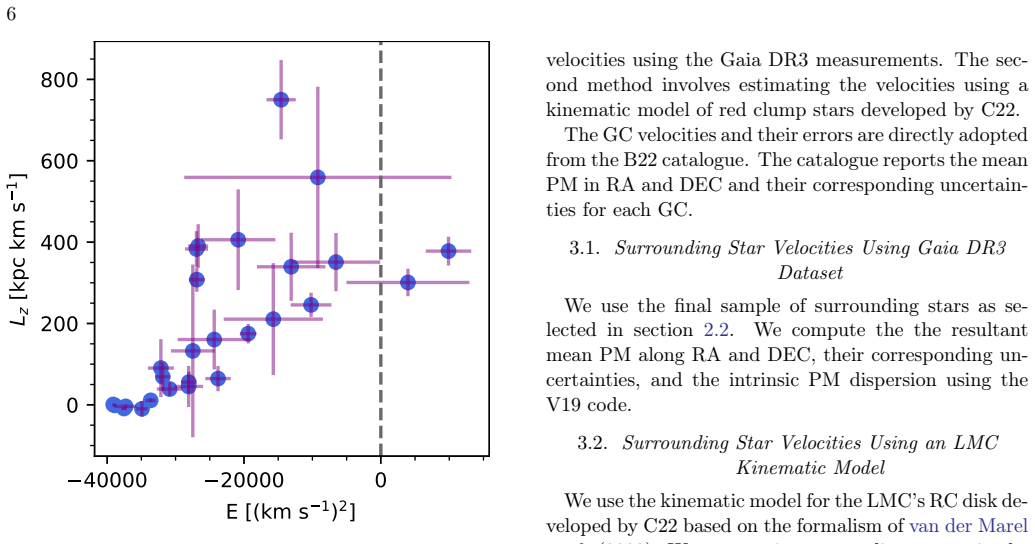
The LMC's Globular Clusters (GCs) bring a novel opportunity to understand the LMC's assembly history and dark matter (DM) properties, provided the kinematically outlying GCs can be reliably identified. However, traditional diagnostics like the Energy-Angular Momentum space fail because of large uncertainties on the GC velocities. In this work, we develop a new, robust statistical framework for identifying kinematically outlying LMC GCs, by using their Gaia-DR3 Proper Motions (PMs) combined with previous Line-of-Sight (LoS) velocity measurements. We use the difference between a GC's velocity vector and the average velocity vector of the surrounding red clump stars as a metric for quantifying a GC's kinematic peculiarity. We account for both the velocity measurement uncertainties and the LMC's intrinsic velocity dispersion. We find 5 LMC GCs to be kinematically outlying based on PM differences alone, and additional 6 GCs if LoS velocity information is also used. Majority of the GCs with outlying PMs are clustered at a distance of 3-4 kpc from the LMC center. The inclusion of outlying LMC GCs introduces a bias of upto 30% in the LMC's enclosed mass estimates derived using GCs as dynamical tracers; caution must be exercised in choosing the GC sample for precisely determining the LMC's DM content. We discuss the possibility that the kinematically outlying LMC GCs may be located in the LMC's elusive stellar halo and/or they could be accreted from external galaxies. Our work thus motivates future spectroscopic follow-up of these outlying GCs.
Figures


Reference graph
Works this paper leans on
-
[1]
Minniti, J. H. 2019, PASP, 131, 024101, doi: 10.1088/1538-3873/aae660
-
[2]
Arora, A., Garavito-Camargo, N., Sanderson, R. E., et al. 2025, ApJ, 988, 190, doi: 10.3847/1538-4357/ade30d 18 Astropy Collaboration, Robitaille, T. P., Tollerud, E. J., et al. 2013, A&A, 558, A33, doi: 10.1051/0004-6361/201322068 Astropy Collaboration, Price-Whelan, A. M., Sipőcz, B. M., et al. 2018, AJ, 156, 123, doi: 10.3847/1538-3881/aabc4f Astropy C...
-
[3]
Baird, S. R., & Flower, P. J. 1986, AJ, 91, 1336, doi: 10.1086/114108
-
[4]
2005, MNRAS, 364, 433, doi: 10.1111/j.1365-2966.2005.09367.x
Battaglia, G., Helmi, A., Morrison, H., et al. 2005, MNRAS, 364, 433, doi: 10.1111/j.1365-2966.2005.09367.x
arXiv 2005
-
[5]
Bekki, K., Couch, W. J., Beasley, M. A., et al. 2004, ApJL, 610, L93, doi: 10.1086/423372
-
[6]
2024, MNRAS, 528, 3198, doi: 10.1093/mnras/stad3920
Belokurov, V., & Kravtsov, A. 2024, MNRAS, 528, 3198, doi: 10.1093/mnras/stad3920
-
[7]
2022, The Astrophysical Journal, 935, 149, doi: 10.3847/1538-4357/ac81c9
Bennet, P., Alfaro-Cuello, M., del Pino, A., et al. 2022, The Astrophysical Journal, 935, 149, doi: 10.3847/1538-4357/ac81c9
-
[8]
2007, The Astrophysical Journal, 668, 949, doi: 10.1086/521385
Besla, G., Kallivayalil, N., Hernquist, L., et al. 2007, The Astrophysical Journal, 668, 949, doi: 10.1086/521385
doi:10.1086/521385 2007
-
[9]
2012, MNRAS, 421, 2109, doi: 10.1111/j.1365-2966.2012.20466.x
Besla, G., Kallivayalil, N., Hernquist, L., et al. 2012, MNRAS, 421, 2109, doi: 10.1111/j.1365-2966.2012.20466.x
arXiv 2012
-
[10]
Besla, G., Martínez-Delgado, D., van der Marel, R. P., et al. 2016, ApJ, 825, 20, doi: 10.3847/0004-637X/825/1/20
-
[11]
Besla, G., Peter, A. H. G., & Garavito-Camargo, N. 2019, JCAP, 2019, 013, doi: 10.1088/1475-7516/2019/11/013
-
[12]
Besla, G., Patton, D. R., Stierwalt, S., et al. 2018, MNRAS, 480, 3376, doi: 10.1093/mnras/sty2041
-
[13]
Binney, J., & Wong, L. K. 2017, MNRAS, 467, 2446, doi: 10.1093/mnras/stx234
-
[15]
The puzzling theoretical predictions for the luminosity of clumping He burning stars
Castellani, V., Degl’Innocenti, S., Girardi, L., et al. 2000, A&A, 354, 150, doi: 10.48550/arXiv.astro-ph/9911432
work page internal anchor Pith review Pith/arXiv arXiv doi:10.48550/arxiv.astro-ph/9911432 2000
-
[16]
2024, ApJ, 962, 162, doi: 10.3847/1538-4357/ad19d0
Chamberlain, K., Besla, G., Patel, E., et al. 2024, ApJ, 962, 162, doi: 10.3847/1538-4357/ad19d0
-
[17]
Choi, Y., Olsen, K. A. G., Besla, G., et al. 2022, The Astrophysical Journal, 927, 153, doi: 10.3847/1538-4357/ac4e90
-
[18]
Choi, Y., Nidever, D. L., Olsen, K., et al. 2018, ApJ, 866, 90, doi: 10.3847/1538-4357/aae083
-
[19]
C., Jerjen, H., Kim, D., & Schirmer, M
Conn, B. C., Jerjen, H., Kim, D., & Schirmer, M. 2018, ApJ, 852, 68, doi: 10.3847/1538-4357/aa9eda Correa Magnus, L., & Vasiliev, E. 2022, MNRAS, 511, 2610, doi: 10.1093/mnras/stab3726
-
[20]
Galactic kinematics of various stellar types
Cowley, C. R., & Stencel, R. E. 2024, arXiv e-prints, arXiv:2408.06161, doi: 10.48550/arXiv.2408.06161
work page internal anchor Pith review Pith/arXiv arXiv doi:10.48550/arxiv.2408.06161 2024
-
[21]
Where do High-Velocity Dark Matter Particles come from in the Milky Way?
DeBrae, A., Behroozi, P., & Garavito-Camargo, N. 2025, arXiv e-prints, arXiv:2502.17565, doi: 10.48550/arXiv.2502.17565 del Pino, A., Fardal, M. A., van der Marel, R. P., et al. 2021, ApJ, 908, 244, doi: 10.3847/1538-4357/abd5bf del Pino, A., Libralato, M., van der Marel, R. P., et al. 2022, ApJ, 933, 76, doi: 10.3847/1538-4357/ac70cf
work page internal anchor Pith review Pith/arXiv arXiv doi:10.48550/arxiv.2502.17565 2025
-
[22]
R., Subramaniam, A., & Subramanian, S
Dhanush, S. R., Subramaniam, A., & Subramanian, S. 2024, ApJ, 968, 103, doi: 10.3847/1538-4357/ad4453 D’Onghia, E., & Lake, G. 2008, ApJL, 686, L61, doi: 10.1086/592995
-
[23]
Dooley, G. A., Peter, A. H. G., Carlin, J. L., et al. 2017, MNRAS, 472, 1060, doi: 10.1093/mnras/stx2001
-
[24]
Erkal, D., & Belokurov, V. A. 2020, Monthly Notices of the Royal Astronomical Society, 495, 2554, doi: 10.1093/mnras/staa1238
-
[25]
1987, MNRAS, 225, 155, doi: 10.1093/mnras/225.1.155
Fasano, G., & Franceschini, A. 1987, MNRAS, 225, 155, doi: 10.1093/mnras/225.1.155
-
[26]
R., Mucciarelli, A., Carretta, E., & Origlia, L
Ferraro, F. R., Mucciarelli, A., Carretta, E., & Origlia, L. 2006, The Astrophysical Journal, 645, L33, doi: 10.1086/506178
-
[27]
Flower, P. J. 1984, in IAU Symposium, Vol. 108, Structure and Evolution of the Magellanic Clouds, ed. S. van den Bergh & K. S. D. de Boer, 31, doi: 10.1017/S0074180900039802
-
[28]
R., Besla, G., Mocz, P., et al
Foote, H. R., Besla, G., Mocz, P., et al. 2023, ApJ, 954, 163, doi: 10.3847/1538-4357/ace533
-
[29]
Foote, H. R., Rathore, H., Besla, G., et al. 2026, arXiv e-prints, arXiv:2601.00946, doi: 10.48550/arXiv.2601.00946
work page internal anchor Pith review Pith/arXiv arXiv doi:10.48550/arxiv.2601.00946 2026
-
[30]
Forbes, D. A., & Bridges, T. 2010, MNRAS, 404, 1203–1214, doi: 10.1111/j.1365-2966.2010.16373 Gaia Collaboration. 2016, Astronomy & Astrophysics, 595, A1, doi: 10.1051/0004-6361/201629272 —. 2022, Gaia Data Release 3: Summary of the content and survey properties, doi: 10.48550/arXiv.2208.00211 Gaia Collaboration, Helmi, A., van Leeuwen, F., et al. 2018, A...
arXiv 2010
-
[31]
Gilligan, C. K., Chaboyer, B., Cummings, J. D., et al. 2019, Monthly Notices of the Royal Astronomical Society, 486, 5581, doi: 10.1093/mnras/stz1174 —. 2020, Monthly Notices of the Royal Astronomical Society, 494, 1946, doi: 10.1093/mnras/staa822
-
[32]
Girardi, L. 2016, Annual Review of Astronomy and Astrophysics, 54, 95, doi: 10.1146/annurev-astro-081915-023354 19
-
[33]
Glatt, K., Grebel, E. K., & Koch, A. 2010, Astronomy & Astrophysics, 517, A50, doi: 10.1051/0004-6361/201014187
-
[34]
Glatt, K., Gallagher, III, J. S., Grebel, E. K., et al. 2008, AJ, 135, 1106, doi: 10.1088/0004-6256/135/4/1106
-
[35]
Goodwin, S. P. 1997, Monthly Notices of the Royal Astronomical Society: Letters, 286, L39, doi: 10.1093/mnras/286.3.L39
-
[36]
A., & Ruiz, M
Graham, J. A., & Ruiz, M. T. 1974, Astronomical Journal, 79, 363
1974
-
[37]
Harris, C. R., Millman, K. J., van der Walt, S. J., et al. 2020, Nature, 585, 357, doi: 10.1038/s41586-020-2649-2
-
[38]
He, X.-J., Luo, A. L., & Chen, Y.-Q. 2022, MNRAS, 512, 1710, doi: 10.1093/mnras/stac484
-
[39]
2008, The Astronomy and Astrophysics Review, 15, 145, doi: 10.1007/s00159-008-0009-6
Helmi, A. 2008, The Astronomy and Astrophysics Review, 15, 145, doi: 10.1007/s00159-008-0009-6
-
[40]
Helmi, A., Babusiaux, C., Koppelman, H. H., et al. 2018, Nature, 563, 85, doi: 10.1038/s41586-018-0625-x
-
[41]
1990, ApJ, 356, 359, doi: 10.1086/168845
Hernquist, L. 1990, ApJ, 356, 359, doi: 10.1086/168845
doi:10.1086/168845 1990
-
[42]
Hunter, J. D. 2007, Computing in Science & Engineering, 9, 90, doi: 10.1109/MCSE.2007.55
-
[43]
Jahn, E. D., Sales, L. V., Wetzel, A., et al. 2022, MNRAS, 513, 2673, doi: 10.1093/mnras/stac811
-
[44]
2016, MNRAS, 461, 2212, doi: 10.1093/mnras/stw1343 Jiménez-Arranz, Ó., & Roca-Fàbrega, S
Jethwa, P., Erkal, D., & Belokurov, V. 2016, MNRAS, 461, 2212, doi: 10.1093/mnras/stw1343 Jiménez-Arranz, Ó., & Roca-Fàbrega, S. 2025, A&A, 698, L7, doi: 10.1051/0004-6361/202555019 Jiménez-Arranz, Ó., Roca-Fàbrega, S., Romero-Gómez, M., et al. 2024, A&A, 688, A51, doi: 10.1051/0004-6361/202349058 Jiménez-Arranz, Ó ., Romero-Gómez, M., Luri, X., et al. 20...
-
[45]
Somerville, R. S. 1999, ApJ, 527, 199, doi: 10.1086/308066
-
[46]
Johnson, R. A., Beaulieu, S. F., Gilmore, G. F., et al. 2001, MNRAS, 324, 367, doi: 10.1046/j.1365-8711.2001.04291.x
arXiv 2001
-
[47]
P., Besla, G., Anderson, J., & Alcock, C
Kallivayalil, N., van der Marel, R. P., Besla, G., Anderson, J., & Alcock, C. 2013, ApJ, 764, 161, doi: 10.1088/0004-637X/764/2/161
-
[48]
Kim, S., Staveley-Smith, L., Dopita, M. A., et al. 2003, ApJS, 148, 473, doi: 10.1086/376980
doi:10.1086/376980 2003
-
[49]
Crain, R. A., & Bastian, N. 2019, MNRAS, 486, 3180, doi: 10.1093/mnras/sty1609
-
[50]
Kuzma, P. B., Ferguson, A. M. N., & Peñarrubia, J. 2021, Monthly Notices of the Royal Astronomical Society, 507, 1127–1137, doi: 10.1093/mnras/stab2280
-
[51]
Lindegren, L., Klioner, S. A., Hernández, J., & et al. 2021, Astronomy & Astrophysics, 649, A2, doi: 10.1051/0004-6361/202039709
-
[52]
2012, A&A, 543, A75, doi: 10.1051/0004-6361/201218847
Lyubenova, M., Kuntschner, H., Rejkuba, M., et al. 2012, A&A, 543, A75, doi: 10.1051/0004-6361/201218847
-
[53]
Mackey, A. D., & Gilmore, G. F. 2003, Monthly Notices of the Royal Astronomical Society, 338, 85, doi: 10.1046/j.1365-8711.2003.06021.x —. 2004, Monthly Notices of the Royal Astronomical Society, 355, 504, doi: 10.1111/j.1365-2966.2004.08343.x
arXiv 2003
-
[54]
2023, Monthly Notices of the Royal Astronomical Society, 521, 3540, doi: 10.1093/mnras/stad757
Makarov, D., Khoperskov, S., Makarov, D., et al. 2023, Monthly Notices of the Royal Astronomical Society, 521, 3540, doi: 10.1093/mnras/stad757
-
[55]
Marino, A. F., Przybilla, N., Milone, A. P., et al. 2018, AJ, 156, 116, doi: 10.3847/1538-3881/aad3cd Martínez-García, A. M., del Pino, A., Aparicio, A., van der
-
[56]
Marel, R. P., & Watkins, L. L. 2021, MNRAS, 505, 5884, doi: 10.1093/mnras/stab1568
-
[57]
Massari, D., Koppelman, H. H., & Helmi, A. 2019, Astronomy & Astrophysics, 630, L4, doi: 10.1051/0004-6361/201936135
-
[58]
McConnachie, A. W. 2012, AJ, 144, 4, doi: 10.1088/0004-6256/144/1/4
-
[59]
McLaughlin, D. E., & van der Marel, R. P. 2005, The Astrophysical Journal Supplement Series, 161, 304, doi: 10.1086/497429
doi:10.1086/497429 2005
-
[60]
Milone, A. P., Cordoni, G., Marino, A. F., et al. 2023, A&A, 672, A161, doi: 10.1051/0004-6361/202244798
-
[61]
1975, PASJ, 27, 533
Miyamoto, M., & Nagai, R. 1975, PASJ, 27, 533
1975
-
[62]
Mucciarelli, A., Ferraro, F. R., Origlia, L., & Pecci, F. F. 2007, The Astronomical Journal, 133, 2053, doi: 10.1086/513076
-
[63]
2021, Nature Astronomy, 5, 1247, doi: 10.1038/s41550-021-01493-y
Mucciarelli, A., Massari, D., Minelli, A., et al. 2021, Nature Astronomy, 5, 1247, doi: 10.1038/s41550-021-01493-y
-
[64]
2018, ApJL, 863, 28, doi: 10.3847/2041-8213/aad7f7
Koposov, S. 2018, ApJL, 863, 28, doi: 10.3847/2041-8213/aad7f7
-
[65]
2022, Astronomy & Astrophysics, 666, A80, doi: 10.1051/0004-6361/202243378
Narloch, W., Pietrzyń ski, G., Gieren, W., et al. 2022, Astronomy & Astrophysics, 666, A80, doi: 10.1051/0004-6361/202243378
-
[66]
Olsen, K. A. G., Hodge, P. W., Mateo, M., et al. 1998, MNRAS, 300, 665, doi: 10.1046/j.1365-8711.1998.01860.x
arXiv 1998
-
[67]
Olsen, K. A. G., & Massey, P. 2007, ApJL, 656, L61, doi: 10.1086/512484
-
[68]
Gordon, K. D. 2011, ApJ, 737, 29, doi: 10.1088/0004-637X/737/1/29
-
[69]
Harris, H. C. 1991, AJ, 101, 515, doi: 10.1086/115701 20
doi:10.1086/115701 1991
-
[70]
Olszewski, E. W., Suntzeff, N. B., & Mateo, M. 1996, Annual Review of Astronomy and Astrophysics, 34, 511, doi: 10.1146/annurev.astro.34.1.511
-
[71]
Pace, A. B., Erkal, D., & Li, T. S. 2022, The Astrophysical Journal, 940, 136, doi: 10.3847/1538-4357/ac997b
-
[72]
Pagnini, G., Matteo, P. D., Khoperskov, S., et al. 2023, Astronomy & Astrophysics, 673, A86, doi: 10.1051/0004-6361/202245128
-
[73]
2020, The Astrophysical Journal, 893, 121, doi: 10.3847/1538-4357/ab7b75
Patel, E., Kallivayalil, N., Garavito-Camargo, N., et al. 2020, The Astrophysical Journal, 893, 121, doi: 10.3847/1538-4357/ab7b75
-
[74]
Peacock, J. A. 1983, MNRAS, 202, 615, doi: 10.1093/mnras/202.3.615
-
[75]
Perina, S., Cohen, J. G., Barmby, P., et al. 2010, A&A, 511, A23, doi: 10.1051/0004-6361/200913459
-
[76]
2021, MNRAS, 500, 2514, doi: 10.1093/mnras/staa3407
Pfeffer, J., Lardo, C., Bastian, N., Saracino, S., & Kamann, S. 2021, MNRAS, 500, 2514, doi: 10.1093/mnras/staa3407
-
[77]
Piatti, A. E. 2014, ISRN Astronomy and Astrophysics, 2014, 398182, doi: 10.1155/2014/398182
-
[78]
Piatti, A. E. 2022, Monthly Notices of the Royal Astronomical Society: Letters, 511, L72, doi: 10.1093/mnrasl/slac010
-
[79]
Piatti, A. E., Keller, S. C., Mackey, A. D., & Costa, G. S. D. 2014, Monthly Notices of the Royal Astronomical Society, 444, 1425, doi: 10.1093/mnras/stu1535
-
[80]
Piatti, A. E., & Mackey, A. D. 2018, Monthly Notices of the Royal Astronomical Society, 478, 2164, doi: 10.1093/mnras/sty1048 Pietrzyński, G., Graczyk, D., Gieren, W., et al. 2013, Nature, 495, 76, doi: 10.1038/nature11878
-
[81]
2019, A&A, 621, A56, doi: 10.1051/0004-6361/201833355
Posti, L., & Helmi, A. 2019, A&A, 621, A56, doi: 10.1051/0004-6361/201833355
discussion (0)
Sign in with ORCID, Apple, or X to comment. Anyone can read and Pith papers without signing in.