Recognition: 1 theorem link
· Lean TheoremSymmetry-directed electronic and optical properties in a two-dimensional square-lattice ZnPc-MOF
Pith reviewed 2026-05-15 13:46 UTC · model grok-4.3
The pith
Symmetry in square-lattice ZnPc-MOF enforces two-fold band degeneracy along specific lines in AB-stacked bilayers and sets polarization-dependent optical rules.
A machine-rendered reading of the paper's core claim, the machinery that carries it, and where it could break.
Core claim
Group representation theory applied to the little groups of the square lattice classifies the bands of the ZnPc-MOF structures. The AB-stacked bilayer exhibits persistent two-fold degeneracy along the Y and Y' high-symmetry lines solely because two-dimensional irreps are present along those directions. Optical selection rules follow directly from the symmetry, producing pronounced polarization dependence in the conductivity. In the 45° twisted bilayer the resonant coupling Hamiltonian locates quasicrystalline states nearer the Fermi energy than in graphene, suggesting a larger role in low-energy physics despite weaker coupling strengths.
What carries the argument
Classification of electronic bands by the irreducible representations of the little groups of the square-lattice symmetries, together with the resonant coupling Hamiltonian used to model quasicrystalline states in the twisted bilayer.
If this is right
- AB-stacked bilayers maintain two-fold degenerate bands along the Y and Y' lines as a direct result of two-dimensional irreps.
- Optical conductivity displays strong polarization dependence set by the derived transition selection rules.
- Quasicrystalline states in the 45° twisted bilayer lie closer to the Fermi energy than in graphene quasicrystals.
- Weaker resonant coupling in ZnPc-MOF still produces greater low-energy contribution from quasicrystalline states than in graphene.
Where Pith is reading between the lines
- Square-lattice MOFs may allow symmetry-based engineering of degeneracies that differ from those in hexagonal 2D materials.
- Angle-resolved photoemission on twisted ZnPc-MOF bilayers could map the predicted quasicrystalline states near the Fermi level.
- The same little-group analysis could be applied to other square-lattice frameworks to predict optical and transport anisotropies.
Load-bearing premise
The ideal crystal symmetry of the ZnPc-MOF exactly matches the fabricated samples and the resonant coupling Hamiltonian captures all relevant interactions without higher-order corrections or lattice relaxation.
What would settle it
An experimental spectrum showing energy splitting of bands along the Y line in an AB-stacked bilayer sample would demonstrate that the predicted two-fold degeneracy is lifted.
Figures




read the original abstract
The electronic structure of materials is fundamentally governed by their crystal symmetry. While most research on two-dimensional materials has focused on hexagonal lattices, such as graphene, hexagonal boron nitride, and transition metal dichalcogenides. This work explores a square-lattice system: the experimentally realized phthalocyanine-based metal-organic framework (ZnPc-MOF). Using group representation theory, we classify the electronic bands of ZnPc-MOF monolayer, AA- and AB-stacked bilayers, and twisted bilayers in terms of the irreducible representations (irreps) of their little groups. We find that bands in the AB-stacked bilayer remain two-fold degenerate along the $Y$ and $Y^{\prime}$ high-symmetry lines, as a consequence of the sole presence of two-dimensional irreps along these directions. We further derive optical transition selection rules to interpret the optical conductivity, revealing pronounced polarization-dependent optical responses. Additionally, we investigate the quasicrystalline electronic states in the 45$^{\circ}$ twisted bilayer (ZnPc-MOF quasicrystal) using the resonant coupling Hamiltonian. Compared to graphene quasicrystals, ZnPc-MOF quasicrystal exhibits weaker resonant coupling strengths, yet its quasicrystalline states lie closer to the Fermi energy, suggesting a greater contribution to low-energy electronic phenomena.
Editorial analysis
A structured set of objections, weighed in public.
Referee Report
Summary. The manuscript applies group representation theory to classify the electronic bands of the ZnPc-MOF in its monolayer form, AA- and AB-stacked bilayers, and 45° twisted bilayer configurations. It claims that the AB-stacked bilayer exhibits two-fold degenerate bands along the Y and Y' high-symmetry lines due to the exclusive presence of two-dimensional irreducible representations in the little groups at these points. Optical transition selection rules are derived to explain polarization-dependent optical conductivity, and quasicrystalline states in the twisted bilayer are analyzed using a resonant coupling Hamiltonian, noting weaker coupling but closer proximity to the Fermi energy compared to graphene quasicrystals.
Significance. If the symmetry classifications hold, the work supplies a symmetry-based framework for electronic and optical properties in an experimentally realized square-lattice MOF, extending such analyses beyond the more common hexagonal 2D materials. The resonant-coupling treatment of the quasicrystal and the optical selection rules are standard tools applied here; explicit comparison to graphene highlights material-specific differences in low-energy states. Absence of direct DFT validation or experimental benchmarks keeps the immediate impact moderate.
major comments (1)
- The central claim that bands in the AB-stacked bilayer remain two-fold degenerate along Y and Y' because the little groups contain solely two-dimensional irreps is load-bearing for the bilayer results. The manuscript presents this as an immediate consequence without providing the character table, explicit list of group elements for the AB registry, or irrep decomposition at those points. Standard square-lattice little groups (C2v or C4v subgroups) commonly admit both 1D and 2D representations; confirmation that AB stacking eliminates all 1D irreps is required to substantiate the degeneracy.
minor comments (2)
- The resonant coupling Hamiltonian is invoked for the 45° twisted bilayer but its explicit form, coupling parameters, and cutoff criteria are not stated, preventing quantitative assessment of the 'weaker resonant coupling strengths' relative to graphene.
- Optical conductivity results are described as showing 'pronounced polarization-dependent responses,' yet the manuscript does not reference the specific figures, energy ranges, or computed spectra that support this statement.
Simulated Author's Rebuttal
We thank the referee for their careful reading of the manuscript and for highlighting the need for explicit symmetry details to support the bilayer degeneracy claim. We agree that providing the character tables, group elements, and irrep decompositions will strengthen the presentation. We address the major comment below and will revise the manuscript accordingly to include these elements.
read point-by-point responses
-
Referee: The central claim that bands in the AB-stacked bilayer remain two-fold degenerate along Y and Y' because the little groups contain solely two-dimensional irreps is load-bearing for the bilayer results. The manuscript presents this as an immediate consequence without providing the character table, explicit list of group elements for the AB registry, or irrep decomposition at those points. Standard square-lattice little groups (C2v or C4v subgroups) commonly admit both 1D and 2D representations; confirmation that AB stacking eliminates all 1D irreps is required to substantiate the degeneracy.
Authors: We agree that the manuscript would be strengthened by explicitly including the character table for the little group at the Y (and Y') points under AB stacking, along with the list of group elements and the irrep decomposition of the bands. In the revised manuscript, we will add a dedicated subsection (or appendix) presenting these details. Our symmetry analysis shows that the AB registry reduces the little group such that only two-dimensional irreps appear at these points (specifically, the 2D irrep of the relevant C2v subgroup is realized, with no 1D irreps compatible with the stacking-induced symmetry), directly enforcing the two-fold degeneracy. This is consistent with the monolayer and AA cases where both 1D and 2D irreps occur. We will also include a brief comparison to the standard C4v/C2v tables to clarify how AB stacking eliminates the 1D representations. revision: yes
Circularity Check
No significant circularity in symmetry-based band classification
full rationale
The paper applies standard group representation theory to classify electronic bands of the ZnPc-MOF monolayer, AA/AB bilayers, and twisted structures according to little-group irreps, then derives optical selection rules directly from those irreps. The AB-bilayer degeneracy along Y/Y' is stated as following from the character table containing only 2D irreps at those points, which is obtained by enumerating the symmetry operations of the AB registry rather than by redefinition or parameter fitting. The resonant-coupling Hamiltonian for the 45° quasicrystal is introduced as a standard approximation without coefficients tuned to reproduce the degeneracy result. No self-citation chains, ansatzes smuggled via prior work, or fitted inputs renamed as predictions appear in the derivation; the chain remains independent and verifiable against external group-theory tables and standard tight-binding models.
Axiom & Free-Parameter Ledger
axioms (2)
- domain assumption The crystal symmetry of the ZnPc-MOF monolayer and bilayers is accurately described by the ideal space group without reconstruction or defects.
- domain assumption The resonant coupling Hamiltonian captures the dominant mixing of states in the 45° twisted bilayer.
Lean theorems connected to this paper
-
IndisputableMonolith/Foundation/AlexanderDuality.leanalexander_duality_circle_linking unclear?
unclearRelation between the paper passage and the cited Recognition theorem.
bands in the AB-stacked bilayer remain two-fold degenerate along the Y and Y′ high-symmetry lines, as a consequence of the sole presence of two-dimensional irreps along these directions
What do these tags mean?
- matches
- The paper's claim is directly supported by a theorem in the formal canon.
- supports
- The theorem supports part of the paper's argument, but the paper may add assumptions or extra steps.
- extends
- The paper goes beyond the formal theorem; the theorem is a base layer rather than the whole result.
- uses
- The paper appears to rely on the theorem as machinery.
- contradicts
- The paper's claim conflicts with a theorem or certificate in the canon.
- unclear
- Pith found a possible connection, but the passage is too broad, indirect, or ambiguous to say the theorem truly supports the claim.
Reference graph
Works this paper leans on
-
[1]
Band structure change from monolayer to AA- and AB-stacked bilayer. The evolution of the band structure from a mono- layer to AA- and AB-stacked bilayers can be understood in terms of interlayer hybridization and symmetry. To facilitate the discussion, we denote the highest valence band (VB) of the monolayer asV 1, and the two low- est conduction bands (C...
-
[2]
However, the en- ergy levels atkandk ′ are not always assigned the same irrep
Irrep relations between symmetrically equivalent wavevectors Owing to symmetry, the Hamiltonians at a wavevec- torkand its symmetrically equivalent wavevectork ′ = σ(xy)z kshare identical energy spectra. However, the en- ergy levels atkandk ′ are not always assigned the same irrep. By comparing the high-symmetry points and lines X,Y, ∆ with their symmetri...
-
[3]
Optical absorption spectrum and optical transitioin selectioin rules. The optical conductivity tensorσ αβ(ω) is calculated using the Kubo formula: σαβ(ω) = ie2ℏ NkΩc X k X n,m fmk −f nk ϵmk −ϵ nk × ⟨ψnk|vα|ψmk⟩⟨ψmk|vβ|ψnk⟩ ϵmk −ϵ nk −(ℏω+ iη) , (9) FIG. 4. Optical absorption spectra of charge neutral (a) monolayer, (b) AA-stacked, (c) AB-stacked, and (d) ...
-
[4]
Understanding optical absorption spectra using optical transition selection rules. The optical absorption spectrum for specifically po- larized light is determined by both the OTSRs and the Pauli exclusion principle. In this subsection, we apply these two fundamental rules to understand the key fea- tures of the optical absorption spectrum for photon en- ...
-
[5]
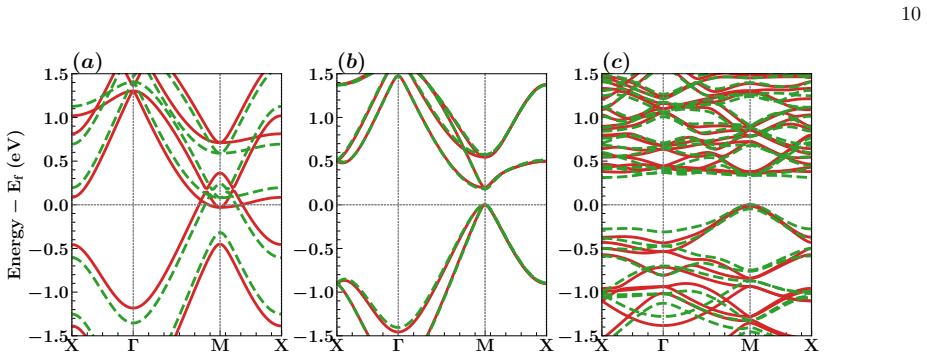
Although these changes lead to some fine-tuning of the spectral features, all key characteristics, including the absorption steps and peaks, remain intact. Among the three systems, the 36.87 ◦ twisted bilayer experiences 10 X Γ M X−1.5 −1.0 −0.5 0.0 0.5 1.0 1.5 Energy − Ef (eV) (a) X Γ M X−1.5 −1.0 −0.5 0.0 0.5 1.0 1.5 (b) X Γ M X−1.5 −1.0 −0.5 0.0 0.5 1....
-
[6]
K. S. Novoselov, A. K. Geim, S. V. Morozov, D. Jiang, Y. Zhang, S. V. Dubonos, I. V. Grigorieva, and A. A. Firsov, Electric Field Effect in Atomically Thin Carbon Films, Science306, 666 (2004)
work page 2004
-
[7]
M. Z. Hasan and C. L. Kane, Colloquium: Topological insulators, Rev. Mod. Phys.82, 3045 (2010)
work page 2010
-
[8]
X.-L. Qi and S.-C. Zhang, Topological insulators and su- perconductors, Rev. Mod. Phys.83, 1057 (2011)
work page 2011
-
[9]
A. K. Geim and K. S. Novoselov, The rise of graphene, Nature Materials6, 183 (2007)
work page 2007
-
[10]
D. Pacil´ e, J. C. Meyer, C ¸ . ¨O. Girit, and A. Zettl, The two-dimensional phase of boron nitride: Few-atomic- 16 TABLE C2. Character tables of little groups for high-symmetry points and lines for AA-stacked bilayer. C2v D2h D4h AA-stacked bilayer Y|∆ ′ E C 2x σxy σxz ∆|Y ′ E C 2y σxy σyz Σ E C 2xy σxy σ(xy)z X|X ′ E C 2z C2x C2y i σ xy σxz σyz Γ|M E C4...
work page 2008
-
[11]
C. Lee, Q. Li, W. Kalb, X.-Z. Liu, H. Berger, R. W. Carpick, and J. Hone, Frictional Characteristics of Atomically Thin Sheets, Science328, 76 (2010)
work page 2010
-
[12]
A. H. Castro Neto, F. Guinea, N. M. R. Peres, K. S. Novoselov, and A. K. Geim, The electronic properties of graphene, Rev. Mod. Phys.81, 109 (2009)
work page 2009
-
[13]
G. Giovannetti, P. A. Khomyakov, G. Brocks, P. J. Kelly, and J. van den Brink, Substrate-induced band gap in graphene on hexagonal boron nitride: Ab initio density functional calculations, Phys. Rev. B76, 073103 (2007)
work page 2007
-
[14]
D. Xiao, G.-B. Liu, W. Feng, X. Xu, and W. Yao, Cou- pled Spin and Valley Physics in Monolayers of MoS2 and Other Group-VI Dichalcogenides, Phys. Rev. Lett.108, 196802 (2012)
work page 2012
-
[16]
R. Samajdar, W. W. Ho, H. Pichler, M. D. Lukin, and S. Sachdev, Complex Density Wave Orders and Quantum Phase Transitions in a Model of Square-Lattice Rydberg Atom Arrays, Phys. Rev. Lett.124, 103601 (2020)
work page 2020
-
[17]
P. Li, L. Sun, and G. P. Wang, Various dual-polarization Dirac-like cones in a two-phase photonic crystal with a simple square lattice, Phys. Rev. B112, 075425 (2025)
work page 2025
-
[18]
M. Zhao, Y. Huang, Y. Peng, Z. Huang, Q. Ma, and H. Zhang, Two-dimensional metal–organic framework nanosheets: synthesis and applications, Chem. Soc. Rev. 47, 6267 (2018)
work page 2018
-
[19]
G. Chakraborty, I.-H. Park, R. Medishetty, and J. J. Vit- tal, Two-Dimensional Metal-Organic Framework Materi- als: Synthesis, Structures, Properties and Applications, Chemical Reviews121, 3751 (2021)
work page 2021
-
[20]
M. Ko, L. Mendecki, and K. A. Mirica, Conductive two-dimensional metal–organic frameworks as multifunc- tional materials, Chem. Commun.54, 7873 (2018)
work page 2018
-
[21]
P. Horcajada, S. Surbl´ e, C. Serre, D.-Y. Hong, Y.-K. Seo, J.-S. Chang, J.-M. Gren` eche, I. Margiolaki, and G. F´ erey, Synthesis and catalytic properties of MIL- 100(Fe), an iron(iii) carboxylate with large pores, Chem. Commun. , 2820 (2007)
work page 2007
-
[22]
Z. Wang, P. St. Petkov, J. Zhang, B. Liang, S. Revuelta, K. Xiao, K. Tiwari, Q. Guo, Z. Li, J. Zhang, H. Qi, S. Zhou, U. Kaiser, T. Heine, E. C´ anovas, S. S. P. Parkin, X. Feng, and R. Dong, Benzenehexol-Based 2D Conju- gated Metal–Organic Frameworks with Kagome Lattice Exhibiting a Metallic State, Advanced Functional Mate- rials34, 2404680 (2024)
work page 2024
-
[23]
A. Urtizberea, E. Natividad, P. J. Alonso, M. A. Andr´ es, I. Gasc´ on, M. Goldmann, and O. Roubeau, A Porphyrin Spin Qubit and Its 2D Framework Nanosheets, Advanced Functional Materials28, 1801695 (2018). 17 TABLE C4. Character table of little groups at Γ andMfor AB-stacked bilaye. ΓE C4z C 3 4z C2z {C2x|τ0} {C2y|τ0} {C2xy|τ0} {C2xy|τ0} {i|τ0} {S4z|τ0} {...
work page 2018
-
[24]
M. Abel, S. Clair, O. Ourdjini, M. Mossoyan, and L. Porte, Single Layer of Polymeric Fe-Phthalocyanine: An Organometallic Sheet on Metal and Thin Insulating Film, Journal of the American Chemical Society133, 1203 (2011)
work page 2011
-
[25]
J. Zhou and Q. Sun, Magnetism of Phthalocyanine- Based Organometallic Single Porous Sheet, Journal of the American Chemical Society133, 15113 (2011)
work page 2011
-
[26]
J. Zhou, Q. Wang, Q. Sun, Y. Kawazoe, and P. Jena, Strain-Induced Spin Crossover in Phthalocyanine-Based Organometallic Sheets, The Journal of Physical Chem- istry Letters3, 3109 (2012)
work page 2012
- [27]
-
[28]
G. Yu, Y. Wang, M. I. Katsnelson, H.-Q. Lin, and S. Yuan, Interlayer hybridization in graphene quasicrys- tal and other bilayer graphene systems, Phys. Rev. B TABLE C6. Character table of little groups on symmetry lines Σ, ∆, and ∆ ′ for AB-stacked bilayer, for which we take wavevector atk=u(b 1 +b 2),k=ub 2, andk=ub 1, respec- tively. ΣE{C 2xy|τ0} {σ xy|...
work page 2022
-
[29]
Y. Cao, V. Fatemi, S. Fang, K. Watanabe, T. Taniguchi, E. Kaxiras, and P. Jarillo-Herrero, Unconventional su- perconductivity in magic-angle graphene superlattices, Nature556, 43 (2018)
work page 2018
-
[30]
Y. Cao, V. Fatemi, A. Demir, S. Fang, S. L. Tomarken, J. Y. Luo, J. D. Sanchez-Yamagishi, K. Watanabe, T. Taniguchi, E. Kaxiras, R. C. Ashoori, and P. Jarillo- Herrero, Correlated insulator behaviour at half-filling in magic-angle graphene superlattices, Nature556, 80 (2018)
work page 2018
-
[31]
R. Bistritzer and A. H. MacDonald, Moir´ e bands in twisted double-layer graphene, Proceedings of the Na- tional Academy of Sciences108, 12233 (2011). 18 TABLE C7. Character table ofD 4d point group for 45 ◦ twisted bilayer. The four 2-fold rotations with axes inside thexy-plane have the same characters and given in 4C ′ 2 to- gether. The four mirror refl...
work page 2011
-
[32]
T. Kariyado and A. Vishwanath, Flat band in twisted bilayer Bravais lattices, Phys. Rev. Res.1, 033076 (2019)
work page 2019
-
[33]
X.-J. Zhao, Y. Yang, D.-B. Zhang, and S.-H. Wei, For- mation of Bloch Flat Bands in Polar Twisted Bilayers without Magic Angles, Phys. Rev. Lett.124, 086401 (2020)
work page 2020
-
[34]
Z. Zhan, Y. Zhang, P. Lv, H. Zhong, G. Yu, F. Guinea, J. A. Silva-Guill´ en, and S. Yuan, Tunability of multiple ultraflat bands and effect of spin-orbit coupling in twisted bilayer transition metal dichalcogenides, Phys. Rev. B 102, 241106 (2020)
work page 2020
- [35]
-
[36]
L. Feng, W. Xu, H. Luo, and G. Yu, Twist-angle mod- ulation on bandgaps in twisted bilayerγ-graphyne and graphdiyne, Journal of Physics D: Applied Physics58, 155304 (2025)
work page 2025
- [37]
-
[38]
S. J. Ahn, P. Moon, T.-H. Kim, H.-W. Kim, H.-C. Shin, E. H. Kim, H. W. Cha, S.-J. Kahng, P. Kim, M. Koshino, Y.-W. Son, C.-W. Yang, and J. R. Ahn, Dirac electrons in a dodecagonal graphene quasicrystal, Science361, 782 (2018)
work page 2018
-
[39]
W. Yao, E. Wang, C. Bao, Y. Zhang, K. Zhang, K. Bao, C. K. Chan, C. Chen, J. Avila, M. C. Asensio, J. Zhu, and S. Zhou, Quasicrystalline 30°twisted bi- layer graphene as an incommensurate superlattice with strong interlayer coupling, Proceedings of the National Academy of Sciences115, 6928 (2018)
work page 2018
-
[40]
G. Yu, Z. Wu, Z. Zhan, M. I. Katsnelson, and S. Yuan, Dodecagonal bilayer graphene quasicrystal and its ap- proximants, npj Computational Materials5, 122 (2019)
work page 2019
-
[41]
Y. Li, C. Shi, F. Zhang, X. Liu, Y. Xue, V.-A. Ha, Q. Gao, C. Dong, Y.-C. Lin, L. N. Holtzman, N. Morales- Dur´ an, H. Kim, Y. Jiang, M. Holbrook, J. Hone, K. Bar- mak, J. A. Robinson, X. Li, F. Giustino, E. Khalaf, Y. Han, and C.-K. Shih, Robust supermoir´ e pattern in large-angle single-twist bilayers, Nature Physics21, 1085 (2025)
work page 2025
-
[42]
Y. Li, F. Zhang, V.-A. Ha, Y.-C. Lin, C. Dong, Q. Gao, Z. Liu, X. Liu, S. H. Ryu, H. Kim, C. Jozwiak, A. Bost- wick, K. Watanabe, T. Taniguchi, B. Kousa, X. Li, E. Rotenberg, E. Khalaf, J. A. Robinson, F. Giustino, and C.-K. Shih, Tuning commensurability in twisted van der Waals bilayers, Nature625, 494 (2024)
work page 2024
-
[43]
J. Kim, J. Lee, C. Cho, J. Nam, B. Ji, H. Cho, H. T. Shin, D. Sivanesan, S. S. Park, J. Kim, and W. Choe, Isoretic- ular moir´ e metal-organic frameworks with quasiperiodic- ity, Nature Communications16, 7384 (2025)
work page 2025
-
[44]
Y. Che, H. Lv, X. Wu, and J. Yang, Engineering Al- termagnetic States in Two-Dimensional Square Tessella- tions, Phys. Rev. Lett.135, 036701 (2025)
work page 2025
-
[45]
Y. Che, Y. Guo, H. Lv, X. Wu, and J. Yang, Symmetry- Driven Multiferroic Altermagnetism in Two-Dimensional Materials, Journal of the American Chemical Society 148, 5125 (2026)
work page 2026
-
[46]
F. Ferrari and R. Valent´ ı, Altermagnetism on the Shastry-Sutherland lattice, Phys. Rev. B110, 205140 (2024)
work page 2024
-
[47]
Z.-M. Wang, Y. Zhang, S.-B. Zhang, J.-H. Sun, E. Dagotto, D.-H. Xu, and L.-H. Hu, Spin-Orbital Al- termagnetism, Phys. Rev. Lett.135, 176705 (2025)
work page 2025
- [48]
-
[49]
R. Jaeschke-Ubiergo, V.-K. Bharadwaj, W. Campos, R. Zarzuela, N. Biniskos, R. M. Fernandes, T. Jungwirth, J. Sinova, and L. ˇSmejkal, “Atomic altermagnetism,” (2025), arXiv:2503.10797 [cond-mat.mtrl-sci]
-
[50]
Y. Fang and J. Cano, Filling anomaly for general two- and three-dimensionalC 4 symmetric lattices, Phys. Rev. B103, 165109 (2021)
work page 2021
-
[51]
Q. Xu, A. Fischer, N. Tancogne-Dejean, T. Zhang, E. V. n. Bostr¨ om, M. Claassen, D. M. Kennes, A. Rubio, and L. Xian, Engineering 2D Square Lattice Hubbard Models in 90°Twisted GeX/SnX (X = S, Se) Moir´ e Su- perlattices, Phys. Rev. X15, 041049 (2025)
work page 2025
-
[52]
S. Nath, A. Bandyopadhyay, S. Datta, M. Mohi Uddin, and D. Jana, Electronic and optical properties of non- hexagonal Dirac material S-graphene sheet and nanorib- bons, Physica E: Low-dimensional Systems and Nanos- tructures120, 114087 (2020)
work page 2020
-
[53]
C. S. van Niekerk and R. Warmbier, Symmetry-Based Model Hamiltonians for Topological Analysis of 2D Ma- terials with Square Lattice, physica status solidi (b)260, 2300018 (2023)
work page 2023
-
[54]
J. C. Slater and G. F. Koster, Simplified LCAO Method for the Periodic Potential Problem, Phys. Rev.94, 1498 (1954)
work page 1954
-
[55]
P. Hohenberg and W. Kohn, Inhomogeneous Electron Gas, Phys. Rev.136, B864 (1964)
work page 1964
-
[56]
W. Kohn and L. J. Sham, Self-Consistent Equations In- cluding Exchange and Correlation Effects, Phys. Rev. 140, A1133 (1965)
work page 1965
-
[57]
G. Kresse and J. Furthm¨ uller, Efficiency of ab-initio total energy calculations for metals and semiconductors using a plane-wave basis set, Computational Materials Science 6, 15 (1996)
work page 1996
-
[58]
A. V. Krukau, O. A. Vydrov, A. F. Izmaylov, and G. E. Scuseria, Influence of the exchange screening parameter on the performance of screened hybrid functionals, The Journal of Chemical Physics125, 224106 (2006)
work page 2006
-
[59]
S. Grimme, Semiempirical GGA-type density functional constructed with a long-range dispersion correction, 19 TABLE C8. CRs between high-symmetry lines and high-symmetry points. The CR for the pairs (Γ,∆, X) and (Γ,∆ ′, X′) is collectively denoted as (Γ,∆ (′), X(′)). Similarly, (M, Y, X) and (M, Y ′, X′) are labeled as (M, Y (′), X(′)). As an example, cons...
work page 2006
-
[60]
L. Elcoro, B. Bradlyn, Z. Wang, M. G. Vergniory, J. Cano, C. Felser, B. A. Bernevig, D. Orobengoa, G. de la Flor, and M. I. Aroyo, Double crystallographic groups and their representations on the Bilbao Crystal- lographic Server, Journal of Applied Crystallography50, 1457 (2017)
work page 2017
-
[61]
G. Yu, Y. Wang, M. I. Katsnelson, and S. Yuan, Origin of the magic angle in twisted bilayer graphene from hy- bridization of valence and conduction bands, Phys. Rev. B108, 045138 (2023)
work page 2023
-
[62]
Y. Li, Z. Zhan, X. Kuang, Y. Li, and S. Yuan, TBPLaS: A tight-binding package for large-scale simulation, Com- puter Physics Communications285, 108632 (2023)
work page 2023
-
[63]
J. P. Perdew, K. Burke, and M. Ernzerhof, Generalized Gradient Approximation Made Simple, Phys. Rev. Lett. 77, 3865 (1996)
work page 1996
-
[64]
N. Marzari, A. A. Mostofi, J. R. Yates, I. Souza, and D. Vanderbilt, Maximally localized Wannier functions: Theory and applications, Rev. Mod. Phys.84, 1419 (2012)
work page 2012
-
[65]
P. Moon, M. Koshino, and Y.-W. Son, Quasicrystalline electronic states in 30 ◦ rotated twisted bilayer graphene, Phys. Rev. B99, 165430 (2019)
work page 2019
-
[66]
G. Yu, Z. Wu, Z. Zhan, M. I. Katsnelson, and S. Yuan, Electronic structure of 30 ◦ twisted double bi- layer graphene, Phys. Rev. B102, 115123 (2020)
work page 2020
-
[67]
M. Koshino, Interlayer interaction in general incommen- surate atomic layers, New Journal of Physics17, 015014 (2015)
work page 2015
-
[68]
M. Koshino and P. Moon, Electronic Properties of In- commensurate Atomic Layers, Journal of the Physical Society of Japan84, 121001 (2015)
work page 2015
-
[69]
Moon, Resonant interaction in chiral Eshelby-twisted van der Waals atomic layers, Phys
P. Moon, Resonant interaction in chiral Eshelby-twisted van der Waals atomic layers, Phys. Rev. B104, 115407 (2021)
work page 2021
-
[70]
J. A. Crosse and P. Moon, Quasicrystalline electronic states in twisted bilayers and the effects of interlayer and sublattice symmetries, Phys. Rev. B103, 045408 (2021)
work page 2021
-
[71]
G. Yu, Y. Wang, M. I. Katsnelson, H.-Q. Lin, and S. Yuan, Compatibility relationships in van der Waals quasicrystals, Phys. Rev. B106, 075121 (2022)
work page 2022
-
[72]
S. Plimpton, Fast Parallel Algorithms for Short-Range Molecular Dynamics, Journal of Computational Physics 117, 1 (1995)
work page 1995
discussion (0)
Sign in with ORCID, Apple, or X to comment. Anyone can read and Pith papers without signing in.