REVIEW 3 major objections 6 minor 68 references
Very long-term relaxation of harmonic 1D self-gravitating systems
T0 review · 3 major / 6 minor · reviewed 2026-08-02 · deepseek-v4-flash
Pith's one-line read For a 1D self-gravitating system in a harmonic potential, the relaxation time scales as the square of the particle number, t_rel ∝ N², not linearly as Balescu–Lenard theory would predict.
desk verdict A clean numerical study that plausibly identifies N² relaxation for degenerate harmonic 1D systems, but the asymptotic claim outruns the data; deserves refereeing with requests for larger-N checks. read the letter →
The pith
A machine-rendered reading of the paper's core claim, the machinery that carries it, and where it could break.
The reading
What carries the argument
The load-bearing object is the dynamically degenerate harmonic potential, a constant-density slab whose quadratic mean-field potential gives every orbit the same frequency Ω, making the Balescu–Lenard resonance condition degenerate. The measurements rely on an exact collision-driven 1D integrator (forces are constant between crossings, collisions are processed with a heap-based event scheduler) and on a relaxation metric: the ensemble-averaged Kolmogorov–Smirnov distance between the evolving cumulative mass profile and the Rybicki finite-N thermodynamic equilibrium. The relaxation time is defined implicitly as the time when this distance crosses an ad hoc threshold D0 = 0.015.
What would settle it
Run the same relaxation measurement for the harmonic system at substantially larger N (e.g., N = 300 to 1000) using a faster, approximate integrator and check whether log(t_rel) versus log(N) remains a clean power law with slope 2. If the local slope flattens toward 1 as N grows, the quadratic law is a finite-N artifact. A second check is to repeat the measurement at a much lower threshold (e.g., D0 = 0.005) with much longer integration times and see whether the same N² slope emerges from the late-time relaxation.
Extended reading notes
Core claim
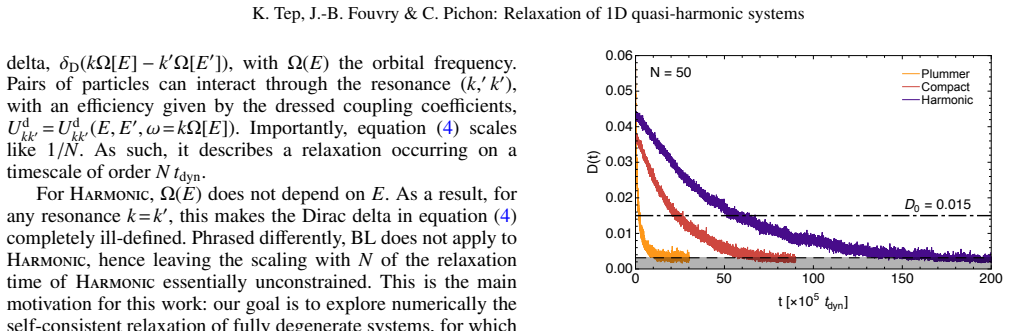
For a 1D self-gravitating system with a harmonic mean-field potential, every particle has the same orbital frequency Ω, so the resonance condition δ(kΩ − k'Ω) in the Balescu–Lenard equation no longer selects specific resonant pairs and the equation becomes ill-posed. The paper's central numerical discovery is that such fully degenerate systems still relax toward the finite-N thermodynamic equilibrium, but on a timescale t_rel ∝ N² t_dyn, instead of the usual t_rel ∝ N t_dyn found for non-degenerate systems such as Plummer or compact-support clusters. The quadratic scaling is read off from the crossing time of a Kolmogorov–Smirnov distance threshold between the instantaneous and equilibrium c
Load-bearing premise
The quadratic scaling is inferred from the crossing time of an adopted threshold D0 = 0.015 in a Kolmogorov–Smirnov distance, measured only for N between 21 and 141 with small-N points excluded as 'polluted by small-N effects'; if these crossing times blend a transient phase with the asymptotic relaxation, the fitted exponent may not be the true large-N law.
Editorial extensions
If this is right
- Fully degenerate harmonic 1D clusters relax on N² timescales, an order of magnitude slower in N than the linear law predicted by Balescu–Lenard theory.
- Partially degenerate clusters exhibit two scaling regimes, with the N²-to-N crossover shifting to higher N as the fraction of degenerate orbits increases.
- Compact but non-degenerate systems relax linearly with N, with a prefactor about ten times larger than that of the infinite-support Plummer system.
- The long N² relaxation of harmonic cores implies that density cores in galaxy centers can persist much longer than standard relaxation estimates, affecting how long shallow cores survive and how efficiently substructures sink via dynamical friction.
Reading between the lines
- The same quadratic law may apply, with a different prefactor, to 3D harmonic spheres, which would extend the paper's 1D conclusion to the globular-cluster core-stalling problem; this is a conjecture beyond the paper's own scope.
- The N² law is measured only up to N = 141; a faster approximate integrator could test whether the slope 2 persists at N ~ 1000, or whether the finite-N window is showing a transient dressed by the threshold crossing.
- A time-averaged Hamiltonian or renormalized kinetic description (e.g., a point-vortex analogy) might predict the prefactor of the N² law analytically, turning the empirical scaling into a computed one.
Editorial analysis
A structured set of objections, weighed in public.
Referee Report
Summary. The paper studies the very long-term collisional relaxation of one-dimensional self-gravitating systems using an exact, collision-driven N-body integrator. It measures the Kolmogorov–Smirnov distance between the ensemble-averaged cumulative mass profile and the finite-N thermodynamic equilibrium of Rybicki (1971), and defines a relaxation time through an ad hoc threshold D0. The main numerical results are: Plummer and Compact (non-degenerate) systems relax on a timescale t_rel ∝ N t_dyn; Harmonic (fully dynamically degenerate) systems relax as t_rel ∝ N^2 t_dyn; and Anharmonic (partially degenerate) systems show a quadratic branch at low N that transitions to linear scaling at larger N, with the transition pushed to larger N as the degeneracy fraction increases. The paper interprets the slow harmonic relaxation as a manifestation of thermodynamic blocking and discusses astrophysical implications for density cores.
Significance. If the central claim holds, the paper is of genuine interest: it identifies a regime in which the standard inhomogeneous Balescu–Lenard scaling t_rel ∝ N t_dyn fails, and it provides a clean numerical benchmark for future kinetic theories of dynamically degenerate self-gravitating systems. The numerical methodology is a major strength: the collision-driven integrator is exact up to round-off, global invariants are conserved to ~1e-23, and the authors use ensemble averaging and a two-threshold consistency check. The public code and detailed appendices also make the measurements reproducible. However, the asymptotic N^2 scaling for the fully degenerate case is inferred from a narrow N window and from the extrapolation of a trend seen in the Anharmonic series; the current evidence is suggestive but not conclusive.
major comments (3)
- [§3.3, Figs. 2–3] The central claim that Harmonic relaxes as t_rel ∝ N^2 is inferred from a narrow window, 21≤N≤141, after discarding small-N points as ‘polluted by small-N effects’ without a stated criterion. The Anharmonic series in Fig. 3 shows that the same N^2 branch is, for every finite ε>0, a pre-asymptotic regime that bends to N at larger N, with the bend moving to larger N as ε decreases. Since no ε=0 run extends beyond N=141, the data do not distinguish between an N_trans(ε) that diverges as ε→0 and a finite N_trans(0)>141; the headline distinction between Harmonic and non-degenerate systems is therefore an extrapolation. A quantitative fit (log t_rel vs log N with slope uncertainty), an explicit estimate of N_trans(ε), or an analytic argument that N_trans diverges is needed to support the asymptotic claim.
- [§3.2, Eq. (8)] The relaxation time is defined by an ad hoc threshold D0. The check with D0=0.022 (Appendix F) is reassuring, but both thresholds are crossed in the same finite-N window, so it does not test whether the measured exponent is the asymptotic one. The paper also does not report a regression or slope uncertainties; the lines in Figs. 2–3 are visual guides. Since the inferred exponent is the main quantitative result, the crossing-time definition, the treatment of multiple crossings, and the systematic uncertainty from D0 and the N range should be quantified.
- [§3.3, Fig. 2 caption] The statement that small-N measurements are ‘polluted by small-N effects’ is not demonstrated. If the finite-N Rybicki equilibrium (Appendix D) is used exactly, one must specify what the pollution is—for example, the initial KS distance, finite-N corrections to the equilibrium, or remnants of violent relaxation. This matters because excluding those points is part of what determines the fitted exponent.
minor comments (6)
- [§2.1] Typo: ‘particule’ should be ‘particle’.
- [§3] Typo: ‘mesure’ should be ‘measure’.
- [Figs. 2–3] The x-axis begins at 20, while the text states 21≤N≤141. Please make the plotting range and the stated range consistent.
- [§3.2] The error-bar definition is unclear: after ensemble averaging there is one DKS(t) curve per N, yet the text says t_rel is the mean of all crossing times with min/max error bars. Clarify whether the scatter is over realizations, over sampling intervals, or over threshold crossings of the averaged curve.
- [§3.3 and §4.2] The appeal to Deme & Fouvry’s thermodynamic blocking is qualitative and is not used to predict the N^2 scaling. Please mark this as an interpretative hypothesis or provide a quantitative connection.
- [Appendix C.5] Define ε precisely in the main text and figure captions: ε is described as the fraction of non-degenerate orbits, while the constant-density core contains a fraction 1−ε. A reader could confuse the two.
Circularity Check
No significant circularity: the N^2 scaling is an empirical measurement against an externally defined equilibrium, with no fitted constants or load-bearing self-citations.
full rationale
The paper's central claims are numerical measurements rather than derivations from fitted inputs. The relaxation time is defined by Eq. (8) as the crossing time of the measured KS distance (Eq. 7) below a fixed threshold D0 = 0.015, with the thermodynamical equilibrium M_th taken from Rybicki (1971) (Appendix D), an external result that does not depend on the present authors. No parameter in Figures 2 and 3 is fitted to force either the N or N^2 scaling; the scaling is read off the crossing times over 21 ≤ N ≤ 141, and Appendix F shows the same trends at the alternative threshold D0 = 0.022. The self-citation to Deme & Fouvry (2025) (`thermodynamic blocking') is used only as an interpretive expectation after the measurement, and the paper explicitly defers an a priori prediction of the N-dependence to future work, so it is not load-bearing for the measured scaling. The excluded small-N points and the limited N range are acknowledged statistical and numerical limitations, not definitional reductions. No equation in the paper is equivalent to its own input by construction, and the harmonic N^2 result is not derived by renaming or importing an ansatz from prior work.
Assumptions & free parameters
free parameters (2)
- D0 (relaxation threshold) =
0.015
- N_r×N (ensemble size) =
~1e5
assumptions (5)
- domain assumption Finite-N Rybicki equilibrium is the correct attractor of 1D self-gravitating systems with fixed E_tot and zero momentum.
- domain assumption Exact collision-driven integrator with 80-bit double floats reliably tracks dynamics up to 2×10^7 t_dyn.
- domain assumption Balescu–Lenard equation and its 1/N scaling apply to non-degenerate 1D systems.
- standard math Eddington inversion yields valid self-consistent equilibria for the chosen densities.
- domain assumption KS distance threshold crossing gives an operational relaxation time.
Cite this review
Pith. "Pith review of Very long-term relaxation of harmonic 1D self-gravitating systems." pith.science (2026). https://pith.science/paper/ORBR2A2B
@misc{pith2026260311238,
  author       = {Pith},
  title        = {Pith review of: Very long-term relaxation of harmonic 1D self-gravitating systems},
  year         = {2026},
  howpublished = {\url{https://pith.science/paper/ORBR2A2B}},
  note         = {Machine review of arXiv:2603.11238}
}
abstract
One-dimensional self-gravitating systems admit genuine thermodynamical equilibria. For systems with strictly monotonic orbital frequency profile, the Landau and Balescu-Lenard theories predict a relaxation time scaling linearly with the number of particles, $N$, in agreement with simulations. Yet, these theories become ill-posed for degenerate frequency profiles, as is the case in the harmonic potential, where all particles share the exact same mean orbital frequency. Using an exact collision-driven 1D integrator, we investigate numerically the self-consistent relaxation of 1D harmonic self-gravitating systems. We show that harmonic systems relax on a timescale that grows quadratically with $N$. We show that systems that are only partially degenerate display the same quadratic scaling for low $N$, but transition to the linear, non-degenerate behaviour for larger $N$. The larger the fraction of degenerate orbits, the larger the value of $N$ at which this transition of dynamical regime occurs. Finally, we explore the dynamics of fully non-degenerate systems, albeit with finite radial support: we confirm that their relaxation time scales linearly with $N$, though with a substantially larger prefactor than in non-compact systems. Astrophysically, this investigation should offer some new clues on the dynamics of density cores, as in the center of dwarf galaxies.
Figures


Reference graph
Works this paper leans on
-
[1]
& van den Bosch , F
Banik , U. & van den Bosch , F. C. 2022, ApJ, 926, 215
2022
-
[2]
& Bovy , J
Bennett , M. & Bovy , J. 2021, MNRAS, 503, 376
2021
-
[3]
Bezanson, J., Edelman, A., Karpinski, S., & Shah, V. B. 2017, SIAM Review, 59, 65
2017
-
[4]
& Tremaine , S
Binney , J. & Tremaine , S. 2008, Galactic Dynamics: Second Edition (Princeton Univ. Press)
2008
-
[5]
& Venaille , A
Bouchet , F. & Venaille , A. 2012, Phys. Rep., 515, 227
2012
-
[6]
2014, Physics of long-range interacting systems (Oxford Univ
Campa , A., Dauxois , T., Fanelli , D., & Ruffo , S. 2014, Physics of long-range interacting systems (Oxford Univ. Press)
2014
-
[7]
2012 a , Physica A, 391, 3680
Chavanis , P.-H. 2012 a , Physica A, 391, 3680
2012
-
[8]
2012 b , Physica A, 391, 3657
Chavanis , P.-H. 2012 b , Physica A, 391, 3657
2012
Show all 68 references
-
[9]
2022, Physica A, 606, 128089
Chavanis , P.-H. 2022, Physica A, 606, 128089
2022
-
[10]
2023, Europ
Chavanis , P.-H. 2023, Europ. Phys. J. Plus, 138, 136
2023
-
[11]
& Lemou , M
Chavanis , P.-H. & Lemou , M. 2007, Eur. Phys. J. B, 59, 217
2007
-
[12]
2002, Phys
Chavanis , P.-H., Rosier , C., & Sire , C. 2002, Phys. Rev. E, 66, 036105
2002
-
[13]
& Greenberg, E
Chib, S. & Greenberg, E. 1995, Am. Stat., 49, 327
1995
-
[14]
& Touma , J
Colombi , S. & Touma , J. 2014, MNRAS, 441, 2414
2014
-
[15]
Conover, W. J. 1999, Practical Nonparametric Statistics, 3rd edn. (New York: John Wiley & Sons)
1999
-
[16]
Daligault , J. 2011, J. Stat. Phys., 143, 1189
2011
-
[17]
C., Banik , U., et al
Dattathri , S., van den Bosch , F. C., Banik , U., et al. 2025, arXiv, 2511.11804
2025
-
[18]
2014, Comput
Dehnen , W. 2014, Comput. Astrophys. Cosmol., 1, 1
2014
-
[19]
& Fouvry , J.-B
Deme , B. & Fouvry , J.-B. 2025, Universe, 11, 419
2025
-
[20]
1986, Non-Uniform Random Variate Generation (Springer-Verlag)
Devroye, L. 1986, Non-Uniform Random Variate Generation (Springer-Verlag)
1986
-
[21]
& Marcos , B
Di Cintio , P. & Marcos , B. 2025, A&A, 700, A230
2025
-
[22]
Dubin , D. H. E. 2003, Phys. Plasmas, 10, 1338
2003
-
[23]
Dupree , T. H. 1966, Phys. Fluids, 9, 1773
1966
-
[24]
J., Brown , A., Adkins , T., & Schekochihin , A
Ewart , R. J., Brown , A., Adkins , T., & Schekochihin , A. A. 2022, J. Plasma Phys., 88, 925880501
2022
-
[25]
& Fouvry , J.-B
Flores , S. & Fouvry , J.-B. 2025, Phys. Rev. E, 111, 044111
2025
-
[26]
2022, , 106, 054123
Fouvry , J.-B. 2022, , 106, 054123
2022
-
[27]
& Chavanis , P.-H
Fouvry , J.-B. & Chavanis , P.-H. 2025, Phys. Rev. E, 112, 064113
2025
-
[28]
2021, MNRAS, 508, 2210
Fouvry , J.-B., Hamilton , C., Rozier , S., & Pichon , C. 2021, MNRAS, 508, 2210
2021
-
[29]
& Roule , M
Fouvry , J.-B. & Roule , M. 2023, Phys. Rev. E, 108, 054108
2023
-
[30]
Frankel , N., Bovy , J., Tremaine , S., & Hogg , D. W. 2023, MNRAS, 521, 5917
2023
-
[31]
B., Nastac , M
Ginat , Y. B., Nastac , M. L., Ewart , R. J., et al. 2025, Phys. Rev. D, 112, 063501
2025
-
[32]
2007, New
Harfst , S., Gualandris , A., Merritt , D., et al. 2007, New. Astron., 12, 357
2007
-
[33]
2010, MNRAS, 407, 355
Heyvaerts , J. 2010, MNRAS, 407, 355
2010
-
[34]
2009, MNRAS, 397, 709
Inoue , S. 2009, MNRAS, 397, 709
2009
-
[35]
& Worrakitpoonpon , T
Joyce , M. & Worrakitpoonpon , T. 2010, J. Stat. Mech., 2010, 10012
2010
-
[36]
& Worrakitpoonpon , T
Joyce , M. & Worrakitpoonpon , T. 2011, Phys. Rev. E, 84, 011139
2011
-
[37]
M., Berczik , P., Ernst , A., & Spurzem , R
Just , A., Khan , F. M., Berczik , P., Ernst , A., & Spurzem , R. 2011, MNRAS, 411, 653
2011
-
[38]
2003, Found
Katz , J. 2003, Found. Phys., 33, 223
2003
-
[39]
& Sridhar , S
Kaur , K. & Sridhar , S. 2018, ApJ, 868, 134
2018
-
[40]
& Stone , N
Kaur , K. & Stone , N. C. 2022, MNRAS, 515, 407
2022
-
[41]
Kraichnan , R. H. 1959, J. Fluid Mech., 5, 497
1959
-
[42]
Krommes , J. A. 2002, Phys. Rep., 360, 1
2002
-
[43]
1967, MNRAS, 136, 101
Lynden-Bell , D. 1967, MNRAS, 136, 101
1967
-
[44]
2023, Class
Miller , B., Manfredi , G., Pirjol , D., & Rouet , J.-L. 2023, Class. Quant. Grav., 40, 073001
2023
-
[45]
Mukherjee , D., Zhu , Q., Trac , H., & Rodriguez , C. L. 2021, ApJ, 916, 9
2021
-
[46]
L., Ewart , R
Nastac , M. L., Ewart , R. J., Juno , J., Barnes , M., & Schekochihin , A. A. 2025, arXiv, 2503.17278
2025 arXiv
-
[47]
Noullez , A., Fanelli , D., & Aurell , E. 2003, J. Comp. Phys., 186, 697
2003
-
[48]
1990, Phys
Padmanabhan , T. 1990, Phys. Rep., 188, 285
1990
-
[49]
& Weinberg , M
Petersen , M. & Weinberg , M. 2025, J. Open Source Softw., 10, 7302
2025
-
[50]
A., Read , J
Petts , J. A., Read , J. I., & Gualandris , A. 2016, MNRAS, 463, 858
2016
-
[51]
I., Goerdt , T., Moore , B., et al
Read , J. I., Goerdt , T., Moore , B., et al. 2006, MNRAS, 373, 1451
2006
-
[52]
& Casella, G
Robert, C. & Casella, G. 2004, Monte Carlo Statistical Methods: Second Edition (New York: Springer)
2004
-
[53]
2022, Phys
Roule , M., Fouvry , J.-B., Pichon , C., & Chavanis , P.-H. 2022, Phys. Rev. E, 106, 044118
2022
-
[54]
2025, A&A, 699, A140
Roule , M., Fouvry , J.-B., Pichon , C., & Chavanis , P.-H. 2025, A&A, 699, A140
2025
-
[55]
Rybicki , G. B. 1971, Ap&SS, 14, 56
1971
-
[56]
2006, Phys
San Miguel , A. 2006, Phys. Rev. E, 74, 046706
2006
-
[57]
E., Dehnen , W., Jungman , G., & Tremaine , S
Schulz , A. E., Dehnen , W., Jungman , G., & Tremaine , S. 2013, MNRAS, 431, 49
2013
-
[58]
Sellwood , J. A. 2015, MNRAS, 453, 2919
2015
-
[59]
Taylor , J. B. & McNamara , B. 1971, Phys. Fluids, 14, 1492
1971
-
[60]
N., Levin , Y., & Pakter , R
Teles , T. N., Levin , Y., & Pakter , R. 2011, MNRAS, 417, L21
2011
-
[61]
T., Rodriguez , C
Tep , K., Cook , B. T., Rodriguez , C. L., et al. 2025, ApJ, 993, 180
2025
-
[62]
2006, Phys
Valageas , P. 2006, Phys. Rev. E, 74, 016606
2006
-
[63]
2020, MNRAS, 497, 536
Wang , L., Iwasawa , M., Nitadori , K., & Makino , J. 2020, MNRAS, 497, 536
2020
-
[64]
2015, MNRAS, 450, 4070
Wang , L., Spurzem , R., Aarseth , S., et al. 2015, MNRAS, 450, 4070
2015
-
[65]
1969, Phys
Weinstock , J. 1969, Phys. Fluids, 12, 1045
1969
-
[66]
Yawn , K. R. & Miller , B. N. 1997, Phys. Rev. Lett., 79, 3561
1997
-
[67]
Zelnikov , M. I. & Kuskov , D. S. 2016, MNRAS, 455, 3597
2016
-
[68]
& Qin , M.-Z
Zhang , M.-Q. & Qin , M.-Z. 1993, Comput. & Math. Appl., 26, 51
1993
Reviewed August 2, 2026 · model on record in the stance chip above.
Discussion (0). Continue with ORCID to comment.