Prediction of Grade, Gender, and Academic Performance of Children and Teenagers from Handwriting Using the Sigma-Lognormal Model
Pith reviewed 2026-05-15 12:29 UTC · model grok-4.3
The pith
Handwriting kinematics in children encode measurable signals of grade level and academic traits through sigma-lognormal parameters.
A machine-rendered reading of the paper's core claim, the machinery that carries it, and where it could break.
Core claim
Handwriting dynamics contain measurable signals related to developmental stage and individual differences, especially for the grade prediction task. These findings highlight the potential of kinematic handwriting analysis and confirm that through their development, children's handwriting evolves toward a lognormal motor organization.
What carries the argument
The sigma-lognormal model, which represents each handwriting stroke as a superposition of lognormal velocity profiles and yields a compact set of parameters that quantify stroke timing, amplitude, and organization.
If this is right
- Grade prediction succeeds reliably, indicating that motor-control changes track school progression more closely than gender or academic performance.
- Sigma-lognormal parameters capture aspects of stroke organization that basic statistical descriptors alone do not fully explain.
- The observed shift toward lognormal velocity profiles with increasing grade provides a quantitative signature of motor maturation.
- The same feature families yield detectable but weaker signals for gender classification and academic performance classification.
Where Pith is reading between the lines
- Routine classroom writing tasks could be repurposed for low-cost tracking of developmental trajectories across large student cohorts.
- The approach might transfer to other scripted motor behaviors, such as drawing or typing, to study similar maturation patterns.
- Combining sigma-lognormal descriptors with brief cognitive measures could tighten predictions of academic outcomes in future studies.
Load-bearing premise
Aggregating dense stroke-level recordings into student-level features preserves the relevant predictive information without critical loss due to individual stroke variability.
What would settle it
Grade prediction accuracy falling to chance level on a held-out set of students whose handwriting was recorded under the same protocol would falsify the claim that the extracted signals encode developmental stage.
Figures


read the original abstract
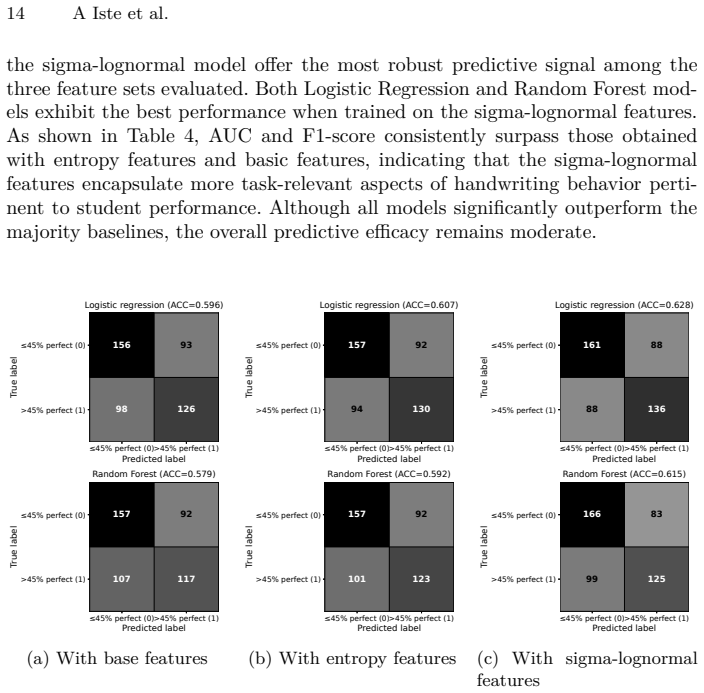
Digital handwriting acquisition enables the capture of detailed temporal and kinematic signals reflecting the motor processes underlying writing behavior. While handwriting analysis has been extensively explored in clinical or adult populations, its potential for studying developmental and educational characteristics in children remains less investigated. In this work, we examine whether handwriting dynamics encode information related to student characteristics using a large-scale online dataset collected from Japanese students from elementary school to junior high school. We systematically compare three families of handwriting-derived features: basic statistical descriptors of kinematic signals, entropy-based measures of variability, and parameters obtained from the sigma-lognormal model. Although the dataset contains dense stroke-level recordings, features are aggregated at the student level to enable a controlled comparison between representations. These features are evaluated across three prediction tasks: grade prediction, gender classification, and academic performance classification, using Linear or Logistic Regression and Random Forest models under consistent experimental settings. The results show that handwriting dynamics contain measurable signals related to developmental stage and individual differences, especially for the grade prediction task. These findings highlight the potential of kinematic handwriting analysis and confirm that through their development, children's handwriting evolves toward a lognormal motor organization.
Editorial analysis
A structured set of objections, weighed in public.
Referee Report
Summary. The manuscript examines whether handwriting dynamics from a large dataset of Japanese elementary to junior high school students encode signals related to grade, gender, and academic performance. It extracts and compares three feature families—basic statistical kinematic descriptors, entropy-based variability measures, and parameters from the sigma-lognormal model—aggregates them at the student level from dense stroke recordings, and evaluates them using linear/logistic regression and random forest models on three prediction tasks. The central claim is that these features capture measurable developmental and individual-difference signals, with the strongest results for grade prediction, supporting the idea that children's handwriting evolves toward lognormal motor organization.
Significance. If the quantitative results hold, the work would demonstrate the applicability of kinematic handwriting analysis and the sigma-lognormal model to pediatric populations for studying developmental stages and educational correlates. The large-scale online dataset and systematic feature-family comparison are strengths that could support non-invasive assessment tools in education or child development research. The findings align with motor-control literature on lognormal organization but require stronger empirical grounding to establish practical utility.
major comments (3)
- [Abstract] Abstract: the claim that 'the results show that handwriting dynamics contain measurable signals' is presented without any quantitative metrics (accuracy, F1, R², AUC), error bars, cross-validation details, or baseline comparisons, leaving the strength of support for all three tasks unclear and preventing assessment of effect sizes or practical relevance.
- [Methods] Methods (aggregation step): features are aggregated from stroke-level recordings to student-level summaries 'to enable a controlled comparison,' yet the manuscript supplies no within-student stroke variance statistics, no ablation of aggregation operators (mean, median, quantiles), and no comparison to stroke-retaining approaches such as mixed-effects models or per-stroke classification with student clustering. This is load-bearing for the grade-prediction claim because developmental signals may reside primarily in stroke-to-stroke consistency rather than summary statistics.
- [Results] Results: the reported positive outcomes across tasks must be accompanied by direct head-to-head comparisons of the three feature families, statistical significance tests, and performance on held-out data with explicit baselines; without these, it is impossible to determine whether the sigma-lognormal parameters add value beyond the statistical and entropy features.
minor comments (2)
- [Abstract] Abstract: the concluding sentence 'confirm that through their development, children's handwriting evolves toward a lognormal motor organization' overstates the direct evidence from the supervised prediction tasks; rephrase to indicate that the results are consistent with this interpretation.
- [Methods] Notation: ensure consistent use of 'sigma-lognormal' versus 'Sigma-Lognormal' throughout and define all entropy measures explicitly when first introduced.
Simulated Author's Rebuttal
We thank the referee for their constructive comments, which have helped us identify areas where the manuscript can be strengthened. We have revised the abstract to include quantitative metrics, added details on the aggregation process with supporting statistics, and expanded the results section with comparative analyses and statistical tests. Our point-by-point responses follow.
read point-by-point responses
-
Referee: [Abstract] Abstract: the claim that 'the results show that handwriting dynamics contain measurable signals' is presented without any quantitative metrics (accuracy, F1, R², AUC), error bars, cross-validation details, or baseline comparisons, leaving the strength of support for all three tasks unclear and preventing assessment of effect sizes or practical relevance.
Authors: We agree that the abstract should provide quantitative support for the claims. In the revised version, we will incorporate specific metrics including R² values for grade prediction, accuracy and F1 scores for gender and academic performance classification, cross-validation details, and baseline comparisons. This will enable readers to evaluate effect sizes and practical relevance directly from the abstract. revision: yes
-
Referee: [Methods] Methods (aggregation step): features are aggregated from stroke-level recordings to student-level summaries 'to enable a controlled comparison,' yet the manuscript supplies no within-student stroke variance statistics, no ablation of aggregation operators (mean, median, quantiles), and no comparison to stroke-retaining approaches such as mixed-effects models or per-stroke classification with student clustering. This is load-bearing for the grade-prediction claim because developmental signals may reside primarily in stroke-to-stroke consistency rather than summary statistics.
Authors: The student-level aggregation was chosen to focus on between-student differences for the individual-level prediction tasks while enabling a controlled comparison across feature families. We will add within-student stroke variance statistics to the methods section in the revision. A full ablation of operators and comparisons to mixed-effects or per-stroke models would require new experiments; we will instead include a sensitivity analysis on aggregation choices (e.g., mean versus median) and a discussion of why stroke-level retention was not pursued for this study design. revision: partial
-
Referee: [Results] Results: the reported positive outcomes across tasks must be accompanied by direct head-to-head comparisons of the three feature families, statistical significance tests, and performance on held-out data with explicit baselines; without these, it is impossible to determine whether the sigma-lognormal parameters add value beyond the statistical and entropy features.
Authors: We accept that head-to-head comparisons and statistical rigor are required. The revised results will include tables directly comparing the three feature families on all tasks and models, paired statistical significance tests (e.g., on cross-validation folds), held-out test performance, and explicit baselines such as majority-class or random predictors. These additions will clarify the incremental contribution of the sigma-lognormal parameters. revision: yes
Circularity Check
No circularity in feature extraction or supervised prediction pipeline
full rationale
The paper extracts statistical, entropy, and sigma-lognormal parameters from stroke data, aggregates them to student level, and feeds the resulting vectors into standard classifiers (linear/logistic regression, random forest) to predict external labels (grade, gender, academic performance) on held-out data. No claimed prediction reduces by construction to a fitted input parameter, no uniqueness theorem is invoked via self-citation, and no ansatz is smuggled through prior work. The pipeline is externally falsifiable via cross-validation performance metrics and does not equate any output to its own inputs.
Axiom & Free-Parameter Ledger
free parameters (1)
- sigma-lognormal model parameters
axioms (1)
- domain assumption Handwriting movements follow lognormal velocity profiles as described by the sigma-lognormal model
Reference graph
Works this paper leans on
-
[1]
In: International Encyclope- dia of Statistical Science, pp
Akaike, H.: Akaikes Information Criterion. In: International Encyclope- dia of Statistical Science, pp. 41–42. Springer, Berlin, Heidelberg (2025). https://doi.org/10.1007/978-3-662-69359-9_14
-
[2]
Image and Vision Computing 59, 17–30 (Mar 2017)
Akbari, Y., Nouri, K., Sadri, J., Djeddi, C., Siddiqi, I.: Wavelet-based gender detection on off-line handwritten documents using probabilistic fi- nite state automata. Image and Vision Computing 59, 17–30 (Mar 2017). https://doi.org/10.1016/j.imavis.2016.11.017
-
[3]
Suen, C.: Transfer Learning to Detect Age From Hand- writing
AL-Qawasmeh, N., Y. Suen, C.: Transfer Learning to Detect Age From Hand- writing. Advances in Artificial Intelligence and Machine Learning 02(02) (2022). https://doi.org/10.54364/AAIML.2022.1126
-
[4]
Neural Computing and Applications 35(33), 23909–23925 (Nov 2023)
Alaei, F., Alaei, A.: Review of age and gender detection methods based on hand- writing analysis. Neural Computing and Applications 35(33), 23909–23925 (Nov 2023). https://doi.org/10.1007/s00521-023-08996-x
-
[5]
In: 2019 International Conference on Document Analysis and Recognition (ICDAR)
Basavaraja, V., Shivakumara, P., Guru, D.S., Pal, U., Lu, T., Blumenstein, M.: Age Estimation using Disconnectedness Features in Handwriting. In: 2019 International Conference on Document Analysis and Recognition (ICDAR). pp. 1131–1136. IEEE, Sydney, Australia (Sep 2019). https://doi.org/10.1109/ICDAR.2019.00183
-
[6]
Pattern Recognition Letters 121, 123–132 (Apr 2019)
Bi, N., Suen, C.Y., Nobile, N., Tan, J.: A multi-feature selection ap- proach for gender identification of handwriting based on kernel mu- tual information. Pattern Recognition Letters 121, 123–132 (Apr 2019). https://doi.org/10.1016/j.patrec.2018.05.005
-
[7]
In: 2020 11th IEEE International Conference on Cog- nitive Infocommunications (CogInfoCom)
Cordasco, G., Buonanno, M., Faundez-Zanuy, M., Riviello, M.T., Likforman- Sulem, L., Esposito, A.: Gender Identification through Handwriting: an Online Approach. In: 2020 11th IEEE International Conference on Cog- nitive Infocommunications (CogInfoCom). pp. 000197–000202 (Sep 2020). https://doi.org/10.1109/CogInfoCom50765.2020.9237863, iSSN: 2380-7350
-
[8]
arXiv e-prints arXiv:2405.16959 (May 2024)
D’Alessandro, T., Carmona-Duarte, C., De Stefano, C., Diaz, M., Ferrer, M.A., Fontanella, F.: A Machine Learning Approach to Analyze the Effects of Alzheimer’s Disease on Handwriting through Lognormal Features. arXiv e-prints arXiv:2405.16959 (May 2024). https://doi.org/10.48550/arXiv.2405.16959
-
[9]
In: 2016 24th Signal Processing and Communication Application Confer- ence (SIU)
Erbilek, M., Fairhurst, M., Li, C.: Exploring gender prediction from digital hand- writing. In: 2016 24th Signal Processing and Communication Application Confer- ence (SIU). pp. 789–792 (May 2016). https://doi.org/10.1109/SIU.2016.7495858
-
[10]
Scalable Funding of Bitcoin Micropayment Channel Networks
Gattal, A., Djeddi, C., Bensefia, A., Ennaji, A.: Handwriting Based Gender Classi- fication Using COLD and Hinge Features. In: El Moataz, A., Mammass, D., Man- souri, A., Nouboud, F. (eds.) Image and Signal Processing, vol. 12119, pp. 233–242. Springer International Publishing, Cham (2020). https://doi.org/10.1007/978-3- 030-51935-3_25, series Title: Lectur...
-
[11]
Expert Systems with Applications 99, 155–167 (Jun 2018)
Gattal, A., Djeddi, C., Siddiqi, I., Chibani, Y.: Gender classification from offline multi-script handwriting images using oriented Basic Image Fea- tures (oBIFs). Expert Systems with Applications 99, 155–167 (Jun 2018). https://doi.org/10.1016/j.eswa.2018.01.038
-
[12]
https://doi.org/10.1007/978-3-319-32270-4_18
José Carlos, R.N., Gabriel, M., El Yacoubi, M., Garcia-Salicetti, S.: Age characterization from online handwriting - Archive ouverte HAL (2016). https://doi.org/10.1007/978-3-319-32270-4_18
-
[13]
IEEE Transactions on Pattern Analysis and Machine Intelligence44(10), 6472– 6485 (2022)
Lai, S., Jin, L., Zhu, Y., Li, Z., Lin, L.: SynSig2Vec: Forgery-free learning of dy- namic signature representations by sigma lognormal-based synthesis and 1D CNN. IEEE Transactions on Pattern Analysis and Machine Intelligence 44(10), 6472– 6485 (2022). https://doi.org/10.1109/TPAMI.2021.3087619 18 A Iste et al
-
[14]
Multimedia Tools and Applications 80(16), 24573– 24602 (Jul 2021)
Maken, P., Gupta, A.: A method for automatic classification of gender based on text- independent handwriting. Multimedia Tools and Applications 80(16), 24573– 24602 (Jul 2021)
work page 2021
-
[15]
Cogent Education 4(1), 1386427 (Jan 2017)
McCarroll, H., Fletcher, T.: Does handwriting instruction have a place in the instructional day? The relationship between handwrit- ing quality and academic success. Cogent Education 4(1), 1386427 (Jan 2017). https://doi.org/10.1080/2331186X.2017.1386427, _eprint: https://www.tandfonline.com/doi/pdf/10.1080/2331186X.2017.1386427
-
[16]
In: 2016 15th International Con- ference on Frontiers in Handwriting Recognition (ICFHR)
Mirza, A., Moetesum, M., Siddiqi, I., Djeddi, C.: Gender Classification from Offline Handwriting Images Using Textural Features. In: 2016 15th International Con- ference on Frontiers in Handwriting Recognition (ICFHR). pp. 395–398. IEEE, Shenzhen, China (Oct 2016). https://doi.org/10.1109/ICFHR.2016.0080
-
[17]
Pattern Recognition42(12), 3324–3337 (2009)
O’Reilly, C., Plamondon, R.: Development of a sigma–lognormal represen- tation for on-line signatures. Pattern Recognition 42(12), 3324–3337 (2009). https://doi.org/10.1016/j.patcog.2008.10.017
-
[18]
Frontiers in Psychology4, 945 (2013)
Plamondon, R., O’Reilly, C., Rémi, C., Duval, T.: The lognormal handwriter: learning, performing, and declining. Frontiers in Psychology 4, 945 (12 2013). https://doi.org/10.3389/fpsyg.2013.00945
-
[19]
PLOS ONE 11(12), e0166868 (Dec 2016)
Rosso, O.A., Ospina, R., Frery, A.C.: Classification and Verification of Handwrit- ten Signatures with Time Causal Information Theory Quantifiers. PLOS ONE 11(12), e0166868 (Dec 2016). https://doi.org/10.1371/journal.pone.0166868, pub- lisher: Public Library of Science
-
[20]
Applied Sciences 12(10), 5256 (Jan 2022)
Shin, J., Maniruzzaman, M., Uchida, Y., Hasan, M.A.M., Megumi, A., Suzuki, A., Yasumura, A.: Important Features Selection and Classification of Adult and Child from Handwriting Using Machine Learning Methods. Applied Sciences 12(10), 5256 (Jan 2022). https://doi.org/10.3390/app12105256
-
[21]
Merrill-Palmer Quarterly 52(4), 755–778 (2006)
Son, S.H., Meisels, S.J.: The Relationship of Young Children’s Motor Skills to Later Reading and Math Achievement. Merrill-Palmer Quarterly 52(4), 755–778 (2006)
work page 2006
-
[22]
In: 2016 15th International Conference on Frontiers in Handwriting Recognition (ICFHR)
Tan, J., Bi, N., Suen, C.Y., Nobile, N.: Multi-feature Selection of Handwriting for Gender Identification Using Mutual Information. In: 2016 15th International Conference on Frontiers in Handwriting Recognition (ICFHR). pp. 578–583 (Oct 2016). https://doi.org/10.1109/ICFHR.2016.0111, iSSN: 2167-6445
discussion (0)
Sign in with ORCID, Apple, or X to comment. Anyone can read and Pith papers without signing in.