REVIEW 4 major objections 4 minor 53 references
Concurrent Prehensile and Nonprehensile Manipulation: A Practical Approach to Multi-Stage Dexterous Tasks
T0 review · 4 major / 4 minor · reviewed 2026-08-04 · deepseek-v4-flash
Pith's one-line read The paper claims that long-horizon concurrent prehensile and nonprehensile manipulation can be made sample-efficient by decomposing demonstrations into object-centric skills and executing them via a retrieve-align-execute paradigm.
desk verdict Solid practical systems paper with real trials, but the 'consistently outperforms' claim is contradicted by the held-out Grasp+Grasp cell, and open-loop replay after alignment is an unvalidated load-bearing assumption. read the letter →
The pith
A machine-rendered reading of the paper's core claim, the machinery that carries it, and where it could break.
The reading
What carries the argument
The load-bearing object is the object-centric skill: a demonstrated sub-trajectory transformed into a canonical frame defined by the target object's centroid and PCA-derived yaw. At deployment, the robot (1) retrieves the closest skill by Chamfer distance over point clouds, (2) aligns by closed-loop tracking of the first canonical action using an extended Kalman filter that tracks centroid and yaw and gates yaw updates through an observability flag, then (3) executes the remainder open-loop in the frozen alignment frame. This isolates contact-sensitive parts into short, replayable segments.
What would settle it
Track the held object's pose during the open-loop second subtask (e.g., with a fiducial or depth registration). If it drifts more than the alignment tolerance (roughly a centimetre or a few degrees) while the task still succeeds, the frozen-frame assumption is violated; alternatively, run Grasp+Pull with a stiffer drawer that exerts larger reaction forces and check whether the success gap versus closed-loop execution widens.
Extended reading notes
Core claim
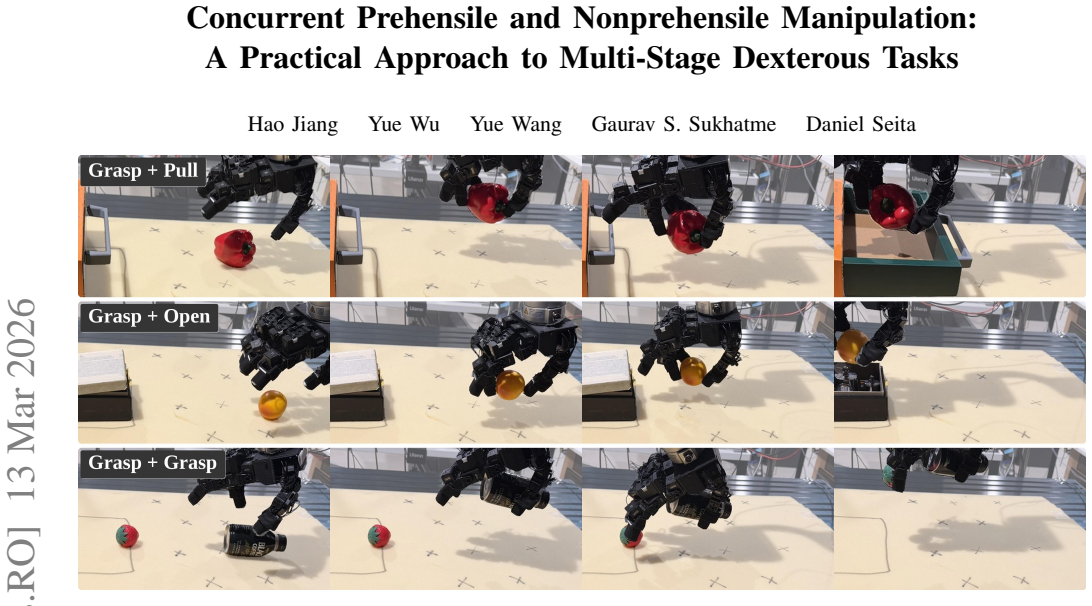
DexMulti's central claim is that a retrieve-align-execute decomposition is a viable inductive bias for concurrent prehensile and nonprehensile manipulation. On three two-stage tasks (grasp-plus-pull, grasp-plus-open, grasp-plus-grasp) and two mechanically different dexterous hands, the method reports an average 66% success on training objects with 3-4 demonstrations per object, roughly 2-3 times higher than diffusion-policy baselines, with generalization to unseen objects and spatial shifts up to ±25 cm. The paper also shows that an uncertainty-aware estimator tracking only centroid and yaw, with an explicit observability flag, outperforms both raw PCA yaw and a full 6D pose tracker.
Load-bearing premise
The rest of the skill is executed open-loop using the object pose frozen at the end of alignment, so the claim collapses if the grasped object shifts during the contact-rich second subtask.
Editorial extensions
If this is right
- With only 3-4 demonstrations per object, average success reaches 66%, and 5 demonstrations per object suffice on the studied Grasp+Open configuration.
- The method outperforms end-to-end diffusion policies by 2-3 times while using 4-10 times fewer demonstrations.
- Held-out objects and spatial variations up to ±25 cm are handled without retraining.
- The same pipeline transfers across two mechanically distinct dexterous hands without architecture changes.
- Replacing full 6D pose tracking with an uncertainty-aware centroid+yaw estimate improves success, suggesting task-relevant state is enough.
Reading between the lines
- Because the pipeline never learns a policy, it could likely compose with a high-level planner that re-orders or branches skills, extending to tasks the demonstrations never showed.
- The frozen-frame open-loop stage is the fragile point; adding tactile or visual servoing during the second subtask would test whether concurrent-manipulation robustness is limited by drift.
- The yaw-observability gating is a transferable idea: any planar manipulation system with symmetric or textureless objects could adopt the same explicit 'when to trust orientation' reasoning.
- Retrieval via geometric similarity suggests a natural extension to interpolation or blending of multiple skills for geometries between stored examples.
Editorial analysis
A structured set of objections, weighed in public.
Referee Report
Summary. DexMulti addresses concurrent prehensile/nonprehensile dexterous manipulation by decomposing demonstrations into object-centric skills and executing them via a retrieve-align-execute paradigm: retrieve a demonstration via Chamfer matching in canonical point-cloud space, align to a tracked centroid+yaw estimate from an EKF with yaw-observability gating, then replay the remainder of the skill open-loop using the pose frozen at the end of alignment. The paper evaluates on three two-stage tasks (Grasp+Pull, Grasp+Open, Grasp+Grasp) with two dexterous hands (Allegro and LEAP), reporting success rates that substantially exceed diffusion-policy baselines and claiming sample efficiency of 3-4 demonstrations per object. The central claim is that object-centric skill decomposition with retrieval and uncertainty-aware alignment is a practical, sample-efficient alternative to end-to-end policies for multi-stage dexterous manipulation.
Significance. If the claims are upheld, the paper makes a useful contribution to practical dexterous manipulation: it demonstrates a concrete object-centric skill abstraction that appears far more sample-efficient than monolithic diffusion policies, validates the approach across two mechanically different hand embodiments, and provides a reproducible pipeline with released code and videos. The use of held-out objects and real-world trials is a strength. However, the current empirical support has load-bearing gaps: one held-out cell where the baseline outperforms the method, a sample-efficiency analysis without statistical grounding, and an unmeasured open-loop assumption about object stability during contact-rich execution. These gaps prevent the central claim from being fully established in its present form.
major comments (4)
- [Sec. V-B, Table I] The statement that the method 'consistently outperforms diffusion-based policies' is contradicted by the held-out Grasp+Grasp cell: Ours succeeds in 3/15 trials while Object-centric DP3 succeeds in 7/15. This is not a negligible difference at these sample sizes, and it directly undermines the unqualified 'consistently outperforms' claim in the abstract and Sec. V-B. Please qualify the claim, provide a per-task failure analysis for this cell, or report statistical comparisons (e.g., confidence intervals or exact tests) rather than only raw counts.
- [Sec. IV-D(c), Alg. 1 lines 12-17] After alignment converges, the remaining canonical skill is replayed open-loop using (c_fixed, psi_fixed) frozen at the end of alignment. The central concurrent-manipulation claim rests on the assumption that the grasped object's pose relative to the hand does not change while the hand pulls a drawer or opens a lid. The paper reports no measurement of object centroid/yaw drift during the second subtask, and the reported failure mode 'hand does not contact the drawer handle at the correct location' is consistent with such drift. Without a drift measurement or an ablation that keeps the EKF active during execution, the success rates in Table I do not establish robustness to the contact-rich portion of these tasks.
- [Sec. V-C, Fig. 6] The sample-efficiency figure claims 'our method achieves perfect success rates with only 5 demonstrations' and maintains 100% across all data budgets, but no error bars, trial counts, or confidence intervals are provided. Since success is a Bernoulli outcome and the earlier tables show substantial trial-to-trial variability, this claim is not statistically supported. Please report the number of trials per point and intervals (e.g., Clopper-Pearson) for both methods, and clarify whether the 100% values are over a sufficient number of trials.
- [Abstract and Sec. V-B] The headline 'average success rate of 66% on training objects' does not match the LEAP training-object aggregate in Table I: 22+23+12=57 successes out of 34+34+27=95 trials, which is 60%. Please clarify how the 66% is computed (e.g., per-task averaging, inclusion of Allegro data, or a different aggregation). Without this clarification, the abstract's main quantitative claim is not reproducible from the reported tables.
minor comments (4)
- [Tables I and III] The LEAP rows in Table III appear identical to the LEAP rows in Table I. If these are the same experiments, please state so explicitly; if they are separate, clarify the relationship to avoid apparent duplication.
- [Sec. IV-D(a), Eq. (2)] The retrieval score is written for a single object, but Alg. 1 line 4 uses a joint score over all task-relevant objects. Please specify how the per-object Chamfer distances are combined (sum, weighted sum, etc.).
- [Appendix B(c)] The object-centric DP3 baseline is described as using a 4-channel point cloud (XYZ plus contact map), but the main text says 'segmented point clouds' without immediately defining the contact channel. Clarify this near the first mention in Sec. IV-A or V-A.
- [Fig. 6] The plot would be more useful with numerical success values annotated on each point and a statement of the number of trials per condition; currently the reader cannot assess the precision of the reported effects.
Circularity Check
No significant circularity: success rates are empirically measured on held-out trials; no prediction reduces to a fitted input or self-citation chain.
full rationale
DexMulti's central claim is empirical: Tables I–III report success rates on real-world trials with held-out test objects and randomized placements, against diffusion-policy baselines trained on the same demonstrations. The retrieve–align–execute pipeline does not fit any parameter to the success metric: retrieval (Eq. 2) minimizes Chamfer distance over stored demonstrations, alignment (Eq. 3) transforms canonical actions by an EKF object-state estimate, and open-loop replay (Alg. 1, lines 12–17) is an execution choice, not a derived prediction. No equation defines the predicted outcome in terms of the input, and no fitted quantity is renamed as a prediction. The paper's self-citations ([14], [30], [31]) appear only as related-work context and task-definition precedents; they do not supply the load-bearing evidence for sample efficiency or generalization. Stated limitations (Sec. VI, Appendix D) — reliance on teleoperation demonstrations, limited geometry distribution, frozen-pose replay — are honest scope/correctness risks, not circular reductions. Under the required Eq-X=Eq-Y standard, no circular step can be exhibited.
Assumptions & free parameters
free parameters (5)
- Yaw observability hysteresis thresholds =
not reported
- EKF process and measurement noise covariances =
not reported
- Keyframe contact-signal threshold =
not reported
- Chamfer retrieval yaw hypothesis set Θ =
not reported
- Collision sphere bin count K =
6 (chosen)
assumptions (6)
- domain assumption Objects rest on a planar surface; pose is fully characterized by a 3D centroid and yaw about the vertical axis.
- domain assumption Multi-view RGB-D segmentation (Grounding DINO + SAM2) yields accurate, complete object point clouds.
- domain assumption Hand-object contact can be detected from geometric proximity between hand FK point cloud and object point cloud.
- domain assumption After alignment converges, open-loop replay in the frozen object frame remains valid through the contact-rich second subtask.
- domain assumption Chamfer-distance retrieval from the current point cloud to stored canonical skills selects a transferable skill for held-out object geometries.
- domain assumption Constant-velocity EKF dynamics adequately model object motion during alignment.
Cite this review
Pith. "Pith review of Concurrent Prehensile and Nonprehensile Manipulation: A Practical Approach to Multi-Stage Dexterous Tasks." pith.science (2026). https://pith.science/paper/BZIOQAZF
@misc{pith2026260311655,
  author       = {Pith},
  title        = {Pith review of: Concurrent Prehensile and Nonprehensile Manipulation: A Practical Approach to Multi-Stage Dexterous Tasks},
  year         = {2026},
  howpublished = {\url{https://pith.science/paper/BZIOQAZF}},
  note         = {Machine review of arXiv:2603.11655}
}
read the original abstract
Dexterous hands enable concurrent prehensile and nonprehensile manipulation, such as holding one object while interacting with another, a capability essential for everyday tasks yet underexplored in robotics. Learning such long-horizon, contact-rich multi-stage behaviors is challenging because demonstrations are expensive to collect and end-to-end policies require substantial data to generalize across varied object geometries and placements. We present DexMulti, a sample-efficient approach for real-world dexterous multi-task manipulation that decomposes demonstrations into object-centric skills with well-defined temporal boundaries. Rather than learning monolithic policies, our method retrieves demonstrated skills based on current object geometry, aligns them to the observed object state using an uncertainty-aware estimator that tracks centroid and yaw, and executes them via a retrieve-align-execute paradigm. We evaluate on three multi-stage tasks requiring concurrent manipulation (Grasp + Pull, Grasp + Open, and Grasp + Grasp) across two dexterous hands (Allegro and LEAP) in over 1,000 real-world trials. Our approach achieves an average success rate of 66% on training objects with only 3-4 demonstrations per object, outperforming diffusion policy baselines by 2-3x while requiring far fewer demonstrations. Results demonstrate robust generalization to held-out objects and spatial variations up to +/-25 cm.
Figures


Figures from the paper (2 more)


Reference graph
Works this paper leans on
-
[1]
Solving rubik’s cube with a robot hand,
OpenAI, I. Akkaya, M. Andrychowicz, M. Chociej, M. Litwin, B. McGrew, A. Petron, A. Paino, M. Plappert, G. Powell, R. Ribas, J. Schneider, N. Tezak, J. Tworek, P. Welinder, L. Weng, Q. Yuan, W. Zaremba, and L. Zhang, “Solving rubik’s cube with a robot hand,” arXiv preprint arXiv:1910.07113, 2019
arXiv 1910
-
[2]
In-Hand Object Rotation via Rapid Motor Adaptation,
H. Qi, A. Kumar, R. Calandra, Y . Ma, and J. Malik, “In-Hand Object Rotation via Rapid Motor Adaptation,” in Conference on Robot Learning (CoRL), 2022
2022
-
[3]
Dexgraspnet: A large-scale robotic dexterous grasp dataset for general objects based on simulation,
R. Wang, J. Zhang, J. Chen, Y . Xu, P. Li, T. Liu, and H. Wang, “Dexgraspnet: A large-scale robotic dexterous grasp dataset for general objects based on simulation,” in IEEE International Conference on Robotics and Automation (ICRA), 2023
2023
-
[4]
CordViP: Correspondence-based Visuomotor Policy for Dexterous Manipulation in Real-World,
Y . Fu, Q. Feng, N. Chen, Z. Zhou, M. Liu, M. Wu, T. Chen, S. Rong, J. Liu, H. Dong, and S. Zhang, “CordViP: Correspondence-based Visuomotor Policy for Dexterous Manipulation in Real-World,” in Robotics: Science and Systems (RSS), 2025
2025
-
[5]
Diffusion Policy: Visuomotor Policy Learning via Action Diffusion,
C. Chi, Z. Xu, S. Feng, E. Cousineau, Y . Du, B. Burchfiel, R. Tedrake, and S. Song, “Diffusion Policy: Visuomotor Policy Learning via Action Diffusion,” in Robotics: Science and Systems (RSS), 2023
2023
-
[6]
3D Diffusion Policy: Generalizable Visuomotor Policy Learning via Simple 3D Representations,
Y . Ze, G. Zhang, K. Zhang, C. Hu, M. Wang, and H. Xu, “3D Diffusion Policy: Generalizable Visuomotor Policy Learning via Simple 3D Representations,” in Robotics: Science and Systems (RSS), 2024
2024
-
[7]
In-hand cube reconfiguration: Simplified,
S. Patidar, A. Sieler, and O. Brock, “In-hand cube reconfiguration: Simplified,” in IEEE/RSJ International Conference on Intelligent Robots and Systems (IROS), 2023
2023
-
[8]
In-Hand Dexterous Manipulation of Piecewise-Smooth 3-D Objects,
D. Rus, “In-Hand Dexterous Manipulation of Piecewise-Smooth 3-D Objects,” in International Journal of Robotics Research (IJRR), 1999
1999
Show all 53 references
-
[9]
Frogger: Fast robust grasp generation via the min-weight metric,
A. H. Li, P. Culbertson, J. W. Burdick, and A. D. Ames, “Frogger: Fast robust grasp generation via the min-weight metric,” in IEEE/RSJ International Conference on Intelligent Robots and Systems (IROS), 2023
2023
-
[10]
Deep differen- tiable grasp planner for high-dof grippers,
M. Liu, Z. Pan, K. Xu, K. Ganguly, and D. Manocha, “Deep differen- tiable grasp planner for high-dof grippers,” in Robotics: Science and Systems (RSS), 2020
2020
-
[11]
Synthesizing diverse and physically stable grasps with arbitrary hand structures using dif- ferentiable force closure estimator,
T. Liu, Z. Liu, Z. Jiao, Y . Zhu, and S.-C. Zhu, “Synthesizing diverse and physically stable grasps with arbitrary hand structures using dif- ferentiable force closure estimator,” in IEEE Robotics and Automation Letters (RA-L), 2022
2022
-
[12]
DexVLG: Dexterous Vision-Language-Grasp Model at Scale,
J. He, D. Li, X. Yu, Z. Qi, W. Zhang, J. Chen, Z. Zhang, Z. Zhang, L. Yi, and H. Wang, “DexVLG: Dexterous Vision-Language-Grasp Model at Scale,” in IEEE International Conference on Computer Vision (ICCV), 2025
2025
-
[13]
Get a grip: Multi-finger grasp evaluation at scale enables robust sim-to-real transfer,
T. G. W. Lum, A. H. Li, P. Culbertson, K. Srinivasan, A. D. Ames, M. Schwager, and J. Bohg, “Get a grip: Multi-finger grasp evaluation at scale enables robust sim-to-real transfer,” in Conference on Robot Learning (CoRL), 2024
2024
-
[14]
Learning to Singu- late Objects in Packed Environments using a Dexterous Hand,
H. Jiang, Y . Wang, H. Zhou, and D. Seita, “Learning to Singu- late Objects in Packed Environments using a Dexterous Hand,” in International Symposium on Robotics Research (ISRR), 2024
2024
-
[15]
Robot Synesthesia: In-Hand Manipulation with Visuotactile Sensing,
Y . Yuan, H. Che, Y . Qin, B. Huang, Z.-H. Yin, K.-W. Lee, Y . Wu, S.-C. Lim, and X. Wang, “Robot Synesthesia: In-Hand Manipulation with Visuotactile Sensing,” in IEEE International Conference on Robotics and Automation (ICRA), 2024
2024
-
[16]
Learning Dexterous In-Hand Manipulation,
OpenAI, M. Andrychowicz, B. Baker, M. Chociej, R. Jozefowicz, B. McGrew, J. Pachocki, A. Petron, M. Plappert, G. Powell, A. Ray, J. Schneider, S. Sidor, J. Tobin, P. Welinder, L. Weng, and W. Zaremba, “Learning Dexterous In-Hand Manipulation,” in International Journal of Robot...
2019
-
[17]
Sequential dexter- ity: Chaining dexterous policies for long-horizon manipulation,
Y . Chen, C. Wang, L. Fei-Fei, and C. K. Liu, “Sequential dexter- ity: Chaining dexterous policies for long-horizon manipulation,” in Conference on Robot Learning (CoRL), 2023
2023
-
[18]
DexCap: Scalable and Portable Mocap Data Collection System for Dexterous Manipulation,
C. Wang, H. Shi, W. Wang, R. Zhang, L. Fei-Fei, and C. K. Liu, “DexCap: Scalable and Portable Mocap Data Collection System for Dexterous Manipulation,” in Robotics: Science and Systems (RSS), 2024
2024
-
[19]
Progress in Nonprehensile Manipulation,
M. T. Mason, “Progress in Nonprehensile Manipulation,” in International Journal of Robotics Research (IJRR), 1999
1999
-
[20]
Task-oriented dexterous hand pose synthesis using differentiable grasp wrench boundary es- timator,
J. Chen, Y . Chen, J. Zhang, and H. Wang, “Task-oriented dexterous hand pose synthesis using differentiable grasp wrench boundary es- timator,” in IEEE/RSJ International Conference on Intelligent Robots and Systems (IROS), 2024
2024
-
[21]
Multi-object grasping-types and taxonomy,
Y . Sun, E. Amatova, and T. Chen, “Multi-object grasping-types and taxonomy,” in IEEE International Conference on Robotics and Automation (ICRA), 2022
2022
-
[22]
Multi-object grasping – estimating the number of objects in a robotic grasp,
T. Chen, A. Shenoy, A. Kolinko, S. Shah, and Y . Sun, “Multi-object grasping – estimating the number of objects in a robotic grasp,” in IEEE/RSJ International Conference on Intelligent Robots and Systems (IROS), 2021
2021
-
[23]
Grasping a handful: Sequential multi-object dexterous grasp genera- tion,
H. Lu, Y . Dong, Z. Weng, F. T. Pokorny, J. Lundell, and D. Kragic, “Grasping a handful: Sequential multi-object dexterous grasp genera- tion,” in IEEE Robotics and Automation Letters (RA-L), 2025
2025
-
[24]
Static grasp stability analysis of multiple spatial objects,
T. Yamada and H. Yamamoto, “Static grasp stability analysis of multiple spatial objects,” Journal of Control Science and Engineering, vol. 3, 2015
2015
-
[25]
Computation of grasp internal forces for stably grasping multiple objects,
Y . Yu, K. Fukuda, and S. Tsujio, “Computation of grasp internal forces for stably grasping multiple objects,” in IEEE/RSJ International Conference on Intelligent Robots and Systems (IROS), 2001
2001
-
[26]
Optimization of power grasps for multiple objects,
T. Yoshikawa, T. Watanabe, and M. Daito, “Optimization of power grasps for multiple objects,” in IEEE International Conference on Robotics and Automation (ICRA), 2001
2001
-
[27]
Kinematics and internal force in grasping multiple objects,
K. Harada and M. Kaneko, “Kinematics and internal force in grasping multiple objects,” in IEEE/RSJ International Conference on Intelligent Robots and Systems (IROS), 1998
1998
-
[28]
Exploiting kinematic redundancy for robotic grasping of multiple objects,
K. Yao and A. Billard, “Exploiting kinematic redundancy for robotic grasping of multiple objects,” in IEEE Transactions on Robotics, 2023
2023
-
[29]
Grasp multiple objects with one hand,
Y . Li, B. Liu, Y . Geng, P. Li, Y . Yang, Y . Zhu, T. Liu, and S. Huang, “Grasp multiple objects with one hand,” in IEEE Robotics and Automation Letters (RA-L), 2024
2024
-
[30]
Se- quential multi-object grasping with one dexterous hand,
S. He, Z. Shangguan, K. Wang, Y . Gu, Y . Fu, Y . Fu, and D. Seita, “Se- quential multi-object grasping with one dexterous hand,” in IEEE/RSJ International Conference on Intelligent Robots and Systems (IROS), 2025
2025
-
[31]
Learning geometry-aware nonprehensile pushing and pulling with dexterous hands,
Y . Li, Y . Ling, G. Sukhatme, and D. Seita, “Learning geometry-aware nonprehensile pushing and pulling with dexterous hands,” in IEEE International Conference on Robotics and Automation (ICRA), 2026
2026
-
[32]
Mogrip: Gripper for multiobject grasping in pick-and-place tasks using translational movements of fingers,
J. Eom, S. Y . Yu, W. Kim, C. Park, K. Y . Lee, and K.-J. Cho, “Mogrip: Gripper for multiobject grasping in pick-and-place tasks using translational movements of fingers,” Science Robotics, 2024
2024
-
[33]
Learning a thousand tasks in a day,
K. Dreczkowski, P. Vitiello, V . V osylius, and E. Johns, “Learning a thousand tasks in a day,” Science Robotics, 2025
2025
-
[34]
Ram: Retrieval-based affordance transfer for generalizable zero-shot robotic manipulation,
Y . Kuang, J. Ye, H. Geng, J. Mao, C. Deng, L. Guibas, H. Wang, and Y . Wang, “Ram: Retrieval-based affordance transfer for generalizable zero-shot robotic manipulation,” in Conference on Robot Learning (CoRL), 2024
2024
-
[35]
Grounding DINO: Marrying DINO with Grounded Pre- training for Open-set Object Detection,
S. Liu, Z. Zeng, T. Ren, F. Li, H. Zhang, J. Yang, C. Li, J. Yang, H. Su, J. Zhu, et al., “Grounding DINO: Marrying DINO with Grounded Pre- training for Open-set Object Detection,” in European Conference on Computer Vision (ECCV), 2024
2024
-
[36]
SAM 2: Segment Anything in Images and Videos,
N. Ravi, V . Gabeur, Y .-T. Hu, R. Hu, C. Ryali, T. Ma, H. Khedr, R. R ¨adle, C. Rolland, L. Gustafson, E. Mintun, J. Pan, K. V . Alwala, N. Carion, C.-Y . Wu, R. Girshick, P. Doll ´ar, and C. Feichtenhofer, “SAM 2: Segment Anything in Images and Videos,” arXiv preprint arXiv:...
2024 arXiv
-
[37]
Dexpoint: Gener- alizable point cloud reinforcement learning for sim-to-real dexterous manipulation,
Y . Qin, B. Huang, Z.-H. Yin, H. Su, and X. Wang, “Dexpoint: Gener- alizable point cloud reinforcement learning for sim-to-real dexterous manipulation,” Conference on Robot Learning (CoRL), 2022
2022
-
[38]
FoundationPose: Unified 6d pose estimation and tracking of novel objects,
B. Wen, W. Yang, J. Kautz, and S. Birchfield, “FoundationPose: Unified 6d pose estimation and tracking of novel objects,” in CVPR, 2024
2024
-
[39]
Pyroki: A modular toolkit for robot kinematic optimization,
C. M. Kim*, B. Yi*, H. Choi, Y . Ma, K. Goldberg, and A. Kanazawa, “Pyroki: A modular toolkit for robot kinematic optimization,” in IEEE/RSJ International Conference on Intelligent Robots and Systems (IROS), 2025
2025
-
[40]
Leap hand: Low-cost, efficient, and anthropomorphic hand for robot learning,
K. Shaw, A. Agarwal, and D. Pathak, “Leap hand: Low-cost, efficient, and anthropomorphic hand for robot learning,” in Robotics: Science and Systems (RSS), 2023
2023
-
[41]
Pointnet: Deep learning on point sets for 3d classification and segmentation,
C. R. Qi, H. Su, K. Mo, and L. J. Guibas, “Pointnet: Deep learning on point sets for 3d classification and segmentation,” in IEEE Conference on Computer Vision and Pattern Recognition (CVPR), 2017
2017
-
[42]
RISE: 3D Perception Makes Real-World Robot Imitation Simple and Effective,
C. Wang, H. Fang, H.-S. Fang, and C. Lu, “RISE: 3D Perception Makes Real-World Robot Imitation Simple and Effective,” arXiv preprint arXiv:2404.12281, 2024
2024 arXiv
-
[43]
Orca: An open-source, reliable, cost-effective, anthropomorphic robotic hand for uninterrupted dexterous task learning,
C. C. Christoph, M. Eberlein, F. Katsimalis, A. Roberti, A. Sympetheros, M. R. V ogt, D. Liconti, C. Yang, B. G. Cangan, R. J. Hinchet, and R. K. Katzschmann, “Orca: An open-source, reliable, cost-effective, anthropomorphic robotic hand for uninterrupted dexterous task learnin...
2025
-
[44]
SAM 3D: 3Dfy Anything in Images,
Y . Lyu, N. Madapana, V . Aggarwal, Q. Deng, J. Tremblay, J. Wang, K. Zheng, R. Rallapalli, N. Jaipuria, B. K. Iwana, and I. Prasad, “SAM 3D: 3Dfy Anything in Images,” 2025. [Online]. Available: https://arxiv.org/abs/2511.16624
2025 arXiv
-
[45]
A Density-based Algorithm for Discovering Clusters in Large Spatial Databases with Noise,
M. Ester, H.-P. Kriegel, J. Sander, X. Xu, et al., “A Density-based Algorithm for Discovering Clusters in Large Spatial Databases with Noise,” in International Conference on Knowledge Discovery and Data Mining (KDD), 1996
1996
-
[46]
Denoising diffusion implicit models,
J. Song, C. Meng, and S. Ermon, “Denoising diffusion implicit models,” in International Conference on Learning Representations (ICLR), 2021
2021
-
[47]
LEAP Hand V2 Advanced: Dexterous, Low-cost Hybrid Rigid-Soft Hand for Robot Learning,
K. Shaw and D. Pathak, “LEAP Hand V2 Advanced: Dexterous, Low-cost Hybrid Rigid-Soft Hand for Robot Learning,” in IEEE-RAS International Conference on Humanoid Robots (Humanoids), 2025. APPENDIX A. Additional Method Details a) Perception Pipeline: We stream synchronized RGB- D...
2025
-
[48]
Workspace cropping: Points are cropped to a prede- fined 3D bounding region around the tabletop
-
[49]
Random downsampling: The cropped cloud is uni- formly downsampled to at most 8192 points to bound computation cost
-
[50]
Statistical outlier removal: Points with abnormally large distances to their neighbors are removed
-
[51]
Radius outlier removal: Sparse points with insuffi- cient local support are discarded
-
[52]
Density-based clustering: DBSCAN [45] is applied to remove small isolated clusters, assuming segmented object point clouds form coherent structures
-
[53]
All denoising and downsampling operations are implemented on the GPU and deployed across multiple ROS nodes
Farthest point sampling (FPS): The remaining points are downsampled to a fixed size of 512 points. All denoising and downsampling operations are implemented on the GPU and deployed across multiple ROS nodes. b) Skill Segmentation: To reason about hand-object interaction for sk...
Reviewed August 4, 2026 · model on record in the stance chip above.
Discussion (0). Sign in to comment.