Equilibrium figure of Haumea and possible detection by stellar occultation
Pith reviewed 2026-05-15 12:22 UTC · model grok-4.3
The pith
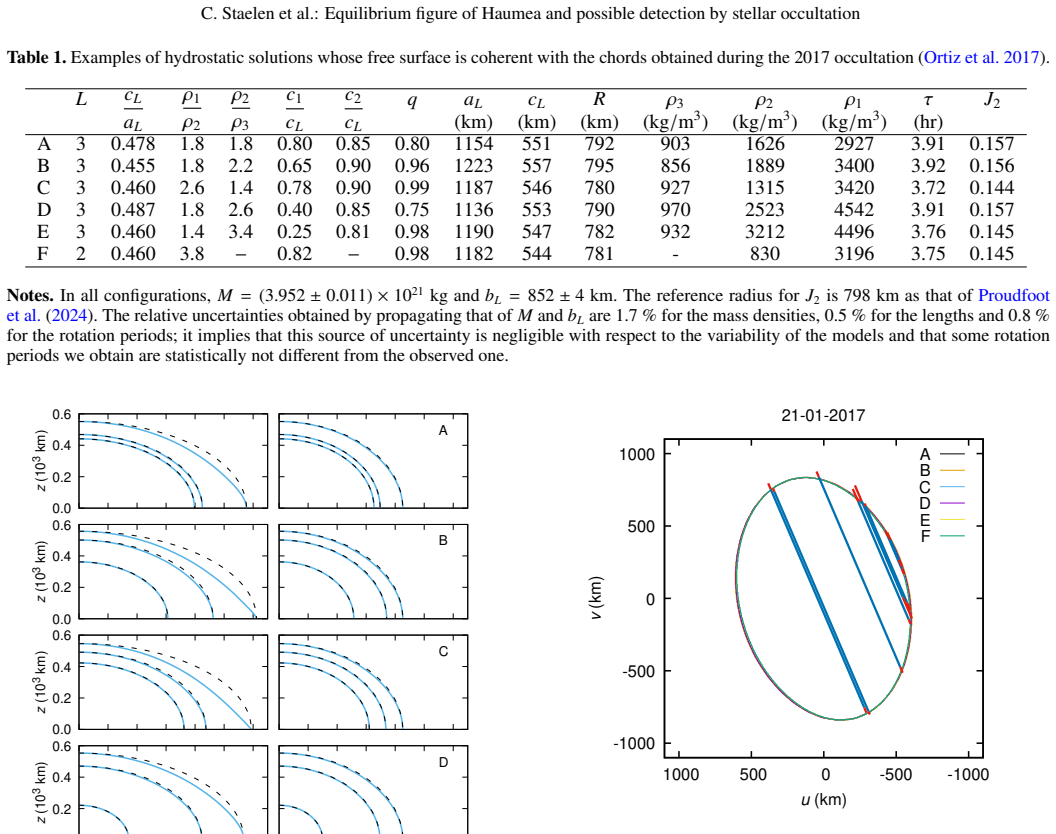
Haumea's observed shape matches hydrostatic models near critical rotation that pinch and deviate up to 110 km from an ellipsoid.
A machine-rendered reading of the paper's core claim, the machinery that carries it, and where it could break.
Core claim
Using the code BALEINES, which solves for the equilibrium figures of the boundaries between layers, we show that the hydrostatic models closest to the shape derived by stellar occultation approach a state of critical rotation, which translates into a pinched shape with large deviations from an ellipsoid (up to 110 km).
What carries the argument
BALEINES code that solves equilibrium figures of the layer boundaries for three-layer interior models of Haumea.
If this is right
- Existing stellar occultation data and light curves cannot distinguish an ellipsoid from the pinched shape.
- The pinched figure should be detectable if northern or southern limb chords are obtained during the May 4 2026 stellar occultation.
- Haumea is close to the critical rotation rate for its mass and density distribution.
Where Pith is reading between the lines
- Confirmation would imply Haumea's spin is near the breakup limit set by its internal density profile.
- The same layered modeling approach can be used to interpret shapes of other fast-spinning trans-Neptunian objects.
- A detected pinch would favor the assumed interior layering over non-hydrostatic explanations such as a recent collision.
Load-bearing premise
Haumea is in hydrostatic equilibrium with one of the three assumed interior structures consisting of a rocky core, an intermediate layer of partial differentiation or organics, and a volatile-rich outer shell that may contain porosity.
What would settle it
Chords recorded on the northern or southern limbs of Haumea's shadow during the May 4 2026 stellar occultation that show no pinched shape or deviations smaller than about 50 km from an ellipsoid.
Figures



read the original abstract
The equilibrium figure of dwarf planet Haumea is studied to determine if the observed shape is compatible with a differentiated hydrostatic body. Three groups of interior models of Haumea are assumed, all with a rocky core and a volatile-rich outer shell that may contain some porosity. A third layer located between the core and the outer shell has a density suggesting partial differentiation or the presence of a large fraction of organic matter. Using the code BALEINES, which solves for the equilibrium figures of the boundaries between layers, we show that the hydrostatic models closest to the shape derived by stellar occultation approach a state of critical rotation, which translates into a pinched shape with large deviations from an ellipsoid (up to 110 km). The previous stellar occultation and light curves cannot distinguish between the ellipsoid and the pinched shape, but we predict this figure could be observable on the next stellar occultation of Haumea on May 4, 2026, if some chords are obtained in the northern or southern limbs of the shadow.
Editorial analysis
A structured set of objections, weighed in public.
Referee Report
Summary. The manuscript examines whether the shape of dwarf planet Haumea derived from stellar occultation is consistent with hydrostatic equilibrium. It assumes three groups of three-layer interior models (rocky core, intermediate layer of uncertain composition, and volatile-rich outer shell that may include porosity) and uses the BALEINES code to compute equilibrium figures of the layer boundaries. The central result is that the models closest to the observed shape approach critical rotation, producing a pinched non-ellipsoidal figure with deviations up to 110 km from an ellipsoid; the authors predict this feature could be detected during the May 2026 occultation if northern or southern limb chords are obtained.
Significance. If the modeling holds, the work strengthens the case for differentiated hydrostatic equilibrium in Haumea and supplies a concrete, falsifiable prediction for the 2026 occultation. The use of a dedicated multi-layer equilibrium code (BALEINES) to generate non-ellipsoidal figures is a technical strength that goes beyond simple ellipsoidal approximations common in the literature.
major comments (2)
- [§3] §3 (Interior models and BALEINES implementation): The manuscript states that BALEINES solves for equilibrium boundaries but provides no explicit equations, convergence criteria, or numerical scheme. Without these details it is impossible to verify that the reported approach to critical rotation and the 110 km deviation are not artifacts of the discretization or boundary conditions.
- [Table 2] Table 2 (or equivalent parameter table): The ranges and specific values chosen for the three model groups (core density, intermediate-layer density and thickness, outer-shell porosity) are not tabulated with uncertainties or sensitivity tests. The claim that only models near critical rotation match the occultation shape therefore rests on an incompletely documented parameter search.
minor comments (2)
- [Abstract] The abstract and introduction use “pinched shape” without a quantitative definition (e.g., the maximum radial deviation or the flattening parameter at which the equatorial profile ceases to be convex).
- [Results] No error budget is given for the 110 km deviation figure; it is unclear whether this is the maximum, rms, or peak-to-peak value relative to the best-fit ellipsoid.
Simulated Author's Rebuttal
We thank the referee for the positive assessment of our manuscript and the recommendation for major revision. We address the two major comments below and will incorporate the requested improvements to enhance reproducibility and documentation.
read point-by-point responses
-
Referee: §3 (Interior models and BALEINES implementation): The manuscript states that BALEINES solves for equilibrium boundaries but provides no explicit equations, convergence criteria, or numerical scheme. Without these details it is impossible to verify that the reported approach to critical rotation and the 110 km deviation are not artifacts of the discretization or boundary conditions.
Authors: We agree that additional technical details on BALEINES are required. In the revised manuscript we will expand §3 with a new subsection that presents the governing equations (generalized Clairaut equation for multi-layer bodies under hydrostatic equilibrium), the numerical scheme (spectral expansion in spherical harmonics up to degree 20 with finite-difference radial discretization), and the convergence criteria (potential residual < 10^{-5} and shape change < 1 km between iterations). We will also note that BALEINES has been benchmarked against analytic ellipsoidal solutions for uniform-density bodies, confirming that the reported 110 km deviation arises from the approach to critical rotation rather than discretization artifacts. revision: yes
-
Referee: Table 2 (or equivalent parameter table): The ranges and specific values chosen for the three model groups (core density, intermediate-layer density and thickness, outer-shell porosity) are not tabulated with uncertainties or sensitivity tests. The claim that only models near critical rotation match the occultation shape therefore rests on an incompletely documented parameter search.
Authors: We acknowledge that the parameter exploration needs fuller documentation. We will revise Table 2 to list the full ranges explored for each parameter (core density 2.5–3.5 g cm^{-3}, intermediate-layer density 1.8–2.4 g cm^{-3} and thickness 50–150 km, outer-shell porosity 0–30 %), together with the specific values of the best-matching models. We will also add a sensitivity-analysis paragraph and an accompanying figure that quantifies how the equatorial pinch deviation varies with rotation rate, showing that deviations remain >50 km unless the spin period is within ~5 % of the critical value, thereby reinforcing that only near-critical models reproduce the occultation-derived shape. revision: yes
Circularity Check
No significant circularity in the hydrostatic modeling chain
full rationale
The derivation assumes three-layer interior density profiles as inputs, invokes the external BALEINES solver to compute layer-boundary equilibrium figures under hydrostatic equilibrium and rotation, then compares the resulting shapes to the independently measured occultation-derived figure of Haumea. Compatible models are shown to lie near critical rotation and exhibit a pinched non-ellipsoidal deviation; the 2026 occultation is offered as an independent future test. No equation reduces the output shape to a re-expression of the input densities or occultation data by construction, no self-citation supplies a load-bearing uniqueness theorem, and the central result remains falsifiable against new observations without circular reduction.
Axiom & Free-Parameter Ledger
free parameters (3)
- Layer densities =
not specified
- Layer thicknesses or radii =
not specified
- Porosity in outer shell =
not specified
axioms (2)
- domain assumption Haumea is in hydrostatic equilibrium
- domain assumption Interior structure consists of three layers with specified density ranges
Lean theorems connected to this paper
-
IndisputableMonolith/Foundation/RealityFromDistinction.leanreality_from_one_distinction unclear?
unclearRelation between the paper passage and the cited Recognition theorem.
Using the code BALEINES, which solves for the equilibrium figures of the boundaries between layers, we show that the hydrostatic models closest to the shape derived by stellar occultation approach a state of critical rotation, which translates into a pinched shape with large deviations from an ellipsoid (up to 110 km).
What do these tags mean?
- matches
- The paper's claim is directly supported by a theorem in the formal canon.
- supports
- The theorem supports part of the paper's argument, but the paper may add assumptions or extra steps.
- extends
- The paper goes beyond the formal theorem; the theorem is a base layer rather than the whole result.
- uses
- The paper appears to rely on the theorem as machinery.
- contradicts
- The paper's claim conflicts with a theorem or certificate in the canon.
- unclear
- Pith found a possible connection, but the passage is too broad, indirect, or ambiguous to say the theorem truly supports the claim.
Reference graph
Works this paper leans on
-
[1]
2024, Nature Communications, 15, 6202
Barnouin, O., Ballouz, R.-L., Marchi, S., et al. 2024, Nature Communications, 15, 6202
work page 2024
-
[2]
Barr, A. C. & Schwamb, M. E. 2016, MNRAS, 460, 1542 Brozovi´c, M. & Jacobson, R. A. 2024, AJ, 167, 256
work page 2016
-
[3]
2023, Journal of Geophys- ical Research: Planets, 128, e2022JE007432
Castillo-Rogez, J., Weiss, B., Beddingfield, C., et al. 2023, Journal of Geophys- ical Research: Planets, 128, e2022JE007432
work page 2023
- [4]
- [5]
-
[6]
Holler, B. J., Grundy, W. M., Buie, M. W., & Noll, K. S. 2021, Icarus, 355, 114130
work page 2021
-
[7]
Jorda, L., Lamy, P. L., Gaskell, R. W., et al. 2012, Icarus, 221, 1089
work page 2012
-
[8]
Kondratyev, B. P. 2016, Ap&SS, 361, 169
work page 2016
-
[9]
Kondratyev, B. P. 2024, Astronomy Reports, 68, 1449
work page 2024
- [10]
-
[11]
1982, Deformations of an Elastic Earth (New York: Academic Press)
Lanzano, P. 1982, Deformations of an Elastic Earth (New York: Academic Press)
work page 1982
-
[12]
Lockwood, A. C., Brown, M. E., & Stansberry, J. 2014, Earth Moon and Planets, 111, 127
work page 2014
- [13]
-
[14]
McKinnon, W. B., Glein, C. R., Bertrand, T., & Rhoden, A. R. 2020, arXiv preprint arXiv:2011.14030
-
[15]
Murray, C. D. & Dermott, S. F. 1999, Solar System Dynamics (Cambridge: Cam- bridge University Press)
work page 1999
-
[16]
Noviello, J. L., Desch, S. J., Neveu, M., Proudfoot, B. C. N., & Sonnett, S. 2022, The Planetary Science Journal, 3, 225
work page 2022
-
[17]
L., Santos-Sanz, P., Sicardy, B., et al
Ortiz, J. L., Santos-Sanz, P., Sicardy, B., et al. 2017, Nature, 550, 219
work page 2017
-
[18]
L., Thirouin, A., Campo Bagatin, A., et al
Ortiz, J. L., Thirouin, A., Campo Bagatin, A., et al. 2012, MNRAS, 419, 2315
work page 2012
-
[19]
Proudfoot, B. C. N., Ragozzine, D. A., Giforos, W., et al. 2024, The Planetary Science Journal, 5, 69
work page 2024
-
[20]
Rizos, J. L., Ortiz, J. L., Gutierrez, P. J., Navajas, I. M., & Lara, L. M. 2025, A&A, 703, A178
work page 2025
- [21]
-
[22]
Vermersch, J., Rambaux, N., & Sicardy, B. 2025, Philos. Trans. A Math. Phys. Eng. Sci., 383, 20240186
work page 2025
-
[23]
Zharkov, V . N. & Trubitsyn, V . P. 1978, Physics of planetary interiors (Tucson: Pachart Publishing House) Article number, page 4 of 5 C. Staelen et al.: Equilibrium figure of Haumea and possible detection by stellar occultation Appendix A: Light curves The Hapke model was used for the reflectance of Haumea, with the same parameters as Lockwood et al. (2...
work page 1978
discussion (0)
Sign in with ORCID, Apple, or X to comment. Anyone can read and Pith papers without signing in.