Recognition: no theorem link
Virtual reality for large-scale laboratories based on colorized point clouds: design and pedagogical impact
Pith reviewed 2026-05-15 12:06 UTC · model grok-4.3
The pith
WebVR system from colorized point clouds lets engineering students explore labs remotely with interactive safety features.
A machine-rendered reading of the paper's core claim, the machinery that carries it, and where it could break.
Core claim
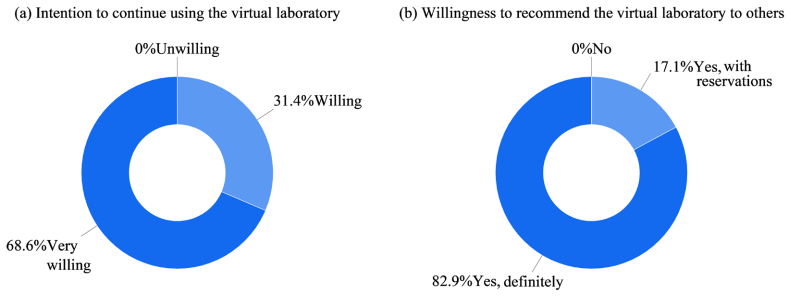
The authors constructed and evaluated a WebVR environment for a large-scale laboratory by integrating high-fidelity colorized point cloud visualization with interactive features including guided navigation and safety simulations. Anonymous questionnaire feedback from users indicated 100 percent positive ratings for interface and content, 88.6 percent selecting scene realism as the top strength, 74.3 percent noting significantly higher engagement, and 82.9 percent willing to recommend the system, supporting the claim that the approach effectively complements conventional on-site laboratory instruction.
What carries the argument
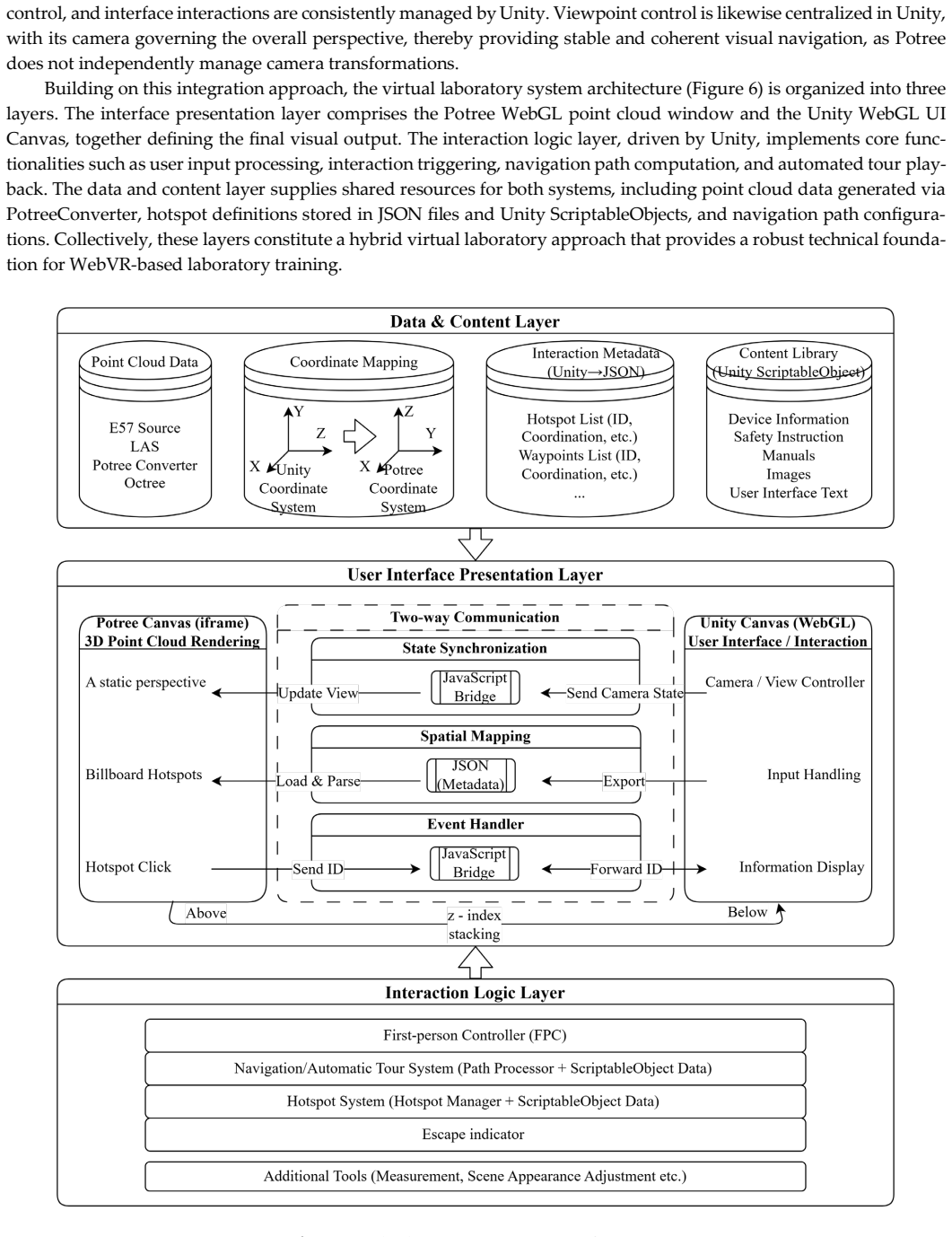
The Unity and Potree integration that renders and enables interaction with massive colorized point cloud data inside a standard web browser to support immersive exploration and simulations.
If this is right
- Engineering programs can offer lab access to larger numbers of students without expanding physical space or equipment.
- High-risk procedures can be rehearsed repeatedly in a zero-harm virtual setting before real exposure.
- Remote or scheduling-constrained learners receive equivalent training opportunities through ordinary web browsers.
- Thematic analysis of user comments supplies direct guidance for adding features like improved navigation paths.
Where Pith is reading between the lines
- The same point-cloud capture method could adapt to fields with changing equipment layouts by periodic rescanning.
- Adding built-in performance tracking inside the VR environment would allow direct measurement of skill gains rather than relying on surveys.
- Multi-user sessions could extend the platform to team-based exercises that mirror group lab work.
Load-bearing premise
Self-reported questionnaire scores on engagement and recommendation directly indicate improved learning outcomes or skill transfer to real laboratory settings.
What would settle it
A controlled comparison measuring students' actual task performance, error rates, and safety compliance in physical lab sessions after equivalent training via the virtual system versus traditional instruction.
Figures




read the original abstract
Effective laboratory training is essential in engineering education, yet conventional on-site instruction is often constrained by time, accessibility, and safety considerations. To ad-dress these challenges, this study presents the design, implementation, and evaluation of a web-based virtual reality (WebVR) representation of a large-scale engineering laboratory constructed from massive colorized point cloud data. This study proposes a novel WebVR approach that integrates Unity and Potree for high-fidelity point-cloud visualization com-bined with advanced interactive capabilities in a browser-based virtual laboratory. It supports immersive first-person exploration, guided navigation, interactive hotspots con-veying equipment and safety information, as well as emergency evacuation simulations. The usability, usefulness, and acceptance of the virtual laboratory were evaluated through an anonymous questionnaire administered to students and laboratory staff. User evalua-tion results indicated consistently positive feedback, with 100% of respondents rating the interface/navigation and visual/interactive content as good or excellent, 88.6% identifying scene realism as the biggest system strength (the most frequently selected), 74.3% reporting significantly higher engagement compared with traditional online laboratory training, and 82.9% indicating they would definitely recommend the system as a learning resource. In addition, a thematic analysis of qualitative feedback was performed to inform future enhancements of the WebVR environment. Overall, the findings demonstrate that the WebVR-based virtual laboratory can effectively complement conventional on-site labora-tory instruction, offering a scalable, accessible, and low-risk platform that enhances learning experiences in engineering education.
Editorial analysis
A structured set of objections, weighed in public.
Referee Report
Summary. The manuscript presents the design and implementation of a browser-based WebVR virtual laboratory for a large-scale engineering facility, constructed from colorized point-cloud data using Unity and Potree. The system supports first-person immersive navigation, interactive hotspots with equipment and safety information, and emergency evacuation simulations. Evaluation is performed via an anonymous post-use questionnaire administered to students and laboratory staff, yielding uniformly positive ratings on interface, visuals, and engagement (100% good/excellent on navigation and content; 74.3% higher engagement than traditional online training; 82.9% would recommend), accompanied by thematic analysis of open feedback. The authors conclude that the platform can effectively complement conventional on-site laboratory instruction by providing a scalable, accessible, and low-risk learning environment.
Significance. If the pedagogical effectiveness claims are substantiated, the work would demonstrate a practical, hardware-light method for delivering high-fidelity virtual laboratory experiences at scale, addressing documented constraints of time, accessibility, and safety in engineering education. The point-cloud-to-WebVR pipeline could serve as a reusable template for other large facilities.
major comments (1)
- [Evaluation] Evaluation section (questionnaire results and discussion): The central claim that the WebVR system 'enhances learning experiences' and 'can effectively complement conventional on-site laboratory instruction' is not supported by the reported evidence. The questionnaire measures only post-use usability, perceived realism, and self-reported engagement; no pre/post knowledge tests, control-group comparisons, objective performance metrics (e.g., task completion time or error rates in the physical lab), or retention measures are presented. This leaves the mapping from acceptance data to actual pedagogical impact unsupported.
minor comments (2)
- [Abstract] Abstract: Typographical error 'ad-dress' should be corrected to 'address'.
- [System Design] The manuscript would benefit from explicit discussion of how the point-cloud resolution and colorization parameters were chosen, as these choices directly affect visual fidelity and are not quantified.
Simulated Author's Rebuttal
We thank the referee for the constructive and detailed feedback on our manuscript. We have reviewed the comments carefully and agree that the evaluation section requires clarification to ensure our claims are appropriately supported by the data presented.
read point-by-point responses
-
Referee: Evaluation section (questionnaire results and discussion): The central claim that the WebVR system 'enhances learning experiences' and 'can effectively complement conventional on-site laboratory instruction' is not supported by the reported evidence. The questionnaire measures only post-use usability, perceived realism, and self-reported engagement; no pre/post knowledge tests, control-group comparisons, objective performance metrics (e.g., task completion time or error rates in the physical lab), or retention measures are presented. This leaves the mapping from acceptance data to actual pedagogical impact unsupported.
Authors: We agree with the referee that the current evidence is limited to usability, perceived realism, and self-reported engagement metrics from the post-use questionnaire, without objective measures of learning outcomes such as knowledge gains or performance comparisons. The study was conceived as an initial demonstration of the WebVR platform's technical feasibility and user acceptance in an educational setting. To address this, we will revise the abstract, discussion, and conclusions to temper the language, stating that the positive feedback indicates strong potential to complement conventional instruction rather than claiming direct enhancement of learning experiences. We will also add an explicit limitations section and describe planned future work involving controlled pre/post assessments and objective metrics. These revisions will be incorporated in the next manuscript version. revision: yes
Circularity Check
No circularity: evaluation rests on independent questionnaire data
full rationale
The paper presents a system design using Unity and Potree for point-cloud WebVR, followed by direct evaluation via an anonymous post-use questionnaire yielding specific percentages (100% positive interface ratings, 74.3% higher engagement, 82.9% recommendation). No equations, fitted parameters, predictions, or derivations appear. The conclusion that the system complements on-site labs is drawn from these raw feedback counts and thematic analysis rather than any self-referential reduction. No self-citations, uniqueness theorems, or ansatzes are invoked as load-bearing steps. This matches the default case of an empirical design paper whose central claims are supported by external measurements, not constructed from the design choices themselves.
Axiom & Free-Parameter Ledger
axioms (1)
- domain assumption Colorized point cloud data accurately represents the physical laboratory layout, equipment, and safety features at a level usable for training
Reference graph
Works this paper leans on
-
[1]
Using the laboratory to engage all students in science practices
Walker, J.P.; Sampson, V.; Southerland, S.; Enderle, P.J. Using the laboratory to engage all students in science practices. Chemistry Education Research and Practice 2016, 17, 1098–1113, doi:https://doi.org/10.1039/C6RP00093B
-
[2]
F e i s e l , L . D . ; R o s a , A . J . T h e R o l e o f t h e L a b o r a t o r y i n U n d e r g r a d u a t e E n g i n e e r i n g E d u c a t i o n . Journal of Engineering Education 2005, 94, 121–130, doi:https://doi.org/10.1002/j.2168-9830.2005.tb00833.x
-
[3]
Papadopoli, R.; Nobile, C.; Trovato, A.; Pileggi, C.; Pavia, M. Chemical risk and safety awareness, perception, and practices among research laboratories workers in Italy. Journal of Occupational Medicine and Toxicology 2020, 15, doi:https://doi.org/10.1186/s12995-020-00268-x
-
[4]
Current status, challenges, and future directions of university labo ratory safety in China
Bai, M.; Liu, Y.; Qi, M.; Roy, N.; Shu, C.M.; Khan, F.; Zhao, D. Current status, challenges, and future directions of university labo ratory safety in China. Journal of Loss Prevention in the Process Industries 2021, 74, 104671, doi:https://doi.org/10.1016/j.jlp.2021.104671
-
[5]
Xu, C.; Guo, L.; Wang, K.; Yang, T.; Feng, Y.; Wang, H.; Li, D.; Fu, G. Current challenges of university laboratory: Characteristics of human factors and safety management system deficiencies based on accident statistics. Journal of Safety Research 2023, 86, 318–335, doi:https://doi.org/10.1016/j.jsr.2023.07.010
-
[6]
Enhanced education on geology by 3D interactive virtual geological scenes
Fang, Y.; Li, Y.; Fan, L. Enhanced education on geology by 3D interactive virtual geological scenes. Computers & Education: X Reality 2025, 6, 100094, doi:https://doi.org/10.1016/j.cexr.2025.100094
-
[7]
Palmer, C.; Roullier, B.; Aamir, M.; Stella, L.; Diala, U.; Anjum, A.; McQuade, F.; Cox, K.; Calvert, A. Virtual Reality based Digital Twin System for remote laboratories and online practical learning; 2021
work page 2021
-
[8]
Marougkas, A.; Troussas, C.; Krouska, A.; Sgouropoulou, C. Virtual Reality in Education: A Review of Learning Theories, Approaches and Methodologies for the Last Decade. Electronics 2023, 12, 2832, doi:https://doi.org/10.3390/electronics12132832
-
[9]
Fan, L.; Deng, K.; Liu, F. Educational impacts of generative artificial intelligence on learning and performance of engineering students in China. Scientific Reports 2025, 15, 26521, doi: https://doi.org/10.1038/s41598-025-06930- w
-
[10]
Darejeh, A.; Chilcott, G.; Oromiehie, E.; Mashayekh, S. Virtual Reality and Digital Twins for Mechanical Engineering Lab Education: Applications in Composite Manufacturing. Education Sciences 2025 , 15, 1519, doi:https://doi.org/10.3390/educsci15111519
-
[11]
Game on: Immersive virtual laboratory simulation improves student learning outcomes & motivation
Tsirulnikov, D.; Suart, C.; Abdullah, R.; Vulcu, F.; Mullarkey, C. Game on: Immersive virtual laboratory simulation improves student learning outcomes & motivation. FEBS open bio 2023 , 13, doi:https://doi.org/10.1002/2211-5463.13567
-
[12]
360° Virtual Laboratory Tour with Embedded Skills Videos
Levonis, S.M.; Tauber, A.L.; Schweiker, S.S. 360° Virtual Laboratory Tour with Embedded Skills Videos. Journal of Chemical Education 2021, 98, 651–654, doi:https://doi.org/10.1021/acs.jchemed.0c00622
-
[13]
Sustainable Higher Education and Technology - Enhanced Learning (TEL)
Daniela, L.; Visvizi, A.; Gutiérrez -Braojos, C.; Lytras, M.D. Sustainable Higher Education and Technology - Enhanced Learning (TEL). Sustainability 2018, 10, 3883, doi:https://doi.org/10.3390/su10113883
-
[14]
Educational effectiveness research (EER): A state-of -the-art review
Reynolds, D.; Sammons, P.; Fraine, B.; Damme, J.; Townsend, T.; Teddlie; Stringfield, S. Educational effectiveness research (EER): A state-of -the-art review. School Effectiveness and School Improvement 2014, 25, doi:https://doi.org/10.1080/09243453.2014.885450
-
[15]
A Self-determination Theory Perspective on Student Engagement
Reeve, J. A Self-determination Theory Perspective on Student Engagement. 2012; pp. 149–172
work page 2012
-
[16]
Reeve, J.; Cheon, S.H.; Jang, H. How and why students make academic progress: Reconceptualizing the student engagement construct to increase its explanatory power. Contemporary Educational Psychology 2020, 62, 101899, doi:https://doi.org/10.1016/j.cedpsych.2020.101899 . 22
-
[17]
Wong, Z.Y.; Liem, G.A.D. Stud ent Engagement: Current State of the Construct, Conceptual Refinement, and Future Research Directions. Educational Psychology Review 2022, 34, 107–138, doi:https://doi.org/10.1007/s10648- 021-09628-3
-
[18]
Radianti, J.; Majchrzak, T.A.; Fromm, J.; Wohlgenannt, I. A systematic review of immersive virtual reality applications for higher education: Design elements, lessons learned, and research agenda. Computers & Education 2020, 147, 103778, doi:https://doi.org/10.1016/j.compedu.2019.103778
-
[19]
Cognitive -Load Theory: Methods to Manage Working Memory Load in the Learning of Complex Tasks
Paas, F.; Van Merrienboer, J.J.G. Cognitive -Load Theory: Methods to Manage Working Memory Load in the Learning of Complex Tasks. Current Directions in Psychological Science 2020, 29, 096372142092218, doi:https://doi.org/10.1177/0963721420922183
-
[20]
Castro-Alonso, J.C.; de Koning, B.B.; Fiorella, L.; Paas, F. Five Strategies for Optimizing Instructional Materials: Instructor- and Learner -Managed Cognitive Load. Educational Psychology Review 2021, 33, 1379– 1407, doi:https://doi.org/10.1007/s10648-021-09606-9
-
[21]
Signaling in virtual reality influences learning outcome and cognitive load
Albus, P.; Vogt, A.; Seufert , T. Signaling in virtual reality influences learning outcome and cognitive load. Computers & Education 2021, 166, 104154, doi:https://doi.org/10.1016/j.compedu.2021.104154
-
[22]
Cross-Modal Interaction Between Auditory and Visual Input Impacts Memory Retrieval
Marian, V.; Hayakawa, S.; Schroeder, S.R. Cross-Modal Interaction Between Auditory and Visual Input Impacts Memory Retrieval. Frontiers in Neuroscience 2021, Volume 15 - 2021, doi:https://doi.org/10.3389/fnins.2021.661477
-
[23]
Bedenlier, S.; Bond, M.; Buntins, K.; Zawacki-Richter, O.; Kerres, M. Facilitating student engagement through educational technology in higher education: A systematic review in the field of arts and humanities. Australasian Journal of Educational Technology 2020, 126–150, doi:https://doi.org/10.14742/ajet.5477
-
[24]
Social Constructivism: A New P aradigm in Teaching and Learning Environment
Saleem, A.; Kausar, H.; Deeba, F. Social Constructivism: A New P aradigm in Teaching and Learning Environment. PERENNIAL JOURNAL OF HISTORY 2021, 2, 403–421, doi:https://doi.org/10.52700/pjh.v2i2.86
-
[25]
Mishra, N. Constructivist Approach to Learning: An Analysis of P edagogical Models of Social Constructivist Learning Theory. Journal of Research and Development 2023, 6, 22–29, doi:https://doi.org/10.3126/jrdn.v6i01.55227
-
[26]
Digital Transformation in Higher Education Institutions: A Systematic Literature Review
Benavides, L.M.; Tamayo Arias, J.A.; Arango Serna, M.D.; Branch Bedoya, J.W.; Burgos, D. Digital Transformation in Higher Education Institutions: A Systematic Literature Review. Sensors 2020, 20, 3291, doi:https://doi.org/10.3390/s20113291
-
[27]
Management of Digital and Intellectual Technologies Integration in Education Informatization
Kalaman, O.; Bondarenko, S.A.; Telovata, M.; Petrenko, N.; Yershova, O.; Sagan, O. Management of Digital and Intellectual Technologies Integration in Education Informatization. TEM Journal 2023, 1645– 1657, doi:https://doi.org/10.18421/TEM123-46
-
[28]
Hamad, A.; Jia, B. How Virtual Reality Technology Has Changed Our Lives: An Overview of the Current and Potential Applications and Limitations. International Journal of Environmental Research and Public Health 2022, 19, 11278, doi:https://doi.org/10.3390/ijerph191811278
-
[29]
M a r o u g k a s , A . ; T r o u s s a s , C . ; K r o u s k a , A . ; S g o u r o p o u l o u , C . H o w p e r s o n a l i z e d a n d e f f e c t i v e i s i m m e r s i v e virtual reality in education? A systematic literature review for the last decade. Multimedia Tools and Applications 2024, 83, 18185–18233, doi:https://doi.org/10.1007/s11042-023-15986-7
-
[30]
Virtual reality and gamification in education: a systematic review
Lampropoulos, G.; Kinshuk. Virtual reality and gamification in education: a systematic review. Educational technology research and development 2024, 72, 1691–1785, doi:https://doi.org/10.1007/s11423-024-10351-3
-
[31]
Makransky, G.; Petersen, G.B. The Cognitive Affective Model of Immersive Learning (CAMIL): a Theoretical Research-Based Model of Learning in Immersive Virtual Reality. Educational Psychology Review 2021, 33, 937– 958, doi:https://doi.org/10.1007/s10648-020-09586-2
-
[32]
Mallek, F.; Mazhar, T.; Faisal Abbas Shah, S.; Ghadi, Y.Y.; Hamam, H. A review on cultivating effective learning: synthesizing educational theories and virtual reality for enhanced educational experiences. PeerJ Computer Science 2024, 10, e2000, doi:https://doi.org/10.7717/peerj-cs.2000. 23
-
[33]
The Application of Virtual Reality in Engineering Education
Soliman, M.; Pesyridis, A.; Dalaymani-Zad, D.; Gronfula, M.; Kourmpetis, M. The Application of Virtual Reality in Engineering Education. Applied Sciences 2021, 11, 2879, doi:https://doi.org/10.3390/app11062879
-
[34]
Reusable educational resources for developing complex thinking on open platforms
Sanabria-Z, J.; Alfaro-Ponce, B.; González-Pérez, L.I.; Ramírez-Montoya, M.S. Reusable educational resources for developing complex thinking on open platforms. Education and Information Technologies 2024, 29, 1173–1199, doi:https://doi.org/10.1007/s10639-023-12316-0
-
[35]
Virtual reality for assessment in undergraduate nursing and medical education – a systematic review
Neher, A.; Bühlmann, F.; Müller, M.; Berendonk, C.; Sauter, T.; Birrenbach, T. Virtual reality for assessment in undergraduate nursing and medical education – a systematic review. BMC Medical Education 2025, 25, doi:https://doi.org/10.1186/s12909-025-06867-8
-
[36]
Virtual reality in medical students’ education: a scoping review protocol
Jiang, H.; Vimalesvaran, S.; Kyaw, B.; Tudor Car, L. Virtual reality in medical students’ education: a scoping review protocol. BMJ Open 2021, 11, e046986, doi:https://doi.org/10.1136/bmjopen-2020-046986
-
[37]
Haptic virtual reality and immersive learning for enhanced organic chemistry instruction
Edwards, B.I.; Bielawski, K.S.; Prada, R.; Cheok, A.D. Haptic virtual reality and immersive learning for enhanced organic chemistry instruction. Virtual Reality 2019, 23, 363–373, doi: https://doi.org/10.1007/s10055- 018-0345-4
-
[38]
Student experiences from virtual reality- based chemistry laboratory exercises
Viitaharju, P.; Nieminen, M.; Linnera, J.; Yliniemi, K.; Karttunen, A.J. Student experiences from virtual reality- based chemistry laboratory exercises. Education for Chemical Engineers 2023, 44, 191 –199, doi:https://doi.org/10.1016/j.ece.2023.06.004
-
[39]
Dunnagan, C.L.; Dannenberg, D.A.; Cuales, M.P.; Earnest, A.D.; Gurnsey, R.M.; Gallardo -Williams, M.T. Production and Evaluation of a Realistic Immersive Virtual Reality Organic Chemistry Laboratory Experience: Infrared Spectroscopy. Journal of Chemical Education 2020, 97, 258 –262, doi:https://doi.org/10.1021/acs.jchemed.9b00705
-
[40]
Tan, Y.; Xu, W.; Li, S.; Chen, K. Augmented and Virtual Reality (AR/VR) for Education and Training in the AEC Industry: A Systematic Review of Research and Applications. Buildings 2022, 12, 1529, doi:https://doi.org/10.3390/buildings12101529
-
[41]
Yang, Y.-F.; Fan, C.-C. Evaluating the effectiveness of Virtual Reality (VR) technology in safety management and educational training: an empirical study on the application and feasibility of digital training systems. Interactive Learning Environments 2025, 33, 3804–3832, doi:https://doi.org/10.1080/10494820.2025.2454434
-
[42]
Approximate Intrinsic Voxel Structure for Point Cloud Simplification
Lv, C.; Lin, W.; Zhao, B. Approximate Intrinsic Voxel Structure for Point Cloud Simplification. IEEE Transactions on Image Processing 2021, 30, 7241–7255, doi:https://doi.org/10.1109/TIP.2021.3104174
-
[43]
Oka, M.; Shinkuma, R.; Sato, T.; Oki, E.; Iwai, T.; Nihei, K.; Takahashi, E.; Kanetomo, D.; Satoda, K. Spatial Feature-Based Prioritization for Transmission of Point Cloud Data in 3D-Image Sensor Networks. IEEE Sensors Journal 2021, 21, 23145–23161, doi:https://doi.org/10.1109/JSEN.2021.3106963
-
[44]
Shuaiqing, W.; Qijun, H.; Dongsheng, X.; Leping, H.; Rengang, L.; Bo, X.; Qinghui, K. A new point cloud simplification method with feature and inte grity preservation by partition strategy. Measurement 2022, 197, 111173, doi:https://doi.org/10.1016/j.measurement.2022.111173
-
[45]
ConPCAC: Co nditional Lossless Point Cloud Attribute Compression via Spatial Decomposition
Zhang, J.; Chen, T.; You, K.; Ding, D.; Ma, Z. ConPCAC: Co nditional Lossless Point Cloud Attribute Compression via Spatial Decomposition. IEEE Transactions on Circuits and Systems for Video Technology 2025, 35, 7210–7221, doi:https://doi.org/10.1109/TCSVT.2025.3540931
-
[46]
Graziosi, D.; Nakagami, O.; Kuma, S.; Zaghetto, A.; Suzuki, T.; Tabatabai, A. An overview of ongoing point cloud compression standardization activities: video -based (V -PCC) and geometry -based (G -PCC). APSIPA Transactions on Signal and Information Processing 2020, 9, 1–17, doi:https://doi.org/10.1017/ATSIP.2020.12
-
[47]
Lin, T.-L.; Lin, C.-H.; Chiou, Y.-S.; Chen, S.-L. Improved grid refine segmentation for 3D point cloud in video- based p oint cloud compression (V -PCC). Multimedia Tools and Applications 2024, 83, 62701 –62720, doi:https://doi.org/10.1007/s11042-023-17845-x. 24
-
[48]
VoxelContext -Net: An Octree based Framework for Point Cloud Compression
Que, Z.; Lu, G.; Xu, D. VoxelContext -Net: An Octree based Framework for Point Cloud Compression. In P r o c e e d i n g s o f t h e 2 0 2 1 I E E E / C V F C o n f e r e n c e o n C o m p u t e r V i s i o n a n d P a t t e r n R e c o g n i t i o n ( C V P R ) , 2 0–25 June 2021, 2021; pp. 6038–6047
work page 2021
-
[49]
Cai, Y.; Fan, L. An Efficient Approach to Automatic Construction of 3D Watertight Geometry of Buildings Using Point Clouds. Remote Sensing 2021, 13, 1947, doi:https://doi.org/10.3390/rs13101947
-
[50]
Advancements in point cloud data augmentation for deep learning: A survey
Zhu, Q.; Fan, L.; Weng, N. Advancements in point cloud data augmentation for deep learning: A survey. Pattern Recognition 2024, 153, 110532, doi:https://doi.org/10.1016/j.patcog.2024.110532
-
[51]
Point cloud registration: a mini-review of current state, challenging issues and future directions
Brightman, N.; Fan, L.; Zhao, Y. Point cloud registration: a mini-review of current state, challenging issues and future directions. AIMS Geosciences 2023, 9, 68–85, doi:https://doi.org/10.3934/geosci.2023005
-
[52]
Error in target -based georeferencing and registration in terrestrial laser scanning
Fan, L.; Smethurst, J.A.; Atkinson, P.M.; Powrie, W. Error in target -based georeferencing and registration in terrestrial laser scanning. Computers & Geosciences 2015, 83, 54–64, doi:https://doi.org/10.1016/j.cageo.2015.06.021
-
[53]
An Iterative Coarse -to-Fine Sub-Sampling Method for Density Reduction of Terrain Point Clouds
Fan, L.; Atkinson, P.M. An Iterative Coarse -to-Fine Sub-Sampling Method for Density Reduction of Terrain Point Clouds. Remote Sensing 2019, 11, 947, doi:https://doi.org/10.3390/rs11080947
-
[54]
A new multi-resolution based method for estimating local surface roughness from point clouds
Fan, L.; Atkinson, P.M. A new multi-resolution based method for estimating local surface roughness from point clouds. ISPRS Journal of Photogrammetry and Remote Sensing 2018, 144, 369–378, doi:https://doi.org/10.1016/j.isprsjprs.2018.08.003
-
[55]
Lal, B.; Chinthamu, N.; Harichandana, B.; Charanarur, P.; Sharma, A.; Anandan, R. Monitoring and Sensing of Real-Time Data with Deep Learning Through Micro- and Macro-analysis in Hardware Support Packages. SN Computer Science 2023, 4, doi:https://doi.org/10.1007/s42979-023-02037-z
-
[56]
Cognitive and affective processes for learning science in immersive virtual reality
Parong, J.; Mayer, R. Cognitive and affective processes for learning science in immersive virtual reality. Journal of Computer Assisted Learning 2020, 37, 226–241, doi:https://doi.org/10.1111/jcal.12482
-
[57]
Heritage education through serious games
Luigini, A.; Fanini, B.; Basso, A.; Basso, D. Heritage education through serious games. A web -based proposal for primary schools to cope with distance learning. VITRUVIO - International Journal of Architectural Technology and Sustainability 2020, 5, 73, doi:https://doi.org/10.4995/vitruvio-ijats.2020.14665
-
[58]
Organizing and visualizing point clouds with continuous levels of detail
Oosterom, P.; van Oosterom, S.; Liu, H.; Thompson, R.; Meijers, M.; Verbree, E. Organizing and visualizing point clouds with continuous levels of detail. ISPRS Journal of Photogrammetry and Remote Sensing 2022, 194, 119– 131, doi:https://doi.org/10.1016/j.isprsjprs.2022.10.004
-
[59]
Fa st Out -of-Core Octree Generation for Massive Point Clouds
Schütz, M.; Ohrhallinger, S.; Wimmer, M. Fa st Out -of-Core Octree Generation for Massive Point Clouds. Computer Graphics Forum 2020, 39, doi:https://doi.org/10.1111/cgf.14134
-
[60]
Study of an Application Deve lopment Environment Based on Unity Game Engine
Ahamed, S.; Das, A.; Tanjib, S.; Eity, M. Study of an Application Deve lopment Environment Based on Unity Game Engine. International Journal of Computer Science and Information Technology 2020, 12, 43 –62, doi:https://doi.org/10.5121/ijcsit.2020.12103
-
[61]
Valori, I.; McKenna -Plumley, P.E.; Callegher, C.Z.; Farroni, T
Bayramova, R. ; Valori, I.; McKenna -Plumley, P.E.; Callegher, C.Z.; Farroni, T. The role of vision and proprioception in self -motion encoding: An immersive virtual reality study. Attention, Perception, & Psychophysics 2021, 83, 2865–2878, doi:https://doi.org/10.3758/s13414-021-02344-8
-
[62]
A Review on Software Defined Content Delivery Network: A Novel Combination of CDN and SDN
Yang, H.; Pan, H.; Ma, L. A Review on Software Defined Content Delivery Network: A Novel Combination of CDN and SDN. IEEE Access 2023, 11, 43822–43843, doi:https://doi.org/10.1109/ACCESS.2023.3267737
-
[63]
Cai, Y.; Fan, L.; Atkinson, P.M.; Zhang, C. Semantic Segmentation of Terrestrial Laser Scanning Point Clouds Using Locally Enhanced Image-Based Geometric Representations. IEEE Transactions on Geoscience and Remote Sensing 2022, 60, 1–15, doi:https://doi.org/10.1109/TGRS.2022.3161982
-
[64]
Z h u , Q . ; X i a o , J . ; F a n , L . I n d o o r M S : A M u l t i s p e c t r a l D a t a s e t f o r S e m a n t i c S e g m e n t a t i o n i n I n d o o r S c e n e Understanding. IEEE Sensors Journal 2025, 25, 19837–19847, doi:https://doi.org/10.1109/JSEN.2025.3559348 . 25
-
[65]
System Usability Scale Benchmarking for Digital Health Apps: Meta-analysis
Hyzy, M.; Bond, R.; Mulvenna, M.; Bai, L.; Dix, A.; Leigh, S.; Hunt, S. System Usability Scale Benchmarking for Digital Health Apps: Meta-analysis. JMIR Mhealth Uhealth 2022, 10, e37290, doi:https://doi.org/10.2196/37290
-
[66]
Motion Sickness in Mixed -Reality Situational Awareness System
Haamer, R.E.; Mikhailava, N.; Podliesnova, V.; Saremat, R.; Lusmägi, T.; Petrinec, A.; Anbarjafari, G. Motion Sickness in Mixed -Reality Situational Awareness System. Applied Sciences 2024 , 14, 2231, doi:https://doi.org/10.3390/app14062231
-
[67]
Rózsa, S.; Hargitai, R.; Láng, A.; Osváth, A.; Hupuczi, E.; Tamás, I.; Kállai, J. Measuring Immersion, Involvement, and Attention Focusing Tendencies in the Mediated Environment: The Applicability of the Immersive Tendencies Questionnaire. Front Psychol 2022, 13, 931955, doi:https://doi.org/10.3389/fpsyg.2022.931955
discussion (0)
Sign in with ORCID, Apple, or X to comment. Anyone can read and Pith papers without signing in.