REVIEW 2 major objections 5 minor 75 references
SGMatch: Semantic-Guided Non-Rigid Shape Matching with Flow Regularization
T0 review · 2 major / 5 minor · reviewed 2026-07-14 · grok-4.5
Pith's one-line read SGMatch recovers accurate point-to-point maps on non-rigid 3D shapes by fusing vision-model semantics with flow-matching smoothness, improving most under non-isometry and topological noise.
desk verdict Solid functional-map engineering paper: SGLCA + CFM give real gains on SMAL/TOPKIDS; ablations mostly clean, joint contribution only partially isolated. read the letter →
The pith
A machine-rendered reading of the paper's core claim, the machinery that carries it, and where it could break.
The reading
What carries the argument
Semantic-Guided Local Cross-Attention (SGLCA), which gates geometric descriptors with projected semantic features and restricts attention to local mesh neighborhoods, together with a conditional flow matching objective that supervises a time-varying velocity field along linear feature-transport paths after spectral heat diffusion.
What would settle it
Train and evaluate the full model versus its geometric-only ablation on a new non-isometric shape family whose appearance lies far outside the foundation model's pretraining distribution; if the semantic-plus-flow gains vanish while the same model still wins on SMAL and TOPKIDS, the claim that the lifted semantics are reliable anchors is falsified.
Extended reading notes
Core claim
SGMatch establishes that coupling 3D-lifted semantic cues from vision foundation models with trajectory-level feature transport regularization produces competitive near-isometric matching and consistent gains under non-isometric deformations and topological noise, reporting the lowest mean geodesic errors among compared unsupervised methods on SMAL and TOPKIDS while also lowering conformal distortion.
Load-bearing premise
The method assumes that multi-view features lifted from a frozen vision foundation model supply stable semantic anchors that correctly line up corresponding body parts across different shapes and species without category-specific training.
Signed reviews
Editorial analysis
A structured set of objections, weighed in public.
Referee Report
Summary. The paper introduces SGMatch, an unsupervised deep functional-map pipeline for non-rigid 3D shape matching. It fuses multi-view-lifted DINOv2 semantic features into geometric descriptors via a Semantic-Guided Local Cross-Attention (SGLCA) module that uses channel gating and 1-ring neighborhood attention, then regularizes the recovered soft point-wise maps by supervising a time-conditioned velocity field under a conditional flow-matching (CFM) objective after spectral heat diffusion. The method is evaluated on FAUST/SCAPE/SHREC’19 (near-isometric), SMAL and DT4D-H (non-isometric), and TOPKIDS (topological noise), reporting competitive geodesic errors on near-isometric data and state-of-the-art numbers on the harder regimes (SMAL 2.5, TOPKIDS 3.3), supported by PCK/AUC curves, conformal-distortion plots, multi-seed statistics, runtime/memory figures, and component ablations.
Significance. If the reported gains hold under independent re-implementation, the work supplies a practical, modular way to inject frozen vision-foundation-model semantics into the classical functional-map pipeline while adding a trajectory-level smoothness prior. This directly addresses two long-standing failure modes—symmetry ambiguity and local spatial inconsistency under non-isometry or topological noise—without requiring part labels or category-specific fine-tuning. The multi-seed stability numbers, conformal-distortion analysis, and extensive appendix ablations (fusion variants, sampling, neighborhood size, diffusion time) constitute reproducible evidence that strengthens the empirical claim beyond typical conference tables.
major comments (2)
- [§5.5, Table 2] The central performance claim on non-isometric data rests on the joint contribution of SGLCA semantics and CFM, yet Table 2 (SMAL) does not furnish a complete factorial. Row I removes semantics while retaining heat diffusion + CFM (error 3.2); row V removes both heat diffusion and CFM while keeping semantics (error 2.7). Consequently it remains impossible to quantify how much of the 0.8-point improvement over HybridFMap (3.3) is carried by the foundation-model anchors versus the flow regularizer alone. A 2 imes2 (semantics on/off imes CFM on/off, heat fixed) on the same split is required to make the attribution load-bearing.
- [§4.4, Eq. (16)] The CFM regularizer (Eqs. 13–16) is trained on soft maps that are themselves being optimized; early-training soft maps can be highly inaccurate. While the Charbonnier loss and importance sampling mitigate outliers, no diagnostic is provided that the learned velocity field does not reinforce incorrect local matches. A simple plot of geodesic error (or conformal distortion) versus training epoch, with and without CFM, would confirm that the trajectory constraint improves rather than locks in early errors.
minor comments (5)
- [Abstract / §1] The abstract and introduction repeatedly claim “consistent improvements under non-isometric deformations and topological noise.” On DT4D-H inter-class the absolute gain over HybridFMap is only 0.1; a more precise phrasing (“best or second-best, with largest relative gains on SMAL and TOPKIDS”) would avoid overstatement.
- [§4.2 / App. E.1] Neighborhood size k is fixed at 32 with self-loop padding (App. E.1). A short remark on how this interacts with meshes of highly varying valence would help readers port the module.
- [§4.1] Semantic features are obtained by multi-view rendering + frozen DINOv2 + averaging (Eqs. 3–4). The text never states whether the same camera set is used at test time or whether the features are cached; a one-sentence clarification would aid reproducibility.
- [Fig. 1] Figure 1 (left) caption asserts that semantic features “resolve ambiguity,” yet the qualitative example is only visual; a quantitative left/right symmetry error (common in the functional-map literature) would make the claim sharper.
- [Throughout] Several concatenated words appear in the arXiv text (e.g., “Establishingaccurate,” “non-isometricdeformations”). These are presumably PDF extraction artifacts, but a clean re-compilation would improve readability.
Circularity Check
No circularity: empirical unsupervised learning method evaluated on held-out public benchmarks with standard non-forcing losses and ablations.
full rationale
SGMatch is a deep functional-maps pipeline that fuses multi-view DINOv2 semantic features via a local cross-attention module and adds a conditional-flow-matching regularizer on soft correspondences. The training objective (L_spectral + λ_cfm L_cfm) comprises ordinary structural/bijectivity/orthogonality terms, a coupling residual between functional and pointwise maps, and a Charbonnier velocity-matching loss along linear feature paths; none of these algebraically define or force the reported mean geodesic errors. All quantitative claims are obtained by training on designated train splits and measuring geodesic error / PCK / conformal distortion on completely held-out test shapes from FAUST, SCAPE, SHREC’19, SMAL, DT4D-H and TOPKIDS. Ablations (Table 2) and parameter sweeps isolate components without circular re-use of the evaluation metric. Self-citations (e.g., authors’ prior DCMATCH or multi-shape papers) appear only in related-work lists and are not invoked as uniqueness theorems or load-bearing premises. Consequently the derivation chain never reduces a claimed prediction to its own inputs by construction.
Assumptions & free parameters
free parameters (5)
- λ_cfm =
100
- diffusion time τ =
10^{-2} or 10^{-4}
- confidence concentration α =
2
- neighborhood size k =
32
- temperature τ_T =
0.07
assumptions (3)
- domain assumption Laplace–Beltrami eigenfunctions truncated to k dimensions form a sufficient basis for functional maps under the deformations of interest.
- domain assumption Multi-view-averaged DINOv2 features back-projected onto the mesh supply semantically consistent vertex descriptors across non-isometric instances.
- ad hoc to paper Linear interpolation paths in feature space plus a learned velocity field yield spatially coherent correspondences when supervised by soft maps.
invented entities (2)
-
Semantic-Guided Local Cross-Attention (SGLCA) module
-
Conditional flow matching regularization for soft point-wise maps
Cite this review
Pith. "Pith review of SGMatch: Semantic-Guided Non-Rigid Shape Matching with Flow Regularization." pith.science (2026). https://pith.science/paper/GW52JTWF
@misc{pith2026260312937,
  author       = {Pith},
  title        = {Pith review of: SGMatch: Semantic-Guided Non-Rigid Shape Matching with Flow Regularization},
  year         = {2026},
  howpublished = {\url{https://pith.science/paper/GW52JTWF}},
  note         = {Machine review of arXiv:2603.12937}
}
read the original abstract
Establishing accurate point-to-point correspondences between non-rigid 3D shapes remains a critical challenge, particularly under non-isometric deformations and topological noise. Existing functional map pipelines suffer from ambiguities that geometric descriptors alone cannot resolve, and spatial inconsistencies inherent in the projection of truncated spectral bases to dense pointwise correspondences. In this paper, we introduce SGMatch, a learning-based framework that couples 3D-lifted semantic cues with trajectory-level feature transport regularization. Specifically, we design a Semantic-Guided Local Cross-Attention module that integrates semantic features from vision foundation models into geometric descriptors while preserving local structural continuity. Furthermore, we adapt conditional flow matching as a time-conditioned feature transport regularizer that promotes spatially coherent point-wise recovery. Experimental results on multiple benchmarks demonstrate that SGMatch achieves competitive performance across near-isometric settings and consistent improvements under non-isometric deformations and topological noise.
Figures


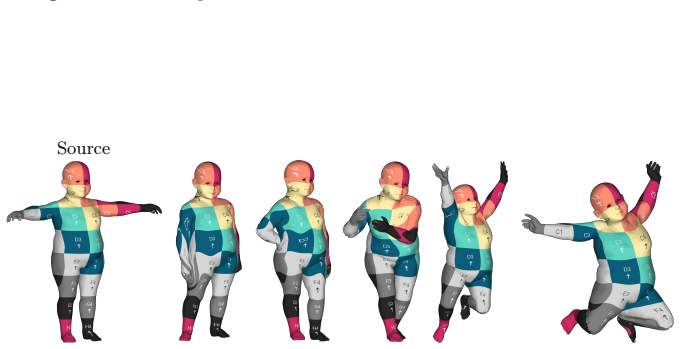
Figures from the paper (10 more)


Reference graph
Works this paper leans on
-
[1]
In: SIGGRAPH Asia 2023 Conference Papers
Abdelreheem, A., Eldesokey, A., Ovsjanikov, M., Wonka, P.: Zero-shot 3d shape correspondence. In: SIGGRAPH Asia 2023 Conference Papers. pp. 1–11 (2023)
2023
-
[2]
In: ACM Siggraph 2005 Papers, pp
Anguelov, D., Srinivasan, P., Koller, D., Thrun, S., Rodgers, J., Davis, J.: Scape: shape completion and animation of people. In: ACM Siggraph 2005 Papers, pp. 408–416 (2005)
2005
-
[3]
In: ICCV
Aubry, M., Schlickewei, U., Cremers, D.: The wave kernel signature: A quantum mechanical approach to shape analysis. In: ICCV. pp. 1626–1633. IEEE (2011)
2011
-
[4]
ACM Transactions on Multimedia Computing, Communications and Applications20(3), 1–24 (2023)
Baldrati, A., Bertini, M., Uricchio, T., Del Bimbo, A.: Composed image retrieval using contrastive learning and task-oriented clip-based features. ACM Transactions on Multimedia Computing, Communications and Applications20(3), 1–24 (2023)
2023
-
[5]
In: CVPR
Bastian, L., Xie, Y., Navab, N., Lähner, Z.: Hybrid functional maps for crease- aware non-isometric shape matching. In: CVPR. pp. 3313–3323 (2024)
2024
-
[6]
In: ICML
Behmanesh, M., Krahn, M., Ovsjanikov, M.: Tide: Time derivative diffusion for deep learning on graphs. In: ICML. pp. 2015–2030. PMLR (2023)
2015
-
[7]
In: CVPR
Bogo, F., Romero, J., Loper, M., Black, M.J.: Faust: Dataset and evaluation for 3d mesh registration. In: CVPR. pp. 3794–3801 (2014)
2014
-
[8]
In: CVPR
Bronstein, M.M., Kokkinos, I.: Scale-invariant heat kernel signatures for non-rigid shape recognition. In: CVPR. pp. 1704–1711. IEEE (2010)
2010
Show all 75 references
-
[9]
In: ECCV
Cao, D., Bernard, F.: Unsupervised deep multi-shape matching. In: ECCV. pp. 55–71. Springer (2022)
2022
-
[10]
In: ECCV
Cao, D., Lähner, Z., Bernard, F.: Synchronous diffusion for unsupervised smooth non-rigid 3d shape matching. In: ECCV. pp. 262–281. Springer (2024)
2024
-
[11]
ACM TOG42(4), 1–15 (2023)
Cao, D., Roetzer, P., Bernard, F.: Unsupervised learning of robust spectral shape matching. ACM TOG42(4), 1–15 (2023)
2023
-
[12]
In: CVPR
Caron, M., Touvron, H., Misra, I., Jégou, H., Mairal, J., Bojanowski, P., Joulin, A.: Emerging properties in self-supervised vision transformers. In: CVPR. pp. 9650– 9660 (2021)
2021
-
[13]
In: CVPR
Chen, Z., Jiang, P., Huang, R.: Dv-matcher: Deformation-based non-rigid point cloud matching guided by pre-trained visual features. In: CVPR. pp. 27264–27274 (2025)
2025
-
[14]
ACM TOG24(2), 289–310 (2005)
Dinh, H.Q., Yezzi, A., Turk, G.: Texture transfer during shape transformation. ACM TOG24(2), 289–310 (2005)
2005
-
[15]
In: CVPR
Donati, N., Corman, E., Ovsjanikov, M.: Deep orientation-aware functional maps: Tackling symmetry issues in shape matching. In: CVPR. pp. 742–751 (2022)
2022
-
[16]
In: CVPR
Donati, N., Sharma, A., Ovsjanikov, M.: Deep geometric functional maps: Robust feature learning for shape correspondence. In: CVPR. pp. 8592–8601 (2020)
2020
-
[17]
In: CVPR
Dutt, N.S., Muralikrishnan, S., Mitra, N.J.: Diffusion 3d features (diff3f): Decorat- ing untextured shapes with distilled semantic features. In: CVPR. pp. 4494–4504 (2024)
2024
-
[18]
ACM TOG39(5), 1–38 (2020)
Egger,B.,Smith,W.A.,Tewari,A.,Wuhrer,S.,Zollhoefer,M.,Beeler,T.,Bernard, F., Bolkart, T., Kortylewski, A., Romdhani, S., et al.: 3d morphable face mod- els—past, present, and future. ACM TOG39(5), 1–38 (2020)
2020
-
[19]
In: Computer Graphics Forum
Ehm, V., Amrani, N.E., Xie, Y., Bastian, L., Gao, M., Wang, W., Sang, L., Cao, D., Weißberg, T., Lähner, Z., et al.: Beyond complete shapes: A benchmark for quantitative evaluation of 3d shape surface matching algorithms. In: Computer Graphics Forum. vol. 44, p. e70186. Wiley ...
2025
-
[20]
arXiv preprint arXiv:2309.05013 (2023) 16 Tianwei Ye et al
Ehm, V., Roetzer, P., Eisenberger, M., Gao, M., Bernard, F., Cremers, D.: Ge- ometrically consistent partial shape matching. arXiv preprint arXiv:2309.05013 (2023) 16 Tianwei Ye et al
2023 arXiv
-
[21]
In: CVPR
Eisenberger, M., Lahner, Z., Cremers, D.: Smooth shells: Multi-scale shape regis- tration with functional maps. In: CVPR. pp. 12265–12274 (2020)
2020
-
[22]
In: CVPR
Eisenberger, M., Novotny, D., Kerchenbaum, G., Labatut, P., Neverova, N., Cre- mers, D., Vedaldi, A.: Neuromorph: Unsupervised shape interpolation and corre- spondence in one go. In: CVPR. pp. 7473–7483 (2021)
2021
-
[23]
NeurIPS33, 10491–10502 (2020)
Eisenberger, M., Toker, A., Leal-Taixé, L., Cremers, D.: Deep shells: Unsupervised shape correspondence with optimal transport. NeurIPS33, 10491–10502 (2020)
2020
-
[24]
In: 2016 Fourth International Conference on 3D Vision (3DV)
Eynard, D., Rodola, E., Glashoff, K., Bronstein, M.M.: Coupled functional maps. In: 2016 Fourth International Conference on 3D Vision (3DV). pp. 399–407. IEEE (2016)
2016
-
[25]
In: CVPR
Gao, M., Lahner, Z., Thunberg, J., Cremers, D., Bernard, F.: Isometric multi-shape matching. In: CVPR. pp. 14183–14193 (2021)
2021
-
[26]
In: ECCV
Groueix, T., Fisher, M., Kim, V.G., Russell, B.C., Aubry, M.: 3d-coded: 3d corre- spondences by deep deformation. In: ECCV. pp. 230–246 (2018)
2018
-
[27]
arXiv preprint arXiv:2506.02070 (2025)
Holderrieth, P., Erives, E.: An introduction to flow matching and diffusion models. arXiv preprint arXiv:2506.02070 (2025)
2025
-
[28]
Hormann, K., Greiner,G.: Mips:An efficient globalparametrization method (2000)
2000
-
[29]
ACM TOG33(4), 1–11 (2014)
Huang, Q., Wang, F., Guibas, L.: Functional map networks for analyzing and exploring large shape collections. ACM TOG33(4), 1–11 (2014)
2014
-
[30]
In: Computer Graphics Forum
Huang, R., Ren, J., Wonka, P., Ovsjanikov, M.: Consistent zoomout: Efficient spectral map synchronization. In: Computer Graphics Forum. vol. 39, pp. 265–
-
[31]
Wiley Online Library (2020)
2020
-
[32]
In: CVPR
Jiang, H., Karpur, A., Cao, B., Huang, Q., Araujo, A.: Omniglue: Generalizable feature matching with foundation model guidance. In: CVPR. pp. 19865–19875 (2024)
2024
-
[33]
ACM TOG30(4), 1–12 (2011)
Kim, V.G., Lipman, Y., Funkhouser, T.: Blended intrinsic maps. ACM TOG30(4), 1–12 (2011)
2011
-
[34]
In: Eurographics Workshop on 3D Object Retrieval, EG 3DOR
Lähner, Z., Rodolà, E., Bronstein, M.M., Cremers, D., Burghard, O., Cosmo, L., Dieckmann, A., Klein, R., Sahillioˇ glu, Y., et al.: Shrec’16: Matching of deformable shapes with topological noise. In: Eurographics Workshop on 3D Object Retrieval, EG 3DOR. pp. 55–60. Eurographic...
2016
-
[35]
NeurIPS35, 29336–29349 (2022)
Li, L., Donati, N., Ovsjanikov, M.: Learning multi-resolution functional maps with spectral attention for robust shape matching. NeurIPS35, 29336–29349 (2022)
2022
-
[36]
ACM TOG36(6), 194–1 (2017)
Li, T., Bolkart, T., Black, M.J., Li, H., Romero, J.: Learning a model of facial shape and expression from 4d scans. ACM TOG36(6), 194–1 (2017)
2017
-
[37]
In: CVPR
Liang, F., Wu, B., Dai, X., Li, K., Zhao, Y., Zhang, H., Zhang, P., Vajda, P., Marculescu, D.: Open-vocabulary semantic segmentation with mask-adapted clip. In: CVPR. pp. 7061–7070 (2023)
2023
-
[38]
arXiv preprint arXiv:2210.02747 (2022)
Lipman, Y., Chen, R.T., Ben-Hamu, H., Nickel, M., Le, M.: Flow matching for generative modeling. arXiv preprint arXiv:2210.02747 (2022)
2022 arXiv
-
[39]
arXiv preprint arXiv:2412.06264 (2024)
Lipman, Y., Havasi, M., Holderrieth, P., Shaul, N., Le, M., Karrer, B., Chen, R.T., Lopez-Paz, D., Ben-Hamu, H., Gat, I.: Flow matching guide and code. arXiv preprint arXiv:2412.06264 (2024)
2024 arXiv
-
[40]
In: ICCV
Litany, O., Remez, T., Rodola, E., Bronstein, A., Bronstein, M.: Deep functional maps: Structured prediction for dense shape correspondence. In: ICCV. pp. 5659– 5667 (2017)
2017
-
[41]
In: Computer Graphics Forum
Litany, O., Rodolà, E., Bronstein, A.M., Bronstein, M.M.: Fully spectral partial shape matching. In: Computer Graphics Forum. vol. 36, pp. 247–258. Wiley Online Library (2017) SGMatch: Semantic-Guided Non-Rigid Shape Matching 17
2017
-
[42]
In: Seminal Graphics Papers: Pushing the Boundaries, Volume 2, pp
Loper, M., Mahmood, N., Romero, J., Pons-Moll, G., Black, M.J.: Smpl: A skinned multi-person linear model. In: Seminal Graphics Papers: Pushing the Boundaries, Volume 2, pp. 851–866 (2023)
2023
-
[43]
IEEE TVCG (2025)
Luo, F., Li, Q., Hu, L., Wang, H., Xu, H., Liu, X., Liu, S., Chen, H.: Deep frequency awareness functional maps for robust shape matching. IEEE TVCG (2025)
2025
-
[44]
Magnet, R., Ren, J., Sorkine-Hornung, O., Ovsjanikov, M.: Smooth non-rigid shape matching via effective dirichlet energy optimization. In: 3DV. pp. 495–504. IEEE (2022)
2022
-
[45]
In: Eurographics Workshop on 3D Object Retrieval
Melzi, S., Marin, R., Rodolà, E., Castellani, U., Ren, J., Poulenard, A., Ovsjanikov, P., et al.: Shrec’19: matching humans with different connectivity. In: Eurographics Workshop on 3D Object Retrieval. pp. 1–8. The Eurographics Association (2019)
2019
-
[46]
arXiv preprint arXiv:1904.07865 (2019)
Melzi, S., Ren, J., Rodola, E., Sharma, A., Wonka, P., Ovsjanikov, M.: Zoomout: Spectral upsampling for efficient shape correspondence. arXiv preprint arXiv:1904.07865 (2019)
1904 arXiv
-
[47]
In: Computer Graphics Forum
Morreale, L., Aigerman, N., Kim, V.G., Mitra, N.J.: Neural semantic surface maps. In: Computer Graphics Forum. vol. 43, p. e15005. Wiley Online Library (2024)
2024
-
[48]
In: Computer Graphics Forum
Nogneng, D., Ovsjanikov, M.: Informative descriptor preservation via commutativ- ity for shape matching. In: Computer Graphics Forum. vol. 36, pp. 259–267. Wiley Online Library (2017)
2017
-
[49]
arXiv preprint arXiv:2304.07193 (2023)
Oquab, M., Darcet, T., Moutakanni, T., Vo, H., Szafraniec, M., Khalidov, V., Fernandez, P., Haziza, D., Massa, F., El-Nouby, A., et al.: Dinov2: Learning robust visual features without supervision. arXiv preprint arXiv:2304.07193 (2023)
2023 arXiv
-
[50]
ACM TOG31(4), 1–11 (2012)
Ovsjanikov, M., Ben-Chen, M., Solomon, J., Butscher, A., Guibas, L.: Functional maps: a flexible representation of maps between shapes. ACM TOG31(4), 1–11 (2012)
2012
-
[51]
In: AAAI
Perez, E., Strub, F., De Vries, H., Dumoulin, V., Courville, A.: Film: Visual rea- soning with a general conditioning layer. In: AAAI. vol. 32 (2018)
2018
-
[52]
In: ICCV
Pierson, E., Li, L., Dai, A., Ovsjanikov, M.: Diffumatch: Category-agnostic spectral diffusion priors for robust non-rigid shape matching. In: ICCV. pp. 5745–5756 (2025)
2025
-
[53]
Experimental Mathematics2(1), 15–36 (1993)
Pinkall,U.,Polthier,K.:Computingdiscreteminimalsurfacesandtheirconjugates. Experimental Mathematics2(1), 15–36 (1993)
1993
-
[54]
In: ICML
Radford, A., Kim, J.W., Hallacy, C., Ramesh, A., Goh, G., Agarwal, S., Sastry, G., Askell, A., Mishkin, P., Clark, J., et al.: Learning transferable visual models from natural language supervision. In: ICML. pp. 8748–8763. PmLR (2021)
2021
-
[55]
In: Computer Graphics Forum
Ren, J., Melzi, S., Wonka, P., Ovsjanikov, M.: Discrete optimization for shape matching. In: Computer Graphics Forum. vol. 40, pp. 81–96. Wiley Online Library (2021)
2021
-
[56]
In: Computer Graphics Forum
Ren, J., Panine, M., Wonka, P., Ovsjanikov, M.: Structured regularization of func- tional map computations. In: Computer Graphics Forum. vol. 38, pp. 39–53. Wiley Online Library (2019)
2019
-
[57]
ACM TOG37(6), 1–16 (2018)
Ren, J., Poulenard, A., Wonka, P., Ovsjanikov, M.: Continuous and orientation- preserving correspondences via functional maps. ACM TOG37(6), 1–16 (2018)
2018
-
[58]
In: Computer Graphics Forum
Rodolà, E., Cosmo, L., Bronstein, M.M., Torsello, A., Cremers, D.: Partial func- tional correspondence. In: Computer Graphics Forum. vol. 36, pp. 222–236. Wiley Online Library (2017)
2017
-
[59]
The Visual Computer 36(8), 1705–1721 (2020)
Sahillioğlu, Y.: Recent advances in shape correspondence. The Visual Computer 36(8), 1705–1721 (2020)
2020
-
[60]
ACM TOG41(3), 1–16 (2022) 18 Tianwei Ye et al
Sharp, N., Attaiki, S., Crane, K., Ovsjanikov, M.: Diffusionnet: Discretization ag- nostic learning on surfaces. ACM TOG41(3), 1–16 (2022) 18 Tianwei Ye et al
2022
-
[61]
arXiv preprint arXiv:2508.10104 (2025)
Siméoni, O., Vo, H.V., Seitzer, M., Baldassarre, F., Oquab, M., Jose, C., Khali- dov, V., Szafraniec, M., Yi, S., Ramamonjisoa, M., et al.: Dinov3. arXiv preprint arXiv:2508.10104 (2025)
2025 arXiv
-
[62]
NeurIPS34, 3108–3120 (2021)
Song, C., Wei, J., Li, R., Liu, F., Lin, G.: 3d pose transfer with correspondence learning and mesh refinement. NeurIPS34, 3108–3120 (2021)
2021
-
[63]
IEEE TPAMI45(8), 10488–10499 (2023)
Song, C., Wei, J., Li, R., Liu, F., Lin, G.: Unsupervised 3d pose transfer with cross consistency and dual reconstruction. IEEE TPAMI45(8), 10488–10499 (2023)
2023
-
[64]
In: CVPR
Sun, M., Mao, S., Jiang, P., Ovsjanikov, M., Huang, R.: Spatially and spectrally consistent deep functional maps. In: CVPR. pp. 14497–14507 (2023)
2023
-
[65]
NeurIPS34, 5731–5744 (2021)
Trappolini, G., Cosmo, L., Moschella, L., Marin, R., Melzi, S., Rodolà, E.: Shape registration in the time of transformers. NeurIPS34, 5731–5744 (2021)
2021
-
[66]
In: Computer Graphics Forum
Van Kaick, O., Zhang, H., Hamarneh, G., Cohen-Or, D.: A survey on shape cor- respondence. In: Computer Graphics Forum. vol. 30, pp. 1681–1707. Wiley Online Library (2011)
2011
-
[67]
In: AAAI
Xia, Y., Lu, Y., Gao, Y., Ma, J.: Locality preserving refinement for shape matching with functional maps. In: AAAI. vol. 38, pp. 6207–6215 (2024)
2024
-
[68]
In: AAAI
Xia, Y., Ye, T., Zhou, H., Wang, Z., Ma, J.: Multi-shape matching with cycle consistency basis via functional maps. In: AAAI. vol. 39, pp. 8575–8583 (2025)
2025
-
[69]
In: CVPR
Xie, Y., Ehm, V., Roetzer, P., El Amrani, N., Gao, M., Bernard, F., Cremers, D.: Echomatch: Partial-to-partial shape matching via correspondence reflection. In: CVPR. pp. 11665–11675 (2025)
2025
-
[70]
arXiv preprint arXiv:2509.16017 (2025)
Yang, M., Fan, F., Li, Z., Deng, S., Ma, Y., Ma, J.: Distillmatch: Leveraging knowl- edge distillation from vision foundation model for multimodal image matching. arXiv preprint arXiv:2509.16017 (2025)
2025
-
[71]
arXiv preprint arXiv:2509.01204 (2025)
Ye, T., Ma, Y., Mei, X.: Dcmatch: Unsupervised multi-shape matching with dual- level consistency. arXiv preprint arXiv:2509.01204 (2025)
2025
-
[72]
arXiv preprint arXiv:2511.15967 (2025)
Yuan, M., Zhang, Y., Zhang, W., Ma, L., Gao, Y., Ying, J., Xin, Y.: Infoclip: Bridg- ing vision-language pretraining and open-vocabulary semantic segmentation via information-theoretic alignment transfer. arXiv preprint arXiv:2511.15967 (2025)
2025
-
[73]
In: CVPR
Zhang, Y., Zhao, X.: Mesa: Matching everything by segmenting anything. In: CVPR. pp. 20217–20226 (2024)
2024
-
[74]
In: CVPR
Zhuravlev, A., Lähner, Z., Golyanik, V.: Denoising functional maps: Diffusion mod- els for shape correspondence. In: CVPR. pp. 26899–26909 (2025)
2025
-
[75]
In: CVPR
Zuffi, S., Kanazawa, A., Jacobs, D.W., Black, M.J.: 3d menagerie: Modeling the 3d shape and pose of animals. In: CVPR. pp. 6365–6373 (2017) SGMatch: Semantic-Guided Non-Rigid Shape Matching 19 A Implementation Details A.1 Experimental Settings All learning-based methods are im...
2017
Reviewed July 14, 2026 · model on record in the stance chip above.
Discussion (0). Continue with ORCID to comment.