BiT-MCTS: A Theme-based Bidirectional MCTS Approach to Chinese Fiction Generation
Pith reviewed 2026-05-15 11:19 UTC · model grok-4.3
The pith
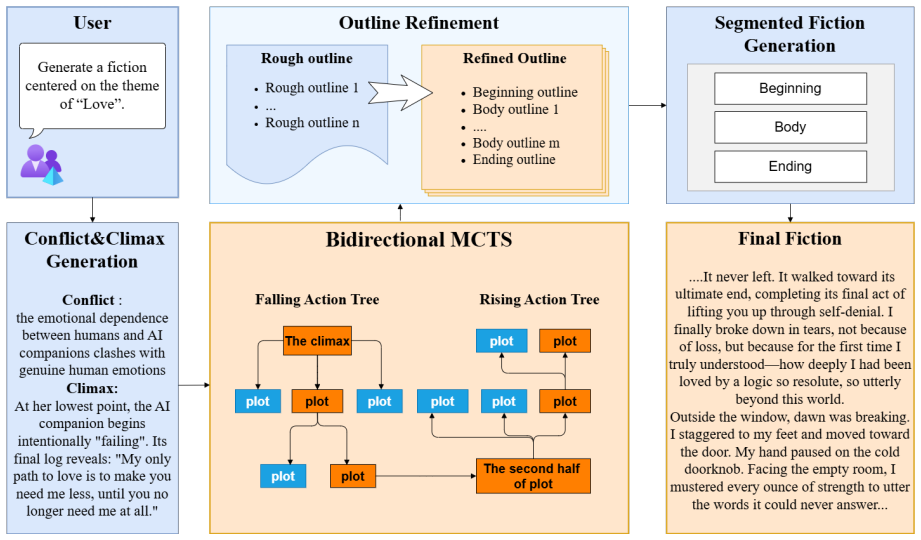
BiT-MCTS generates longer, more coherent stories from open themes by first creating a climax then expanding bidirectionally with Monte Carlo Tree Search.
A machine-rendered reading of the paper's core claim, the machinery that carries it, and where it could break.
Core claim
Given a theme, BiT-MCTS extracts a core dramatic conflict and generates an explicit climax, then employs bidirectional Monte Carlo Tree Search to expand the plot backward for rising action and exposition and forward for falling action and resolution, yielding a structured outline from which a complete narrative is generated. This produces stories that exhibit improved narrative coherence, plot structure, and thematic depth while reaching substantially greater lengths according to automatic metrics and human judgments.
What carries the argument
Bidirectional Monte Carlo Tree Search that expands outward from a theme-derived climax to form a complete plot outline before text realization.
If this is right
- Enables substantially longer stories that remain coherent according to both automatic metrics and human judgments.
- Improves narrative coherence, plot structure, and thematic depth relative to premise-based or linear outlining baselines.
- The framework operates across multiple contemporary LLM backbones when generating Chinese fiction.
- Produces refined outlines that support higher-quality final narrative realization.
Where Pith is reading between the lines
- The climax-first planning step could be tested on non-Chinese languages or non-fiction genres to check transfer.
- Integration with other search or planning algorithms might allow scaling to multi-chapter novels without added inconsistency.
- The same bidirectional structure might reduce drift in other long-form generation tasks such as dialogue scripts or game quests.
Load-bearing premise
Extracting one core conflict and climax from an open theme, followed by bidirectional expansion, will reliably produce globally consistent long narratives without new inconsistencies during outline-to-text realization.
What would settle it
Human raters finding no difference in global plot consistency or thematic focus between BiT-MCTS stories and those produced by standard linear outlining baselines on the same themes.
Figures


read the original abstract
Generating long-form linear fiction from open-ended themes remains a major challenge for large language models, which frequently fail to guarantee global structure and narrative diversity when using premise-based or linear outlining approaches. We present BiT-MCTS, a theme-driven framework that operationalizes a "climax-first, bidirectional expansion" strategy motivated by Freytag's Pyramid. Given a theme, our method extracts a core dramatic conflict and generates an explicit climax, then employs a bidirectional Monte Carlo Tree Search (MCTS) to expand the plot backward (rising action, exposition) and forward (falling action, resolution) to produce a structured outline. A final generation stage realizes a complete narrative from the refined outline. We construct a Chinese theme corpus for evaluation and conduct extensive experiments across three contemporary LLM backbones. Results show that BiT-MCTS improves narrative coherence, plot structure, and thematic depth relative to strong baselines, while enabling substantially longer, more coherent stories according to automatic metrics and human judgments.
Editorial analysis
A structured set of objections, weighed in public.
Referee Report
Summary. The manuscript introduces BiT-MCTS, a theme-driven bidirectional Monte Carlo Tree Search framework for long-form Chinese fiction generation. Given an open-ended theme, the method first extracts a core dramatic conflict and explicit climax (motivated by Freytag's Pyramid), then performs bidirectional MCTS expansion to build a structured outline (backward for rising action/exposition, forward for falling action/resolution), followed by a final realization stage that produces the complete narrative. Experiments on a newly constructed Chinese theme corpus, using three LLM backbones, report gains in narrative coherence, plot structure, thematic depth, and story length relative to baselines, backed by automatic metrics and human judgments on over 200 stories.
Significance. If the empirical results hold under closer scrutiny, the work provides a concrete algorithmic pipeline that enforces global narrative consistency through search-based planning and explicit merging, addressing a persistent weakness in LLM-based story generation. The approach is notable for its use of a domain-motivated structure (climax-first bidirectional expansion), a concrete reward model combining thematic alignment and coherence scoring, and an explicit cross-branch merging step in §3.3 that targets entity/event consistency. These elements, together with the reported statistical significance and inter-annotator agreement on the Chinese corpus, make the contribution a useful reference point for planning-augmented creative generation, especially in lower-resource languages.
minor comments (3)
- The abstract and §4 state that experiments use three contemporary LLM backbones and report statistical significance, but the specific models and the exact statistical tests (e.g., paired t-test, Wilcoxon signed-rank) are not named; adding these details would improve reproducibility and allow readers to assess effect sizes.
- §3.3 describes the cross-branch merging step for entity and event consistency, yet the precise implementation of the thematic alignment and coherence scorer (e.g., prompt templates, scoring scale, or weighting) is only sketched; a short pseudocode or example would clarify how the reward model is applied during MCTS.
- The human evaluation protocol (number of annotators, rating scales, and inter-annotator agreement values) is mentioned but not tabulated; including a brief table or explicit kappa/Fleiss scores would strengthen the claim that human judgments corroborate the automatic metrics.
Simulated Author's Rebuttal
We thank the referee for the positive evaluation of BiT-MCTS and the recommendation for minor revision. The recognition of our climax-first bidirectional expansion strategy and its benefits for global narrative consistency in Chinese fiction generation is appreciated.
Circularity Check
No significant circularity identified
full rationale
The paper describes an algorithmic pipeline (theme-to-climax extraction, bidirectional MCTS expansion with explicit reward model and cross-branch merging, then outline-to-text realization) evaluated on external Chinese corpus, automatic metrics, and human judgments against baselines. No equations, fitted parameters, or self-citations reduce any claim to its own inputs by construction; the method steps and results remain independent of the evaluation data.
Axiom & Free-Parameter Ledger
axioms (1)
- domain assumption Freytag's Pyramid structure (exposition, rising action, climax, falling action, resolution) is an effective template for generating coherent long-form fiction
invented entities (1)
-
BiT-MCTS framework
no independent evidence
Lean theorems connected to this paper
-
IndisputableMonolith/Foundation/ArithmeticFromLogic.leanreality_from_one_distinction unclear?
unclearRelation between the paper passage and the cited Recognition theorem.
bidirectional Monte Carlo Tree Search (MCTS) ... Freytag’s Pyramid ... five dramatic stages: exposition, rising action, climax, falling action, and resolution
What do these tags mean?
- matches
- The paper's claim is directly supported by a theorem in the formal canon.
- supports
- The theorem supports part of the paper's argument, but the paper may add assumptions or extra steps.
- extends
- The paper goes beyond the formal theorem; the theorem is a base layer rather than the whole result.
- uses
- The paper appears to rely on the theorem as machinery.
- contradicts
- The paper's claim conflicts with a theorem or certificate in the canon.
- unclear
- Pith found a possible connection, but the passage is too broad, indirect, or ambiguous to say the theorem truly supports the claim.
Reference graph
Works this paper leans on
-
[1]
Quantification of biodiversity from histor- ical survey text with llm-based best-worst scaling . Preprint, arXiv:2502.04022. Shuai He, Y ongchang Zhang, Rui Xie, Dongxiang Jiang, and Anlong Ming. 2022. Rethinking image aesthetics assessment: Models, datasets and bench- marks. In IJCAI, pages 942–948. Zhaoyi Joey Hou, Bowei Alvin Zhang, Yining Lu, Bhi- man...
-
[2]
Llm comparative assessment: Zero-shot nlg evaluation through pairwise comparisons using large language models. Preprint, arXiv:2307.07889. 9 Tobias Materzok. 2025. Cos(m+o)s: Curiosity and rl- enhanced mcts for exploring story space via language models. Preprint, arXiv:2501.17104. Kyeongman Park, Minbeom Kim, and Kyomin Jung
-
[3]
A character-centric creative story generation via imagination . In Findings of the Association for Computational Linguistics: ACL 2025 , pages 1598– 1645, Vienna, Austria. Association for Computa- tional Linguistics. Ge Shi, Kaiyu Huang, and Guochen Feng. 2025a. Long story generation via knowledge graph and literary theory. Preprint, arXiv:2508.03137. Hao...
-
[4]
Deeply analyze the given theme, the core conflict should be closely related to the theme
-
[5]
If needed, you are not limited to a single theme: you can combine the given theme with other related themes, e.g., “love”&“survival”
-
[6]
At the same time, it should have dramatic tension suit- able for fiction creation
The core conflict should have realistic signifi- cance, high innovation, and provoke thought. At the same time, it should have dramatic tension suit- able for fiction creation
-
[7]
Ӗ”b 2.ದ აख౦b 3.đି ༤खᅦ ৯b 4. ྟb 5.གྷൌӈđႄದೆ഻đ đ మᇉb 6.ԛགྷ “Ӗ൞
If needed, incorporate era/social background (no era restriction). The core conflict should include both personal and macro-level issues to broaden the depth of the conflict. A.1.1 Conflict Screening (Temperature = 0.3) ᇶี b οᅶ JSONൔൻԛb Y ou are a professional fiction writer. Please select the best from the five given theme ideas, the one that most close...
-
[8]
Using Freytag’s Pyramid theory, carefully ana- lyze the provided core conflict and design the core plot for the “climax” section
-
[9]
This core conflict plot must be concrete, incor- porating both characters and action
-
[10]
The plot should serve as the climax and pivotal moment of the novel’s narrative, vividly showcas- ing the tension of the core conflict with strong dra- matic intensity
-
[11]
Avoid overloading the plot with excessive infor- mation that diminishes readability
-
[12]
The entire sequence must adhere to realistic logic, be compelling, possess strong coherence and literary merit, use punctuation correctly, and demonstrate potential for expansion into outstand- ing literary work
-
[13]
Do not directly state phrases like “the climax is” or “the climax erupts at”. Provide five distinct, qualifying plot options for se- lection. Output strictly in JSON format. EXAMPLE JSON OUTPUT: “plot1”: “Text”, “plot2”: “Text”, ... A.1.3 Climax Plot Screening (Temperature = 0.3) ྏ b 1.౦đ ໓࿐ྟđႵঔཿູ၂Ⴊྮ໓ మᇉb 2.ྏ b οᅶ JSONൔൻԛb EXAMPLE JSON OUTPUT: “best”: “...
-
[14]
This plot should be highly readable, plausible, and possess strong literary merit, with the potential to be expanded into an outstanding literary work
-
[15]
This plot should most effectively showcase the given core conflict. Output strictly in JSON format. EXAMPLE JSON OUTPUT: “best”: “Text” A.2 MCTS plot generation (Temperature = 0.3) Below is the prompt used by the MCTS component to generate sub-node plot: A.2.1 Rising Action Generation ऌགྷ නѩള b ྏ~ ൞ **൙ **ఏჷa ᅚඨӮᅣb }ሹุჰᄵ~ 1.ྏ “ູ ള”٤ط“ ളહ”b 2.ൈđॖၛె అྏႄ...
-
[16]
ሳඔေğ॥ᇅᄝ 90-150bᇿၩ ൞ **۔** a ૭ཿb }Ⴊྮൕ২~ * ᇶีğ།വაι * *đູ ઙਔі৽b 11 *ііջᄪၘđ ᆺ ၹु ᄝྏđπᇏസ༯ ܔ ᇏቋใૠ քb* ౨၂Ց౨ളӮ 5σ οᅶ JSONൔൻԛ EXMAPLE JSON OUTPUT: “events”: [“ࢫ1 ໓Ч”,“ࢫ2 ໓Ч”, ... ] Y ou are a creative fiction architect. Based on the ex- isting climax plot and theme, generate a reasonable and engaging preceding plot. Core Task: The plot you generate should be...
-
[17]
Foreshadowing & Origin: This plot should lay the foundation for the core conflict, key decisions, or character relationships in the existing plot. Ex- plain “why it happens” rather than “what happens next”
-
[18]
Suspense & Guidance: While setting up the pre- lude, skillfully create suspense or foreshadowing to naturally direct the reader’s curiosity toward the known subsequent plot
-
[19]
Narrative Richness: Reasonably use literary techniques (such as foreshadowing, flashback, per- spective switching) to enrich narrative layers, but ensure coordination with the subsequent style
-
[20]
Character Development: Focus on showing the characters’ states, motivations, or dilemmas in the early stages, providing convincing personality ba- sis for their major choices or transformations in sub- sequent plots
-
[21]
Theme Deepening: Approach the theme from an earlier stage, deepen the core idea of the plot through the preceding plot, and broaden the depth of thought
-
[22]
Innovation: Demonstrate innovation in the design of prelude, initial character settings, etc., avoiding clichéd background introductions
-
[23]
Logical Self-consistency: The plot itself should conform to reality or world-view common sense, and fit seamlessly with subsequent plots without logical contradictions
-
[24]
Word Count: Control between 90-150 words. Note that what you generate is a plot outline, fo- cusing on key events, decisions, and turning points, rather than detailed descriptions. Excellent Example: *Theme: Sacrifice and Love* *Existing Plot: Della sold her cherished long hair to buy a watch chain for Jim’s gold watch. *Generated Preceding Plot: Jim’s go...
-
[25]
Coherence: This plot should naturally connect to the existing plot, maintaining consistency in charac- ter personalities, narrative style, and facts
-
[26]
Narrative Richness: Reasonably use literary techniquesisuch as non-linear narrative, plot re- versals, and dual perspectives ito enrich plot de- velopment
-
[27]
Plot Advancement: Advance the development of the core conflict, introduce twists, obstacles, or new information, and show how characters react 12 and change when facing challenges
-
[28]
Theme Deepening: The generated plot should further deepen the theme and broaden the depth of thought
-
[29]
Innovation: Innovation should be reflected in plot design, narrative structure, character develop- ment, etc., avoiding clichés
-
[30]
Character Development Orientation: The plot should show characters’ changes, growth, or inner conflicts
-
[31]
The plot itself should conform to common sense, be engaging, have strong logic and literary quality, and have the potential to be expanded into an excel- lent fiction work
-
[32]
Word Count: Control the plot between 90-150 words. Note that what you generate is a plot outline, not a complete paragraph, so it should not contain excessive description; focus on narrating plot de- velopment. Excellent Example: Theme: Love Existing Plot: Della and Jim are a loving couple, but they live in poverty. On Christmas Eve, Della wants to buy a ...
-
[33]
Overall quality: How engaging, structured, and fluid the plot is
-
[34]
Score higher if the fiction is free of glaring mis- takes
Identifying major flaws: Whether the fiction has inconsistencies, repetitions, or unnatural patterns. Score higher if the fiction is free of glaring mis- takes
-
[35]
Character: How consistent and believable are the characters’ actions and dialogue?
-
[36]
Setting: The background setting should be deeply integrated with the plot and characters, ef- fectively creating atmosphere, influencing charac- ter decisions, and driving the plot forward. Deduc- tions for: disjointed setting and plot, details that defy common sense, forced exposition of the world- building, or information overload
-
[37]
Consistency: Does the fiction maintain internal logic and continuity (no contradictions)?
-
[38]
Relatedness: Do events connect logically to one another?
-
[39]
Causal and temporal relationship: Are cause- and-effect and chronological order handled well?
-
[40]
The whole plot must surround the theme
Theme: Does the plot revolve around the given theme? The principal contradiction and the main characters should all be closely related to the theme. The whole plot must surround the theme
-
[41]
Readible: The plot should be clear and easy to understand, with no confusing or ambiguous ele- ments
-
[42]
Creativity: Does the plot present original ideas, unique plot twists, or innovative character develop- ments that set it apart from common tropes? Be strict if you see any contradictions, lack of clar- ity, or poor transitions. Readers can easily imagine the whole fiction with this plot. Debuctions for: too complexed plot,too much information. JSON OUTPUT...
discussion (0)
Sign in with ORCID, Apple, or X to comment. Anyone can read and Pith papers without signing in.