Recognition: 2 theorem links
· Lean TheoremCavity elimination in cavity-QED: a self-consistent input-output approach
Pith reviewed 2026-05-15 10:00 UTC · model grok-4.3
The pith
A self-consistent input-output approach eliminates cavity degrees of freedom in CQED systems.
A machine-rendered reading of the paper's core claim, the machinery that carries it, and where it could break.
Core claim
We introduce a self-consistent approach to eliminate the cavity degrees of freedom of cavity quantum electrodynamics devices in the non-adiabatic regime. This yields an exact expression for the effective Purcell-enhanced emission rate and, under approximations, self-consistent dynamical equations and input-output relations for the effective two-level atom, including an effective Lindblad equation with two decoherence rates.
What carries the argument
The self-consistency equation derived from the input-output relations that reduces the atom-cavity system to an effective two-level atom model.
If this is right
- Computation of effective steady states and output flux beyond low-power regime.
- Calculation of two-time correlations and spectral densities with good agreement to full models.
- Reduction in model size for CQED devices.
- Potential generalization to complex atom-cavity configurations.
Where Pith is reading between the lines
- The method may allow analytical solutions for larger open quantum systems involving multiple CQED units.
- The appearance of a negative decoherence rate could indicate coherent effects from the eliminated cavity.
- Extensions to time-dependent driving or multi-atom systems could be tested numerically.
Load-bearing premise
The cavity can be eliminated using a self-consistency condition that retains the non-Markovian character of the atom dynamics.
What would settle it
Disagreement in the predicted two-time correlation functions or spectral densities between the reduced model and full cavity-QED simulations when operating in the strong-coupling regime with high excitation.
Figures




read the original abstract
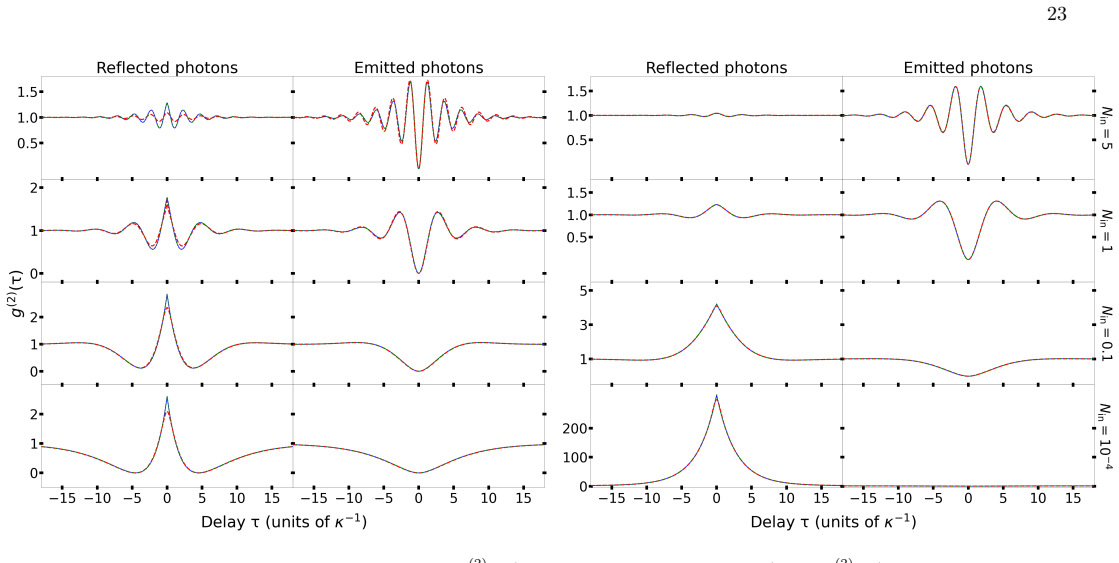
Simplifying composite open quantum systems through model reduction is central to enable their analytical and numerical understanding. In this work, we introduce a self-consistent approach to eliminate the cavity degrees of freedom of cavity quantum electrodynamics (CQED) devices in the non-adiabatic regime, where the cavity memory time is comparable with the timescales of the atom dynamics. To do so, we consider a CQED system consisting of a two-level atom coupled to a single-mode cavity, both subsystems interacting with the environment through an arbitrary number of ports, within the input-output formalism. A self-consistency equation is derived for the reduced atom dynamics. This allows retrieving an exact expression for the effective Purcell-enhanced emission rate and, under reasonable approximations, a set of self-consistent dynamical equations and input-output relations for the effective two level atom. The resulting reduced model captures non-Markovian features, characterized through an effective Lindblad equation exhibiting two decoherence rates, a positive and a negative one. In the continuous-wave excitation regime, we benchmark our approach by computing effective steady states and output flux expressions beyond the low-power excitation regime, for which a semi-classical treatment is usually applied. We also compute two-time correlations and spectral densities, showing an excellent agreement with full cavity quantum electrodynamics simulations, except in the strong-coupling, high-excitation regime. Our results provide a practical framework for reducing the size of CQED models, which could be generalized to more complex atom and cavity configurations.
Editorial analysis
A structured set of objections, weighed in public.
Referee Report
Summary. The manuscript introduces a self-consistent approach to eliminate the cavity degrees of freedom in cavity-QED systems in the non-adiabatic regime using the input-output formalism. It derives a self-consistency equation for the reduced atom dynamics, providing an exact expression for the effective Purcell-enhanced emission rate. Under reasonable approximations, it obtains self-consistent dynamical equations and input-output relations for an effective two-level atom, capturing non-Markovian features through an effective Lindblad equation with one positive and one negative decoherence rate. The approach is benchmarked in the continuous-wave excitation regime against full CQED simulations for steady states, output fluxes, two-time correlations, and spectral densities, showing excellent agreement except in the strong-coupling, high-excitation regime.
Significance. If the central derivations hold, this provides a practical framework for reducing CQED model size while retaining non-Markovian atom dynamics, useful for analytical and numerical studies of composite open quantum systems. The exact Purcell rate and extension to beyond low-power regimes are notable; explicit acknowledgment of breakdown in strong-coupling high-excitation adds credibility. The approach could generalize to more complex configurations.
major comments (2)
- The self-consistency equation is presented as derived from the input-output formalism rather than fitted data, yet the 'reasonable approximations' invoked for the dynamical equations (leading to the reduced non-Markovian model) require explicit justification in the derivation section to rule out circularity when recovering known limits, especially since the model fails when g becomes comparable to other rates.
- The effective Lindblad equation is stated to exhibit a positive and a negative decoherence rate; the manuscript must specify the conditions ensuring complete positivity of the density-matrix evolution and the precise regime of validity for this form.
minor comments (2)
- Add quantitative error metrics (e.g., relative deviations or R² values) in the benchmarking of steady states, fluxes, and correlations to support the claim of 'excellent agreement' with full simulations.
- Clarify in the main text whether the arbitrary number of ports in the abstract is fully implemented or restricted in the numerical examples.
Simulated Author's Rebuttal
We thank the referee for their careful reading and positive evaluation of our manuscript. We address each major comment below and will revise the manuscript to incorporate the requested clarifications.
read point-by-point responses
-
Referee: The self-consistency equation is presented as derived from the input-output formalism rather than fitted data, yet the 'reasonable approximations' invoked for the dynamical equations (leading to the reduced non-Markovian model) require explicit justification in the derivation section to rule out circularity when recovering known limits, especially since the model fails when g becomes comparable to other rates.
Authors: We agree that the approximations require more explicit step-by-step justification to eliminate any perception of circularity. In the revised manuscript we will expand the derivation section to derive the approximations directly from the input-output formalism, demonstrate recovery of known limits without circular reasoning, and restate the breakdown conditions when g becomes comparable to other rates, consistent with the benchmarks already shown. revision: yes
-
Referee: The effective Lindblad equation is stated to exhibit a positive and a negative decoherence rate; the manuscript must specify the conditions ensuring complete positivity of the density-matrix evolution and the precise regime of validity for this form.
Authors: We thank the referee for this observation. The revised manuscript will add an explicit paragraph (or subsection) stating the mathematical conditions on the positive and negative rates that guarantee complete positivity of the density-matrix evolution, together with the precise regime of validity (non-adiabatic regime excluding strong-coupling high-excitation, as already benchmarked). revision: yes
Circularity Check
No significant circularity in the derivation chain
full rationale
The paper derives a self-consistency equation for cavity elimination directly from the input-output formalism applied to the full CQED Hamiltonian and bath couplings. This produces an exact effective Purcell rate expression without reference to fitted data or target outputs. The reduced dynamical equations and input-output relations follow from stated approximations that are then benchmarked against independent full-system numerics, with explicit agreement reported except outside the claimed regime. No load-bearing step reduces by construction to a self-citation, a fitted parameter renamed as prediction, or a definitional tautology; the central construction retains independent content through its explicit derivation and external validation.
Axiom & Free-Parameter Ledger
axioms (2)
- domain assumption Input-output formalism for open quantum systems with arbitrary ports
- ad hoc to paper Existence of a self-consistency equation that eliminates cavity variables while preserving non-Markovian atom dynamics
Reference graph
Works this paper leans on
-
[1]
Had they not, the equality ˆF|0⟩ E = 0would not be fulfilled and the expected dy- namics would naturally go beyond the monoexponen- tial behavior, for a vacuum input in all ports. Since the expression ˆF= (ˆσ z −x ˆI) ˆΩ 2 directly follows from the approximation of a slowly-evolving effective drive, i.e ˆF− ˙ˆF κ′ + ¨ˆF κ′2 ≈ ˆF, it is only natural that m...
-
[2]
S.HarocheandJ.-M.Raimond,Exploring the Quantum: Atoms, Cavities, and Photons(OxfordUniversityPress, 2006)
work page 2006
-
[3]
H. Walther, B. T. H. Varcoe, B.-G. Englert, and T. Becker, Cavity quantum electrodynamics, Rep. Prog. Phys.69, 1325 (2006)
work page 2006
- [4]
-
[5]
A. Reiserer and G. Rempe, Cavity-based quantum net- 30 works with single atoms and optical photons, Rev. Mod. Phys.87, 1379 (2015)
work page 2015
-
[6]
H. J. Kimble, Strong interactions of single atoms and photons in cavity QED, Phys. Scr.1998, 127 (1998)
work page 1998
-
[7]
R. Blatt and C. F. Roos, Quantum simulations with trapped ions, Nat. Phys.8, 277 (2012)
work page 2012
- [8]
- [9]
-
[10]
A. González-Tudela, A. Reiserer, J. J. García-Ripoll, and F. J. García-Vidal, Light–matter interactions in quantum nanophotonic devices, Nat. Rev. Phys.6, 166 (2024)
work page 2024
-
[11]
P. Senellart, G. Solomon, and A. White, High- performance semiconductor quantum-dot single-photon sources, Nat. Nanotechnol.12, 1026 (2017)
work page 2017
-
[12]
R. J. Thompson, G. Rempe, and H. J. Kimble, Observa- tion of normal-mode splitting for an atom in an optical cavity, Phys. Rev. Lett.68, 1132 (1992)
work page 1992
-
[13]
G. Khitrova, H. M. Gibbs, M. Kira, S. W. Koch, and A. Scherer, Vacuum Rabi splitting in semiconductors, Nat. Phys.2, 81 (2006)
work page 2006
- [14]
-
[15]
S. Gleyzes, S. Kuhr, C. Guerlin, J. Bernu, S. Deléglise, U. B. Hoff, M. Brune, J.-M. Raimond, and S. Haroche, Quantum jumps of light recording the birth and death of a photon in a cavity, Nature446, 297 (2007)
work page 2007
-
[16]
P. Grangier, J. A. Levenson, and J.-P. Poizat, Quantum non-demolition measurements in optics, Nature396, 537 (1998)
work page 1998
-
[17]
F. Mivehvar, F. Piazza, T. Donner, and H. Ritsch, Cav- ity QED with quantum gases: New paradigms in many- body physics, Adv. Phys.70, 1 (2021)
work page 2021
-
[18]
J. McKeever, A. Boca, A. D. Boozer, J. R. Buck, and H. J. Kimble, Experimental realization of a one-atom laser in the regime of strong coupling, Nature425, 268 (2003)
work page 2003
- [19]
-
[20]
P. Campagne-Ibarcq, E. Flurin, N. Roch, D. Darson, P. Morfin, M. Mirrahimi, M. H. Devoret, F. Mallet, and B. Huard, Persistent control of a superconducting qubit by stroboscopic measurement feedback, Phys. Rev. X3, 021008 (2013)
work page 2013
-
[21]
A. Sarlette, Z. Leghtas, M. Brune, J. M. Raimond, and P. Rouchon, Stabilization of nonclassical states of one- and two-mode radiation fields by reservoir engineering, Phys. Rev. A86, 012114 (2012)
work page 2012
-
[22]
H. J. Kimble, The quantum internet, Nature453, 1023 (2008)
work page 2008
-
[23]
T. D. Ladd, F. Jelezko, R. Laflamme, Y. Nakamura, C. Monroe, and J. L. O’Brien, Quantum computers, Na- ture464, 45 (2010)
work page 2010
- [24]
-
[25]
N. Somaschi, V. Giesz, L. D. Santis, J. C. Loredo, M. P. Almeida, G. Hornecker, S. L. Portalupi, T. Grange, C. Antón, J. Demory, C. Gómez, I. Sagnes, N. D. Lanzillotti-Kimura, A. Lemaître, A. Auffeves, A. G. White, L. Lanco, and P. Senellart, Near-optimal single- photon sources in the solid state, Nat. Photonics10, 340 (2016)
work page 2016
-
[26]
C. Couteau, S. Barz, T. Durt, T. Gerrits, J. Huwer, R. Prevedel, J. Rarity, A. J. Shields, and G. Weihs, Ap- plications of single photons to quantum communication and computing, Nat. Rev. Phys.5, 326 (2023)
work page 2023
- [27]
-
[28]
L.-M. Duan and H. J. Kimble, Scalable photonic quan- tum computation through cavity-assisted interactions, Phys. Rev. Lett.92, 127902 (2004)
work page 2004
-
[29]
H. Le Jeannic, A. Tiranov, J. Carolan, T. Ramos, Y. Wang, M. H. Appel, S. Scholz, A. D. Wieck, A. Lud- wig, N. Rotenberg, L. Midolo, J. J. García-Ripoll, A. S. Sørensen, and P. Lodahl, Dynamical photon–photon in- teraction mediated by a quantum emitter, Nat. Phys. 18, 1191 (2022)
work page 2022
-
[30]
Monroe, Quantum information processing with atoms and photons, Nature416, 238 (2002)
C. Monroe, Quantum information processing with atoms and photons, Nature416, 238 (2002)
work page 2002
-
[31]
H. Pichler, S. Choi, P. Zoller, and M. D. Lukin, Uni- versal photonic quantum computation via time-delayed feedback, Proc. Natl. Acad. Sci. U.S.A.114, 11362 (2017)
work page 2017
-
[32]
H. J. Carmichael,Statistical Methods in Quantum Op- tics 2(Springer Berlin, Heidelberg, 2007)
work page 2007
-
[33]
J. Larson and T. Mavrogordatos,The Jaynes– Cummings Model and its Descendants (Second Edition): Modern Research Directions(IOP Publishing, 2024)
work page 2024
-
[34]
H. J. Carmichael, R. J. Brecha, M. G. Raizen, H. J. Kimble, and P. R. Rice, Subnatural linewidth averaging for coupled atomic and cavity-mode oscillators, Phys. Rev. A40, 5516 (1989)
work page 1989
-
[35]
L.C.Andreani, G.Panzarini,andJ.-M.Gérard,Strong- coupling regime for quantum boxes in pillar microcavi- ties: Theory, Phys. Rev. B60, 13276 (1999)
work page 1999
-
[36]
A. Auffèves, B. Besga, J.-M. Gérard, and J.-P. Poizat, Spontaneous emission spectrum of a two-level atom in a very-high-Qcavity, Phys. Rev. A77, 063833 (2008)
work page 2008
-
[37]
C. W. Gardiner and M. J. Collett, Input and output in damped quantum systems: Quantum stochastic differ- ential equations and the master equation, Phys. Rev. A 31, 3761 (1985)
work page 1985
-
[38]
C. W. Gardiner and P. Zoller,Quantum Noise: A Handbook of Markovian and Non-Markovian Quantum Stochastic Methods with Applications to Quantum Op- tics(Springer, 2004)
work page 2004
- [39]
-
[40]
H.FlayacandV.Savona,Input-outputtheoryoftheun- conventional photon blockade, Phys. Rev. A88, 033836 (2013)
work page 2013
- [41]
-
[42]
H. J. Carmichael,An Open Systems Approach to Quan- tum Optics(Springer, 1993)
work page 1993
-
[43]
D. F. Walls and G. J. Milburn,Quantum Optics (Springer Berlin, Heidelberg, 2008)
work page 2008
-
[44]
S. Fan, Ş. E. Kocabaş, and J.-T. Shen, Input-output formalism for few-photon transport in one-dimensional nanophotonic waveguides coupled to a qubit, Phys. Rev. A82, 063821 (2010)
work page 2010
-
[45]
K. Lalumière, B. C. Sanders, A. F. van Loo, A. Fe- dorov, A. Wallraff, and A. Blais, Input-output theory for waveguide QED with an ensemble of inhomogeneous atoms, Phys. Rev. A88, 043806 (2013)
work page 2013
-
[46]
C. W. Gardiner, Driving a quantum system with the output field from another driven quantum system, Phys. Rev. Lett.70, 2269 (1993)
work page 1993
-
[47]
H. J. Carmichael, Quantum trajectory theory for cas- caded open systems, Phys. Rev. Lett.70, 2273 (1993)
work page 1993
-
[48]
J. Gough and M. R. James, Quantum feedback net- works: Hamiltonianformulation,Commun.Math.Phys. 287, 1109 (2009)
work page 2009
- [49]
-
[50]
E. Waks and J. Vučković, Dipole induced transparency in drop-filter cavity-waveguide systems, Phys. Rev. Lett.96, 153601 (2006)
work page 2006
-
[51]
A. Majumdar, D. Englund, M. Bajcsy, and J. Vučković, Nonlinear temporal dynamics of a strongly coupled quantum-dot–cavity system, Phys. Rev. A85, 033802 (2012)
work page 2012
-
[52]
A. Auffèves-Garnier, C. Simon, J.-M. Gérard, and J.-P. Poizat, Giant optical nonlinearity induced by a single two-level system interacting with a cavity in the Purcell regime, Phys. Rev. A75, 053823 (2007)
work page 2007
-
[53]
L. A. Lugiato, Optical bistability, Contemp. Phys.24, 333 (1983)
work page 1983
-
[54]
C. M. Savage and H. J. Carmichael, Single atom optical bistability, IEEE J. Quantum Electron.24, 1495 (1988)
work page 1988
-
[55]
J. I. Cirac, Interaction of a two-level atom with a cavity mode in the bad-cavity limit, Phys. Rev. A46, 4354 (1992)
work page 1992
-
[56]
P. Warszawski and H. M. Wiseman, Adiabatic elimi- nation in compound quantum systems with feedback, Phys. Rev. A63, 013803 (2000)
work page 2000
-
[57]
M. Lax, Quantum noise. X. Density-matrix treatment of field and population-difference fluctuations, Phys. Rev. 157, 213 (1967)
work page 1967
-
[58]
Haken, Analogy between higher instabilities in fluids and lasers, Phys
H. Haken, Analogy between higher instabilities in fluids and lasers, Phys. Lett. A53, 77 (1975)
work page 1975
-
[59]
C.Cohen-Tannoudji,Atomicmotioninlaserlight,Phys. Rep.219, 153 (1992)
work page 1992
-
[60]
J. Dalibard and C. Cohen-Tannoudji, Laser cooling be- low the doppler limit by polarization gradients: simple theoretical models, J. Opt. Soc. Am. B6, 2023 (1989)
work page 2023
-
[61]
M. Mirrahimi and P. Rouchon, Singular perturbations and Lindblad-Kossakowski differential equations, IEEE Trans. Autom. Control54, 1325 (2009)
work page 2009
- [62]
-
[63]
N. Piccione, S. Felicetti, and B. Bellomo, Two-photon- interaction effects in the bad-cavity limit, Phys. Rev. A 105, L011702 (2022)
work page 2022
-
[64]
F.-M. L. Régent and P. Rouchon, Adiabatic elimination for composite open quantum systems: Reduced model formulation and numerical simulations, Phys. Rev. A 109, 032603 (2024)
work page 2024
-
[65]
A. N. Tikhonov, Systems of differential equations con- taining small parameters in the derivatives, Mat. Sb. (N.S.)31, 575 (1952)
work page 1952
-
[66]
Fenichel, Geometric singular perturbation theory for ordinary differential equations, J
N. Fenichel, Geometric singular perturbation theory for ordinary differential equations, J. Differ. Equ.31, 53 (1979)
work page 1979
-
[67]
D. Finkelstein-Shapiro, D. Viennot, I. Saideh, T. Hansen, T. Pullerits, and A. Keller, Adiabatic elimination and subspace evolution of open quantum systems, Phys. Rev. A101, 042102 (2020)
work page 2020
- [68]
-
[69]
M. Tokieda and A. Riva, Time-convolutionless master equation applied to adiabatic elimination, Phys. Rev. A 111, 052206 (2025)
work page 2025
-
[70]
S. B. Jäger, T. Schmit, G. Morigi, M. J. Holland, and R. Betzholz, Lindblad master equations for quantum systems coupled to dissipative bosonic modes, Phys. Rev. Lett.129, 063601 (2022)
work page 2022
-
[71]
D. Burgarth, P. Facchi, H. Nakazato, S. Pascazio, and K. Yuasa, Eternal adiabaticity in quantum evolution, Phys. Rev. A103, 032214 (2021)
work page 2021
-
[72]
K. Macieszczak, M. Guţă, I. Lesanovsky, and J. P. Gar- rahan, Towards a theory of metastability in open quan- tum dynamics, Phys. Rev. Lett.116, 240404 (2016)
work page 2016
- [73]
-
[74]
J.S.Douglas, H.Habibian, C.-L.Hung, A.V.Gorshkov, H. J. Kimble, and D. E. Chang, Quantum many-body models with cold atoms coupled to photonic crystals, Nat. Photonics9, 326 (2015)
work page 2015
-
[75]
F. Reiter and A. S. Sørensen, Effective operator formal- ism for open quantum systems, Phys. Rev. A85, 032111 (2012)
work page 2012
-
[76]
H. M. Wiseman and G. J. Milburn, Quantum theory of field-quadrature measurements, Phys. Rev. A47, 642 (1993)
work page 1993
-
[77]
F. Damanet, A. J. Daley, and J. Keeling, Atom-only descriptionsofthedriven-dissipativeDickemodel,Phys. Rev. A99, 033845 (2019)
work page 2019
-
[78]
T. Grigoletto and F. Ticozzi, Model reduction for quan- tum systems: Discrete-time quantum walks and open Markov dynamics, IEEE Trans. Inf. Theory71, 8524 (2025)
work page 2025
-
[79]
T. Grigoletto, Y. Tao, F. Ticozzi, and L. Viola, Exact model reduction for continuous-time open quantum dy- namics, Quantum9, 1814 (2025)
work page 2025
-
[80]
G.Dridi, S.Guérin, H.R.Jauslin,andD.V.G.Jolicard, Adiabatic approximation for quantum dissipative sys- tems: Formulation, topology, and superadiabatic track- ing, Phys. Rev. A82, 022109 (2010)
work page 2010
discussion (0)
Sign in with ORCID, Apple, or X to comment. Anyone can read and Pith papers without signing in.