Recognition: no theorem link
Universal Weakly Fault-Tolerant Quantum Computation via Code Switching in the [[8,3,2]] Code
Pith reviewed 2026-05-15 09:39 UTC · model grok-4.3
The pith
Code switching between two versions of the [[8,3,2]] code enables universal postselected fault-tolerant quantum computation.
A machine-rendered reading of the paper's core claim, the machinery that carries it, and where it could break.
Core claim
Switching between two versions of the [[8,3,2]] code—one supporting weakly fault-tolerant single-qubit Cliffords and the other supporting transversal T/T† for logical CCZ plus CZ/CNOT/SWAP—yields a universal scheme for postselected fault-tolerant quantum computation in which single faults are detected and logical error rates in accepted runs are quadratically suppressed.
What carries the argument
The code-switching protocol between the two versions of the [[8,3,2]] code that combines their supported gates while detecting single faults.
If this is right
- Single-qubit Clifford gates become available in a weakly fault-tolerant form in one code version.
- Transversal T/T† implements logical CCZ while CZ, CNOT, and SWAP remain available in the other version.
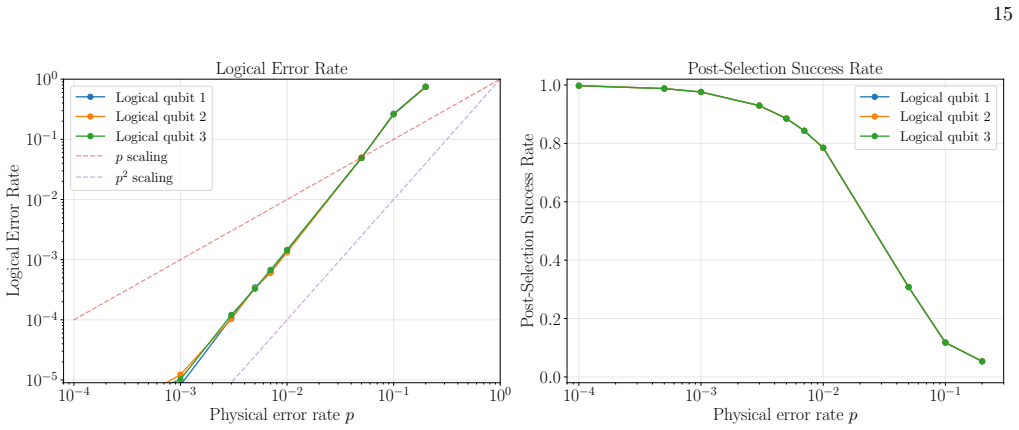
- Accepted computation runs exhibit quadratic suppression of logical errors.
- Universal postselected fault-tolerant computation is achieved without needing a single code with a transversal universal set.
- A three-logical-qubit Grover search can be realized by interleaving the two code versions.
Where Pith is reading between the lines
- The same switching idea could be applied to other small-distance codes to enlarge their gate sets.
- Postselection overhead could be traded against circuit depth in near-term hardware implementations.
- Extending the protocol to distance-3 versions of the code would convert quadratic suppression into cubic suppression.
- The numerical validation on Grover search provides a benchmark that could be compared directly with other postselection schemes.
Load-bearing premise
The two versions of the [[8,3,2]] code support the claimed gates and single faults always produce detectable outcomes.
What would settle it
Numerical or experimental runs in which the logical error rate of accepted outputs fails to decrease quadratically with the physical error rate.
Figures




read the original abstract
Code-switching offers a route to universal, fault-tolerant quantum computation by circumventing the limitation implied by the Eastin-Knill theorem against a universal transversal gate set within a single quantum code. Here, we present a fault-tolerant code-switching protocol between two versions of the $[[8, 3, 2]]$ code. One version supports weakly fault-tolerant single-qubit Clifford gates, while the other supports a logical $\overline{\mathrm{CCZ}}$ gate via transversal $T/T^\dagger$ together with logical $\overline{\mathrm{CZ}}$, $\overline{\mathrm{CNOT}}$, and $\overline{\mathrm{SWAP}}$ gates. Because both codes have distance 2, the protocol operates in a postselected, error-detecting regime: single faults lead to detectable outcomes, and accepted runs exhibit quadratic suppression of logical error rates. This yields a universal scheme for postselected fault-tolerant computation. We validate the protocol numerically through simulations of state preparation, code switching, and a three-logical-qubit implementation of Grover's search.
Editorial analysis
A structured set of objections, weighed in public.
Referee Report
Summary. The manuscript presents a code-switching protocol between two versions of the [[8,3,2]] code to realize a universal gate set for postselected weakly fault-tolerant quantum computation. One code version supports weakly fault-tolerant single-qubit Clifford gates; the other supports a transversal logical CCZ via T/T† gates together with logical CZ, CNOT, and SWAP. Because both codes have distance 2, the protocol is error-detecting: single faults are claimed to produce detectable outcomes, yielding quadratic logical-error suppression on accepted runs. The protocol is validated numerically via simulations of state preparation, code switching, and a three-logical-qubit Grover search.
Significance. If the single-fault detection property is rigorously established, the construction supplies a concrete, small-code route to universality with postselection and quadratic suppression. This is of practical interest for near-term demonstrations and for exploring the boundary between error detection and full fault tolerance. The numerical simulations provide supporting evidence that the protocol functions at the logical level.
major comments (2)
- [code-switching protocol] The quadratic-suppression claim rests on every weight-1 error in the switching circuit producing a detectable (rejected) outcome. The manuscript describes the stabilizer conversion and measurement schedule but does not supply an exhaustive enumeration, lemma, or circuit-level fault table showing that no single Pauli is absorbed into an accepted logical operator (see the code-switching protocol description and the paragraph asserting quadratic suppression).
- [numerical validation] The numerical validation (state preparation, switching, and Grover search) demonstrates logical functionality but reports no per-run error-rate scaling or comparison against the expected quadratic suppression; without this, the simulations provide only moderate support for the fault-tolerance claim (see the simulation results section).
minor comments (2)
- Notation for the two code versions and their stabilizer generators should be introduced with a compact table for quick reference.
- The abstract states 'weakly fault-tolerant' without a one-sentence definition; a brief parenthetical clarification would help readers unfamiliar with the term.
Simulated Author's Rebuttal
We thank the referee for their careful reading and constructive feedback on our manuscript. We address each major comment below and have revised the manuscript to strengthen the presentation of the fault-tolerance properties.
read point-by-point responses
-
Referee: [code-switching protocol] The quadratic-suppression claim rests on every weight-1 error in the switching circuit producing a detectable (rejected) outcome. The manuscript describes the stabilizer conversion and measurement schedule but does not supply an exhaustive enumeration, lemma, or circuit-level fault table showing that no single Pauli is absorbed into an accepted logical operator (see the code-switching protocol description and the paragraph asserting quadratic suppression).
Authors: We agree that an explicit enumeration would make the single-fault detection property more transparent. In the revised manuscript we have added a new appendix that enumerates every weight-1 Pauli error on the code-switching circuit, tabulates the resulting syndrome and measurement outcomes, and verifies that each produces a detectable rejection. This establishes the claimed quadratic suppression on accepted runs. revision: yes
-
Referee: [numerical validation] The numerical validation (state preparation, switching, and Grover search) demonstrates logical functionality but reports no per-run error-rate scaling or comparison against the expected quadratic suppression; without this, the simulations provide only moderate support for the fault-tolerance claim (see the simulation results section).
Authors: We acknowledge that explicit scaling data would strengthen the numerical evidence. The revised manuscript now includes additional simulation results for the three-logical-qubit Grover search that plot logical error rate versus physical error probability on accepted runs, confirming the expected quadratic suppression and providing a direct comparison to the theoretical prediction. revision: yes
Circularity Check
Minor self-citation to prior [[8,3,2]] code analysis; central switching protocol remains independently derived
full rationale
The paper's derivation chain starts from the known stabilizer generators and distance-2 properties of the [[8,3,2]] code, applies standard transversal-gate constructions for Cliffords in one version and T/T† plus CZ/CNOT/SWAP in the other, and defines a measurement-based switching circuit that converts between the two stabilizer sets. These steps use established code properties rather than any fitted parameter or self-referential definition. A self-citation to earlier work on the same code appears but is not load-bearing: the switching protocol, postselection rule, and quadratic error suppression claim are constructed explicitly from the code's distance and the listed transversal gates. Numerical simulations of state preparation, switching, and Grover search provide independent validation. No equation reduces to its own input by construction, and no uniqueness theorem is imported solely from the authors' prior work.
Axiom & Free-Parameter Ledger
axioms (2)
- domain assumption The [[8,3,2]] code admits weakly fault-tolerant single-qubit Clifford gates in one version and a logical CCZ gate via transversal T/T† together with CZ, CNOT, and SWAP in the other version.
- standard math Single faults in a distance-2 code produce detectable outcomes, enabling postselection with quadratic logical-error suppression.
Reference graph
Works this paper leans on
-
[1]
P. W. Shor, Scheme for reducing decoherence in quantum computer memory, Phys. Rev. A52, R2493 (1995)
work page 1995
-
[2]
A. M. Steane, Error correcting codes in quantum theory, Phys. Rev. Lett.77, 793 (1996)
work page 1996
-
[3]
Gottesman, Class of quantum error-correcting codes saturating the quantum hamming bound, Phys
D. Gottesman, Class of quantum error-correcting codes saturating the quantum hamming bound, Phys. Rev. A 54, 1862 (1996)
work page 1996
-
[4]
A. R. Calderbank, E. M. Rains, P. W. Shor, and N. J. A. Sloane, Quantum error correction and orthogonal geom- 12 etry, Physical Review Letters78, 405 (1997)
work page 1997
-
[5]
E. Knill and R. Laflamme, Theory of quantum error- correcting codes, Phys. Rev. A55, 900 (1997)
work page 1997
- [6]
-
[7]
Bacon, Operator quantum error-correcting subsys- tems for self-correcting quantum memories, Phys
D. Bacon, Operator quantum error-correcting subsys- tems for self-correcting quantum memories, Phys. Rev. A73, 012340 (2006)
work page 2006
- [8]
-
[9]
Poulin, Stabilizer formalism for operator quantum er- ror correction, Phys
D. Poulin, Stabilizer formalism for operator quantum er- ror correction, Phys. Rev. Lett.95, 230504 (2005)
work page 2005
-
[10]
R. L. Kosut, A. Shabani, and D. A. Lidar, Robust quan- tum error correction via convex optimization, Physical Review Letters100, 020502 (2008)
work page 2008
-
[11]
F. Gaitan,Quantum Error Correction and Fault Toler- ant Quantum Computing(Taylor & Francis Group, Boca Raton, 2008)
work page 2008
-
[12]
D. Lidar and T. Brun, eds.,Quantum Error Correction (Cambridge University Press, Cambridge, UK, 2013)
work page 2013
-
[13]
D. P. DiVincenzo and P. W. Shor, Fault-tolerant error correction with efficient quantum codes, Physical Review Letters77, 3260 (1996)
work page 1996
-
[14]
D. Aharonov and M. Ben-Or, Fault-tolerant quantum computation with constant error rate, SIAM Journal on Computing38, 1207 (2008), https://doi.org/10.1137/S0097539799359385
-
[15]
P. Aliferis, D. Gottesman, and J. Preskill, Quantum accu- racy threshold for concatenated distance-3 codes, Quant. Inf. Comput.6, 97 (2006)
work page 2006
-
[16]
B. W. Reichardt, Fault-tolerance threshold for a distance-three quantum code, inAutomata, Languages and Programming: 33rd International Colloquium, ICALP 2006, Venice, Italy, July 10-14, 2006, Proceed- ings, Part I, edited by M. Bugliesi, B. Preneel, V. Sas- sone, and I. Wegener (Springer Berlin Heidelberg, Berlin, Heidelberg, 2006) pp. 50–61
work page 2006
-
[17]
Knill, Quantum computing with realistically noisy de- vices, Nature434, 39 (2005)
E. Knill, Quantum computing with realistically noisy de- vices, Nature434, 39 (2005)
work page 2005
-
[18]
E. T. Campbell, B. M. Terhal, and C. Vuillot, Roads towards fault-tolerant universal quantum computation, Nature549, 172 EP (2017)
work page 2017
-
[19]
Acharyaet al., Quantum error correction below the surface code threshold, Nature638, 920 (2025)
R. Acharyaet al., Quantum error correction below the surface code threshold, Nature638, 920 (2025)
work page 2025
-
[20]
Eickbuschet al., Demonstration of dynamic surface codes, Nature Physics21, 1994 (2025)
A. Eickbuschet al., Demonstration of dynamic surface codes, Nature Physics21, 1994 (2025)
work page 1994
-
[21]
N. Lacroixet al., Scaling and logic in the colour code on a superconducting quantum processor, Nature645, 614 (2025)
work page 2025
-
[22]
D. Bluvsteinet al., A fault-tolerant neutral-atom archi- tecture for universal quantum computation, Nature649, 39 (2026)
work page 2026
-
[23]
A. Vezvaee, C. Benito, M. Morford-Oberst, A. Bermudez, and D. A. Lidar, Surface code scaling on heavy-hex super- conducting quantum processors (2025), arXiv:2510.18847 [quant-ph]
-
[24]
P. W. Shor, Fault-tolerant quantum computation, Pro- ceedings of 37th Conference on Foundations of Computer Science , 56 (1996)
work page 1996
-
[25]
B. Eastin and E. Knill, Restrictions on transversal en- coded quantum gate sets, Phys. Rev. Lett.102, 110502 (2009)
work page 2009
-
[26]
C. Gerhard and T. A. Brun, Weakly fault-tolerant computation in a quantum error-detecting code (2026), arXiv:2408.14828 [quant-ph]
-
[27]
A. Y. Kitaev, Quantum computations: algorithms and error correction, Russian Mathematical Surveys52, 1191 (1997)
work page 1997
-
[28]
On Universal and Fault-Tolerant Quantum Computing
P. Boykin, T. Mor, M. Pulver, V. Roychowdhury, and F. Vatan, On universal and fault-tolerant quantum comput- ing: a novel basis and a new constructive proof of uni- versality for Shor’s basis, in40th Annual Symposium on Foundations of Computer Science(IEEE Comput. Soc., Los Alamitos, CA, 1999) p. 486, quant-ph/9906054
work page internal anchor Pith review Pith/arXiv arXiv 1999
-
[29]
S. Bravyi and A. Kitaev, Universal quantum computa- tion with ideal clifford gates and noisy ancillas, Physical Review A71, 022316 (2005)
work page 2005
-
[30]
Litinski, Magic State Distillation: Not as Costly as You Think, Quantum3, 205 (2019)
D. Litinski, Magic State Distillation: Not as Costly as You Think, Quantum3, 205 (2019)
work page 2019
-
[31]
J. T. Anderson, G. Duclos-Cianci, and D. Poulin, Fault- tolerant conversion between the steane and reed-muller quantum codes, Physical Review Letters113, 080501 (2014)
work page 2014
-
[32]
H. Bomb´ ın, Gauge color codes: optimal transversal gates and gauge fixing in topological stabilizer codes, New Journal of Physics17, 083002 (2015)
work page 2015
-
[33]
A. Kubica and M. E. Beverland, Universal transversal gates with color codes: A simplified approach, Phys. Rev. A91, 032330 (2015)
work page 2015
-
[34]
D.-X. Quan, L.-L. Zhu, C.-X. Pei, and B. C. Sanders, Fault-tolerant conversion between adjacent reed–muller quantum codes based on gauge fixing, Journal of Physics A: Mathematical and Theoretical51, 115305 (2018)
work page 2018
-
[35]
F. Butt, S. Heußen, M. Rispler, and M. M¨ uller, Fault- tolerant code-switching protocols for near-term quantum processors, PRX Quantum5, 020345 (2024)
work page 2024
-
[36]
M. Vasmer and A. Kubica, Morphing quantum codes, PRX Quantum3, 030319 (2022)
work page 2022
-
[37]
E. T. Campbell, The smallest interesting colour code (2016)
work page 2016
-
[38]
D. Hangleiter, M. Kalinowski, D. Bluvstein, M. Cain, N. Maskara, X. Gao, A. Kubica, M. D. Lukin, and M. J. Gullans, Fault-tolerant compiling of classically hard in- stantaneous quantum polynomial circuits on hypercubes, PRX Quantum6, 020338 (2025)
work page 2025
-
[39]
Y. Wanget al., Fault-tolerant one-bit ad- dition with the smallest interesting color code, Science Advances10, eado9024 (2024), https://www.science.org/doi/pdf/10.1126/sciadv.ado9024
-
[40]
D. Honciuc Menendez, A. Ray, and M. Vasmer, Im- plementing fault-tolerant non-clifford gates using the [[8,3,2]] color code, Phys. Rev. A109, 062438 (2024)
work page 2024
-
[41]
Bluvsteinet al., Logical quantum processor based on reconfigurable atom arrays, Nature626, 58 (2024)
D. Bluvsteinet al., Logical quantum processor based on reconfigurable atom arrays, Nature626, 58 (2024)
work page 2024
-
[42]
P. Singkanipa, Z. Xia, and D. A. Lidar, Families ofd= 2 2D subsystem stabilizer codes for universal Hamilto- nian quantum computation with two-body interactions, Quantum9, 1821 (2025)
work page 2025
-
[43]
D. B. Tan, D. Bluvstein, M. D. Lukin, and J. Cong, Compiling quantum circuits for dynamically field- programmable neutral atoms array processors, Quantum 8, 1281 (2024)
work page 2024
-
[44]
D. Bluvstein, H. Levine, G. Semeghini, T. T. Wang, S. Ebadi, M. Kalinowski, A. Keesling, N. Maskara, H. Pichler, M. Greiner, V. Vuleti´ c, and M. D. Lukin, A quantum processor based on coherent transport of en- 13 tangled atom arrays, Nature604, 451 (2022)
work page 2022
-
[45]
J. M. Pino, J. M. Dreiling, C. Figgatt, J. P. Gaebler, S. A. Moses, M. S. Allman, C. H. Baldwin, M. Foss-Feig, D. Hayes, K. Mayer, C. Ryan-Anderson, and B. Neyen- huis, Demonstration of the trapped-ion quantum ccd computer architecture, Nature592, 209 (2021)
work page 2021
-
[46]
G. Li, Y. Ding, and Y. Xie, Tackling the qubit mapping problem for nisq-era quantum devices, inProceedings of the Twenty-Fourth International Conference on Architec- tural Support for Programming Languages and Operating Systems(2019) pp. 1001–1014
work page 2019
-
[47]
A. Cowtan, S. Dilkes, R. Duncan, A. Krajenbrink, W. Simmons, and S. Sivarajah, On the qubit routing problem, in14th Conference on the Theory of Quantum Computation, Communication and Cryptography (TQC 2019), Leibniz International Proceedings in Informatics (LIPIcs), Vol. 135 (2019) pp. 5:1–5:32
work page 2019
-
[48]
Stabilizer Codes and Quantum Error Correction
D. Gottesman,Stabilizer Codes and Quantum Error Cor- rection, Ph.D. thesis, California Institute of Technology, Pasadena, CA (1997), quant-ph/9705052
work page internal anchor Pith review Pith/arXiv arXiv 1997
-
[49]
R. Chao and B. W. Reichardt, Quantum error correction with only two extra qubits, Phys. Rev. Lett.121, 050502 (2018)
work page 2018
-
[50]
C. Ryan-Anderson, PECOS: Performance estima- tor of codes on surfaces,https://github.com/ PECOS-packages/PECOS(2019)
work page 2019
-
[51]
L. K. Grover, A fast quantum mechanical algorithm for database search, inProceedings of the Twenty-eighth An- nual ACM Symposium on Theory of Computing, STOC ’96 (ACM, New York, NY, USA, 1996) pp. 212–219
work page 1996
-
[52]
L. K. Grover, Quantum computers can search arbitrar- ily large databases by a single query, Physical Review Letters79, 4709 (1997)
work page 1997
-
[53]
B. Pokharel and D. Lidar, Better-than-classical Grover search via quantum error detection and suppression, npj Quantum Information10(2024)
work page 2024
-
[54]
T. Ginsberg and V. Patel, Quantum error detection for early term fault-tolerant quantum algorithms, arXiv preprint arXiv:2503.10790 (2025)
-
[55]
F. Butt, I. Pogorelov, R. Freund, A. Steiner, M. Meyer, T. Monz, and M. M¨ uller, Demonstration of measurement- free universal logical quantum computation, Nature Communications17, 995 (2026)
work page 2026
- [56]
- [57]
-
[58]
Qiskit contributors, Qiskit aer: A high performance sim- ulator for quantum circuits (2024)
work page 2024
- [59]
-
[60]
M. A. Webster, B. J. Brown, and S. D. Bartlett, The xp stabiliser formalism: a generalisation of the pauli sta- biliser formalism with arbitrary phases, Quantum6, 815 (2022)
work page 2022
-
[61]
D. M. Greenberger, M. A. Horne, and A. Zeilinger, Go- ing beyond bell’s theorem, inBell’s Theorem, Quan- tum Theory and Conceptions of the Universe, edited by M. Kafatos (Springer Netherlands, Dordrecht, 1989) pp. 69–72. Appendix A: Fault-tolerant implementations of two-qubit rotation gates and Hadamard gate |Φ+⟩ X Z X Z Z X Z |+⟩ Y Z RX Z |+⟩ data Z X Y ...
work page 1989
-
[62]
GHZ and dual-GHZ resource states Most of the encoding circuits below reduce, after Gaus- sian elimination of the stabilizer generators, to standard GHZ states, dual GHZ states, Bell pairs, or tensor prod- ucts thereof. Ann-qubit GHZ state [61] in the computa- tional basis is |GHZn⟩= 1√ 2 |0⟩⊗n +|1⟩ ⊗n ,(B1) with +1 eigenoperatorsX ⊗n andZ 0Zj forj= 1, . . . , n−
-
[63]
The corresponding dual GHZ state in theXbasis is |Dual GHZn⟩= 1√ 2 |+⟩⊗n +|−⟩ ⊗n ,(B2) with +1 eigenoperatorsZ ⊗n andX 0Xj forj= 1, . . . , n− 1. The fault-tolerant preparation circuit for|GHZ n⟩is shown in Fig. 11. The dual GHZ state is prepared by the same construction after interchanging theXandZ bases, i.e., by replacing|0⟩ ↔ |+⟩, reversing the CNOT d...
-
[64]
Version 1 The Version 1 preparation circuits are collected in Fig. 12. a. Logical| 000⟩(Fig. 12(a)).This preparation fixes all three logical qubits of the parent [[8,3,3,2]] subsystem code to| 0⟩and all three gauge qubits to|+ g⟩. Since all relevant logical and gauge operators are weight-2, we can reuse the fault-tolerant preparation of logical| +j0n−j−2⟩...
-
[65]
Version 2 The Version 2 preparation circuits are collected in Fig. 13. a. Logical| 000⟩(Fig. 13(a)).This preparation fixes all three logical qubits and all three gauge qubits of the parent [[8,3,3,2]] subsystem code to| 0⟩and|0 g⟩, respec- tively. The +1 eigenoperators reduce as Z 1 =Z 0Z4 →Z 0Z4 Z 2 =Z 0Z2 →Z 0Z2 Z 3 =Z 0Z1 →Z 0Z1 GZ 4 =Z 0Z1Z2Z3 →Z 0Z3 ...
-
[66]
Remarks on circuit simplifications Single-qubit errors may propagate to higher-weight er- rors through an encoding circuit. If these propagated errors can be detected by measuring the ancillas and sta- bilizers in the following subroutines, the encoding circuit is fault-tolerant. Figure 5 has shown that the encoding circuits in this section are fault-tole...
-
[67]
The latter form is useful when only one of the two blocks admits a convenient fault-tolerant intra-block log- ical CNOT implementation. The same cancellation idea also gives a single inter- block logical CZ: replacing the two layers of parallel inter-block CNOT gates by layers of parallel inter-block CZ gates yields the construction shown in Fig. 14(c). 1...
discussion (0)
Sign in with ORCID, Apple, or X to comment. Anyone can read and Pith papers without signing in.