Recognition: no theorem link
Impacts of Electric Vehicle Charging Regimes and Infrastructure Deployments on System Performance: An Agent-Based Study
Pith reviewed 2026-05-15 10:24 UTC · model grok-4.3
The pith
Utilization-refined deployments of EV charging infrastructure lower total system costs by accounting for user behavior responses, with largest gains in combined charging regimes.
A machine-rendered reading of the paper's core claim, the machinery that carries it, and where it could break.
Core claim
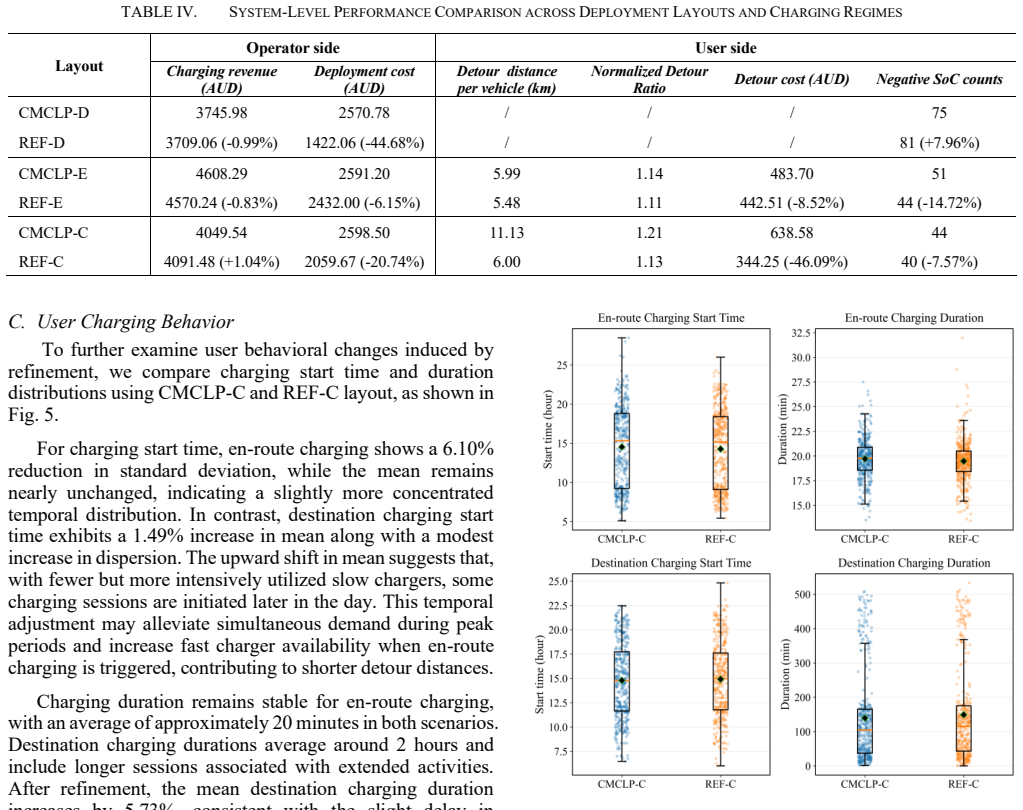
The study demonstrates that deployment strategies informed by utilization patterns from the agent-based model achieve lower total costs than optimization-based deployments. This occurs through a behavioral linkage where better destination charging options reduce reliance on en-route charging, cutting associated detour costs, particularly evident when both regimes are available to users.
What carries the argument
Agent-based modeling framework generating trajectory-level latent public charging demand under three charging regimes in a synthetic Melbourne metropolitan area.
If this is right
- Utilization-refined deployments reduce total system cost including both infrastructure and user costs.
- The most significant cost reduction occurs under the combined charging regime.
- Allocating more AC slow chargers reshapes destination charging behavior to lower en-route charging needs.
- Accounting for user response to infrastructure changes improves planning outcomes over static optimization.
Where Pith is reading between the lines
- Planning models for EV infrastructure should integrate behavioral simulations to capture regime interactions.
- These findings could extend to evaluating impacts on grid load or renewable energy integration in urban areas.
- Validation against real-world charging data from other cities would strengthen the approach.
Load-bearing premise
The agent-based model of the synthetic Melbourne area accurately predicts how users will change their charging behavior in response to different charger deployments.
What would settle it
Observing actual EV charging patterns and total costs in Melbourne after implementing a utilization-refined deployment and comparing them to the model's predictions.
Figures


read the original abstract
The rapid growth of electric vehicles (EVs) requires more effective charging infrastructure planning. Infrastructure layout not only determines deployment cost, but also reshapes charging behavior and influences overall system performance. In addition, destination charging and en-route charging represent distinct charging regimes associated with different power requirements, which may lead to substantially different infrastructure deployment outcomes. This study applies an agent-based modeling framework to generate trajectory-level latent public charging demand under three charging regimes based on a synthetic representation of the Melbourne (Australia) metropolitan area. Two deployment strategies, an optimization-based approach and a utilization-refined approach, are evaluated across different infrastructure layouts. Results show that utilization-refined deployments reduce total system cost, accounting for both infrastructure deployment cost and user generalized charging cost, with the most significant improvement observed under the combined charging regime. In particular, a more effective allocation of AC slow chargers reshapes destination charging behavior, which in turn reduces unnecessary reliance on en-route charging and lowers detour costs associated with en-route charging. This interaction highlights the behavioral linkage between destination and en-route charging regimes and demonstrates the importance of accounting for user response and multiple charging regimes in charging infrastructure planning.
Editorial analysis
A structured set of objections, weighed in public.
Referee Report
Summary. The paper applies an agent-based model to a synthetic representation of Melbourne to generate trajectory-level latent public charging demand under destination, en-route, and combined charging regimes. It compares an optimization-based deployment strategy against a utilization-refined strategy and reports that the latter reduces total system cost (infrastructure deployment plus user generalized charging cost), with the largest gains under the combined regime because improved AC slow-charger allocation reduces unnecessary en-route charging and associated detour costs.
Significance. If the behavioral responses and cost reductions hold under realistic conditions, the work demonstrates the value of jointly modeling multiple charging regimes and user adaptation in infrastructure planning, which could inform more efficient public-charging deployments. The absence of calibration, validation, or sensitivity analysis against observed Melbourne EV data, however, leaves the quantified savings dependent on untested synthetic assumptions.
major comments (2)
- [Abstract and Methods] Abstract and Methods: no calibration, validation data, error bars, or sensitivity tests are reported for the agent behavioral parameters (destination/en-route choice, detour costs, charger preferences). Because the central claim—that utilization-refined deployments lower total cost—rests on the ABM producing realistic trajectory-level demand, this omission is load-bearing.
- [Results] Results: the reported cost reductions (especially the interaction between destination and en-route regimes) are presented without robustness checks against alternative parameterizations of the synthetic population or user-response rules, so it is unclear whether the advantage of the utilization-refined strategy is robust or an artifact of the chosen assumptions.
minor comments (1)
- [Introduction] Notation for generalized charging cost and infrastructure cost components should be defined explicitly when first introduced to avoid ambiguity in the total-system-cost metric.
Simulated Author's Rebuttal
We thank the referee for the constructive and detailed comments. We agree that the lack of calibration, validation, and robustness checks against observed data is a limitation of the current synthetic modeling approach, and we will strengthen the manuscript accordingly by adding sensitivity analyses. Below we respond point by point to the major comments.
read point-by-point responses
-
Referee: [Abstract and Methods] Abstract and Methods: no calibration, validation data, error bars, or sensitivity tests are reported for the agent behavioral parameters (destination/en-route choice, detour costs, charger preferences). Because the central claim—that utilization-refined deployments lower total cost—rests on the ABM producing realistic trajectory-level demand, this omission is load-bearing.
Authors: We agree that the absence of calibration and validation against real-world Melbourne EV data is a load-bearing limitation, as the quantitative cost savings rest on the behavioral assumptions embedded in the synthetic trajectories. The agent parameters were drawn from published literature on EV charging preferences and travel behavior rather than fitted to local observations, and no formal validation or error bars from multiple runs were reported. In the revised manuscript we will add a new sensitivity analysis subsection that systematically varies the key behavioral parameters (detour cost weights, destination versus en-route choice probabilities, and charger-type preferences) across ranges reported in the literature. We will also report results from multiple stochastic replications with error bars to quantify variability in the total system cost reductions. revision: yes
-
Referee: [Results] Results: the reported cost reductions (especially the interaction between destination and en-route regimes) are presented without robustness checks against alternative parameterizations of the synthetic population or user-response rules, so it is unclear whether the advantage of the utilization-refined strategy is robust or an artifact of the chosen assumptions.
Authors: We acknowledge that the results section presents the cost reductions and regime interactions without explicit robustness checks against alternative synthetic population assumptions or user-response rules. The current synthetic population is generated from Melbourne census and travel survey aggregates, but different disaggregation rules or behavioral weights could alter the magnitude of the reported savings. In the revision we will add a set of robustness experiments that (i) perturb the synthetic population generation parameters and (ii) vary the user-response rules (e.g., alternative detour cost functions and charger preference weights). We will report the resulting ranges for the total cost advantage of the utilization-refined strategy and specifically test whether the interaction benefit under the combined regime persists across these variations. revision: yes
- We cannot supply calibration or validation against granular observed EV trajectory data for Melbourne, as such data are not publicly available at the required spatial and temporal resolution.
Circularity Check
No circularity: forward ABM simulation derives results from stated assumptions
full rationale
The paper constructs a synthetic population and agent rules for destination/en-route charging choices, then runs the ABM to generate latent demand trajectories under three regimes. Two deployment strategies are applied to those trajectories and total system cost (infrastructure + generalized user cost) is computed directly from the simulation outputs. No parameter is fitted to the reported cost savings or utilization metrics; the central claims follow from executing the forward model rather than any self-referential equation, self-citation load-bearing uniqueness theorem, or renaming of a fitted quantity. The derivation chain is therefore self-contained against the model's explicit behavioral assumptions.
Axiom & Free-Parameter Ledger
axioms (1)
- domain assumption Synthetic network and demand generation accurately represent real-world Melbourne travel patterns and charging choices.
Reference graph
Works this paper leans on
-
[1]
The Energy Agency, Global EV Outlook 2025: Expanding Sales in Diverse Markets, Paris, France, 2025
work page 2025
-
[2]
Department of Climate Change, Energy, the Environment and Water, National Electric Vehicle Strategy – Annual Update 2024–25, Canberra, Australia, 2025
work page 2024
-
[3]
W. Jing, K. An, M. Ramezani, and I. Kim, “Location Design of Electric Vehicle Charging Facilities: A Path -Distance Constrained Stochastic User Equilibrium Approach,” Journal of Advanced Transportation, vol. 2017, no. 1, p. 4252946, 2017
work page 2017
-
[4]
Electric vehicles charging infrastructure planning: a review,
I. Ullah, J. Zheng, A. Jamal, M. Zahid, M. Almoshageh, and M. Safdar, “Electric vehicles charging infrastructure planning: a review,” International Journal of Green Energy, vol. 21, no. 7, pp. 1710–1728, May 2024
work page 2024
-
[5]
G. Rodrigues et al., “Electric Charging Demand Forecast and Capture for Infrastructure Placement Using Gravity Modelling: A Case Study,” in 2023 IEEE 26th International Conference on Intelligent Transportation Systems (ITSC), Sep. 2023, pp. 2112–2117
work page 2023
-
[6]
N. Amilia, Z. Palinrungi, I. Vanany, and M. Arief, “Designing an Optimized Electric Vehicle Charging Station Infrastructure for Urban Area: A Case study from Indonesia,” in 2022 IEEE 25th International Conference on Intelligent Transportation Systems (ITSC), Oct. 2022, pp. 2812–2817
work page 2022
-
[7]
Z. Yi, B. Chen, X. C. Liu, R. Wei, J. Chen, and Z. Chen, “An agent - based modeling approach for public charging demand estimation and charging station location optimization at urban scale,” Computers, Environment and Urban Systems, vol. 101, p. 101949, Apr. 2023
work page 2023
-
[8]
M. Kavianipour et al. , “Deploying Fast Charging Infrastructure for Electric Vehicles in Urban Networks: An Activity -Based Approach,” Transportation Research Record: Journal of the Transportation Research Board, vol. 2678, no. 5, pp. 416–435, May 2024
work page 2024
-
[9]
A. Rostami, O. Verbas, B. Ghafarnezhad, A. Soltanpour, M. Ghamami, and A. Zockaie, “Exploring impacts of electricity tariff on charging infrastructure planning: An activity -based approach,” Transportation Research Part D: Transport and Environment, vol. 136, p. 104451, Nov. 2024
work page 2024
-
[10]
A. Koutounidis, D. Barzegar Dovom, M. Paulsen, D. Papadaskalopoulos, F. C. Pereira, and C. L. Azevedo, “Bayesian optimization of electric vehicle charging infrastructure location planning: An agent-based simulation approach,” Sustainable Cities and Society, vol. 134, p. 106884, Nov. 2025
work page 2025
-
[11]
Electric vehicle charging stations emplacement using genetic algorithms and agent -based simulation,
J. Jordán, J. Palanca, P. Martí, and V. Julian, “Electric vehicle charging stations emplacement using genetic algorithms and agent -based simulation,” Expert Systems with Applications, vol. 197, p. 116739, Jul. 2022
work page 2022
-
[12]
Electric vehicle charging infrastructure design: Expertise, methods, and challenges,
D. Zhao et al. , “Electric vehicle charging infrastructure design: Expertise, methods, and challenges,” Automation in Construction, vol. 180, p. 106521, Dec. 2025
work page 2025
-
[13]
Y. S. Liu, M. Tayarani, F. You, and H. O. Gao, “Bayesian optimization for battery electric vehicle charging station placement by agent -based demand simulation,” Applied Energy, vol. 375, p. 123975, Dec. 2024
work page 2024
-
[14]
A simulation-based heuristic for city -scale electric vehicle charging station placement,
R. Bi, J. Xiao, D. Pelzer, D. Ciechanowicz, D. Eckhoff, and A. Knoll, “A simulation-based heuristic for city -scale electric vehicle charging station placement,” in 2017 IEEE 20th International Conference on Intelligent Transportation Systems (ITSC), Oct. 2017, pp. 1–7
work page 2017
-
[15]
An Integrated Planning Framework for Different Types of PEV Charging Facilities in Urban Area,
H. Zhang, Z. Hu, Z. Xu, and Y. Song, “An Integrated Planning Framework for Different Types of PEV Charging Facilities in Urban Area,” IEEE Transactions on Smart Grid, vol. 7, no. 5, pp. 2273–2284, Sep. 2016
work page 2016
-
[16]
H. Wang, B. Guo, X. Zhou, S. Wang, Z. Hong, and T. He, “Resource- Oriented Optimization of Electric Vehicle Systems: A Data -Driven Survey on Charging Infrastructure, Scheduling, and Fleet Management,” 2025
work page 2025
-
[17]
D. Ziemke, I. Kaddoura, and K. Nagel, “The MATSim Open Berlin Scenario: A multimodal agent-based transport simulation scenario based on synthetic demand modeling and open data,” Procedia Computer Science, vol. 151, pp. 870–877, Jan. 2019
work page 2019
-
[18]
A Modeling Framework for Behavior, Energy, Autonomy and Mobility (BEAM)
H. Laarabi, Z. Needell, R. Waraich, C. Poliziani, and T. Wenzel, “A Modeling Framework for Behavior, Energy, Autonomy and Mobility (BEAM)” Lawrence Berkeley National Laboratory, Berkeley, CA, USA, Feb. 2024
work page 2024
-
[19]
Charging infrastructure demands of shared -use autonomous electric vehicles in urban areas,
H. Zhang, C. J. R. Sheppard, T. E. Lipman, T. Zeng, and S. J. Moura, “Charging infrastructure demands of shared -use autonomous electric vehicles in urban areas,” Transportation Research Part D: Transport and Environment, vol. 78, p. 102210, Jan. 2020,
work page 2020
-
[20]
An Activity-and Agent-based Co-Simulation Framework for the Metropolitan Rotterdam The Hague Region,
J. Li, H. Zhou, M. Snelder, B. van Arem, and J. Gao, “An Activity-and Agent-based Co-Simulation Framework for the Metropolitan Rotterdam The Hague Region,” Procedia Computer Science, vol. 257, pp. 959–965, Jan. 2025
work page 2025
-
[21]
A. Jafari et al. , “Activity-based and agent -based transport model of Melbourne: an open multi-modal transport simulation model for Greater Melbourne,” Journal of Intelligent Transportation Systems, vol. 29, no. 4, pp. 417–434, Jul. 2025
work page 2025
-
[22]
EV Inequality: 34% of Australians Unable to Install an EV Charger at Home - Savvy
“EV Inequality: 34% of Australians Unable to Install an EV Charger at Home - Savvy.” Accessed: Feb. 15, 2026. [Online]. Available: https://savvy.com.au/media-releases/home-ev-charger-and-solar- installation-survey-2023/
work page 2026
-
[23]
A Nationwide Comparison of Driving Distance Versus Straight-Line Distance to Hospitals,
F. P. Boscoe, K. A. Henry, and M. S. Zdeb, “A Nationwide Comparison of Driving Distance Versus Straight-Line Distance to Hospitals,” Prof Geogr, vol. 64, no. 2, p. 10.1080/00330124.2011.583586, Apr. 2012
discussion (0)
Sign in with ORCID, Apple, or X to comment. Anyone can read and Pith papers without signing in.