Recognition: 2 theorem links
· Lean TheoremA Tutorial on Learning-Based Radio Map Construction: Data, Paradigms, and Physics-Awareness
Pith reviewed 2026-05-15 09:21 UTC · model grok-4.3
The pith
Learning-based radio map construction is organized by data sources, neural paradigms, and three levels of physics integration.
A machine-rendered reading of the paper's core claim, the machinery that carries it, and where it could break.
Core claim
The paper establishes a core taxonomy that divides radio map construction into source-aware forward prediction and source-agnostic inverse reconstruction, surveys five principal neural architecture families spanning convolutional networks, vision transformers, graph networks, generative adversarial networks, and diffusion models, adapts optics-inspired continuous modeling from neural radiance fields and 3D Gaussian splatting, and introduces a three-level physics integration framework consisting of data-level feature engineering, loss-level partial differential equation regularization, and architecture-level structural isomorphism.
What carries the argument
The core taxonomy of source-aware forward prediction versus source-agnostic inverse reconstruction together with the three-level physics integration framework that spans data-level, loss-level, and architecture-level incorporation of physical knowledge.
If this is right
- The taxonomy enables systematic placement of existing work into forward prediction or inverse reconstruction categories.
- Neural architectures and optics-inspired methods can be compared within a shared physics-integration structure.
- Three-level physics incorporation is positioned to improve generalization and reduce reliance on purely data-driven training.
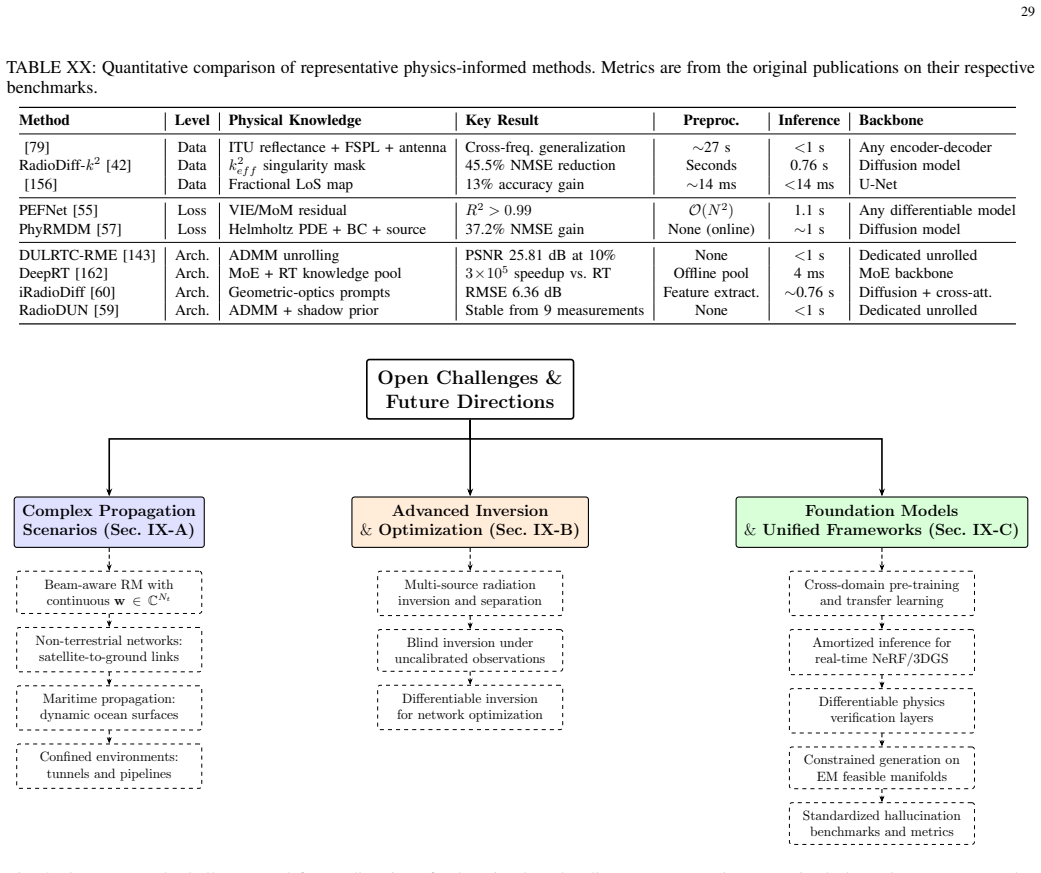
- Identified open challenges such as foundation models and physical hallucination detection define concrete directions for subsequent research.
Where Pith is reading between the lines
- The framework could support standardized benchmarking across wireless AI methods that currently use incompatible radio-map representations.
- Greater emphasis on architecture-level physics isomorphism might reduce training data needs in spectrum-scarce environments.
- Continuous-field modeling borrowed from computer vision could extend to real-time 3D radio map updates if paired with amortized inference techniques.
Load-bearing premise
The proposed taxonomy and three-level physics integration framework accurately and usefully categorize the existing literature on learning-based radio map construction.
What would settle it
Discovery of a learning-based radio map method that fits neither source-aware forward prediction nor source-agnostic inverse reconstruction would falsify the completeness of the central taxonomy.
Figures


read the original abstract
The integration of artificial intelligence into next-generation wireless networks necessitates the accurate construction of radio maps (RMs) as a foundational prerequisite for electromagnetic digital twins. A RM provides the digital representation of the wireless propagation environment, mapping complex geographical and topological boundary conditions to critical spatial-spectral metrics that range from received signal strength to full channel state information matrices. This tutorial presents a comprehensive survey of learning-based RM construction, systematically addressing three intertwined dimensions: data, paradigms, and physics-awareness. From the data perspective, we review physical measurement campaigns, ray tracing simulation engines, and publicly available benchmark datasets, identifying their respective strengths and fundamental limitations. From the paradigm perspective, we establish a core taxonomy that categorizes RM construction into source-aware forward prediction and source-agnostic inverse reconstruction, and examine five principal neural architecture families spanning convolutional neural networks, vision transformers, graph neural networks, generative adversarial networks, and diffusion models. We further survey optics-inspired methods adapted from neural radiance fields and 3D Gaussian splatting for continuous wireless radiation field modeling. From the physics-awareness perspective, we introduce a three-level integration framework encompassing data-level feature engineering, loss-level partial differential equation regularization, and architecture-level structural isomorphism. Open challenges including foundation model development, physical hallucination detection, and amortized inference for real-time deployment are discussed to outline future research directions. The project page is at https://github.com/UNIC-Lab/Awesome-Radio-Map-Categorized.
Editorial analysis
A structured set of objections, weighed in public.
Referee Report
Summary. This tutorial surveys learning-based radio map construction for electromagnetic digital twins in wireless networks. It reviews data sources (physical measurements, ray tracing, public benchmarks) and their limitations; establishes a taxonomy separating source-aware forward prediction from source-agnostic inverse reconstruction; surveys five neural architecture families (CNNs, vision transformers, GNNs, GANs, diffusion models) plus optics-inspired methods (NeRF, 3D Gaussian splatting); introduces a three-level physics-awareness framework (data-level feature engineering, loss-level PDE regularization, architecture-level structural isomorphism); and discusses open challenges including foundation models, physical hallucination detection, and amortized real-time inference.
Significance. If the taxonomy and three-level framework accurately organize the literature, the tutorial provides a valuable structured reference for integrating AI with wireless propagation modeling. The curated GitHub repository of categorized works strengthens accessibility and reproducibility. The survey's emphasis on physics-awareness addresses a timely gap between data-driven methods and electromagnetic constraints, potentially guiding future hybrid approaches.
minor comments (3)
- [Abstract] The abstract states the taxonomy and framework but does not indicate the approximate number of papers reviewed or the time span of the literature covered; adding this would help readers gauge scope.
- [Paradigm perspective] In the paradigm section, the distinction between source-aware forward prediction and source-agnostic inverse reconstruction is central; a short table comparing representative methods from each category (with key metrics or references) would improve clarity.
- [Open challenges] The open-challenges paragraph on physical hallucination detection would benefit from one concrete example drawn from the surveyed literature or an adjacent field (e.g., NeRF artifacts) to make the issue more tangible.
Simulated Author's Rebuttal
We thank the referee for the positive evaluation of our tutorial, the recognition of its structured taxonomy and three-level physics-awareness framework, and the recommendation for minor revision. We appreciate the acknowledgment that the curated GitHub repository enhances accessibility and that the emphasis on physics-awareness addresses a timely gap in the literature.
Circularity Check
No significant circularity in survey taxonomy and framework
full rationale
This is a tutorial survey with no internal derivations, equations, fitted parameters, or new theoretical claims. The core taxonomy (source-aware forward prediction vs. source-agnostic inverse reconstruction) and three-level physics integration framework are presented as organizational lenses applied to external literature. All content relies on cited prior work rather than self-referential definitions or load-bearing self-citations. No step reduces to its own inputs by construction, satisfying the criteria for a self-contained survey with score 0.
Axiom & Free-Parameter Ledger
Lean theorems connected to this paper
-
IndisputableMonolith/Cost/FunctionalEquationwashburn_uniqueness_aczel unclear?
unclearRelation between the paper passage and the cited Recognition theorem.
three-level integration framework encompassing data-level feature engineering, loss-level partial differential equation regularization, and architecture-level structural isomorphism
-
IndisputableMonolith/Foundation/AlexanderDualityalexander_duality_circle_linking unclear?
unclearRelation between the paper passage and the cited Recognition theorem.
Helmholtz equation ∇²u(r) + k²(r)u(r) = −f(r)
What do these tags mean?
- matches
- The paper's claim is directly supported by a theorem in the formal canon.
- supports
- The theorem supports part of the paper's argument, but the paper may add assumptions or extra steps.
- extends
- The paper goes beyond the formal theorem; the theorem is a base layer rather than the whole result.
- uses
- The paper appears to rely on the theorem as machinery.
- contradicts
- The paper's claim conflicts with a theorem or certificate in the canon.
- unclear
- Pith found a possible connection, but the passage is too broad, indirect, or ambiguous to say the theorem truly supports the claim.
Forward citations
Cited by 5 Pith papers
-
Map2APS: A Physically Grounded Benchmark for Direct Angle Power Spectrum Prediction from Urban Geometry
Map2APS is a new large-scale benchmark with 2.55 million samples from 51 urban maps for predicting angle power spectra from geometry, featuring a cross-map split and MS-AReg baseline with 0.948 cosine similarity.
-
Path-Level Radio Map-Aided Fast and Robust Channel Estimation for Pilot-Starved MIMO-OFDM Systems
CHARM extracts ADPS priors from path-level radio maps to reduce 3D angle-delay-AoD search to 1D AoD search per path, delivering 34.8x speedup over joint OMP at T≤4 pilots with comparable accuracy and only 3.7 dB degra...
-
TGPP: Trajectory-Guided Plug-and-Play Priors for Sparse Radio Map Reconstruction
TGPP adds trajectory-guided priors to various reconstruction backbones and a new RadioFlow-LDM model, reducing NMSE by up to 43.1% on trajectory-sampled radio map data.
-
Learning Coverage- and Power-Optimal Transmitter Placement from Building Maps: A Comparative Study of Direct and Indirect Neural Approaches
Neural models predict coverage- and power-optimal transmitter locations from building maps, matching exhaustive search performance at 14-2400x speedups while quantifying an asymmetric coverage-power trade-off.
-
Beam-Aware Radio Map Estimation With Physics-Consistent Parametric Modeling for Unknown Multiple Satellites
A unified parametric framework identifies active satellites and reconstructs RSS fields from measurements by linking beam geometry to spatial signal formation with adaptive complexity control.
Reference graph
Works this paper leans on
-
[1]
S. Dang, O. Amin, B. Shihada, and M.-S. Alouini, “What should 6g be?”Nature Electronics, vol. 3, no. 1, pp. 20–29, 2020
work page 2020
-
[2]
6G omni-scenario on-demand services provisioning: vision, technology and prospect(in chinese),
N. Cheng, F. Chen, W. Chen, Z. Cheng, Q. Yang, C. Li, and X. Shen, “6G omni-scenario on-demand services provisioning: vision, technology and prospect(in chinese),”Sci Sin Inform, vol. 54, pp. 1025–1054, 2024
work page 2024
-
[3]
Measurement-based massive mimo channel modeling for outdoor los and nlos environments,
J. Chen, X. Yin, X. Cai, and S. Wang, “Measurement-based massive mimo channel modeling for outdoor los and nlos environments,”IEEE access, vol. 5, pp. 2126–2140, 2017
work page 2017
-
[4]
M. Boban and V . Degli-Esposti, “White paper on radio channel modeling and prediction to support future environment-aware wireless communication systems,”arXiv preprint arXiv:2309.17088, 2023
-
[5]
A tutorial on environment-aware communications via channel knowledge map for 6g,
Y . Zeng, J. Chen, J. Xu, D. Wu, X. Xu, S. Jin, X. Gao, D. Gesbert, S. Cui, and R. Zhang, “A tutorial on environment-aware communications via channel knowledge map for 6g,”IEEE communications surveys & tutorials, vol. 26, no. 3, pp. 1478–1519, 2024
work page 2024
-
[6]
Learnable wireless digital twins: Reconstructing electromagnetic field with neural representations,
S. Jiang, Q. Qu, X. Pan, A. K. Agrawal, R. Newcombe, and A. Alkha- teeb, “Learnable wireless digital twins: Reconstructing electromagnetic field with neural representations,”IEEE Open Journal of the Communi- cations Society, vol. 6, pp. 1568–1590, 2025
work page 2025
-
[7]
Toward immersive communications in 6g,
X. Shen, J. Gao, M. Li, C. Zhou, S. Hu, M. He, and W. Zhuang, “Toward immersive communications in 6g,”Frontiers in Computer Science, vol. 4, p. 1068478, 2023
work page 2023
-
[8]
Machine learning for channel quality prediction: From concept to experimental validation,
Z. Becvar, J. Plachy, P. Mach, A. Nikolov, and D. Gesbert, “Machine learning for channel quality prediction: From concept to experimental validation,”IEEE Transactions on Wireless Communications, vol. 23, no. 10, pp. 14 605–14 619, 2024
work page 2024
-
[9]
Y . Okawa, N. Morita, J. Kakuta, and M. Ogawa, “Optimal base station sleep control via multi-agent reinforcement learning with data-driven radio environment map calibration,” in2024 IEEE 99th Vehicular Technology Conference (VTC2024-Spring). IEEE, 2024, pp. 1–6
work page 2024
-
[10]
Mobile crowd-sensing wireless activity with measured interference power,
W. Guo and S. Wang, “Mobile crowd-sensing wireless activity with measured interference power,”IEEE wireless communications letters, vol. 2, no. 5, pp. 539–542, 2013
work page 2013
-
[11]
Rem-u-net: Deep learning based agile rem prediction with energy-efficient cell-free use case,
H. Sallouha, S. Sarkar, E. Krijestorac, and D. Cabric, “Rem-u-net: Deep learning based agile rem prediction with energy-efficient cell-free use case,”IEEE open journal of signal processing, vol. 5, pp. 750–765, 2024
work page 2024
-
[12]
Intelligent reconstruction algorithm of electromagnetic map based on propagation model,
H. Li, H. Wang, Z. Shen, and Y . Shi, “Intelligent reconstruction algorithm of electromagnetic map based on propagation model,”Journal of Communications and Networks, vol. 26, no. 5, pp. 533–544, 2024
work page 2024
-
[13]
Machine learning for radio propagation modeling: A comprehensive survey,
M. Vasudevan and M. Yuksel, “Machine learning for radio propagation modeling: A comprehensive survey,”IEEE Open Journal of the Communications Society, vol. 5, pp. 5123–5153, 2024
work page 2024
-
[14]
Dominant path prediction model for urban scenarios,
R. Wahl, G. W¨olfle, P. Wertz, P. Wildbolz, and F. Landstorfer, “Dominant path prediction model for urban scenarios,” in14th IST mobile and wireless communications summit, 2005, pp. 1–5
work page 2005
-
[15]
T. Rautiainen, G. Wolfle, and R. Hoppe, “Verifying path loss and delay spread predictions of a 3D ray tracing propagation model in urban environment,” inProceedings IEEE 56th Vehicular Technology Conference, vol. 4. IEEE, 2002, pp. 2470–2474
work page 2002
-
[16]
Ray techniques in electromagnetics,
G. Deschamps, “Ray techniques in electromagnetics,” inIEEE Proceed- ings, vol. 60, no. 9, 1972, pp. 1022–1035
work page 1972
-
[17]
An overview of propagation models based on deep learning techniques,
J. Mladenovi ´c, A. Ne ˇskovi´c, and N. Ne ˇskovi´c, “An overview of propagation models based on deep learning techniques,”International Journal of Electrical Engineering and Computing, vol. 6, no. 1, pp. 18–25, 2022
work page 2022
-
[18]
Sionna rt: Differentiable ray tracing for radio propagation modeling,
J. Hoydis, F. A ¨ıt Aoudia, S. Cammerer, M. Nimier-David, N. Binder, G. Marcus, and A. Keller, “Sionna rt: Differentiable ray tracing for radio propagation modeling,” in2023 IEEE Globecom Workshops (GC Wkshps). IEEE, 2023, pp. 317–321
work page 2023
-
[19]
X. Wang, P. Zheng, N. Cheng, R. Sun, J. Chen, K. Tao, Z. Yin, Z. Liu, and Y . Zeng, “Radiodiff-turbo: Lightweight generative large electromagnetic model for wireless digital twin construction,” inIEEE INFOCOM 2025 - IEEE Conference on Computer Communications Workshops (INFOCOM WKSHPS), 2025, pp. 1–6
work page 2025
-
[20]
N. Sagir and Z. H. Tugcu, “Machine-learning-based path loss predic- tion for vehicle-to-vehicle communication in highway environments,” Applied Sciences, vol. 14, no. 17, p. 7545, 2024
work page 2024
-
[21]
Radiounet: Fast radio map estimation with convolutional neural networks,
R. Levie, C ¸. Yapar, G. Kutyniok, and G. Caire, “Radiounet: Fast radio map estimation with convolutional neural networks,”IEEE Transactions on Wireless Communications, vol. 20, no. 6, pp. 4001–4015, 2021
work page 2021
-
[22]
Pmnet: Robust pathloss map prediction via supervised learning,
J.-H. Lee, O. G. Serbetci, D. P. Selvam, and A. F. Molisch, “Pmnet: Robust pathloss map prediction via supervised learning,” inGLOBE- COM 2023-2023 IEEE Global Communications Conference. IEEE, 2023, pp. 4601–4606
work page 2023
-
[23]
Rmtransformer: Accurate radio map construction and coverage prediction,
Y . Li, C. Zhang, W. Wang, and Y . Huang, “Rmtransformer: Accurate radio map construction and coverage prediction,” in2025 IEEE 101st Vehicular Technology Conference (VTC2025-Spring). IEEE, 2025, pp. 1–5
work page 2025
-
[24]
Deep completion autoencoders for radio map estimation,
Y . Teganya and D. Romero, “Deep completion autoencoders for radio map estimation,”IEEE Transactions on Wireless Communications, vol. 21, no. 3, pp. 1710–1724, 2021
work page 2021
-
[25]
Deeprem: Deep-learning- based radio environment map estimation from sparse measurements,
A. Chaves-Villota and C. A. Viteri-Mera, “Deeprem: Deep-learning- based radio environment map estimation from sparse measurements,” IEEE Access, vol. 11, pp. 48 697–48 714, 2023
work page 2023
-
[26]
Z. Fang, K. Liu, K. Chen, Q. Liu, J. Zhang, L. Song, and Y . Wang, “Radioformer: A multiple-granularity radio map estimation trans- former with 1 \textpertenthousand spatial sampling,”arXiv preprint arXiv:2504.19161, 2025
-
[27]
Prediction of indoor wireless coverage from 3d floor plans using deep convolutional neural networks
Y . Ansari, N. Tiyal, E. F. Flushing, and S. Razak, “Prediction of indoor wireless coverage from 3d floor plans using deep convolutional neural networks.” inLCN, 2021, pp. 435–438
work page 2021
-
[28]
Visual transformer based unified framework for radio map estimation and optimized site selection,
C. Liaq, Y . Zheng, J. Wang, and S. Liu, “Visual transformer based unified framework for radio map estimation and optimized site selection,” IEICE Transactions on Communications, 2025
work page 2025
-
[29]
Paying deformable attention to sparse spatial observations for deep radio map estimation,
K. Liu, C. Qiu, K. Chen, Q. Zheng, L. Song, and Y . Wang, “Paying deformable attention to sparse spatial observations for deep radio map estimation,”IEEE Trans. Cogn. Commun. Netw., 2025
work page 2025
-
[30]
Transformer- based neural surrogate for link-level path loss prediction from variable- sized maps,
T. M. Hehn, T. Orekondy, O. Shental, A. Behboodi, J. Bucheli, A. Doshi, J. Namgoong, T. Yoo, A. Sampath, and J. B. Soriaga, “Transformer- based neural surrogate for link-level path loss prediction from variable- sized maps,” inGLOBECOM 2023-2023 IEEE Global Communications Conference. IEEE, 2023, pp. 4804–4809
work page 2023
-
[31]
X. Li, S. Zhang, H. Li, X. Li, L. Xu, H. Xu, H. Mei, G. Zhu, N. Qi, and M. Xiao, “Radiogat: A joint model-based and data-driven framework for multi-band radiomap reconstruction via graph attention networks,” IEEE Transactions on Wireless Communications, vol. 23, no. 11, pp. 17 777–17 792, 2024
work page 2024
-
[32]
A graph neural network based radio map construction method for urban environment,
G. Chen, Y . Liu, T. Zhang, J. Zhang, X. Guo, and J. Yang, “A graph neural network based radio map construction method for urban environment,”IEEE Communications Letters, vol. 27, no. 5, pp. 1327– 1331, 2023
work page 2023
-
[33]
Wirelessnet: An efficient radio access network model based on heterogeneous graph neural networks,
J. Perdomo, M. A. Gutierrez-Estevez, C. Zhou, and J. F. Monserrat, “Wirelessnet: An efficient radio access network model based on heterogeneous graph neural networks,”IEEE Access, 2025
work page 2025
-
[34]
Data-driven radio environment map estimation using graph neural networks,
A. Shibli and T. Zanouda, “Data-driven radio environment map estimation using graph neural networks,” in2024 IEEE International Conference on Communications Workshops (ICC Workshops). IEEE, 2024, pp. 650–655
work page 2024
-
[35]
S. Zhang, A. Wijesinghe, and Z. Ding, “Rme-gan: A learning framework for radio map estimation based on conditional generative adversarial network,”IEEE Internet of Things Journal, vol. 10, no. 20, pp. 18 016– 18 027, 2023
work page 2023
-
[36]
Tire-gan: Task-incentivized generative learning for radiomap estimation,
Y . Zhou, A. Wijesinghe, Y . Ma, S. Zhang, and Z. Ding, “Tire-gan: Task-incentivized generative learning for radiomap estimation,”IEEE Wireless Communications Letters, 2025
work page 2025
-
[37]
Act-gan: Radio map construction based on generative adversarial networks with act blocks,
Q. Chen, J. Yang, M. Huang, and Q. Zhou, “Act-gan: Radio map construction based on generative adversarial networks with act blocks,” IET communications, vol. 18, no. 19, pp. 1541–1550, 2024
work page 2024
-
[38]
Z. Pan, Z. Bangning, W. Heng, M. Wenfeng, and G. Daoxing, “Sc- gan: A spectrum cartography with satellite internet based on pix2pix generative adversarial network,”China Communications, vol. 22, no. 2, pp. 47–61, 2025
work page 2025
-
[39]
Recugan: A novel generative ai approach for synthesizing rf coverage maps,
S. Sarkar, M. H. Manshaei, M. Krunz, and H. Ravaee, “Recugan: A novel generative ai approach for synthesizing rf coverage maps,” in 2024 33rd International Conference on Computer Communications and Networks (ICCCN). IEEE, 2024, pp. 1–9. 32
work page 2024
-
[40]
Radio map estimation using a cyclegan-based learning framework for 6g wireless communication,
Y . Ma, C. Zhang, C. He, and X. Li, “Radio map estimation using a cyclegan-based learning framework for 6g wireless communication,” Digital Communications and Networks, 2025
work page 2025
-
[41]
Radiodiff: An effective generative diffusion model for sampling-free dynamic radio map construction,
X. Wang, K. Tao, N. Cheng, Z. Yin, Z. Li, Y . Zhang, and X. Shen, “Radiodiff: An effective generative diffusion model for sampling-free dynamic radio map construction,”IEEE Transactions on Cognitive Communications and Networking, vol. 11, no. 2, pp. 738–750, 2025
work page 2025
-
[42]
X. Wang, Q. Zhang, N. Cheng, R. Sun, Z. Li, S. Cui, and X. Shen, “Radiodiff-k2: Helmholtz equation informed generative diffusion model for multi-path aware radio map construction,”IEEE Journal on Selected Areas in Communications, 2025
work page 2025
-
[43]
X. Wang, Q. Zhang, N. Cheng, J. Chen, Z. Zhang, Z. Li, S. Cui, and X. Shen, “Radiodiff-3d: A 3d × 3d radio map dataset and generative diffusion based benchmark for 6g environment-aware communication,” IEEE Transactions on Network Science and Engineering, 2025
work page 2025
-
[44]
Rm-gen: Conditional diffusion model-based radio map generation for wireless networks,
X. Luo, L. Zhizhen, Z. Peng, X. Dongkuan, and Y . Liu, “Rm-gen: Conditional diffusion model-based radio map generation for wireless networks,” in2024 IFIP Networking Conference (IFIP Networking). IEEE, 2024, pp. 543–548
work page 2024
-
[45]
Denoising diffusion probabilistic model for radio map estimation in generative wireless networks,
X. Luo, Z. Li, Z. Peng, M. Chen, and Y . Liu, “Denoising diffusion probabilistic model for radio map estimation in generative wireless networks,”IEEE Transactions on Cognitive Communications and Networking, vol. 11, no. 2, pp. 751–763, 2025
work page 2025
-
[46]
Z. Liu, S. Zhang, Q. Liu, H. Zhang, and L. Song, “Wifi-diffusion: Achieving fine-grained wifi radio map estimation with ultra-low sampling rate by diffusion models,”IEEE Journal on Selected Areas in Communications, 2025
work page 2025
-
[47]
Generative ckm construction using partially observed data with diffusion model,
S. Fu, Z. Wu, D. Wu, and Y . Zeng, “Generative ckm construction using partially observed data with diffusion model,” in2025 IEEE 101st Vehicular Technology Conference (VTC2025-Spring). IEEE, 2025, pp. 1–5
work page 2025
-
[48]
3d-radiodiff: An altitude-conditioned diffusion model for 3d radio map construction,
L. Zhao, Z. Fei, X. Wang, J. Luo, and Z. Zheng, “3d-radiodiff: An altitude-conditioned diffusion model for 3d radio map construction,” IEEE Wireless Communications Letters, 2025
work page 2025
-
[49]
Z. Dai, D. Wu, Y . Zeng, X. Xu, X. Wang, and Z. Fei, “Bs-1-to-n: Diffusion-based environment-aware cross-bs channel knowledge map generation for cell-free networks,”arXiv preprint arXiv:2507.23236, 2025
-
[50]
Denoising diffusion probabilistic models,
J. Ho, A. Jain, and P. Abbeel, “Denoising diffusion probabilistic models,” Advances in neural information processing systems, vol. 33, pp. 6840– 6851, 2020
work page 2020
-
[51]
Nerf2: Neural radio-frequency radiance fields,
X. Zhao, Z. An, Q. Pan, and L. Yang, “Nerf2: Neural radio-frequency radiance fields,” inProceedings of the 29th Annual International Conference on Mobile Computing and Networking, 2023, pp. 1–15
work page 2023
-
[52]
Wrf-gs: Wireless radiation field reconstruction with 3d gaussian splatting,
C. Wen, J. Tong, Y . Hu, Z. Lin, and J. Zhang, “Wrf-gs: Wireless radiation field reconstruction with 3d gaussian splatting,” inIEEE INFOCOM 2025-IEEE Conference on Computer Communications. IEEE, 2025, pp. 1–10
work page 2025
-
[53]
Rf-3dgs: Wireless channel modeling with radio radiance field and 3d gaussian splatting,
L. Zhang, H. Sun, S. Berweger, C. Gentile, and R. Q. Hu, “Rf-3dgs: Wireless channel modeling with radio radiance field and 3d gaussian splatting,”IEEE Transactions on Wireless Communications, vol. 25, pp. 10 419–10 433, 2026
work page 2026
-
[54]
Physics-informed machine learning,
G. E. Karniadakis, I. G. Kevrekidis, L. Lu, P. Perdikaris, S. Wang, and L. Yang, “Physics-informed machine learning,”Nature Reviews Physics, vol. 3, no. 6, pp. 422–440, 2021
work page 2021
-
[55]
F. Jiang, T. Li, X. Lv, H. Rui, and D. Jin, “Physics-informed neural networks for path loss estimation by solving electromagnetic integral equations,”IEEE Transactions on Wireless Communications, vol. 23, no. 10, pp. 15 380–15 393, 2024
work page 2024
-
[56]
Pinn and gnn-based rf map construction for wireless communication systems,
L. Liu, X. Chen, Z. Tang, M. Ma, and W. Zhang, “Pinn and gnn-based rf map construction for wireless communication systems,” in2025 International Conference on Future Communications and Networks (FCN). IEEE, 2025, pp. 1–6
work page 2025
-
[57]
Rmdm: Radio map diffusion model with physics informed,
H. Jia, W. Chen, Z. Huang, H. Xiao, N. Jia, K. Wu, S. Lai, and Y . Yue, “Rmdm: Radio map diffusion model with physics informed,” in Proceedings of the 33rd ACM International Conference on Multimedia (MM)’25. Association for Computing Machinery, 2025
work page 2025
-
[58]
Physics- guided language model via low-rank adaptation for path loss prediction,
X. Feng, J. Xiong, X. Liu, X. Zhang, H. Zhao, and J. Wei, “Physics- guided language model via low-rank adaptation for path loss prediction,” IEEE Transactions on Cognitive Communications and Networking, 2025
work page 2025
-
[59]
Radiodun: A physics-inspired deep unfolding network for radio map estimation,
T. Chen, Z. Zhou, Z. Fang, W. Zou, K. Liu, K. Chen, Y . Zhang, and Y . Wang, “Radiodun: A physics-inspired deep unfolding network for radio map estimation,”arXiv preprint arXiv:2506.08418, 2025
-
[60]
iradiodiff: Physics-informed diffusion model for indoor radio map construction and localization,
X. Wang, T. Yuan, Y . Cao, N. Cheng, R. Sun, and W. Zhuang, “iradiodiff: Physics-informed diffusion model for indoor radio map construction and localization,” inICC 2026 - IEEE International Conference on Communications, 2026, pp. 1–6
work page 2026
-
[61]
Deep learning in wireless communication receivers: A survey,
S. R. Doha and A. Abdelhadi, “Deep learning in wireless communication receivers: A survey,”Ieee Access, vol. 13, pp. 113 586–113 605, 2025
work page 2025
-
[62]
A recent survey on radio map estimation methods for wireless networks,
B. Feng, M. Zheng, W. Liang, and L. Zhang, “A recent survey on radio map estimation methods for wireless networks,”Electronics, vol. 14, no. 8, p. 1564, 2025
work page 2025
-
[63]
X. Wang, P. Zheng, H. Jia, N. Cheng, R. Sun, C. Zhou, and X. Shen, “Radiodiff-flux: Efficient radio map construction via generative denoise diffusion model trajectory midpoint reuse,”IEEE Transactions on Cognitive Communications and Networking, vol. 12, pp. 4882–4895, 2025
work page 2025
-
[64]
Neural gaussian radio fields for channel estimation,
M. Umer, M. A. Mohsin, A. Bilal, and J. M. Cioffi, “Neural gaussian radio fields for channel estimation,”arXiv preprint arXiv:2508.11668, 2025
-
[65]
6d channel knowledge map construction via bidirectional wireless gaussian splatting,
J. Zhou, C. Hu, G. Wu, Z. Ren, H. Hu, J. Zhang, R. Zhang, and J. Xu, “6d channel knowledge map construction via bidirectional wireless gaussian splatting,”arXiv preprint arXiv:2510.26166, 2025
-
[66]
Computational electro- magnetics: the finite-difference time-domain method,
A. Taflove, S. C. Hagness, and M. Piket-May, “Computational electro- magnetics: the finite-difference time-domain method,”The Electrical Engineering Handbook, vol. 3, no. 629-670, p. 15, 2005
work page 2005
-
[67]
C. A. Balanis,Antenna theory: analysis and design. John wiley & sons, 2016
work page 2016
-
[68]
An introduction to variational autoencoders,
P. K. Diederik and W. Max, “An introduction to variational autoencoders,” Foundations and Trends® in Machine Learning, vol. 12, no. 4, pp. 307– 392, 2019
work page 2019
-
[69]
Score-Based Generative Modeling through Stochastic Differential Equations
Y . Song, J. Sohl-Dickstein, D. P. Kingma, A. Kumar, S. Ermon, and B. Poole, “Score-based generative modeling through stochastic differential equations,”arXiv preprint arXiv:2011.13456, 2020
work page internal anchor Pith review Pith/arXiv arXiv 2011
-
[70]
Reverse-time diffusion equation models,
B. D. Anderson, “Reverse-time diffusion equation models,”Stochastic Processes and their Applications, vol. 12, no. 3, pp. 313–326, 1982
work page 1982
-
[71]
A connection between score matching and denoising autoencoders,
P. Vincent, “A connection between score matching and denoising autoencoders,”Neural computation, vol. 23, no. 7, pp. 1661–1674, 2011
work page 2011
-
[72]
Nerf: Representing scenes as neural radiance fields for view synthesis,
B. Mildenhall, P. P. Srinivasan, M. Tancik, J. T. Barron, R. Ramamoorthi, and R. Ng, “Nerf: Representing scenes as neural radiance fields for view synthesis,”Communications of the ACM, vol. 65, no. 1, pp. 99–106, 2021
work page 2021
-
[73]
Sip2net: Situational-aware indoor pathloss-map prediction network for radio map generation,
W. Lu, Z. Lu, J. Yan, and S. Gao, “Sip2net: Situational-aware indoor pathloss-map prediction network for radio map generation,” inICASSP 2025-2025 IEEE International Conference on Acoustics, Speech and Signal Processing (ICASSP). IEEE, 2025, pp. 1–2
work page 2025
-
[74]
Radioresunet: Wireless measurement by deep learning for indoor environments,
C.-W. Pyo, H. Sawada, and T. Matsumura, “Radioresunet: Wireless measurement by deep learning for indoor environments,” in2022 25th International Symposium on Wireless Personal Multimedia Communi- cations (WPMC). IEEE, 2022, pp. 104–109
work page 2022
-
[75]
A deep learning-based indoor radio estimation method driven by 2.4 ghz ray-tracing data,
C. Pyo, H. Sawada, and T. Matsumura, “A deep learning-based indoor radio estimation method driven by 2.4 ghz ray-tracing data,”IEEE Access, vol. 11, pp. 138 215–138 228, 2023
work page 2023
-
[76]
Deep learning for reduced sampling spatial 3-d rem reconstruction,
A. Ivanov, K. Tonchev, V . Poulkov, and A. Manolova, “Deep learning for reduced sampling spatial 3-d rem reconstruction,”IEEE Open Journal of the Communications Society, vol. 5, pp. 2287–2301, 2024
work page 2024
-
[77]
Channel fingerprint construction for massive mimo: A deep conditional generative approach,
Z. Jin, L. You, X. Li, Z. Gao, Y . Liu, X.-G. Xia, and X. Gao, “Channel fingerprint construction for massive mimo: A deep conditional generative approach,”IEEE Transactions on Wireless Communications, 2025
work page 2025
-
[78]
Beamckmdiff: Beam- aware channel knowledge map construction via diffusion transformer,
L. Zhao, Y . Wang, X. Wang, Z. Fei, and Y . Zeng, “Beamckmdiff: Beam- aware channel knowledge map construction via diffusion transformer,” arXiv preprint arXiv:2601.10207, 2026
-
[79]
W. Chen and J. Chen, “Diffraction and scattering aware radio map and environment reconstruction using geometry model-assisted deep learning,”IEEE Transactions on Wireless Communications, vol. 23, no. 12, pp. 19 804–19 819, 2024
work page 2024
-
[80]
Unirm: A universal large model for multiband 3d radio map construction,
X. Jiang, T. Li, Z. Xiao, K. Chen, S. Ma, Z. Wang, and K. Li, “Unirm: A universal large model for multiband 3d radio map construction,”IEEE Journal on Selected Areas in Communications, 2025
work page 2025
discussion (0)
Sign in with ORCID, Apple, or X to comment. Anyone can read and Pith papers without signing in.