Observable-Conditioned Backaction in Dynamic Circuits: A Higher-Order Context-Conditioned Kernel for Local Dynamics
Pith reviewed 2026-05-15 09:12 UTC · model grok-4.3
The pith
Mid-circuit measurement backaction in dynamic circuits requires a higher-order context-conditioned kernel beyond standard proxies.
A machine-rendered reading of the paper's core claim, the machinery that carries it, and where it could break.
Core claim
The central claim is that the effective backaction kernel decomposes as Γ_eff[Y,O] = Γ_loc[O] + Γ_proxy[O] + Γ_rel[Y,O], where the context-conditioned relative term is necessary to explain disturbances in cases where the global context parity is invisible to single and pair observables by construction in the A6 harness.
What carries the argument
The higher-order context-conditioned kernel Γ_eff[Y,O] that isolates residual context dependence in backaction via Möbius weights evaluated on classical measurement outcomes.
If this is right
- Low-order proxy metrics fail to capture higher-order context effects in dynamic circuits.
- The A6 harness demonstrates that certain parity contexts are fundamentally invisible to standard diagnostics.
- Coherent controllability of backaction is achievable through programmable MARK interactions and eraser-basis conditioning.
- Context-conditioned descriptions outperform proxy-only null models for backaction characterization.
Where Pith is reading between the lines
- Adopting this kernel could improve the design of quantum error correction protocols that account for context-dependent noise.
- This framework might extend to analyzing backaction in other quantum information processing tasks involving mid-circuit measurements.
- Further tests in physical hardware could confirm if the Möbius-weighted ansatz holds beyond the synthetic harness.
Load-bearing premise
That the A6 synthetic harness injects a pure higher-order context dependence without contaminating the low-order proxies.
What would settle it
A measurement in the A6 experiment showing that the observed disturbance on the probe qubit does not correlate with the (C0,C1,C2) parity context in the manner predicted by the kernel decomposition.
Figures


read the original abstract
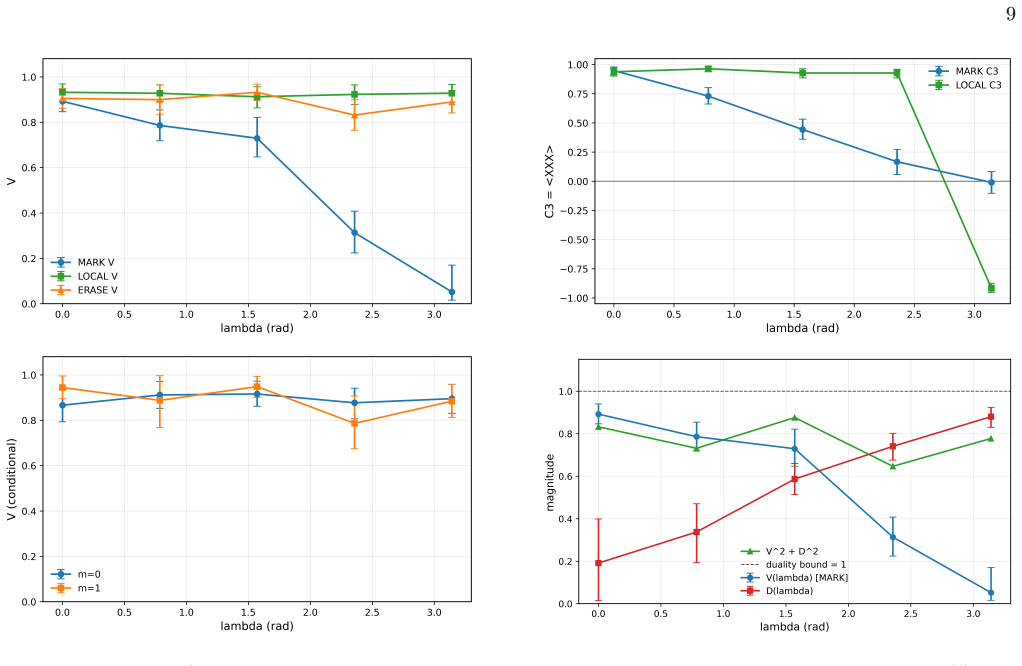
Mid-circuit measurements are essential primitives for dynamic circuits and quantum error correction, yet characterizing their induced disturbance on spectator qubits remains a central practical problem. Device-level benchmarking often compresses this disturbance into low-order proxy metrics such as $T_1$, $T_2$, readout assignment error, and pairwise crosstalk. We argue that these proxies can be operationally incomplete for multiscale dynamic circuits. We introduce a higher-order context-conditioned kernel, $\Gamma_{\mathrm{eff}}[Y,O] = \Gamma_{\mathrm{loc}}[O] + \Gamma_{\mathrm{proxy}}[O] + \Gamma_{\mathrm{rel}}[Y,O]$, where $Y$ is a global context label and $O$ a local observable. The term $\Gamma_{\mathrm{rel}}[Y,O]$ is a phenomenological compression ansatz isolating residual context dependence unexplained by standard proxies. To avoid impossibility issues of quantum partial-information decompositions on non-commuting algebras, the M\"obius weights entering this ansatz are evaluated operationally on classical measurement outcomes. We present evidence in three steps. First, earlier GHZ-versus-clock hardware results motivate an observable-class split. Second, we present dynamical evidence using the A6 synthetic hardware harness. A6 injects a pure higher-order context dependence via a programmed conditional interaction. Because the $(C_0,C_1,C_2)$ parity context is invisible to singles and pairs by construction, standard low-order diagnostics are fundamentally blind to the source of the probe's disturbance. Third, we demonstrate coherent controllability through the A6.2 quantum-eraser experiment. Programmable MARK interactions suppress unconditional fringes while eraser-basis conditioning restores them, consistent with complementarity bounds. These results validate a context-conditioned description of backaction over proxy-only null models.
Editorial analysis
A structured set of objections, weighed in public.
Referee Report
Summary. The paper claims that low-order proxy metrics (T1, T2, readout error, pairwise crosstalk) are operationally incomplete for characterizing mid-circuit measurement backaction in dynamic circuits. It introduces a higher-order context-conditioned kernel Γ_eff[Y,O] = Γ_loc[O] + Γ_proxy[O] + Γ_rel[Y,O], where the residual term Γ_rel[Y,O] is a phenomenological ansatz isolating context dependence via Möbius weights evaluated on classical outcomes. Evidence is presented in three steps: GHZ-versus-clock motivation for observable-class splits, dynamical results from the A6 synthetic harness that injects pure higher-order (C0,C1,C2) parity context invisible to singles/pairs by construction, and the A6.2 quantum-eraser experiment demonstrating coherent controllability via programmable MARK interactions.
Significance. If the central claim holds, the framework offers a systematic way to capture residual context dependence beyond standard proxies, with direct relevance to quantum error correction and multiscale dynamic circuits. Strengths include the operational use of classical Möbius weights to sidestep quantum partial-information decomposition non-commutativity issues and the coherent controllability shown in the eraser experiment. However, the synthetic nature of the A6 harness limits broader significance until the approach is validated on uncontrolled real-device backaction.
major comments (2)
- [A6 synthetic hardware harness] A6 synthetic hardware harness (dynamical evidence section): the claim that results validate a context-conditioned description over proxy-only null models rests on the (C0,C1,C2) parity context being invisible to singles and pairs by construction in the harness. This renders the proxy-blindness demonstration tautological, as it follows directly from the programmed conditional interaction rather than from an empirical mismatch with real device behavior.
- [Kernel definition and ansatz] Phenomenological ansatz for Γ_rel[Y,O] (Eq. defining the kernel): the residual term is introduced as a compression ansatz, but the manuscript provides insufficient detail on its explicit functional form, the precise computation of the Möbius weights from classical outcomes, and any quantitative error analysis or cross-validation against null models, making it difficult to assess whether the residual is load-bearing or an artifact of the fitting procedure.
minor comments (2)
- [Abstract and introduction] The abstract and introduction would benefit from a brief explicit statement of the null-model comparison metrics (e.g., how proxy-only predictions are subtracted before evaluating Γ_rel) to clarify the validation procedure.
- [Kernel definition] Notation for the context label Y and observable O should be defined once at first use with a short operational example to aid readers unfamiliar with the Möbius decomposition.
Simulated Author's Rebuttal
We thank the referee for the careful reading and constructive feedback. We address each major comment below. We have revised the manuscript to provide additional detail where requested and to clarify the rationale for our synthetic testbed, while maintaining that the core claims are supported by the presented evidence.
read point-by-point responses
-
Referee: [A6 synthetic hardware harness] A6 synthetic hardware harness (dynamical evidence section): the claim that results validate a context-conditioned description over proxy-only null models rests on the (C0,C1,C2) parity context being invisible to singles and pairs by construction in the harness. This renders the proxy-blindness demonstration tautological, as it follows directly from the programmed conditional interaction rather than from an empirical mismatch with real device behavior.
Authors: We respectfully disagree that the demonstration is tautological. The A6 harness is intentionally synthetic to create a controlled environment in which a pure higher-order (C0,C1,C2) parity context is injected via a programmed conditional interaction that is invisible to singles and pairs by construction. This design isolates the precise limitation of low-order proxies, which would be difficult to achieve on uncontrolled real hardware where multiple effects are entangled. The experiment therefore provides a rigorous, falsifiable test of whether the context-conditioned kernel captures residual dependence that proxies miss. We have added a new clarifying paragraph in Section 4.2 of the revised manuscript explaining this rationale and its relation to eventual real-device application. revision: partial
-
Referee: [Kernel definition and ansatz] Phenomenological ansatz for Γ_rel[Y,O] (Eq. defining the kernel): the residual term is introduced as a compression ansatz, but the manuscript provides insufficient detail on its explicit functional form, the precise computation of the Möbius weights from classical outcomes, and any quantitative error analysis or cross-validation against null models, making it difficult to assess whether the residual is load-bearing or an artifact of the fitting procedure.
Authors: We thank the referee for highlighting this gap. In the revised manuscript we have substantially expanded the kernel section (now Section 3.2). We now give the explicit functional form of Γ_rel[Y,O] as a Möbius-weighted sum over context subsets, provide the precise inclusion-exclusion formula used to compute the weights directly from the empirical classical outcome distribution P(Y|O), and include a new subsection with quantitative error analysis, cross-validation against proxy-only and randomized null models, and sensitivity checks to the truncation order. These additions show that the residual term remains statistically significant and improves predictive accuracy beyond the null models. revision: yes
Circularity Check
A6 harness enforces higher-order invisibility by construction and Γ_rel is defined as residual after proxy subtraction
specific steps
-
self definitional
[Abstract, second evidence step]
"A6 injects a pure higher-order context dependence via a programmed conditional interaction. Because the (C0,C1,C2) parity context is invisible to singles and pairs by construction, standard low-order diagnostics are fundamentally blind to the source of the probe's disturbance."
The paper programs A6 to enforce exactly the invisibility to low-order observables, then presents the resulting proxy blindness as validation of the context-conditioned kernel. The blindness is true by the harness construction, rendering the demonstration that proxies are incomplete tautological rather than an independent empirical result.
-
self definitional
[Abstract, kernel introduction]
"We introduce a higher-order context-conditioned kernel, Γ_eff[Y,O] = Γ_loc[O] + Γ_proxy[O] + Γ_rel[Y,O] ... The term Γ_rel[Y,O] is a phenomenological compression ansatz isolating residual context dependence unexplained by standard proxies."
Γ_rel is introduced by definition as the term that captures whatever remains after the proxy terms are subtracted. Any subsequent claim that this residual isolates higher-order context dependence therefore holds by the structure of the decomposition itself rather than by independent derivation from device physics.
full rationale
The central validation step uses a synthetic A6 harness explicitly programmed to hide the (C0,C1,C2) parity context from singles and pairs, so the claim that low-order proxies are blind follows directly from that programming rather than from an independent test of real-device behavior. Separately, the decomposition defines Γ_rel[Y,O] as the phenomenological residual unexplained by Γ_loc and Γ_proxy, making any attribution of higher-order context dependence true by the ansatz construction. These two reductions produce moderate circularity burden, but the Möbius evaluation on classical outcomes and the quantum-eraser controllability experiment retain independent empirical content, so the overall derivation is not fully forced by definition.
Axiom & Free-Parameter Ledger
free parameters (1)
- Möbius weights
axioms (1)
- domain assumption Möbius weights entering this ansatz are evaluated operationally on classical measurement outcomes
invented entities (1)
-
higher-order context-conditioned kernel Γ_eff[Y,O]
no independent evidence
Lean theorems connected to this paper
-
IndisputableMonolith/Foundation/ArithmeticFromLogic.leanLogicNat embedding and Möbius structure in orbit recovery echoes?
echoesECHOES: this paper passage has the same mathematical shape or conceptual pattern as the Recognition theorem, but is not a direct formal dependency.
the squarefree divisor / log-prime quota complex ... reduced Euler characteristic is exactly the Mertens sum, chi(Delta_x) = -M(x) ... rigid quotas strand an x/(2 log x)-scale floor of isolated 1-body prime vertices, while softened logistic boundaries restore parity-resolved cancellation
-
IndisputableMonolith/Foundation/AlexanderDuality.leanAlexander duality circle linking and reduced cohomology echoes?
echoesECHOES: this paper passage has the same mathematical shape or conceptual pattern as the Recognition theorem, but is not a direct formal dependency.
Möbius inversion on the subset lattice allocates the entire label-relevant constraint to the tripartite atom: f_Y(C0,C1,C2) = I(Y;C0C1C2) - ... = 1 bit
What do these tags mean?
- matches
- The paper's claim is directly supported by a theorem in the formal canon.
- supports
- The theorem supports part of the paper's argument, but the paper may add assumptions or extra steps.
- extends
- The paper goes beyond the formal theorem; the theorem is a base layer rather than the whole result.
- uses
- The paper appears to rely on the theorem as machinery.
- contradicts
- The paper's claim conflicts with a theorem or certificate in the canon.
- unclear
- Pith found a possible connection, but the passage is too broad, indirect, or ambiguous to say the theorem truly supports the claim.
Reference graph
Works this paper leans on
-
[1]
Definition: Higher-Order Context- Conditioned Kernel. Let Y denote a context label and O an observable or witness queried on a dynamic circuit. We write the total effective backaction as Γeff[Y,O] = Γ loc[O] + Γproxy[O] + Γrel[Y,O],(1) and, when useful, define an associated suppression factor D[Y,O]≡exp −Γ eff[Y,O] .(2) Here Γloc collects ordinary local d...
-
[2]
Let Y be a context variable carried by a context register C = {C0, C1,
Operational Proposition: Context- Dependent Local Dynamics. Let Y be a context variable carried by a context register C = {C0, C1, . . .} and let O be a witness on a probe subsystem P . We say that context- dependent local dynamics, denoted DC(Y→ O ), holds operationally if I(Y;C i)≈0,I(Y;C iCj)≈0∀i, j,(4) while the effective dynamics of O nevertheless de...
-
[3]
Empirical Claim Evaluated Here. The A6 experiment family provides evidence that a proxy-only model, Γeff[Y,O]≈Γ loc[O] + Γproxy[O], is operationally incomplete for the tested circuits. The present evidence supports this claim in the lim- ited sense of a hardware harness with engineered contexts, strong passive controls, lane balancing, and coherent eraser...
-
[4]
Interpretive Mapping. Within DAGI, Γrel[Y,O ] is interpreted as a struc- tured record-sensitive term associated with how a queried observable intersects the context-defining history graph. Nothing in the empirical sections re- quires that interpretation: the operational content of the paper is compatible with standard quantum instruments, decoherence theo...
work page 2048
-
[5]
increasing MARK strength suppressesunconditional fringes in the system marginal, and
-
[6]
conditioning on the marker measured in an eraser basis restores large fringes in the conditional view. The A6.2 source explicitly doesnotyet claim a strong separation from an optimally matched local-dephasing control channel; that remains future work [ 13]. We keep that scope control intact here. D. Results and interpretation The A6.2 run shows the expect...
-
[7]
F. A. Pollock, C. Rodr´ ıguez-Rosario, T. Frauenheim, M. Paternostro, and K. Modi,Operational Markov condi- tion for quantum processes, Phys. Rev. Lett.120, 040405 (2018)
work page 2018
-
[8]
S. Milz and K. Modi,Quantum stochastic processes and quantum non-Markovian phenomena, PRX Quantum2, 030201 (2021)
work page 2021
-
[9]
K. Rudinger, G. J. Ribeill, L. C. G. Govia, M. Ware, E. Nielsen, K. Young, T. A. Ohki, R. Blume-Kohout, and T. Proctor,Characterizing midcircuit measurements on a superconducting qubit using gate set tomography, Phys. Rev. Applied17, 014014 (2022)
work page 2022
-
[10]
L. C. G. Govia, P. Jurcevic, C. J. Wood, N. Kanazawa, S. T. Merkel, and D. C. McKay,A randomized bench- marking suite for mid-circuit measurements, New J. Phys. 25, 123016 (2023)
work page 2023
- [11]
-
[12]
M. O. Scully and K. Dr¨ uhl,Quantum eraser: A proposed photon correlation experiment concerning observation and “delayed choice” in quantum mechanics, Phys. Rev. A25, 2208–2213 (1982)
work page 1982
-
[13]
Y.-H. Kim, R. Yu, S. P. Kulik, Y. Shih, and M. O. Scully, A delayed choice quantum eraser, Phys. Rev. Lett.84, 1–5 (2000)
work page 2000
-
[14]
W. H. Zurek,Decoherence, einselection, and the quantum origins of the classical, Rev. Mod. Phys.75, 715–775 (2003)
work page 2003
-
[15]
M. Schlosshauer,Decoherence and the Quantum-To- Classical Transition(Springer, Berlin, 2007). https: //doi.org/10.1007/978-3-540-35775-9
-
[16]
Rovelli,Relational quantum mechanics, Int
C. Rovelli,Relational quantum mechanics, Int. J. Theor. Phys.35, 1637–1678 (1996)
work page 1996
-
[17]
F. Giacomini, E. Castro-Ruiz, and ˇC. Brukner,Quantum mechanics and the covariance of physical laws in quantum reference frames, Nat. Commun.10, 494 (2019)
work page 2019
-
[18]
P. Sramek,A6: Context-Dependent Local Dynamics from Pure Higher-Order Context on IBM Quantum Hardware: A Controlled DAGI Downward-Causation Harness with Passive Nulls and a Built-In Quantum Eraser Variant (Draft v0.9), Zenodo (2026). https://doi.org/10.5281/ zenodo.18911023
work page 2026
-
[19]
P. Sramek,A6.2: Programmable Global Which-Path Tag- ging and Conditional Interference Restoration on Su- perconducting Quantum Hardware(Draft v0.9), Zenodo (2026).https://doi.org/10.5281/zenodo.18911100
-
[20]
P. Sramek,Observable-Selective Branching: A Hardware- Validated Topological Resolution to the Wigner’s Friend Paradox(v1.0), Zenodo (2026). https://doi.org/10.5 281/zenodo.18921630
work page 2026
-
[21]
P. Sramek,Informational Time Dilation on a Supercon- ducting Quantum Processor: Schedule-Matched Evidence for Irreversibility-Controlled Clock Slowdown(v1.0), Zen- odo (2026). https://doi.org/10.5281/zenodo.1890944 1
-
[22]
P. Sramek,Record, Erasure, and Distributed Witness Sen- sitivity on IBM Quantum Hardware: A DAGI Validation Study(v1.0), Zenodo (2026). https://doi.org/10.528 1/zenodo.18911684
work page 2026
-
[23]
Englert,Fringe Visibility and Which-Way Infor- mation: An Inequality, Phys
B.-G. Englert,Fringe Visibility and Which-Way Infor- mation: An Inequality, Phys. Rev. Lett.77, 2154–2157 (1996)
work page 1996
-
[24]
R. Y. Su, J. Y. Huang, N. D. Stuyck, M. K. Feng, W. Gilbert, T. J. Evans, W. H. Lim, F. E. Hud- son, K. W. Chan, W. Huang, K. M. Itoh, R. Harper, S. D. Bartlett, C. H. Yang, A. Laucht, A. Saraiva, T. Tanttu, and A. S. Dzurak,Characterizing non- Markovian quantum processes by fast Bayesian tomog- raphy, Phys. Rev. A111, 052425 (2025)
work page 2025
- [25]
- [26]
- [27]
-
[28]
Bj¨ orner,A cell complex in number theory, Adv
A. Bj¨ orner,A cell complex in number theory, Adv. Appl. Math.46, 71–85 (2011)
work page 2011
-
[29]
J. Pakianathan and T. Winfree,Threshold complexes and connections to number theory, Turkish J. Math.37, 511– 539 (2013)
work page 2013
discussion (0)
Sign in with ORCID, Apple, or X to comment. Anyone can read and Pith papers without signing in.