Recognition: 2 theorem links
· Lean TheoremPrimordial black holes and the velocity acoustic oscillations features in 21 cm signals from the cosmic Dark Ages
Pith reviewed 2026-05-15 08:28 UTC · model grok-4.3
The pith
Primordial black holes imprint velocity acoustic oscillations in 21 cm signals from the cosmic Dark Ages
A machine-rendered reading of the paper's core claim, the machinery that carries it, and where it could break.
Core claim
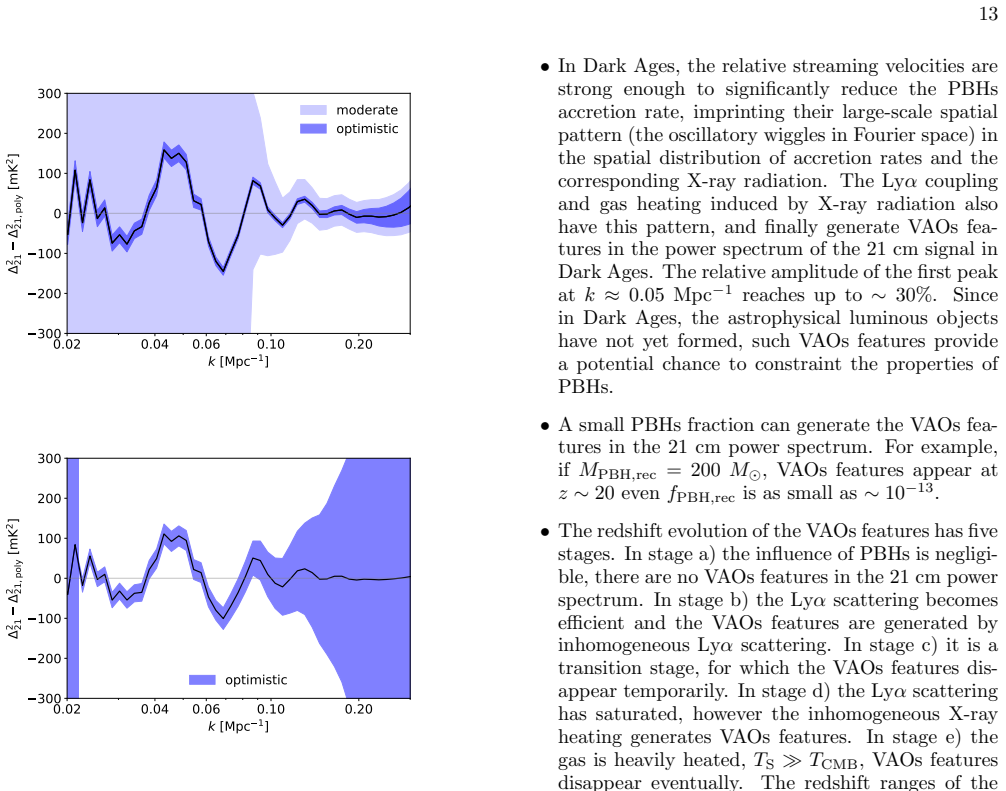
PBHs accrete gas in the Dark Ages and release radiation altering the radiation field and IGM thermal status, thereby affecting the hydrogen spin temperature. The accretion rate modulation by relic supersonic DM-baryon streaming velocities imprints VAOs in the 21 cm power spectrum. Small PBH fractions generate VAO wiggles up to 30% amplitude, visible at z around 20 for f_PBH,rec ~ 10^{-13} with 200 M_sun PBHs or at z~40 for f~3x10^{-10}. The redshift evolution shows separated stages of inhomogeneous Ly-alpha scattering and X-ray heating reflecting PBH characteristics.
What carries the argument
Modulation of PBH accretion by relic supersonic streaming velocities between DM and baryons, imprinting VAOs features in the 21 cm power spectrum through IGM thermal changes.
If this is right
- VAO wiggles up to 30% relative amplitude generated in Dark Ages 21 cm signals by small PBH DM fractions.
- For 200 solar mass PBHs, features appear at z~20 for f_PBH,rec~1e-13 and at z~40 for f_PBH,rec~3e-10.
- Redshift evolution of VAOs shows stages dominated first by inhomogeneous Ly-alpha scattering then by X-ray heating.
- Wiggles at z~20 detectable with SKA-low AA* and at z~40 with hypothetical lunar surface interferometer.
Where Pith is reading between the lines
- Absence of these VAO patterns in observations could provide new upper bounds on the abundance of intermediate-mass PBHs.
- The two-stage redshift evolution might serve as a signature to separate PBH effects from other potential early-universe heating mechanisms.
- This mechanism could be tested further by comparing predicted 21 cm signals with global signal measurements or other probes of IGM thermal history.
Load-bearing premise
Accretion onto PBHs is modulated by relic supersonic relative streaming velocities between dark matter and baryons, leading to radiation and IGM evolution that follows standard models without additional feedback or clustering.
What would settle it
Observing the 21 cm power spectrum at redshift 20 and finding no VAO wiggles exceeding a few percent in amplitude for PBH mass fractions around 10^{-13} would contradict the predicted signal strength from 200 solar mass primordial black holes.
Figures


read the original abstract
Astrophysical luminous objects such as the first stars have not yet formed in the Dark Ages. However, primordial black holes (PBHs) always exist throughout cosmic history since the inflation epoch. During the Dark Ages, PBHs may accrete the ambient gas and release radiation like astrophysical luminous objects, change the cosmic radiation field, the thermal status of the intergalactic medium (IGM), and the hydrogen spin temperature. The accretion rate is modulated by the relic supersonic relative streaming velocities between dark matter (DM) and baryons, imprinting Velocity Acoustic Oscillations (VAOs) features in the 21 cm power spectrum. Such VAOs features could be a promising probe for detecting the PBHs in Dark Ages. We find that even if PBHs comprise only a small fraction of DM, they can generate VAOs wiggles with a relative amplitude up to about 30% in Dark Ages. For example, for PBHs with a mass at recombination of 200 solar masses and mass fraction in the total DM f_PBH,rec around 1e-13 at the recombination era, VAOs features appear at redshift around 20; if f_PBH,rec is around 3e-10, then VAOs features could appear as early as redshift around 40. Moreover, the redshift evolution of the VAOs features exhibits clearly separated stages dominated by inhomogeneous Ly-alpha scattering, and inhomogeneous X-ray heating, respectively. It reflects the characteristics of PBHs (mass and fraction in total DM) and their interactions with the IGM. We also estimate that, the VAOs wiggles at redshift around 20 are detectable for the upcoming SKA-low AA*, while wiggles at redshift around 40 are detectable for an hypothetic lunar surface-based interferometer array in the future.
Editorial analysis
A structured set of objections, weighed in public.
Referee Report
Summary. The manuscript claims that primordial black holes (PBHs) accreting ambient gas during the cosmic Dark Ages produce radiation that imprints velocity acoustic oscillations (VAOs) in the 21 cm power spectrum. The accretion rate is modulated by the relic supersonic baryon-DM streaming velocity v_bc, leading to spatially varying Ly-α and X-ray backgrounds that affect the spin temperature T_s and kinetic temperature T_k. For PBHs with mass 200 M_⊙ at recombination and f_PBH,rec ≈ 10^{-13}, the relative VAO amplitude reaches ~30% near z ≈ 20; higher fractions shift the signal to z ≈ 40. The redshift evolution exhibits distinct stages dominated first by inhomogeneous Ly-α scattering and later by X-ray heating. Detectability is estimated for SKA-low AA* at z ~ 20 and a hypothetical lunar array at z ~ 40.
Significance. If the amplitude and redshift-dependent signatures hold, the work supplies a new, potentially falsifiable probe of PBH abundance and mass in the pre-stellar era using 21 cm cosmology. It extends standard streaming-velocity physics to PBH accretion without introducing new free parameters beyond mass and f_PBH,rec, and predicts observable wiggles whose stage separation could distinguish PBH properties from other early heating sources.
major comments (2)
- [§4 (IGM thermal evolution and 21 cm power spectrum modeling)] The central amplitude calculation (illustrated for 200 M_⊙ and f_PBH,rec = 10^{-13} at z ≈ 20) adopts a pre-computed global IGM thermal history to which PBH-induced perturbations are added linearly. This omits iteration on the local sound speed increase from X-ray heating, which would reduce the supersonic regime of v_bc and therefore the modulation depth of the accretion rate. The 30% relative amplitude claim is load-bearing on this linearization; a quantitative test of the approximation (e.g., via local sound-speed update inside the accretion radius) is required.
- [§3.1 (accretion rate and radiation field)] The accretion prescription is stated to follow standard Bondi-like rates modulated by v_bc, yet no explicit equation or numerical scheme is given for how the resulting radiation field is propagated through the IGM or how radiative transfer couples back to the local gas temperature and ionization fraction. Without these steps, the claimed separation into Ly-α-dominated and X-ray-dominated stages cannot be verified as robust against reasonable variations in efficiency or clustering.
minor comments (2)
- [Abstract and §2] Notation for the PBH mass at recombination (M_PBH,rec) and the fraction f_PBH,rec should be defined once in the text and used consistently; the abstract introduces both without a clear link to the recombination-era definition.
- [§5 (observational prospects)] The detectability estimates for SKA-low AA* and the lunar array lack quantitative signal-to-noise calculations or foreground assumptions; these should be moved to a dedicated subsection with explicit integration times or array specifications.
Simulated Author's Rebuttal
We thank the referee for the careful and constructive review. The comments highlight important aspects of our modeling assumptions and presentation. We address each major comment below and outline the revisions we will make.
read point-by-point responses
-
Referee: [§4 (IGM thermal evolution and 21 cm power spectrum modeling)] The central amplitude calculation (illustrated for 200 M_⊙ and f_PBH,rec = 10^{-13} at z ≈ 20) adopts a pre-computed global IGM thermal history to which PBH-induced perturbations are added linearly. This omits iteration on the local sound speed increase from X-ray heating, which would reduce the supersonic regime of v_bc and therefore the modulation depth of the accretion rate. The 30% relative amplitude claim is load-bearing on this linearization; a quantitative test of the approximation (e.g., via local sound-speed update inside the accretion radius) is required.
Authors: We agree that a fully iterative treatment of the local sound speed would be more complete. However, for the tiny PBH fractions we consider (f_PBH,rec ≈ 10^{-13}), the X-ray heating is strongly perturbative. A simple order-of-magnitude estimate shows that the induced change in sound speed reduces the accretion-rate modulation depth by only a few percent, leaving the reported ~30% VAO amplitude essentially unchanged. In the revised manuscript we will add this quantitative estimate together with a brief discussion of the linearization's validity. revision: partial
-
Referee: [§3.1 (accretion rate and radiation field)] The accretion prescription is stated to follow standard Bondi-like rates modulated by v_bc, yet no explicit equation or numerical scheme is given for how the resulting radiation field is propagated through the IGM or how radiative transfer couples back to the local gas temperature and ionization fraction. Without these steps, the claimed separation into Ly-α-dominated and X-ray-dominated stages cannot be verified as robust against reasonable variations in efficiency or clustering.
Authors: The accretion rate is computed from the standard Bondi-Hoyle-Lyttleton formula with the supersonic streaming velocity v_bc (as in the references we cite). The radiation field is obtained by volume-integrating the PBH emissivity (power-law X-ray spectrum plus Ly-α line emission) and the IGM thermal and ionization response follows the usual inhomogeneous equations for T_k and x_e. We will insert the explicit equations and a concise description of the numerical scheme into the revised §3.1 so that the stage separation and its robustness can be directly verified. revision: yes
Circularity Check
No significant circularity in derivation chain
full rationale
The paper derives VAO amplitudes in the 21 cm power spectrum by applying standard Bondi accretion modulated by relic v_bc streaming velocities to chosen PBH mass and f_PBH,rec values, then propagating the resulting inhomogeneous Ly-alpha and X-ray fields through pre-existing IGM thermal and spin-temperature models. No quantity is defined in terms of the output signal, no parameters are fitted to the target VAO wiggles, and no load-bearing step reduces to a self-citation or ansatz imported from the authors' prior work. The quoted examples (e.g., 30% amplitude at z~20 for f_PBH,rec~1e-13) are forward calculations from fixed inputs rather than tautological re-expressions of those inputs.
Axiom & Free-Parameter Ledger
free parameters (2)
- PBH mass at recombination =
200 solar masses
- f_PBH,rec =
1e-13 or 3e-10
axioms (2)
- domain assumption PBHs accrete ambient gas and release radiation that alters IGM thermal status and hydrogen spin temperature.
- standard math Relic supersonic relative streaming velocities between DM and baryons modulate the accretion rate.
Lean theorems connected to this paper
-
IndisputableMonolith/Cost/FunctionalEquation.leanwashburn_uniqueness_aczel unclear?
unclearRelation between the paper passage and the cited Recognition theorem.
The accretion rate of a PBH is ˙M_B = 4π λ ρ_b v_eff r_B,eff² (Eq. 4); v_eff = √(v_db² + c_s²).
-
IndisputableMonolith/Foundation/RealityFromDistinction.leanreality_from_one_distinction unclear?
unclearRelation between the paper passage and the cited Recognition theorem.
VAOs features appear … for f_PBH,rec ~ 10^{-13} … at redshift around 20.
What do these tags mean?
- matches
- The paper's claim is directly supported by a theorem in the formal canon.
- supports
- The theorem supports part of the paper's argument, but the paper may add assumptions or extra steps.
- extends
- The paper goes beyond the formal theorem; the theorem is a base layer rather than the whole result.
- uses
- The paper appears to rely on the theorem as machinery.
- contradicts
- The paper's claim conflicts with a theorem or certificate in the canon.
- unclear
- Pith found a possible connection, but the passage is too broad, indirect, or ambiguous to say the theorem truly supports the claim.
Reference graph
Works this paper leans on
-
[1]
S. R. Furlanetto, S. P. Oh, and F. H. Briggs, Phys. Rep. 433, 181 (2006), astro-ph/0608032
work page internal anchor Pith review Pith/arXiv arXiv 2006
- [3]
-
[4]
T. Fl¨ oss, T. de Wild, P. D. Meerburg, and L. V. E. Koop- mans, J. Cosmology Astropart. Phys.2022, 020 (2022), 2201.08843
- [5]
- [6]
- [7]
-
[8]
B. J. Carr, arXiv e-prints astro-ph/0511743 (2005), astro- ph/0511743
work page internal anchor Pith review Pith/arXiv arXiv 2005
-
[9]
Upper limits on the size of a primordial black hole
T. Harada and B. J. Carr, Phys. Rev. D71, 104009 (2005), astro-ph/0412134
work page internal anchor Pith review Pith/arXiv arXiv 2005
-
[10]
B. J. Carr and M. J. Rees, Nature278, 605 (1979)
work page 1979
-
[11]
B. J. Carr, K. Kohri, Y. Sendouda, and J. Yokoyama, Phys. Rev. D81, 104019 (2010), 0912.5297
work page internal anchor Pith review Pith/arXiv arXiv 2010
-
[12]
Cosmic microwave background limits on accreting primordial black holes
Y. Ali-Ha¨ ımoud and M. Kamionkowski, Phys. Rev. D95, 043534 (2017), 1612.05644
work page internal anchor Pith review Pith/arXiv arXiv 2017
-
[13]
Bondi accretion in the early universe
M. Ricotti, ApJ662, 53 (2007), 0706.0864
work page internal anchor Pith review Pith/arXiv arXiv 2007
-
[14]
M. Ricotti, J. P. Ostriker, and K. J. Mack, ApJ680, 829 (2008), 0709.0524
work page internal anchor Pith review Pith/arXiv arXiv 2008
- [15]
-
[16]
V. Takhistov, P. Lu, K. Murase, Y. Inoue, and G. B. Gelmini, MNRAS517, L1 (2022), 2111.08699
-
[17]
V. Bosch-Ramon and N. Bellomo, A&A638, A132 (2020), 2004.11224
-
[18]
S. Bird, I. Cholis, J. B. Mu˜ noz, Y. Ali-Ha¨ ımoud, M. Kamionkowski, E. D. Kovetz, A. Raccanelli, and A. G. Riess, Phys. Rev. Lett.116, 201301 (2016), 1603.00464
work page internal anchor Pith review Pith/arXiv arXiv 2016
-
[19]
New constraints on primordial black holes abundance from femtolensing of gamma-ray bursts
A. Barnacka, J.-F. Glicenstein, and R. Moderski, Phys. Rev. D86, 043001 (2012), 1204.2056
work page internal anchor Pith review Pith/arXiv arXiv 2012
-
[20]
CMB bounds on disk-accreting massive Primordial Black Holes
V. Poulin, P. D. Serpico, F. Calore, S. Clesse, and K. Kohri, Phys. Rev. D96, 083524 (2017), 1707.04206
work page internal anchor Pith review Pith/arXiv arXiv 2017
- [21]
-
[22]
A. M. Green and B. J. Kavanagh, Journal of Physics G Nuclear Physics48, 043001 (2021), 2007.10722
work page internal anchor Pith review Pith/arXiv arXiv 2021
-
[23]
Yang, MNRAS508, 5709 (2021), 2110.06447
Y. Yang, MNRAS508, 5709 (2021), 2110.06447
-
[24]
K. J. Mack and D. H. Wesley, arXiv e-prints arXiv:0805.1531 (2008), 0805.1531. 16
work page internal anchor Pith review Pith/arXiv arXiv 2008
-
[25]
S. J. Clark, B. Dutta, Y. Gao, L. E. Strigari, and S. Wat- son, Phys. Rev. D95, 083006 (2017), 1612.07738
work page internal anchor Pith review Pith/arXiv arXiv 2017
- [26]
- [27]
-
[28]
Relative velocity of dark matter and baryonic fluids and the formation of the first structures
D. Tseliakhovich and C. Hirata, Phys. Rev. D82, 083520 (2010), 1005.2416
work page internal anchor Pith review Pith/arXiv arXiv 2010
-
[29]
Supersonic Relative Velocity between Dark Matter and Baryons: A Review
A. Fialkov, International Journal of Modern Physics D 23, 1430017 (2014), 1407.2274
work page internal anchor Pith review Pith/arXiv arXiv 2014
-
[31]
J. Flitter and E. D. Kovetz, Phys. Rev. D106, 063504 (2022), 2207.05083
- [32]
-
[33]
Constraining Dark Matter-Baryon Scattering with Linear Cosmology
C. Dvorkin, K. Blum, and M. Kamionkowski, Phys. Rev. D89, 023519 (2014), 1311.2937
work page internal anchor Pith review Pith/arXiv arXiv 2014
-
[34]
T. H. Greif, S. D. M. White, R. S. Klessen, and V. Springel, ApJ736, 147 (2011), 1101.5493
work page internal anchor Pith review Pith/arXiv arXiv 2011
-
[35]
Suppression and Spatial Variation of Early Galaxies and Minihalos
D. Tseliakhovich, R. Barkana, and C. M. Hirata, MN- RAS418, 906 (2011), 1012.2574
work page internal anchor Pith review Pith/arXiv arXiv 2011
-
[36]
Effect of Streaming Motion of Baryons Relative to Dark Matter on the Formation of the First Stars
A. Stacy, V. Bromm, and A. Loeb, ApJ730, L1 (2011), 1011.4512
work page internal anchor Pith review Pith/arXiv arXiv 2011
-
[37]
Impact of the Relative Motion between the Dark Matter and Baryons on the First Stars
A. Fialkov, R. Barkana, D. Tseliakhovich, and C. M. Hirata, MNRAS424, 1335 (2012), 1110.2111
work page internal anchor Pith review Pith/arXiv arXiv 2012
- [38]
-
[39]
L. Conaboy, I. T. Iliev, A. Fialkov, K. L. Dixon, and D. Sullivan, MNRAS525, 5479 (2023), 2207.11614
-
[40]
Supersonic Gas Streams Enhance the Formation of Massive Black Holes in the Early Universe
S. Hirano, T. Hosokawa, N. Yoshida, and R. Kuiper, Sci- ence357, 1375 (2017), 1709.09863
work page internal anchor Pith review Pith/arXiv arXiv 2017
- [41]
-
[42]
Large-scale BAO signatures of the smallest galaxies
N. Dalal, U.-L. Pen, and U. Seljak, J. Cosmology As- tropart. Phys.2010, 007 (2010), 1009.4704
work page internal anchor Pith review Pith/arXiv arXiv 2010
-
[43]
The impact of the supersonic baryon-dark matter velocity difference on the z~20 21cm background
M. McQuinn and R. M. O’Leary, ApJ760, 3 (2012), 1204.1345
work page internal anchor Pith review Pith/arXiv arXiv 2012
-
[44]
The signature of the first stars in atomic hydrogen at redshift 20
E. Visbal, R. Barkana, A. Fialkov, D. Tseliakhovich, and C. M. Hirata, Nature487, 70 (2012), 1201.1005
work page internal anchor Pith review Pith/arXiv arXiv 2012
-
[45]
J. Bovy and C. Dvorkin, ApJ768, 70 (2013), 1205.2083
work page internal anchor Pith review Pith/arXiv arXiv 2013
-
[46]
The 21-cm signature of the first stars during the Lyman-Werner feedback era
A. Fialkov, R. Barkana, E. Visbal, D. Tseliakhovich, and C. M. Hirata, MNRAS432, 2909 (2013), 1212.0513
work page internal anchor Pith review Pith/arXiv arXiv 2013
-
[47]
A new light on 21 cm intensity fluctuations from the dark ages
Y. Ali-Ha¨ ımoud, P. D. Meerburg, and S. Yuan, Phys. Rev. D89, 083506 (2014), 1312.4948
work page internal anchor Pith review Pith/arXiv arXiv 2014
-
[48]
The 21-cm BAO signature of enriched low-mass galaxies during cosmic reionization
A. Cohen, A. Fialkov, and R. Barkana, MNRAS459, L90 (2016), 1508.04138
work page internal anchor Pith review Pith/arXiv arXiv 2016
- [49]
- [50]
- [51]
- [52]
-
[53]
D. Sarkar and E. D. Kovetz, Phys. Rev. D107, 023524 (2023), 2210.16853
-
[54]
A fundamental plane of black hole activity
A. Merloni, S. Heinz, and T. di Matteo, MNRAS345, 1057 (2003), astro-ph/0305261
work page internal anchor Pith review Pith/arXiv arXiv 2003
-
[55]
E. Lusso, A. Comastri, B. D. Simmons, M. Mignoli, G. Zamorani, C. Vignali, M. Brusa, F. Shankar, D. Lutz, J. R. Trump, et al., MNRAS425, 623 (2012), 1206.2642
work page internal anchor Pith review Pith/arXiv arXiv 2012
- [56]
-
[57]
P. E. Dewdney, P. J. Hall, R. T. Schilizzi, and T. J. L. W. Lazio, IEEE Proceedings97, 1482 (2009)
work page 2009
-
[58]
Reionization and the Cosmic Dawn with the Square Kilometre Array
G. Mellema, L. V. E. Koopmans, F. A. Abdalla, G. Bernardi, B. Ciardi, S. Daiboo, A. G. de Bruyn, K. K. Datta, H. Falcke, A. Ferrara, et al., Experimental Astron- omy36, 235 (2013), 1210.0197
work page internal anchor Pith review Pith/arXiv arXiv 2013
-
[59]
L. Koopmans, J. Pritchard, G. Mellema, J. Aguirre, K. Ahn, R. Barkana, I. van Bem- mel, G. Bernardi, A. Bonaldi, F. Briggs, et al., in Advancing Astrophysics with the Square Kilometre Array (2015), p. 1, 1505.07568
- [60]
- [61]
-
[62]
M. Klein Wolt, H. Falcke, and L. Koopmans, in American Astronomical Society Meeting Abstracts #243 (2024), vol. 243, p. 264.01
work page 2024
- [63]
- [64]
-
[65]
Constraining Primordial Black Holes with the EDGES 21-cm Absorption Signal
A. Hektor, G. H¨ utsi, L. Marzola, M. Raidal, V. Vasko- nen, and H. Veerm¨ ae, Phys. Rev. D98, 023503 (2018), 1803.09697
work page internal anchor Pith review Pith/arXiv arXiv 2018
-
[66]
Escriv` a, Universe8, 66 (2022), 2111.12693
A. Escriv` a, Universe8, 66 (2022), 2111.12693
-
[67]
Primordial Black Holes - Perspectives in Gravitational Wave Astronomy -
M. Sasaki, T. Suyama, T. Tanaka, and S. Yokoyama, Classical and Quantum Gravity35, 063001 (2018), 1801.05235
work page internal anchor Pith review Pith/arXiv arXiv 2018
- [68]
-
[69]
R. V. Vasudevan and A. C. Fabian, MNRAS381, 1235 (2007), 0708.4308
work page internal anchor Pith review Pith/arXiv arXiv 2007
-
[70]
A. Marconi, G. Risaliti, R. Gilli, L. K. Hunt, R. Maiolino, and M. Salvati, MNRAS351, 169 (2004), astro- ph/0311619
-
[71]
CRASH: a Radiative Transfer Scheme
A. Maselli, A. Ferrara, and B. Ciardi, MNRAS345, 379 (2003), astro-ph/0307117
work page internal anchor Pith review Pith/arXiv arXiv 2003
-
[72]
The Energy Cascade from Warm Dark Matter Decays
M. Vald´ es and A. Ferrara, MNRAS387, L8 (2008), 0803.0370
work page internal anchor Pith review Pith/arXiv arXiv 2008
-
[73]
21cmFAST: A Fast, Semi-Numerical Simulation of the High-Redshift 21-cm Signal
A. Mesinger, S. Furlanetto, and R. Cen, MNRAS411, 955 (2011), 1003.3878
work page internal anchor Pith review Pith/arXiv arXiv 2011
-
[74]
J. R. Pritchard and A. Loeb, Reports on Progress in Physics75, 086901 (2012), 1109.6012
work page internal anchor Pith review Pith/arXiv arXiv 2012
-
[75]
Planck 2018 results. VI. Cosmological parameters
Planck Collaboration, N. Aghanim, Y. Akrami, M. Ash- down, J. Aumont, C. Baccigalupi, M. Ballardini, A. J. Banday, R. B. Barreiro, N. Bartolo, et al., A&A641, A6 (2020), 1807.06209
work page internal anchor Pith review Pith/arXiv arXiv 2020
-
[76]
A. Merloni, S. Heinz, and T. Di Matteo, Monthly No- tices of the Royal Astronomical Society345, 1057–1076 (2003), ISSN 1365-2966, URLhttp://dx.doi.org/10. 1046/j.1365-2966.2003.07017.x
-
[77]
S. G. Murray, J. Pober, and M. Kolopanis, Journal of Open Source Software9, 6501 (2024), URLhttps:// doi.org/10.21105/joss.06501. 17
-
[78]
C. Trott, s. Breen, J. Green, and S. Pearcey, Ska-low substation templates (2024), URLhttps:// doi.org/10.5281/zenodo.16951143
-
[79]
B. Carr and F. K¨ uhnel, Annual Review of Nuclear and Particle Science70, 355 (2020), 2006.02838
-
[80]
Detecting the Stochastic Gravitational Wave Background from Primordial Black Hole Formation
S. Clesse, J. Garc´ ıa-Bellido, and S. Orani, arXiv e-prints arXiv:1812.11011 (2018), 1812.11011
work page internal anchor Pith review Pith/arXiv arXiv 2018
-
[81]
D. Inman and Y. Ali-Ha¨ ımoud, Phys. Rev. D100, 083528 (2019), 1907.08129
- [82]
discussion (0)
Sign in with ORCID, Apple, or X to comment. Anyone can read and Pith papers without signing in.