Recognition: 3 theorem links
· Lean TheoremOn the Duality of Coverings in Hilbert Geometry
Pith reviewed 2026-05-15 09:12 UTC · model grok-4.3
The pith
Covering numbers for Hilbert balls satisfy a polarity duality with constants exponential only in dimension.
A machine-rendered reading of the paper's core claim, the machinery that carries it, and where it could break.
Core claim
We prove that there exists an absolute constant c at least 1 such that for any alpha between 0 and 1, the covering number N of G by alpha-balls in the Hilbert metric of K is between c to the minus d times the polar covering number and c to the d times it, and the same holds for the boundary covering numbers S.
What carries the argument
Polarity duality for the Hilbert covering numbers N^H and S^H relating a pair of convex bodies to their polars.
If this is right
- Classical volumetric duality for translative coverings is recovered as a special case.
- A new boundary-covering duality is obtained in the translative setting.
- The duality constants depend only on dimension and are independent of the specific shapes and the radius alpha.
- Faifman's polarity bounds for Holmes-Thompson volume and area receive an alternative proof.
Where Pith is reading between the lines
- Algorithms for computing coverings in one geometry could be applied to the polar to obtain bounds in the other.
- This suggests potential applications in optimization and sampling where Hilbert metrics arise naturally.
- Similar dualities might hold for other projective metrics or Finsler geometries beyond Hilbert.
Load-bearing premise
G and K must be convex bodies with G contained in the interior of K and the origin in the interior of G so that the Hilbert metric is defined and polarity applies.
What would settle it
Finding convex bodies G and K in high dimension where the ratio between N^H_K(G, alpha) and N^H_{G°}(K°, alpha) exceeds any constant to the power d for a fixed constant.
Figures


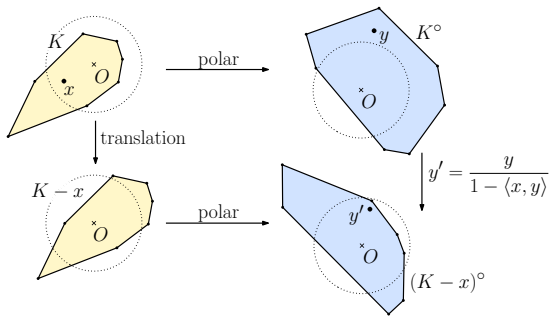


read the original abstract
We prove polarity duality for covering problems in Hilbert geometry. Let $G$ and $K$ be convex bodies in $\mathbb{R}^d$ where $G \subset \operatorname{int}(K)$ and $\operatorname{int}(G)$ contains the origin. Let $N^H_K(G,\alpha)$ and $S^H_K(G,\alpha)$ denote, respectively, the minimum numbers of radius-$\alpha$ Hilbert balls in the geometry induced by $K$ needed to cover $G$ and $\partial G$. Our main result is a Hilbert-geometric analogue of the K\"{o}nig-Milman covering duality: there exists an absolute constant $c \geq 1$ such that for any $\alpha \in (0,1]$, \[ c^{-d}\,N^H_{G^{\circ}}(K^{\circ},\alpha) ~ \leq ~ N^H_K(G,\alpha) ~ \leq ~ c^{d}\,N^H_{G^{\circ}}(K^{\circ},\alpha), \] and likewise, \[ c^{-d}\,S^H_{G^{\circ}}(K^{\circ},\alpha) ~ \leq ~ S^H_K(G,\alpha) ~ \leq ~ c^{d}\,S^H_{G^{\circ}}(K^{\circ},\alpha). \] We also recover the classical volumetric duality for translative coverings of centered convex bodies, and obtain a new boundary-covering duality in that setting. The Hilbert setting is subtler than the translative one because the metric is not translation invariant, and the local Finsler unit ball depends on the base point. The proof involves several ideas, including $\alpha$-expansions, a stability lemma that controls the interaction between polarity and expansion, and, in the boundary case, a localized relative isoperimetric argument combined with Holmes--Thompson area estimates. In addition, we provide an alternative proof of Faifman's polarity bounds for Holmes--Thompson volume and area in the Funk and Hilbert geometries.
Editorial analysis
A structured set of objections, weighed in public.
Referee Report
Summary. The manuscript proves a polarity duality for covering numbers in Hilbert geometry. For convex bodies G ⊂ int(K) in R^d with 0 ∈ int(G), it establishes that there exists an absolute constant c ≥ 1 such that for α ∈ (0,1], c^{-d} N^H_{G°}(K°,α) ≤ N^H_K(G,α) ≤ c^d N^H_{G°}(K°,α), and likewise for the boundary covering numbers S^H_K(G,α) and S^H_{G°}(K°,α). The argument proceeds via α-expansions, a stability lemma controlling the interaction of polarity with expansions, and (for boundaries) a localized relative isoperimetric inequality combined with Holmes-Thompson area estimates. The paper also recovers the classical König-Milman volumetric duality for translative coverings of centered convex bodies and supplies an alternative proof of Faifman's polarity bounds for Holmes-Thompson volume and area in the Funk and Hilbert geometries.
Significance. If the central inequalities hold, the result supplies a non-trivial extension of covering duality to a non-translation-invariant Finsler metric whose local unit ball varies with base point. The absolute (i.e., body-independent) constant c, the treatment of boundary coverings, and the recovery of the classical translative case are all positive features. The alternative derivation of Faifman's Holmes-Thompson polarity bounds is an additional contribution. The work is therefore of interest to researchers in convex geometry and metric geometry.
minor comments (3)
- §2 (Preliminaries): the precise definition of the Hilbert covering number N^H_K(G,α) (minimum number of radius-α balls in the K-induced metric) should be stated explicitly before the main theorem, rather than being left implicit from the abstract.
- §4 (Boundary case): the localized relative isoperimetric inequality is invoked to control the boundary covering; a short remark clarifying why the Holmes-Thompson area estimate remains uniform under the α-expansion would improve readability.
- Notation: the superscript ° for polarity is used throughout; a single sentence recalling that G° denotes the polar with respect to the origin (which lies in int(G)) would prevent any momentary ambiguity for readers.
Simulated Author's Rebuttal
We thank the referee for their positive evaluation of the manuscript and for recommending minor revision. The report raises no specific major comments requiring point-by-point rebuttal.
Circularity Check
No circularity: direct geometric derivation via expansions and stability
full rationale
The paper derives the claimed polarity duality for Hilbert covering numbers N^H and S^H through explicit constructions: α-expansions of convex bodies, a stability lemma controlling polarity-expansion interaction, and (for boundaries) a localized relative isoperimetric inequality combined with Holmes-Thompson volume estimates. These steps rest on standard convex geometry and Finsler properties of the Hilbert metric without reducing the inequalities to fitted parameters, self-definitions, or load-bearing self-citations. The absolute constant c arises from uniform distortion bounds that hold independently for any centered G ⊂ int(K). An alternative proof of Faifman's polarity bounds is supplied separately but is not required for the central duality. The derivation chain is therefore self-contained against external benchmarks.
Axiom & Free-Parameter Ledger
axioms (2)
- domain assumption G and K are convex bodies in R^d with G ⊂ int(K) and 0 ∈ int(G)
- standard math Holmes-Thompson volume and area satisfy the polarity bounds proved by Faifman
Lean theorems connected to this paper
-
IndisputableMonolith/Foundation/RealityFromDistinction.leanreality_from_one_distinction unclear?
unclearRelation between the paper passage and the cited Recognition theorem.
there exists an absolute constant c ≥ 1 such that ... c^{-d} N^H_{G°}(K°,α) ≤ N^H_K(G,α) ≤ c^d N^H_{G°}(K°,α)
-
IndisputableMonolith/Cost/FunctionalEquation.leanwashburn_uniqueness_aczel unclear?
unclearRelation between the paper passage and the cited Recognition theorem.
Holmes–Thompson volume and area ... Faifman’s polarity bounds
-
IndisputableMonolith/Foundation/AlexanderDuality.leanalexander_duality_circle_linking unclear?
unclearRelation between the paper passage and the cited Recognition theorem.
α-expansions ... polarity-expansion stability lemma
What do these tags mean?
- matches
- The paper's claim is directly supported by a theorem in the formal canon.
- supports
- The theorem supports part of the paper's argument, but the paper may add assumptions or extra steps.
- extends
- The paper goes beyond the formal theorem; the theorem is a base layer rather than the whole result.
- uses
- The paper appears to rely on the theorem as machinery.
- contradicts
- The paper's claim conflicts with a theorem or certificate in the canon.
- unclear
- Pith found a possible connection, but the passage is too broad, indirect, or ambiguous to say the theorem truly supports the claim.
Reference graph
Works this paper leans on
-
[2]
J. C. ´Alvarez Paiva and A. C. Thompson. Volumes on normed and Finsler spaces. In D. Bao, R. L. Bryant, S.-S. Chern, and Z. Shen, editors,A Sampler of Riemann–Finsler Geometry, volume 50 ofMSRI Publications, pages 1–48. Cambridge University Press, 2004.doi:10. 1017/9781009701280.002
work page 2004
-
[3]
Regularity and Inferential Theories of Causation
L. Anand and S. Govindjee.Continuum Mechanics of Solids. Oxford Graduate Texts. Oxford University Press, 2020.doi:10.1093/oso/9780198864721.001.0001
-
[4]
S. Artstein, V. Milman, and S. J. Szarek. Duality of metric entropy.Annals of Mathematics, 159(3):1313–1328, 2004.doi:10.4007/annals.2004.159.1313
-
[5]
S. Artstein-Avidan, A. Giannopoulos, and V. D. Milman.Asymptotic Geometric Analysis, Part I, volume 202 ofMathematical Surveys and Monographs. American Mathematical Society, 2015
work page 2015
-
[6]
R. Arya, S. Arya, G. D. da Fonseca, and D. M. Mount. Optimal bound on the combinatorial complexity of approximating polytopes.ACM Trans. Algorithms, 18:1–29, 2022.doi:10. 1145/3559106
work page 2022
-
[7]
S. Arya, G. D. da Fonseca, and D. M. Mount. Near-optimalε-kernel construction and related problems. InProc. 33rd Internat. Sympos. Comput. Geom., pages 10:1–15, 2017. URL:https: //arxiv.org/abs/1703.10868,doi:10.4230/LIPIcs.SoCG.2017.10
work page internal anchor Pith review Pith/arXiv arXiv doi:10.4230/lipics.socg.2017.10 2017
-
[8]
S. Arya, G. D. da Fonseca, and D. M. Mount. On the combinatorial complexity of ap- proximating polytopes.Discrete Comput. Geom., 58(4):849–870, 2017.doi:10.1007/ s00454-016-9856-5
work page 2017
-
[9]
S. Arya, G. D. da Fonseca, and D. M. Mount. Approximate polytope membership queries. SIAM J. Comput., 47(1):1–51, 2018.doi:10.1137/16M1061096
-
[10]
S. Arya, G. D. da Fonseca, and D. M. Mount. Economical convex coverings and applications. InProc. 34th Annu. ACM-SIAM Sympos. Discrete Algorithms, pages 1834–1861, 2023.doi: 10.1137/1.9781611977554.ch70
-
[11]
S. Arya, G. D. da Fonseca, and D. M. Mount. Economical convex coverings and applications. SIAM J. Comput., 53(4):1002–1038, 2024.doi:10.1137/23M1568351
-
[12]
S. Arya, G. D. da Fonseca, and D. M. Mount. Optimal area-sensitive bounds for polytope approximation.Discrete Comput. Geom., 2026.doi:10.1007/s00454-025-00815-5
-
[13]
S. Arya and D. M. Mount. Optimal volume-sensitive bounds for polytope approximation. In Proc. 39th Internat. Sympos. Comput. Geom., pages 9:1–9:16, 2023.doi:10.4230/LIPIcs. SoCG.2023.9
-
[14]
Cauchy's Surface Area Formula in the Funk Geometry
S. Arya and D. M. Mount. Cauchy’s surface area formula in the Funk geometry, 2026.arXiv: 2601.16468. 28
work page internal anchor Pith review Pith/arXiv arXiv 2026
-
[15]
Barvinok.A Course in Convexity, volume 54 ofGraduate Studies in Mathematics
A. Barvinok.A Course in Convexity, volume 54 ofGraduate Studies in Mathematics. American Mathematical Society, 2002. URL:https://bookstore.ams.org/gsm-54/
work page 2002
-
[16]
K. Borsuk. Drei S¨ atze ¨ uber dien-dimensionale euklidische Sph¨ are.Fund. Math., 20:177–190, 1933.doi:10.4064/fm-20-1-177-190
-
[17]
J. Bourgain and V. D. Milman. New volume ratio properties for convex symmetric bodies. Invent. Math., 88:319–340, 1987.doi:10.1007/BF01388911
-
[18]
S. Brazitikos, A. Giannopoulos, P. Valettas, and B.-H Vritsiou.Geometry of Isotropic Convex Bodies, volume 196 ofMathematical Surveys and Monographs. American Mathematical Society, Providence, RI, 2014.doi:10.1090/surv/196
-
[19]
H. Br¨ onnimann, B. Chazelle, and J. Pach. How hard is halfspace range searching?Discrete Comput. Geom., 10:143–155, 1993.doi:10.1007/BF02573971
-
[20]
Busemann.The Geometry of Geodesics
H. Busemann.The Geometry of Geodesics. Academic Press, New York, 1955
work page 1955
-
[21]
F. Eisenbrand, N. H¨ ahnle, and M. Niemeier. Covering cubes and the closest vector problem. InProc. 27th Annu. Sympos. Comput. Geom., pages 417–423, 2011.doi:10.1145/1998196. 1998264
-
[22]
G. Ewald, D. G. Larman, and C. A. Rogers. The directions of the line segments and of ther- dimensional balls on the boundary of a convex body in Euclidean space.Mathematika, 17:1–20, 1970.doi:10.1112/S0025579300002655
-
[23]
D. Faifman. A Funk perspective on billiards, projective geometry and Mahler volume.J. Differential Geom., 127:161–212, 2024.doi:10.4310/jdg/1717356157
-
[24]
D. Faifman, C. Vernicos, and C. Walsh. Volume growth of Funk geometry and the flags of polytopes, 2023.arXiv:2306.09268
-
[25]
R. D. Holmes and A. C. Thompson.n-dimensional area and content in Minkowski spaces. Pacific J. Math., 85:77–110, 1979.doi:10.2140/pjm.1979.85.77
-
[26]
B. Klartag. Logarithmic bounds for isoperimetry and slices of convex sets.Ars Inveniendi Analytica, page Paper No. 4, 2023.doi:10.15781/jsjy-0b06
-
[27]
H. K¨ onig and V. D. Milman. On the covering numbers of convex bodies. In J. Lindenstrauss and V. D. Milman, editors,Geometrical Aspects of Functional Analysis, pages 82–95, 1987. doi:10.1007/BFb0078138
-
[28]
M. Meyer and A. Pajor. On the Blaschke-Santal´ o inequality.Arch. Math., 55:82–93, 1990. doi:10.1007/BF01199119
-
[29]
V. D. Milman and A. Pajor. Entropy and asymptotic geometry of non-symmetric convex bodies.Adv. Math., 152:314–335, 2000.doi:10.1006/aima.1999.1903
-
[30]
M. Nasz´ odi and M. Venzin. Covering convex bodies and the closest vector problem.Discrete Comput. Geom., 67:1191–1210, 2022.doi:10.1007/s00454-022-00392-x
-
[31]
P. P. McMullen and G. C. Shephard.Convex Polytopes and the Upper Bound Conjecture. London Math. Soc. Lecture Notes Series 3. Cambridge University Press, 1971. 29
work page 1971
-
[32]
A. Papadopoulos and M. Troyanov. From funk to hilbert geometry. In Athanase Papadopoulos and Marc Troyanov, editors,Handbook of Hilbert Geometry, pages 33–67. European Mathe- matical Society, Z¨ urich, 2014.doi:10.4171/147-1/2
-
[33]
A. Papadopoulos and M. Troyanov.Handbook of Hilbert Geometry. EMS Press, 2014.doi: 10.4171/147
work page doi:10.4171/147 2014
-
[34]
Pietsch.Theorie der Operatorenideale (Zusammenfassung)
A. Pietsch.Theorie der Operatorenideale (Zusammenfassung). Friedrich-Schiller-Universit¨ at, Jena, Germany, 1972
work page 1972
-
[35]
C. A. Rogers and G. C. Shephard. The difference body of a convex body.Arch. Math., 8:220–233, 1957.doi:10.1007/BF01899997
-
[36]
Rudin.Real and Complex Analysis
W. Rudin.Real and Complex Analysis. McGraw Hill, 3rd edition, 1987
work page 1987
-
[37]
L. A. Santal´ o. An affine invariant for convex bodies ofn-dimensional space.Portugaliae Mathematica, 8:155–161, 1949. (In Spanish)
work page 1949
-
[38]
R. Schneider. Crofton formulas in hypermetric projective Finsler spaces.Archiv der Mathe- matik, 77:85–97, 2001.doi:10.1007/PL00000469
- [39]
- [40]
-
[41]
R. Schneider.Convex bodies: The Brunn-Minkowski theory, volume 151 ofEncyclopedia of Mathematics and its Applications. Cambridge University Press, second edition, 2014.doi: 10.1017/CBO9781139003858
-
[42]
A. C. Thompson.Minkowski Geometry, volume 63 ofEncyclopedia of Mathematics and its Applications. Cambridge University Press, 1996.doi:10.1017/CBO9781107325845
-
[43]
M. Troyanov. Funk and Hilbert geometries from the Finslerian viewpoint. InHandbook of Hilbert geometry, pages 69–110. European Mathematical Society Publishing House, 2014.doi: 10.4171/147-1/3
-
[44]
C. Vernicos and C. Walsh. Flag-approximability of convex bodies and volume growth of Hilbert geometries.Annales scientifiques de l’ ´Ecole normale sup´ erieure, 54(5):1297–1314, 2021. doi:10.24033/asens.2482. A Proofs of Covering Lemmas In this appendix, we prove the covering lemmas from Section 2.3. The Hilbert proofs use the bounded-radius Holmes–Thomps...
discussion (0)
Sign in with ORCID, Apple, or X to comment. Anyone can read and Pith papers without signing in.