Recognition: no theorem link
Solar Neutrino Probes of Light New Physics: Updated Limits from LUX-ZEPLIN Experiment
Pith reviewed 2026-05-15 08:00 UTC · model grok-4.3
The pith
LUX-ZEPLIN sets improved limits on light mediator models using solar neutrino scattering.
A machine-rendered reading of the paper's core claim, the machinery that carries it, and where it could break.
Core claim
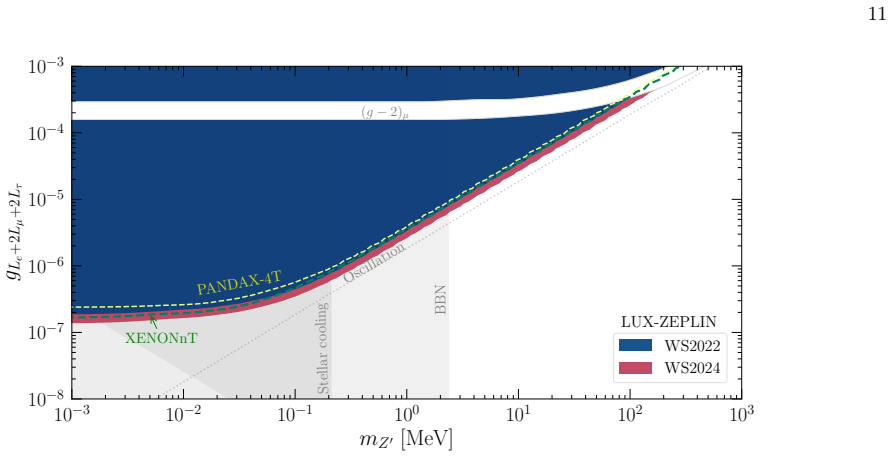
Incorporating contributions from scalar, vector, and tensor light mediator interactions consistent with Lorentz invariance and from vector mediators in anomaly-free leptophilic U(1)' gauge extensions with symmetries Le-Lμ, Le-Lτ, Lμ-Lτ, and Le+2Lμ+2Lτ into the neutrino-electron scattering cross-section, and analyzing the latest LZ ER datasets with the most precise solar neutrino flux predictions, we report novel constraints on the coupling-mass parameter space that demonstrate significantly improved limits in previously unconstrained regions.
What carries the argument
The neutrino-electron scattering cross-section modified by contributions from light mediators, applied to solar neutrino fluxes and compared to LZ electron recoil observations.
If this is right
- New upper limits are derived for the coupling strengths of light scalar, vector, and tensor mediators as a function of their mass.
- Constraints are obtained for the parameter space of specific leptophilic U(1)' models associated with lepton flavor symmetries.
- LZ bounds are shown to be competitive or stronger than those from laboratory experiments, cosmology, and astrophysics in certain regimes.
- These results indicate that direct detection experiments can effectively probe light new physics through solar neutrino interactions.
Where Pith is reading between the lines
- Such constraints may limit the viability of light mediator models proposed to address neutrino-related puzzles.
- Similar analyses could be extended to other direct detection experiments or future runs of LZ for even stronger bounds.
- Connections to astrophysical neutrino sources might offer additional tests of these interaction models.
- Model builders could use these limits to guide the construction of viable extensions beyond the standard model.
Load-bearing premise
The limits depend on the assumption that solar neutrino flux predictions are precise and that the electron recoil events arise from neutrino scattering without substantial unmodeled backgrounds or systematics.
What would settle it
Detection of a low-energy electron recoil rate in LZ that significantly deviates from the expected rate including the new physics contributions would falsify the reported constraints.
Figures


read the original abstract
The recent low-energy electron recoil (ER) results reported by the LUX-ZEPLIN (LZ) experiment have established the most stringent constraints to date on new physics scenarios, specifically for solar axion-like particles with keV-scale masses and mirror dark matter. Motivated by this enhanced sensitivity and the resulting restrictive limits, our present work focuses on probing light mediator models via elastic neutrino-electron scattering induced by solar neutrinos. We specifically consider two broad classes of new physics scenarios: (i) universal light mediator models consistent with Lorentz invariance, including scalar, vector, and tensor interactions, and (ii) anomaly-free leptophilic $U(1)'$ gauge extensions featuring a new vector mediator associated with the $L_e-L_\mu$, $L_e-L_\tau$, $L_\mu-L_\tau$, and $L_e+2L_\mu+2L_\tau$ symmetries. By incorporating contributions from these interactions into the neutrino-electron scattering cross-section and utilizing the most precise solar neutrino flux predictions, we analyze the latest LZ ER datasets. We report novel constraints on the coupling-mass parameter space for these models. Furthermore, we contextualize our findings by comparing them with established bounds from various laboratory, cosmological, and astrophysical sources. Our analysis demonstrates that LZ data provide significantly improved limits in previously unconstrained regions of the parameter space.
Editorial analysis
A structured set of objections, weighed in public.
Referee Report
Summary. The manuscript analyzes elastic solar neutrino-electron scattering in the LUX-ZEPLIN (LZ) experiment to derive updated limits on light mediator models. It incorporates scalar, vector, and tensor interactions (universal Lorentz-invariant class) plus anomaly-free leptophilic U(1)' vector mediators (Le-Lμ, Le-Lτ, Lμ-Lτ, Le+2Lμ+2Lτ) into the differential cross section, employs the most precise solar neutrino flux predictions, and fits the latest LZ low-energy electron-recoil data to extract novel constraints on the mediator mass-coupling plane, claiming significantly improved bounds in previously unconstrained regions relative to laboratory, cosmological, and astrophysical limits.
Significance. If the central results hold after addressing uncertainty propagation, the work supplies timely, complementary constraints on light new physics using solar neutrinos as a probe. The explicit comparison of LZ-derived contours with existing bounds from other sources strengthens the paper's utility for model-building and future experimental planning in the sub-GeV mediator regime.
major comments (2)
- [Analysis and Results] The headline claim of significantly improved limits rests on fixed solar neutrino flux normalizations (8B, hep, etc.) without marginalization over their uncertainties. Because the expected event rate scales linearly with flux, an unpropagated O(10-20%) flux uncertainty can shift the exclusion contours by O(1) factors in the coupling-mass plane; this is load-bearing for the “previously unconstrained regions” assertion (see Analysis and Results sections).
- [Data Analysis] Background modeling and systematic uncertainties for the ER spectrum are not detailed. The attribution of all observed events to neutrino scattering plus modeled backgrounds is central to the limit extraction; without explicit treatment of sub-dominant ER backgrounds or their uncertainties, the robustness of the new constraints cannot be assessed (see Data Analysis section).
minor comments (2)
- [Abstract] The abstract states that “most precise” fluxes are used but does not specify whether any flux-related nuisance parameters are floated; a one-sentence clarification would improve readability.
- [Model Definitions] Notation for the new-physics couplings (e.g., g_φ, g_V) should be defined once in the text before the first use in equations to avoid ambiguity for readers.
Simulated Author's Rebuttal
We thank the referee for their thorough review and valuable comments on our manuscript. We address each major comment below and have revised the manuscript accordingly to enhance the robustness of our analysis.
read point-by-point responses
-
Referee: [Analysis and Results] The headline claim of significantly improved limits rests on fixed solar neutrino flux normalizations (8B, hep, etc.) without marginalization over their uncertainties. Because the expected event rate scales linearly with flux, an unpropagated O(10-20%) flux uncertainty can shift the exclusion contours by O(1) factors in the coupling-mass plane; this is load-bearing for the “previously unconstrained regions” assertion (see Analysis and Results sections).
Authors: We agree that propagating the solar neutrino flux uncertainties is important for a complete assessment of the limits. In the original analysis, we used the central values from the most precise predictions available. However, to strengthen the results, we have now included a marginalization over the flux normalizations as nuisance parameters in the likelihood fit, using their reported uncertainties (e.g., ~2% for 8B, larger for hep but with smaller contribution). The revised contours remain significantly improved in the relevant regions, though slightly more conservative. We have updated the Analysis and Results sections to describe this procedure and present the updated figures. revision: yes
-
Referee: [Data Analysis] Background modeling and systematic uncertainties for the ER spectrum are not detailed. The attribution of all observed events to neutrino scattering plus modeled backgrounds is central to the limit extraction; without explicit treatment of sub-dominant ER backgrounds or their uncertainties, the robustness of the new constraints cannot be assessed (see Data Analysis section).
Authors: We appreciate this point. The LZ data analysis relies on the background model published by the LZ collaboration, which includes detailed modeling of ER backgrounds such as those from 214Pb, 85Kr, and other sources. In the revised manuscript, we have expanded the Data Analysis section to provide a more explicit description of these backgrounds, their contributions to the low-energy spectrum, and how their systematic uncertainties are incorporated into the limit-setting procedure. This includes referencing the relevant LZ papers and adding a brief discussion on the impact of these uncertainties on our new physics limits. revision: yes
Circularity Check
No circularity: limits derived from independent SSM fluxes and LZ data
full rationale
The paper computes modified neutrino-electron scattering rates by adding new-physics contributions to the SM cross section, folds them with external standard solar model flux predictions, and compares the resulting event spectrum to the published LZ ER dataset to extract coupling-mass limits. The solar fluxes are taken from independent SSM calculations; the LZ spectrum is independent experimental data. No parameter is fitted to the LZ data and then re-labeled as a prediction, no self-citation supplies a uniqueness theorem or ansatz that the present work relies upon, and no known empirical pattern is merely renamed. The derivation chain therefore remains self-contained against external inputs.
Axiom & Free-Parameter Ledger
axioms (2)
- standard math Standard Model neutrino-electron scattering cross section is known and accurate
- domain assumption Solar neutrino fluxes are accurately predicted by standard solar models
Reference graph
Works this paper leans on
-
[1]
Such an interaction introduces an additional scalar current in EνES processes
Universal scalar We begin by examining a light scalar mediatorϕthat couples in a universal manner to all charged leptons and neutrino flavors in the SM. Such an interaction introduces an additional scalar current in EνES processes. The cor- responding interaction Lagrangian is expressed as [17] Lϕ ⊃ −ϕ ge ϕ¯ee+gνℓ ϕ ¯νℓRνℓL +h.c. ,(2.8) where the scalar c...
-
[2]
Universal vector We next examine a light vector mediator, denoted by Z ′, which couples in a universal manner to SM electrons and neutrinos. The associated interaction Lagrangian takes the form LZ′ ⊃Z ′ µ Qe Z′ge Z′¯eγµe+Q νℓ Z′gνℓ Z′ ¯νℓLγµνℓL ,(2.10) where the vector coupling constantsg e Z′ andg νℓ Z′ are for electron and neutrino, respectively. The ve...
-
[3]
With this choice, the resulting cross section closely resembles that of the well-studiedU(1) B−L model, where the corresponding charges satisfyQ e Z′ =Q νℓ Z′ =−1. The distinction between these two models becomes apparent in CEνNS processes, in which quark charges contribute and differ by an overall factor of 1/3 [42, 43]. However, for EνES, where only le...
-
[4]
Universal tensor We next examine a light tensor mediator T that cou- ples universally to SM electrons and neutrinos. The cor- responding interaction Lagrangian can be written as [44] LT ⊃ ge T¯eσµνe−g νl T ¯νℓRσµννℓL Tµν,(2.12) whereσ µν =i(γ µγν −γ νγµ)/2. Here,g e T andg νℓ T de- note the tensor couplings to electrons and neutrinos of flavorℓ, respectiv...
-
[5]
Lepton flavor-dependentU(1) ′ models:L e −L µ, Le −L τ ,L µ −L τ , andL e + 2Lµ + 2Lτ The class ofU(1) ′ extensions considered here is purely leptonic in nature. These models constitute some of the simplest realizations of a new vector mediatorZ ′, as gauge anomaly cancellation can be achieved without in- troducing fermions beyond those already present in...
-
[6]
The survival and transition proba- bilities depend on the mixing anglesϑ 12,ϑ 13, andϑ 23
cos(2ϑ12) + sin2 ϑ13 sin2 ϑ m 13, (3.7) where the superscriptmdenotes quantities modified by solar matter effects. The survival and transition proba- bilities depend on the mixing anglesϑ 12,ϑ 13, andϑ 23. In our analysis, we incorporate the day–night asym- metry arising from Earth matter effects when evaluating these probabilities. For numerical inputs, ...
-
[7]
R. Davis, Jr., D. S. Harmer and K. C. Hoffman, Phys. Rev. Lett.20, 1205-1209 (1968)
work page 1968
-
[8]
Anselmannet al.(GALLEX Collaboration), Phys
P. Anselmannet al.(GALLEX Collaboration), Phys. Lett. B285, 376-389 (1992)
work page 1992
-
[9]
B. T. Cleveland, T. Daily, R. Davis Jr., J. R. Distel, K. Lande, C. K. Lee, P. S. Wildenhain and J. Ullman, Astrophys. J.496, 505-526 (1998)
work page 1998
-
[10]
J. N. Abdurashitovet al.(SAGE Collaboration), Phys. Rev. Lett.83, 4686-4689 (1999)
work page 1999
-
[11]
Q. R. Ahmadet al.(SNO Collaboration), Phys. Rev. Lett.89, 011301 (2002)
work page 2002
-
[12]
S. N. Ahmedet al.(SNO Collaboration), Phys. Rev. Lett. 92, 181301 (2004)
work page 2004
-
[13]
Aharmimet al.(SNO Collaboration), Phys
B. Aharmimet al.(SNO Collaboration), Phys. Rev. Lett. 101, 111301 (2008)
work page 2008
-
[14]
K. S. Hirataet al.(Kamiokande-II Collaboration), Phys. Rev. Lett.63, 16 (1989)
work page 1989
-
[15]
Fukudaet al.(Super-Kamiokande Collaboration), Phys
S. Fukudaet al.(Super-Kamiokande Collaboration), Phys. Rev. Lett.86, 5651-5655 (2001). 13
work page 2001
-
[16]
Arpesellaet al.(Borexino Collaboration), Phys
C. Arpesellaet al.(Borexino Collaboration), Phys. Lett. B658, 101-108 (2008)
work page 2008
-
[17]
Belliniet al.(Borexino Collaboration), Phys
G. Belliniet al.(Borexino Collaboration), Phys. Rev. D 82, 033006 (2010)
work page 2010
- [18]
-
[19]
J. N. Bahcall, M. Kamionkowski and A. Sirlin, Phys. Rev. D51, 6146-6158 (1995)
work page 1995
- [20]
-
[21]
M. W. Goodman and E. Witten, Phys. Rev. D31, 3059 (1985)
work page 1985
-
[22]
A. K. Drukier, K. Freese and D. N. Spergel, Phys. Rev. D33, 3495-3508 (1986)
work page 1986
-
[23]
D. G. Cerde˜ no, M. Fairbairn, T. Jubb, P. A. N. Machado, A. C. Vincent and C. Bœhm, J. High Energ. Phys.2016, 118 (2016) [erratum: J. High Energ. Phys.2016, 48 (2016)]
work page 2016
- [24]
-
[25]
Aprileet al.(XENON Collaboration), JCAP11, 031 (2020)
E. Aprileet al.(XENON Collaboration), JCAP11, 031 (2020)
work page 2020
-
[26]
Aprileet al.(XENON Collaboration), Phys
E. Aprileet al.(XENON Collaboration), Phys. Rev. Lett.129, 161805 (2022)
work page 2022
-
[27]
Caoet al.(PandaX Collaboration), Sci
X. Caoet al.(PandaX Collaboration), Sci. China Phys. Mech. Astron.57, 1476-1494 (2014)
work page 2014
-
[28]
Cuiet al.(PandaX-II Collaboration), Phys
X. Cuiet al.(PandaX-II Collaboration), Phys. Rev. Lett. 119, 181302 (2017)
work page 2017
-
[29]
Zenget al.(PandaX Collaboration), Phys
X. Zenget al.(PandaX Collaboration), Phys. Rev. Lett. 134, 041001 (2025)
work page 2025
-
[30]
D. S. Akeribet al.(LUX-ZEPLIN Collaboration), Phys. Rev. Lett.116, 161301 (2016)
work page 2016
-
[31]
D. S. Akeribet al.(LUX-ZEPLIN Collaboration), Phys. Rev. D101, 052002 (2020)
work page 2020
-
[32]
Aalberset al.(LUX-ZEPLIN Collaboration), Phys
J. Aalberset al.(LUX-ZEPLIN Collaboration), Phys. Rev. Lett.131, 041002 (2023)
work page 2023
-
[33]
Aalberset al.(LUX-ZEPLIN Collaboration), Phys
J. Aalberset al.(LUX-ZEPLIN Collaboration), Phys. Rev. Lett.135, 011802 (2025)
work page 2025
- [34]
-
[35]
Pesudoet al.(DarkSide-20k Collaboration), J
V. Pesudoet al.(DarkSide-20k Collaboration), J. Phys.: Conf. Ser.2156, 012043 (2021)
work page 2021
-
[36]
Aalberset al.(DARWIN Collaboration), Eur
J. Aalberset al.(DARWIN Collaboration), Eur. Phys. J. C80, 1133 (2020)
work page 2020
- [37]
- [38]
-
[39]
J. Abdallah, H. Araujo, A. Arbey, A. Ashkenazi, A. Belyaev, J. Berger, C. Boehm, A. Boveia, A. Bren- nan and J. Brooke, Phys. Dark Univ.9-10, 8-23 (2015)
work page 2015
-
[40]
R. N. Mohapatra and R. E. Marshak, Phys. Rev. Lett. 44, 1316-1319 (1980) [erratum: Phys. Rev. Lett.44, 1643 (1980)]
work page 1980
-
[41]
X. G. He, G. C. Joshi, H. Lew and R. R. Volkas, Phys. Rev. D44, 2118-2132 (1991)
work page 1991
-
[42]
Navaset al.(Particle Data Group), Phys
S. Navaset al.(Particle Data Group), Phys. Rev. D110, 030001 (2024)
work page 2024
- [43]
-
[44]
M. Atzori Corona, M. Cadeddu, N. Cargioli, F. Dordei and C. Giunti, Phys. Rev. D112, 015007 (2025)
work page 2025
-
[45]
J. A. Formaggio and G. P. Zeller, Rev. Mod. Phys.84, 1307-1341 (2012)
work page 2012
-
[46]
B. C. Allanach, J. Davighi and S. Melville, J. High Energ. Phys.2019, 82 (2019) [erratum: J. High Energ. Phys. 2019, 64 (2019)]
work page 2019
-
[47]
P. Ballett, M. Hostert, S. Pascoli, Y. F. Perez-Gonzalez, Z. Tabrizi, and R. Z. Funchal, Phys. Rev. D100, 055012 (2019)
work page 2019
-
[48]
V. De Romeri, O. G. Miranda, D. K. Papoulias, G. Sanchez Garcia, M. T´ ortola and J. W. F. Valle, J. High Energ. Phys.2023, 35 (2023)
work page 2023
- [49]
-
[50]
J. Barranco, A. Bolanos, E. A. Garces, O. G. Miranda and T. I. Rashba, Int. J. Mod. Phys. A27, 1250147 (2012)
work page 2012
-
[51]
M. Atzori Corona, M. Cadeddu, N. Cargioli, F. Dordei, C. Giunti, Y. F. Li, E. Picciau, C. A. Ternes and Y. Y. Zhang, J. High Energ. Phys.2022, 109 (2022)
work page 2022
- [52]
- [53]
- [54]
-
[55]
V. De Romeri, D. K. Papoulias and C. A. Ternes, J. High Energ. Phys.2024, 165 (2024)
work page 2024
- [56]
-
[57]
W. Altmannshofer, S. Gori, J. Mart´ ın-Albo, A. Sousa, and M. Wallbank, Phys. Rev. D100, 115029 (2019)
work page 2019
-
[58]
J. W. Chen, H. C. Chi, C. P. Liu and C. P. Wu, Phys. Lett. B774, 656-661 (2017)
work page 2017
-
[59]
Thompsonet al., X-ray data booklet (2009)
A. Thompsonet al., X-ray data booklet (2009)
work page 2009
-
[60]
K. A. Kouzakov and A. I. Studenikin, Phys. Rev. D 95, 055013 (2017) [erratum: Phys. Rev. D96, 099904 (2017)]
work page 2017
-
[61]
C. C. Hsieh, L. Singh, C. P. Wu, J. W. Chen, H. C. Chi, C. P. Liu, M. K. Pandey and H. T. Wong, Phys. Rev. D 100, 073001 (2019)
work page 2019
- [62]
-
[63]
I. Esteban, M. C. Gonzalez-Garcia, M. Maltoni, I. Martinez-Soler, J. P. Pinheiro and T. Schwetz, J. High Energ. Phys12, 216 (2024)
work page 2024
- [64]
- [65]
-
[66]
G. L. Fogli, E. Lisi, A. Marrone, D. Montanino and A. Palazzo, Phys. Rev. D66, 053010 (2002)
work page 2002
- [67]
-
[68]
J. N. Bahcall, Neutrino Astrophysics, Cambridge Univer- sity Press (1989), ISBN: 9780521379755
work page 1989
-
[69]
N. Vinyoles, A. M. Serenelli, F. L. Villante, S. Basu, J. Bergstr¨ om, M. C. Gonzalez-Garcia, M. Maltoni, C. Pe˜ na-Garay and N. Song, Astrophys. J.835, 202 (2017)
work page 2017
-
[70]
M. Lindner, Y. Mambrini, T. B. de Melo and F. S. Queiroz, Phys. Lett. B811, 135972 (2020)
work page 2020
- [71]
- [72]
-
[73]
Aguilar-Arevaloet al.(CONNIE Collaboration), J
A. Aguilar-Arevaloet al.(CONNIE Collaboration), J. High Energ. Phys.2020, 54 (2020)
work page 2020
-
[74]
Bonetet al.(CONUS Collaboration), J
H. Bonetet al.(CONUS Collaboration), J. High Energ. Phys.2022, 85 (2022)
work page 2022
-
[75]
A. Chattaraj, A. Majumdar and R. Srivastava, Probing Standard Model and Beyond with Reactor CEνNS Data of CONUS+ experiment, arXiv:2501.12441 [hep-ph]
- [76]
-
[77]
S. K. A., A. Majumdar, D. K. Papoulias, H. Prajapati and R. Srivastava, Phys. Lett. B839, 137742 (2023)
work page 2023
-
[78]
Y. M. Andreevet al.(NA64 Collaboration), Phys. Rev. Lett.129, 161801 (2022)
work page 2022
-
[79]
Merkelet al.(A1 Collaboration), Phys
H. Merkelet al.(A1 Collaboration), Phys. Rev. Lett. 106, 251802 (2011)
work page 2011
-
[80]
Abelevet al.(ALICE Collaboration), Phys
B. Abelevet al.(ALICE Collaboration), Phys. Lett. B 720, 52-62 (2013)
work page 2013
discussion (0)
Sign in with ORCID, Apple, or X to comment. Anyone can read and Pith papers without signing in.