Recognition: 2 theorem links
· Lean TheoremLearning Adaptive Parameter Policies for Nonlinear Bayesian Filtering
Pith reviewed 2026-05-15 08:39 UTC · model grok-4.3
The pith
Reinforcement learning trains policies to choose filter parameters dynamically in nonlinear Bayesian estimation.
A machine-rendered reading of the paper's core claim, the machinery that carries it, and where it could break.
Core claim
The paper claims that casting adaptive parameter selection for nonlinear Bayesian filters as a Markov decision process and solving it via reinforcement learning yields policies that improve both the quality and the consistency of state estimates, as shown by experiments with the unscented Kalman filter and the stochastic integration filter.
What carries the argument
A reinforcement-learning agent that selects filter parameters at each time step according to a reward combining estimation accuracy and consistency.
If this is right
- The same learned policy can be reused across multiple time steps without recomputation.
- Any parameter-dependent nonlinear filter becomes eligible for the same training procedure.
- Consistency gains reduce the chance of filter divergence over long sequences.
- Average computational cost can stay the same or drop while accuracy rises.
Where Pith is reading between the lines
- The method could be extended to particle filters by treating the number of particles as one of the selectable actions.
- If the training scenarios miss important operating regimes, the policy may require occasional online adaptation or a richer reward signal.
- The approach links parameter tuning directly to long-horizon estimation performance rather than single-step error.
Load-bearing premise
A reward defined on accuracy and consistency will produce policies that generalize to new time-varying nonlinearities without retraining or instability.
What would settle it
Apply a trained policy to a filtering problem whose degree of nonlinearity exceeds the training distribution and check whether the consistency metrics fall below those of a well-tuned fixed-parameter filter.
Figures



read the original abstract
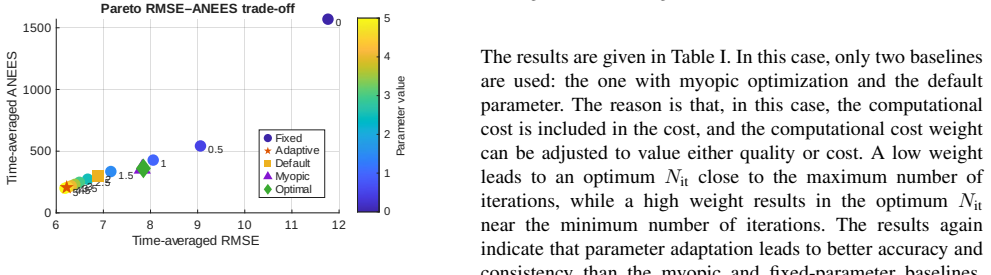
For many nonlinear Bayesian state estimation problems, the posterior recursion is not analytically tractable, leading to algorithms that are influenced by numerical approximation errors. These algorithms depend on parameters that affect the approximation's accuracy and computational cost. The parameters include, for example, the number of particles, scaling parameters, and the number of iterations in iterative computations. Typically, these parameters are fixed or adjusted heuristically, although the approximation accuracy can change over time with the local degree of nonlinearity and uncertainty. The approximation errors introduced at a time step propagate through subsequent updates, affecting the accuracy, consistency, and robustness of future estimates. This paper presents adaptive parameter selection in nonlinear Bayesian filtering as a sequential decision-making problem, where parameters influence not only the immediate estimation outcome but also the future estimates. The decision-making problem is addressed using reinforcement learning to learn adaptive parameter policies for nonlinear Bayesian filters. Experiments with the unscented Kalman filter and stochastic integration filter demonstrate that the learned policies improve both estimate quality and consistency.
Editorial analysis
A structured set of objections, weighed in public.
Referee Report
Summary. The manuscript frames adaptive parameter selection (e.g., scaling parameters, iteration counts) in nonlinear Bayesian filters as a sequential decision-making problem solved via reinforcement learning. The goal is to learn policies that account for how approximation errors propagate across time steps and thereby improve both immediate and future estimate quality and consistency. Experiments with the unscented Kalman filter and stochastic integration filter are reported to demonstrate that the learned policies outperform fixed-parameter baselines.
Significance. If the empirical results hold under scrutiny, the work supplies a principled, data-driven alternative to heuristic parameter tuning in nonlinear filtering. By optimizing for long-horizon estimation metrics rather than instantaneous accuracy alone, the approach could improve robustness in time-varying nonlinear regimes without requiring manual retuning. The formulation is a natural application of RL to filtering and, if reproducible, would constitute a concrete methodological contribution.
major comments (1)
- [Abstract and §4] Abstract and §4 (Experiments): the central claim that 'learned policies improve both estimate quality and consistency' is presented without any quantitative metrics, baseline comparisons, reward-function definition, training hyperparameters, or description of how generalization to unseen trajectories was assessed. Because the performance benefit is the sole empirical support for the method, the absence of these details renders the claim unevaluable and load-bearing for acceptance.
Simulated Author's Rebuttal
We thank the referee for their careful review and for identifying the need to strengthen the empirical presentation. We agree that the performance claims require more explicit quantitative support to be fully evaluable and will revise the manuscript accordingly.
read point-by-point responses
-
Referee: [Abstract and §4] Abstract and §4 (Experiments): the central claim that 'learned policies improve both estimate quality and consistency' is presented without any quantitative metrics, baseline comparisons, reward-function definition, training hyperparameters, or description of how generalization to unseen trajectories was assessed. Because the performance benefit is the sole empirical support for the method, the absence of these details renders the claim unevaluable and load-bearing for acceptance.
Authors: We acknowledge that the current manuscript summarizes the experimental outcomes without providing the requested quantitative details. In the revised version we will expand the abstract to report key metrics (RMSE and NEES) and will rewrite §4 to include: (i) explicit tables comparing learned policies against fixed-parameter baselines on both filters, (ii) the precise reward-function definition (a weighted combination of estimation error and consistency penalty), (iii) the complete list of RL training hyperparameters, and (iv) the train/test split protocol used to evaluate generalization to unseen trajectories. These additions will make the performance benefit directly verifiable while preserving the original experimental design. revision: yes
Circularity Check
No significant circularity
full rationale
The paper formulates adaptive parameter selection for nonlinear filters as a reinforcement learning problem and reports empirical improvements on held-out test trajectories for UKF and SIF. No derivation chain, equations, or self-citations reduce the central performance claims to fitted inputs or self-definitions by construction; the reported gains are measured outcomes rather than tautological restatements of the reward or training objective. The approach is self-contained against external benchmarks.
Axiom & Free-Parameter Ledger
axioms (1)
- domain assumption The approximation error at each time step can be meaningfully quantified by a scalar reward that the reinforcement-learning agent can optimize.
Lean theorems connected to this paper
-
IndisputableMonolith/Cost/FunctionalEquation.leanwashburn_uniqueness_aczel unclear?
unclearRelation between the paper passage and the cited Recognition theorem.
The decision-making problem is addressed using reinforcement learning to learn adaptive parameter policies for nonlinear Bayesian filters. Experiments with the unscented Kalman filter and stochastic integration filter demonstrate that the learned policies improve both estimate quality and consistency.
What do these tags mean?
- matches
- The paper's claim is directly supported by a theorem in the formal canon.
- supports
- The theorem supports part of the paper's argument, but the paper may add assumptions or extra steps.
- extends
- The paper goes beyond the formal theorem; the theorem is a base layer rather than the whole result.
- uses
- The paper appears to rely on the theorem as machinery.
- contradicts
- The paper's claim conflicts with a theorem or certificate in the canon.
- unclear
- Pith found a possible connection, but the passage is too broad, indirect, or ambiguous to say the theorem truly supports the claim.
Reference graph
Works this paper leans on
-
[1]
S ¨arkk¨a,Bayesian Filtering and Smoothing
S. S ¨arkk¨a,Bayesian Filtering and Smoothing. Cambridge University Press, 2013
work page 2013
-
[2]
Unscented filtering and nonlinear estimation,
S. J. Julier and J. K. Uhlmann, “Unscented filtering and nonlinear estimation,”IEEE Proceedings, vol. 92, no. 3, pp. 401–421, 2004
work page 2004
-
[3]
Stochastic integration filter,
J. Dun ´ık, O. Straka, and M.ˇSimandl, “Stochastic integration filter,”IEEE Transactions on Automatic Control, vol. 58, no. 6, pp. 1561–1566, 2013
work page 2013
-
[4]
G. Evensen, “Sequential data assimilation with a nonlinear quasi- geostrophic model using Monte Carlo methods to forecast error statis- tics,”Journal of Geophysical Research: Oceans, vol. 99, no. C5, pp. 10 143–10 162, 1994
work page 1994
-
[5]
J. Anderson and S. Anderson, “A Monte Carlo implementation of the nonlinear filtering problem to produce ensemble assimilations and forecasts,”Monthly Weather Review, vol. 127, no. 12, pp. 2741–2758, 1999
work page 1999
-
[6]
Kernel-based ensemble Gaussian mixture filtering for orbit determination with sparse data,
S. Yun, R. Zanetti, and B. A. Jones, “Kernel-based ensemble Gaussian mixture filtering for orbit determination with sparse data,”Advances in Space Research, vol. 69, no. 12, pp. 4179–4197, June 2022, https://doi.org/10.1016/j.asr.2022.03.041
-
[7]
Efficient Gaussian mixture filters based on transition density approximation,
O. Straka and U. D. Hanebeck, “Efficient Gaussian mixture filters based on transition density approximation,” in2025 28th International Conference on Information Fusion (FUSION), 2025, pp. 1–8
work page 2025
- [8]
-
[9]
Sampling density design for particle filters,
M. Simandl and O. Straka, “Sampling density design for particle filters,” inProceedings of the 13th IFAC Symposium on System Identification, Rotterdam, 2003
work page 2003
-
[10]
Design of efficient point-mass filter with illustration in terrain aided navigation,
J. Matou ˇsek, J. Dun´ık, and M. Brandner, “Design of efficient point-mass filter with illustration in terrain aided navigation,” in26th International Conference on Information Fusion (FUSION), Charleston, USA, 2023
work page 2023
-
[11]
Unscented Kalman filter with advanced adaptation of scaling parameter,
O. Straka, J. Dun ´ık, and M. ˇSimandl, “Unscented Kalman filter with advanced adaptation of scaling parameter,”Automatica, vol. 50, no. 10, pp. 2657–2664, 2014
work page 2014
-
[12]
Unscented Kalman filter: As- pects and adaptive setting of scaling parameter,
J. Dunik, M. Simandl, and O. Straka, “Unscented Kalman filter: As- pects and adaptive setting of scaling parameter,”IEEE Transactions on Automatic Control, vol. 57, no. 9, pp. 2411–2416, 2012
work page 2012
-
[13]
On nonlinearity measuring aspects of stochastic integration filter,
J. Havl ´ık, O. Straka, J. Dun´ık, and J. Ajgl, “On nonlinearity measuring aspects of stochastic integration filter,” inProceedings of the 13th International Conference on Informatics in Control, Automation and Robotics, ser. ICINCO 2016. Setubal, PRT: SCITEPRESS - Science and Technology Publications, Lda, 2016, p. 353–361
work page 2016
-
[14]
An adaptive covariance parameterization technique for the ensemble Gaussian mixture filter,
A. A. Popov and R. Zanetti, “An adaptive covariance parameterization technique for the ensemble Gaussian mixture filter,”SIAM Journal on Scientific Computing, vol. 46, no. 3, 2024
work page 2024
-
[15]
Z. Fan, D. Shen, Y . Bao, K. Pham, E. Blasch, and G. Chen, “RNN- UKF: Enhancing hyperparameter auto-tuning in unscented Kalman filters through recurrent neural networks,” in2024 27th International Conference on Information Fusion (FUSION), 2024, pp. 1–8
work page 2024
-
[16]
Complete offline tuning of the unscented Kalman filter,
L. A. Scardua and J. J. da Cruz, “Complete offline tuning of the unscented Kalman filter,”Automatica, vol. 80, pp. 54–61, 2017
work page 2017
-
[17]
Maneuvering target tracking using q-learning based kalman filter,
Z. Bekhtaoui, A. Meche, M. Dahmani, and K. A. Meraim, “Maneuvering target tracking using q-learning based kalman filter,” in2017 5th International Conference on Electrical Engineering - Boumerdes (ICEE- B), 2017, pp. 1–5
work page 2017
-
[18]
Q-learning- based noise covariance matrices adaptation in Kalman filter for inertial navigation,
G. Shaaban, H. Fourati, C. Prieur, and A. Kibangou, “Q-learning- based noise covariance matrices adaptation in Kalman filter for inertial navigation,”IFAC-PapersOnLine, vol. 58, no. 21, pp. 96–101, 2024, 4th IFAC Conference on Modelling, Identification and Control of Nonlinear Systems MICNON 2024
work page 2024
-
[19]
Lyapunov-based reinforcement learning state estimator,
L. Hu, C. Wu, and W. Pan, “Lyapunov-based reinforcement learning state estimator,” 2021. [Online]. Available: https://arxiv.org/abs/2010. 13529
work page 2021
-
[20]
Kalmannet: Data-driven kalman filtering,
G. Revach, N. Shlezinger, R. J. G. van Sloun, and Y . C. Eldar, “Kalmannet: Data-driven kalman filtering,” inICASSP 2021 - 2021 IEEE International Conference on Acoustics, Speech and Signal Processing (ICASSP), 2021, pp. 3905–3909
work page 2021
-
[21]
Danse: Data-driven non-linear state estimation of model-free process in unsupervised learning setup,
A. Ghosh, A. Honor ´e, and S. Chatterjee, “Danse: Data-driven non-linear state estimation of model-free process in unsupervised learning setup,” IEEE Transactions on Signal Processing, vol. 72, pp. 1824–1838, 2024
work page 2024
-
[22]
Generalized correntropy for robust adaptive filtering,
B. Chen, L. Xing, H. Zhao, N. Zheng, and J. C. Prı´ncipe, “Generalized correntropy for robust adaptive filtering,”IEEE Transactions on Signal Processing, vol. 64, no. 13, pp. 3376–3387, 2016
work page 2016
-
[23]
D. P. Bertsekas,Dynamic programming and optimal control. Athena Scientific, 2007
work page 2007
-
[24]
M. L. Puterman,Markov decision processes: discrete stochastic dynamic programming. John Wiley & Sons, 2014
work page 2014
-
[25]
Distributed design for active fault diag- nosis,
O. Straka and I. Pun ˇcoch´aˇr, “Distributed design for active fault diag- nosis,”International Journal of Systems Science, vol. 53, no. 3, pp. 562–574, 2022
work page 2022
-
[26]
A bayesian framework for reinforcement learning,
M. J. A. Strens, “A bayesian framework for reinforcement learning,” inProceedings of the Seventeenth International Conference on Machine Learning, ser. ICML ’00. San Francisco, CA, USA: Morgan Kaufmann Publishers Inc., 2000, p. 943–950
work page 2000
-
[27]
Huber-based divided difference filter- ing,
C. D. Karlgaard and H. Schaub, “Huber-based divided difference filter- ing,”Journal of Guidance, Control, and Dynamics, vol. 30, no. 3, pp. 885–891, 2007
work page 2007
-
[28]
Stochastic integration student’s-t filter,
O. Straka and J. Dun ´ık, “Stochastic integration student’s-t filter,” in2017 20th International Conference on Information Fusion (Fusion), 2017
work page 2017
-
[29]
Optimal control of markov processes with incomplete state information,
K. ˚Astr¨om, “Optimal control of markov processes with incomplete state information,”Journal of Mathematical Analysis and Applications, vol. 10, no. 1, pp. 174–205, 1965
work page 1965
-
[30]
R. S. Sutton and A. G. Barto,Reinforcement Learning: An Introduction, 2nd ed. The MIT Press, 2018
work page 2018
-
[31]
Average-reward soft actor-critic,
J. Adamczyk, V . Makarenko, S. Tiomkin, and R. V . Kulkarni, “Average-reward soft actor-critic,” 2025. [Online]. Available: https: //arxiv.org/abs/2501.09080
-
[32]
Adaptive choice of scaling pa- rameter in derivative-free local filters,
J. Dun ´ık, M. ˇSimandl, and O. Straka, “Adaptive choice of scaling pa- rameter in derivative-free local filters,” in2010 International Conference on Information Fusion, Edinburgh, Great Britain, 2010
work page 2010
-
[33]
Measuring estimator’s credibility: Noncredibility index,
X. R. Li and Z. Zhao, “Measuring estimator’s credibility: Noncredibility index,” inProceedings of 2006 International Conference on Information Fusion, Florence, Italy, 2006
work page 2006
discussion (0)
Sign in with ORCID, Apple, or X to comment. Anyone can read and Pith papers without signing in.