Recognition: 1 theorem link
· Lean TheoremTastePrint: A 3D Food Printing System for Layer-wise Taste Distribution via Airbrushed Liquid Seasoning
Pith reviewed 2026-05-15 01:07 UTC · model grok-4.3
The pith
TastePrint airbrushes liquid seasonings during 3D food printing to achieve layer-wise spatial taste distribution.
A machine-rendered reading of the paper's core claim, the machinery that carries it, and where it could break.
Core claim
TastePrint combines a user interface for specifying per-layer seasoning patterns on sliced 3D models with a modified food printer that uses a multi-nozzle airbrush to deposit controlled amounts of liquid seasoning at chosen locations during each printing pass, delivering repeatable hardware-level placement and quantity control together with preliminary proof that the resulting taste variations stay distinguishable to tasters.
What carries the argument
The multi-nozzle airbrush spray mechanism integrated into the 3D printer, which applies liquid seasonings at programmable positions and intensities during layer fabrication.
If this is right
- Users gain the ability to design and fabricate foods with non-uniform taste profiles across layers using a standard graphical workflow.
- Seasoning placement and quantity become hardware-repeatable rather than dependent on post-print manual application.
- Spatial taste arrangements remain perceptually meaningful after the printing process completes.
- The system supports existing 3D food printers through the addition of the spray mechanism and interface without requiring entirely new hardware.
Where Pith is reading between the lines
- The calibration consistency between non-edible and edible test surfaces suggests the approach could transfer to additional printable food bases with limited further tuning.
- Layer-wise taste control may enable printed foods that deliver different flavor sequences during normal chewing and swallowing.
- The method could support applications such as portion-controlled seasoning for dietary restrictions or educational foods that teach taste mapping.
- Extending the GUI to support continuous gradients rather than discrete channels would be a direct next step for smoother taste transitions.
Load-bearing premise
The taste localization observed in the 40-trial study and the consistency between filter-paper and mashed-potato measurements will hold for varied food materials, larger participant groups, and real-world consumption conditions.
What would settle it
A follow-up discrimination study on a new food material such as chocolate or pasta dough in which participants no longer reliably identify the centralized seasoning pattern at rates above chance.
Figures




read the original abstract
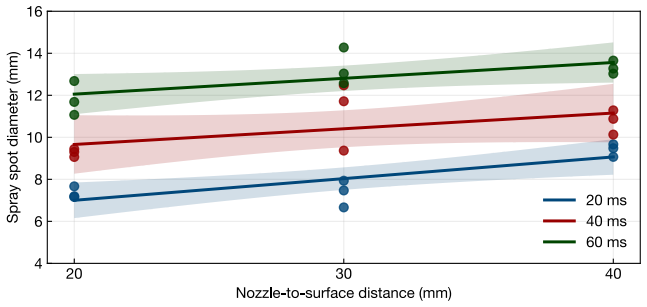
3D food printing enables the customization of food shapes and textures, but typically produces uniform taste profiles due to the limited diversity of printable materials. We present TastePrint, a 3D food printing system that achieves layer-wise spatial taste distribution by dynamically applying liquid seasonings with a programmable airbrush during fabrication. The system integrates (1) a graphical user interface (GUI) that allows users to import 3D models, slice them into layers, and specify seasoning channels, spray positions, and intensities, and (2) a customized 3D food printer equipped with a multi-nozzle spray mechanism. We evaluated the system through technical experiments quantifying spray resolution and deposition accuracy, a minimal sensory discrimination study on taste localization, and an exploratory formative user-feedback study involving three home cooks. The spray-resolution model achieved $R^2 = 0.86$, and the spray-amount model achieved $R^2 = 0.99$. The filter-paper calibration showed broad consistency with measurements obtained on edible mashed-potato samples. In the sensory discrimination study, participants identified the centralized seasoning pattern as more localized in 27 of 40 trials (67.5 %). These findings indicate that TastePrint can provide repeatable hardware-level control over seasoning placement and quantity while offering initial evidence that spatial taste arrangement can remain perceptually meaningful after fabrication.
Editorial analysis
A structured set of objections, weighed in public.
Referee Report
Summary. The manuscript introduces TastePrint, a 3D food printing system that achieves layer-wise spatial taste distribution by dynamically applying liquid seasonings via a programmable airbrush integrated with a customized printer and GUI. It reports technical evaluations with spray-resolution model R²=0.86 and spray-amount model R²=0.99, broad consistency between filter-paper and mashed-potato measurements, a sensory discrimination study with 67.5% (27/40) correct identification of centralized patterns, and formative feedback from three home cooks.
Significance. If the perceptual results hold under larger-scale testing, the work advances 3D food printing by demonstrating repeatable hardware-level control over seasoning placement and quantity, opening avenues for personalized taste in fabricated foods. The high R² fits and cross-material consistency are clear strengths that support the hardware claims.
major comments (1)
- [Sensory discrimination study] Sensory discrimination study: the central claim of 'initial evidence that spatial taste arrangement can remain perceptually meaningful after fabrication' rests entirely on the 67.5% identification rate (27 of 40 trials). The manuscript reports neither participant count, within- vs. between-subjects structure, nor any statistical test (e.g., binomial test against 50% chance), making it impossible to determine whether the result exceeds noise and rendering the perceptual component unsupported.
minor comments (2)
- [Methods] The manuscript would benefit from explicit reporting of participant N, trial randomization, and exact spray parameters used in the GUI description to improve replicability.
- [Technical evaluation] Figure captions and axis labels for the spray-resolution and amount plots should include units and error bars to clarify the R² fits.
Simulated Author's Rebuttal
We thank the referee for their insightful comments on our manuscript. We address the major concern regarding the sensory discrimination study below and will revise the paper to strengthen the reporting of this component.
read point-by-point responses
-
Referee: [Sensory discrimination study] Sensory discrimination study: the central claim of 'initial evidence that spatial taste arrangement can remain perceptually meaningful after fabrication' rests entirely on the 67.5% identification rate (27 of 40 trials). The manuscript reports neither participant count, within- vs. between-subjects structure, nor any statistical test (e.g., binomial test against 50% chance), making it impossible to determine whether the result exceeds noise and rendering the perceptual component unsupported.
Authors: We acknowledge the referee's concern that the sensory discrimination study lacks sufficient detail on participant numbers, design structure, and statistical testing, which weakens the support for the perceptual claims. We agree that this information is necessary. In the revised manuscript, we will expand the description of the study to include the number of participants, specify whether it was within- or between-subjects, and report the results of a binomial test (or equivalent) against chance level to assess if the 67.5% identification rate significantly exceeds 50%. This revision will make the perceptual component more robustly supported. revision: yes
Circularity Check
No circularity: empirical measurements and model fits are independent of claims
full rationale
The paper reports direct hardware measurements of spray resolution and deposition (with R² values for fitted models), consistency checks between filter-paper and mashed-potato samples, and raw counts from a 40-trial sensory discrimination task (27/40 correct). These are standard empirical reporting steps with no equations, predictions, or uniqueness claims that reduce by construction to the inputs or to self-citations. No load-bearing derivations, self-definitional loops, or imported ansatzes appear in the text.
Axiom & Free-Parameter Ledger
axioms (1)
- domain assumption Spray deposition on filter paper is representative of deposition on edible food matrices such as mashed potato
Lean theorems connected to this paper
-
IndisputableMonolith/Cost/FunctionalEquation.leanwashburn_uniqueness_aczel unclear?
unclearRelation between the paper passage and the cited Recognition theorem.
TastePrint... achieves layer-wise spatial taste distribution by dynamically applying liquid seasonings with a programmable airbrush... spray-resolution model achieved R²=0.86, spray-amount model R²=0.99... 27 of 40 trials (67.5%)
What do these tags mean?
- matches
- The paper's claim is directly supported by a theorem in the formal canon.
- supports
- The theorem supports part of the paper's argument, but the paper may add assumptions or extra steps.
- extends
- The paper goes beyond the formal theorem; the theorem is a base layer rather than the whole result.
- uses
- The paper appears to rely on the theorem as machinery.
- contradicts
- The paper's claim conflicts with a theorem or certificate in the canon.
- unclear
- Pith found a possible connection, but the passage is too broad, indirect, or ambiguous to say the theorem truly supports the claim.
Reference graph
Works this paper leans on
-
[1]
Additive manufacturing materials, methods and applications: A review. Mater. Today 81, 1060–1067. doi:10.1016/j.matpr.2021.04.379. Brooks, J., Amin, N., Lopes, P.,
-
[2]
Taste retargeting via chemical taste modulators, in: Proceedings of the 36th Annual ACM Symposium on User Interface Software and Technology, ACM. pp. 1–15. doi:10.1145/3586183. 3606818. Burkard, J., Kohler, L., Berger, T., Logean, M., Mishra, K., Windhab, E.J., Denkel, C.,
-
[3]
Rheology of edible food inks from 2D/3D/4D printing, and its role in future 5D/6D printing. Food Hydrocoll. 132, 107855. doi:10.1016/j.foodhyd. 2022.107855. Demei, K., Zhang, M., Phuhongsung, P., Mujumdar, A.S.,
-
[4]
3D food printing: Controlling characteristics and improving technological effect during food processing. Food Res. Int. 156, 111120. doi:10.1016/j.foodres. 2022.111120. Dom˙ zalska, Z., Jakubczyk, E.,
-
[5]
15 Fahmy, A.R., Amann, L.S., Dunkel, A., Frank, O., Dawid, C., Hofmann, T., Becker, T., Jekle, M.,
doi:10.3390/foods14030393. 15 Fahmy, A.R., Amann, L.S., Dunkel, A., Frank, O., Dawid, C., Hofmann, T., Becker, T., Jekle, M.,
-
[6]
Sensory design in food 3D printing – structuring, texture modulation, taste localization, and thermal stabilization. Innov. Food Sci. Emerg. Technol. 72, 102743. doi:10.1016/j.ifset.2021.102743. Fujiwara, K., Suzuki, Y ., Toba, K., Ogawa, J., Furukawa, H., Hashizume, M., Noji, T., Teratani, K., Ito, N.,
-
[7]
Multifunctional 3D food printer with quad-screw nozzle for four-color printing and dual ink mixing. J. Food Eng. 388, 112384. doi:10.1016/j.jfoodeng.2024.112384. Gustafsson, I.B.,
-
[8]
Culinary arts and meal science – a new scientific research discipline. Food Serv. Technol. 4, 9–20. doi:10.1111/j.1471-5740.2003.00083.x. Hakim, L., Deshmukh, R.K., Lee, Y .S., Gaikwad, K.K.,
-
[9]
Edible ink for food printing and packaging applications: a review. Sustain. Food Technol. 2, 876–892. doi:10.1039/d4fb00036f. Hussain, S., Malakar, S., Arora, V .K.,
- [10]
-
[11]
Dual extrusion 3D printing of mashed potatoes/strawberry juice gel. Lebenson. Wiss. Technol. 96, 589–596. doi:10.1016/j.lwt.2018.06.014. Mendoza-Bautista, K.J., Flores-Jimenez, M.S., Vázquez Tejeda Serrano, L.D., Trujillo de Santiago, G., Alvarez, M.M., Molina, A., Alfaro-Ponce, M., Chairez, I.,
- [12]
-
[13]
TTTV (taste the TV): Taste presentation display for “licking the screen” using a rolling trans- parent sheet and a mixture of liquid sprays, in: The Adjunct Publication of the 34th Annual ACM Symposium on User Interface Software and Technology, ACM. pp. 37–40. doi:10.1145/3474349.3480223. Miyashita, H.,
-
[14]
TTTV2 (transform the taste and visual appearance):tele-eat virtually with a seasoning home appliance that changes the taste and appearance of food or beverages, in: Proceedings of the 28th ACM Symposium on Virtual Reality Software and Technology, ACM. pp. 1–2. doi:10.1145/3562939.3565663. Mosca, A.C., Velde, F.v.d., Bult, J.H.F., van Boekel, M.A.J.S., Sti...
-
[15]
Enhancement of sweetness intensity in gels by inhomogeneous distribution of sucrose. Food Qual. Prefer. 21, 837–842. doi:10.1016/j.foodqual. 2010.04.010. 16 Noort, M.W.J., Bult, J.H.F., Stieger, M., Hamer, R.J.,
-
[16]
Saltiness enhancement in bread by inhomogeneous spatial distribution of sodium chloride. J. Cereal Sci. 52, 378–386. doi:10.1016/j.jcs.2010.06.018. Pan, J., Chen, X., Liu, J., Wang, Z., Aziz, T., Alhomrani, M., Alsanie, W.F., Alamri, A.S., Cui, H., Lin, L.,
-
[17]
Scalability potential of a pneumatic extrusion-based 3D printing system for food products. Innov. Food Sci. Emerg. Technol. 106, 104257. doi:10.1016/j.ifset.2025.104257. Praveena, Lokesh, Buradi, A., Santhosh, Praveena, Vignesh,
-
[18]
A comprehensive review of emerging additive manufacturing (3D printing technology): Methods, materials, applications, challenges, trends and future potential. Mater. Today 52, 1309–1313. doi:10.1016/j.matpr.2021.11.059. Sun, J., Zhou, W., Yan, L., Huang, D., Lin, L.Y .,
-
[19]
Extrusion-based food printing for digitalized food design and nutrition control. J. Food Eng. 220, 1–11. doi:10.1016/j.jfoodeng.2017.02.028. Suzuki, Y ., Takagishi, K., Umezu, S.,
-
[20]
Development of a high-precision viscous chocolate printer utilizing electrostatic inkjet printing. J. Food Process Eng. 42, e12934. doi:10.1111/jfpe.12934. Vadodaria, S., Mills, T.,
-
[21]
Jetting-based 3D printing of edible materials. Food Hydrocoll. 106, 105857. doi:10. 1016/j.foodhyd.2020.105857. Vi, C.T., Marzo, A., Memoli, G., Maggioni, E., Ablart, D., Yeomans, M., Obrist, M.,
-
[22]
LeviSense: A platform for the multisensory integration in levitating food and insights into its effect on flavour perception. Int. J. Hum. Comput. Stud. 139, 102428. doi:10.1016/j.ijhcs.2020.102428. V oon, S.L., An, J., Wong, G., Zhang, Y ., Chua, C.K.,
-
[23]
3D food printing: a categorised review of inks and their development. Virtual Phys. Prototyp. 14, 203–218. doi:10.1080/17452759.2019.1603508. Wang, Y ., Tuccillo, F., Lampi, A.M., Knaapila, A., Pulkkinen, M., Kariluoto, S., Coda, R., Edelmann, M., Jouppila, K., Sandell, M., Piironen, V ., Katina, K.,
-
[24]
Flavor challenges in extruded plant-based meat alternatives: A review. Compr. Rev. Food Sci. Food Saf. 21, 2898–2929. doi:10.1111/1541-4337.12964. Weidner, F., Maier, J.E., Broll, W.,
-
[25]
doi:10.1109/tvcg.2023.3247099. Zampini, M., Spence, C.,
-
[26]
Modifying the multisensory perception of a carbonated beverage using auditory cues. Food Qual. Prefer. 16, 632–641. doi:10.1016/j.foodqual.2004.11.004. Zhu, S., Vazquez Ramos, P., Heckert, O.R., Stieger, M., van der Goot, A.J., Schutyser, M.,
-
[27]
Creating protein-rich snack foods using binder jet 3D printing. J. Food Eng. 332, 111124. doi:10.1016/j.jfoodeng.2022.111124. 17
discussion (0)
Sign in with ORCID, Apple, or X to comment. Anyone can read and Pith papers without signing in.