Recognition: no theorem link
Quantum gravity and matter fields in a general background gauge
Pith reviewed 2026-05-15 00:40 UTC · model grok-4.3
The pith
The one-loop effective action for quantum gravity coupled to matter fields is explicitly computed in a general background gauge and shown to be gauge-independent on-shell.
A machine-rendered reading of the paper's core claim, the machinery that carries it, and where it could break.
Core claim
An explicit off-shell result for the one-loop effective action is obtained in a general background gauge, which reduces in a particular gauge to the effective action found by 't Hooft-Veltman. The validity of the DeWitt-Kallosh theorem is confirmed, implying that the on-shell effective action is independent of the gauge-fixing parameter. This theorem is employed to expose the non-renormalizability of the theory in a general background gauge.
What carries the argument
The DeWitt-Kallosh theorem applied to the one-loop perturbative expansion in a general background gauge for gravity-matter interactions.
If this is right
- The off-shell effective action reduces to the 't Hooft-Veltman result in a specific gauge.
- The on-shell effective action is independent of the gauge-fixing parameter.
- The theory of quantum gravity and matter is non-renormalizable at one-loop order in general background gauges.
Where Pith is reading between the lines
- If the DeWitt-Kallosh theorem holds at higher loops, the on-shell effective action would remain gauge-independent beyond one loop.
- This gauge independence could be used to simplify calculations of physical quantities in quantum gravity.
- Non-renormalizability suggests that quantum gravity requires a different approach, such as non-perturbative methods, even when coupled to matter.
Load-bearing premise
That the one-loop perturbative expansion and the background-field gauge-fixing procedure remain valid for the interacting gravitational plus matter system.
What would settle it
A direct computation of the on-shell effective action in two different gauges yielding different results would falsify the gauge independence claimed by the theorem.
Figures



read the original abstract
We analyse the gauge-dependence of the effective action in an interacting quantum theory of gravitational and matter fields. An explicit off-shell result is obtained in a general background gauge at one-loop order, which reduces in a particular gauge to the effective action found by 't Hooft-Veltman. We confirm the validity of DeWitt-Kallosh theorem, which implies that the on-shell effective action should be independent of the gauge-fixing parameter. We employ this theorem to expose the non-renormalizability of the theory in a general background gauge.
Editorial analysis
A structured set of objections, weighed in public.
Referee Report
Summary. The manuscript computes the one-loop effective action for gravity coupled to matter fields in a general background gauge. An explicit off-shell expression is derived that reduces to the known 't Hooft-Veltman result upon specialization to a particular gauge. The authors verify the DeWitt-Kallosh theorem, establishing on-shell independence of the gauge-fixing parameter, and invoke this independence to conclude that the theory remains non-renormalizable in the general gauge.
Significance. If the explicit one-loop derivation holds, the work supplies a concrete check of gauge independence in an interacting gravitational system and reinforces the established non-renormalizability result beyond a single gauge choice. The direct reduction to the 't Hooft-Veltman action and the theorem confirmation constitute reproducible, falsifiable steps that strengthen the technical foundation for background-field methods in quantum gravity.
major comments (1)
- [Introduction and Section 4] The one-loop perturbative treatment and background-field gauge fixing are assumed valid for the interacting gravity-matter system; the manuscript should explicitly state the range of validity (e.g., energy scales or curvature regimes) under which higher-order or non-perturbative corrections are expected not to alter the gauge-independence conclusion.
minor comments (2)
- [Section 2] Notation for the general background gauge parameter and the specific gauge choice that recovers the 't Hooft-Veltman result should be introduced with a clear equation reference early in the text.
- [Section 3] A brief table or equation summarizing the counterterms before and after gauge specialization would improve readability of the reduction step.
Simulated Author's Rebuttal
We thank the referee for the positive assessment and the recommendation for minor revision. The single major comment is addressed below with a planned addition to the manuscript.
read point-by-point responses
-
Referee: [Introduction and Section 4] The one-loop perturbative treatment and background-field gauge fixing are assumed valid for the interacting gravity-matter system; the manuscript should explicitly state the range of validity (e.g., energy scales or curvature regimes) under which higher-order or non-perturbative corrections are expected not to alter the gauge-independence conclusion.
Authors: We agree that an explicit statement of the regime of validity is warranted. In the revised version we will insert a clarifying paragraph in the Introduction and at the start of Section 4 noting that the calculation is performed within the one-loop approximation of the background-field method. The results therefore hold in the perturbative regime where the typical curvature scale is well below the Planck scale and higher-order loop corrections remain negligible. The DeWitt-Kallosh theorem guarantees on-shell gauge independence at this order; non-perturbative or higher-loop effects lie outside the present analysis. revision: yes
Circularity Check
No significant circularity
full rationale
The paper performs a direct one-loop perturbative calculation of the off-shell effective action in a general background gauge for gravity plus matter. It explicitly reduces to the known 't Hooft-Veltman result in a special gauge and verifies the DeWitt-Kallosh theorem (an external result) for on-shell gauge independence. Non-renormalizability is then restated by applying that theorem. No equation or claim reduces by construction to a fitted parameter, self-definition, or self-citation chain; the central derivation is a standard background-field computation whose output is compared against independent external benchmarks rather than being defined in terms of its own inputs.
Axiom & Free-Parameter Ledger
axioms (2)
- domain assumption One-loop approximation suffices to expose the gauge dependence and renormalizability properties of the theory
- domain assumption Background-field gauge fixing is applicable to the interacting gravitational plus matter system
Reference graph
Works this paper leans on
-
[1]
Propagators for the quantum fields: ℎ/u1D707/u1D708and ¯/u1D702/u1D707, /u1D702/u1D707 The quadratic form in the quantum graviton field is given by /uni222B.dsp /u1D451 4/u1D465ℎ /u1D707/u1D708/u1D435 /u1D707/u1D708 /u1D6FC/u1D6FDℎ /u1D6FC/u1D6FD , (A9) where /u1D435 /u1D707/u1D708 /u1D6FC/u1D6FD= − [ 1 /u1D709 ( 1 2 /u1D715 /u1D707/u1D715 /u1D708/u1D702 /u...
-
[2]
Vertex /u1D524ℎℎ The interactions terms /u1D524ℎℎ arises from [ 36] L ( 2) = − 1 2/u1D447 /u1D6FC/u1D707/u1D708/u1D6FD/u1D6FE /u1D6FF√ /u1D454 D/u1D6FC ℎ /u1D707/u1D708D/u1D6FD ℎ/u1D6FE /u1D6FF− √ /u1D454 2 [ /u1D445 ( 1 4 ℎ2 − 1 2 ℎ /u1D707/u1D708ℎ /u1D707/u1D708 ) + /u1D445 /u1D707/u1D708 ( 2ℎ /u1D6FC /u1D707ℎ/u1D708 /u1D6FC− ℎℎ /u1D707/u1D708 )] , (A14...
-
[3]
The vertex ¯/u1D702/u1D524/u1D702 The interaction terms coming from ghost Lagrangian given in Eq. ( 2.6) reads /u1D705 { 1 2 /u1D524/u1D706 /u1D706¯/u1D702/u1D707/u1D715 2/u1D702 /u1D707− ¯/u1D702/u1D707 ( /u1D524/u1D6FD/u1D706/u1D702 /u1D707/u1D708+ /u1D524/u1D707/u1D708/u1D702/u1D6FD/u1D706 ) /u1D715 /u1D6FD /u1D715 /u1D706/u1D702/u1D708 + 1 2 /u1D702 /...
-
[4]
Gravity coupled to a scalar field Now, we will consider the coupling between the graviton and a scalar field. From the classical Lagrangian − √ ¯/u1D454 ¯/u1D454 /u1D707/u1D708 2 /u1D715 /u1D707¯/u1D719/u1D715 /u1D708¯/u1D719, (A19) we obtain the scalar propagator in the momentum space: − /u1D456 1 /u1D4582 . (A20) The interactions terms arise from the Lagr...
-
[5]
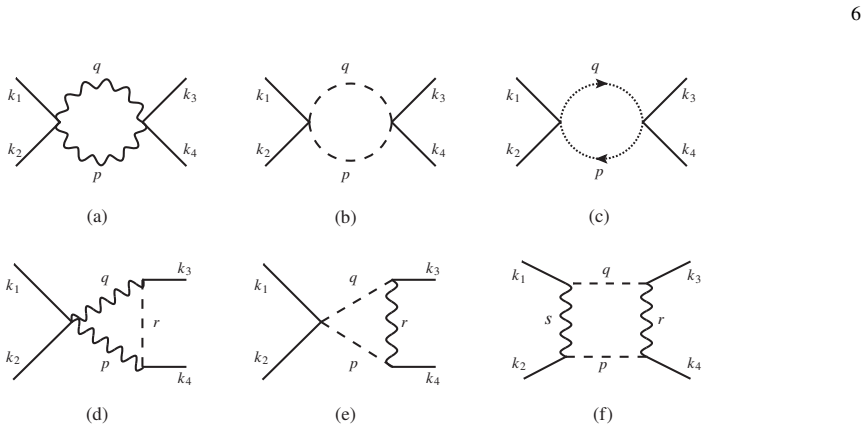
2-point diagrams Here, we present the divergent part of the diagrams shown in F ig. 1. We introduce the following tensor basis: T /u1D707/u1D708 /u1D6FC/u1D6FD ( 1) = /u1D458/u1D707/u1D458 /u1D6FC /u1D458/u1D708/u1D458/u1D6FD , (B1a) T /u1D707/u1D708 /u1D6FC/u1D6FD ( 2) = /u1D702 /u1D707/u1D708/u1D702 /u1D6FC/u1D6FD , (B1b) T /u1D707/u1D708 /u1D6FC/u1D6FD...
-
[6]
3-point function The one-loop diagrams that contributes to the 3-point funct ion /u1D524/u1D707/u1D708( /u1D458) /u1D719 ( /u1D4581) /u1D719 ( /u1D4582) are shown in Fig. 2. In order to simplify our results, we will introduce the tensor basis: T /u1D707/u1D708 /u1D445 ( /u1D458, /u1D4581, /u1D4582) = − 2/u1D4581 · /u1D4582 ( /u1D458/u1D707/u1D458/u1D708− ...
-
[7]
We remember the reader that permutations are imp lied
4-point scalar function Next, let us consider the divergent part of the 4-point scala r function. We remember the reader that permutations are imp lied. The diagram shown in Fig. 3(a) (summing all the permutations) leads to 2( /u1D709 2 + /u1D709 + 1) /u1D705 4 [( /u1D4581 · /u1D4584) ( /u1D4582 · /u1D4583) + ( /u1D4581 · /u1D4583) ( /u1D4582 · /u1D4584) ...
-
[8]
Weinberg, The Quantum Theory of Fields (Cambridge University Press, Cambridge, England, 1995)
S. Weinberg, The Quantum Theory of Fields (Cambridge University Press, Cambridge, England, 1995)
work page 1995
-
[9]
J. F. Donoghue, arXiv:gr-qc/9512024 10.48550/arXiv.gr-qc/9512024 (1995), arXiv:gr-qc/9512024
work page internal anchor Pith review Pith/arXiv arXiv doi:10.48550/arxiv.gr-qc/9512024 1995
-
[10]
G. ’t Hooft and M. J. G. Veltman, Ann. Inst. H. Poincare Phy s. Theor. A 20, 69 (1974); Euclidean Quantum Gravity , 3 (1993)
work page 1974
- [11]
-
[12]
A. O. Barvinsky, D. Blas, M. Herrero-Valea, S. M. Sibirya kov, and C. F. Steinwachs, JHEP 07 (7), 035, arXiv:1705.03480 [hep-th]
work page internal anchor Pith review Pith/arXiv arXiv
-
[13]
Background gauge renormalization and BRST identities
J. Frenkel and J. Taylor, Annals Phys. 389, 234 (2018) , arXiv:1801.01098 [hep-th]
work page internal anchor Pith review Pith/arXiv arXiv 2018
- [14]
-
[15]
B. S. DeWitt, Phys. Rev. 162, 1195 (1967)
work page 1967
- [16]
-
[17]
M. T. Grisaru, P. van Nieuwenhuizen, and C. Wu, Phys. Rev. D 12, 3203 (1975)
work page 1975
- [18]
- [19]
-
[20]
1-Loop Divergences of Quantum Gravity Using Conformal Parametrization
G. de Berredo-Peixoto, A. Penna-Firme, and I. L. Shapir o, Mod. Phys. Lett. A 15, 2335 (2000) , arXiv:gr-qc/0103043
work page internal anchor Pith review Pith/arXiv arXiv 2000
-
[21]
One-loop effective action for Einstein gravity in special background gauge
P. Lavrov and A. Reshetnyak, Phys. Lett. B 351, 105 (1995) , arXiv:hep-th/9503195
work page internal anchor Pith review Pith/arXiv arXiv 1995
- [22]
-
[23]
S. Ichinose, Phys. Lett. B 284, 234 (1992) ; Nucl. Phys. B 395, 433 (1993)
work page 1992
-
[24]
Renormalisation of Newton's constant
K. Falls, Phys. Rev. D 92, 124057 (2015) , arXiv:1501.05331 [hep-th]
work page internal anchor Pith review Pith/arXiv arXiv 2015
-
[25]
N. Ohta, R. Percacci, and A. Pereira, JHEP 06 (6), 115, arXiv:1605.00454 [hep-th]
work page internal anchor Pith review Pith/arXiv arXiv
-
[26]
M.Yu. Kalmykov, K. Kazakov, P. Pronin, and K. Stepanyantz, Class. Quant. Grav. 15, 3777 (1998) , arXiv:hep-th/9809169
work page internal anchor Pith review Pith/arXiv arXiv 1998
-
[27]
J. D. Gonc ¸alves, T. de Paula Netto, and I. L. Shapiro, Phys. Rev. D 97, 026015 (2018) , arXiv:1712.03338 [hep-th]
work page internal anchor Pith review Pith/arXiv arXiv 2018
-
[28]
A. O. Barvinsky, A. Y . Kamenshchik, I. P. Karmazin, and I. V . Mishakov,Class. Quantum Grav. 9, L27 (1992) ; A. O. Barvinsky and A. Y . Kamenshchik, Int. J. Mod. Phys. D 05, 825 (1996) , arXiv:gr-qc/9510032
work page internal anchor Pith review Pith/arXiv arXiv 1992
-
[29]
B. L. Spokoiny, Physics Letters B 147, 39 (1984) ; R. Fakir and W. G. Unruh, Phys. Rev. D 41, 1783 (1990)
work page 1984
- [30]
-
[31]
Gauge Invariance in Field Theory and Statistical Physics in Operator Formalism
C. Becchi, A. Rouet, and R. Stora,Annals Phys. 98, 287 (1976) ; I. V . Tyutin, P. N. Lebedev Physical Institute39, 10.48550/arXiv.0812.0580 (1975)
work page internal anchor Pith review Pith/arXiv arXiv doi:10.48550/arxiv.0812.0580 1976
- [32]
- [33]
- [34]
- [35]
-
[36]
A. O. Barvinsky, A. Yu. Kamenshchik, and I. P. Karmazin, Phys. Rev. D 48, 3677 (1993)
work page 1993
-
[37]
A. Y . Kamenshchik and C. F. Steinwachs, Phys. Rev. D 91, 084033 (2015)
work page 2015
-
[38]
Fujii, Gen Relat Gravit 13, 1147 (1981) ; F
Y . Fujii, Gen Relat Gravit 13, 1147 (1981) ; F. S. Accetta, D. J. Zoller, and M. S. Turner, Phys. Rev. D 31, 3046 (1985)
work page 1981
- [39]
-
[40]
P. A. Grassi, T. Hurth, and A. Quadri, Phys. Rev. D 70, 105014 (2004) , arXiv:hep-th/0405104
work page internal anchor Pith review Pith/arXiv arXiv 2004
-
[41]
Two-Loop Quantum Gravity Corrections to Cosmological Constant in Landau Gauge
K.-j. Hamada and M. Matsuda, Phys. Rev. D 93, 064051 (2016) , arXiv:1511.09161 [hep-th]
work page internal anchor Pith review Pith/arXiv arXiv 2016
-
[42]
H. H. Patel, Comput. Phys. Commun. 197, 276 (2015) , arXiv:1503.01469 [hep-ph]
work page internal anchor Pith review Pith/arXiv arXiv 2015
- [43]
discussion (0)
Sign in with ORCID, Apple, or X to comment. Anyone can read and Pith papers without signing in.