REVIEW 3 major objections 5 minor 14 references
I3DM: Implicit 3D-aware Memory Retrieval and Injection for Consistent Video Scene Generation
T0 review · 3 major / 5 minor · reviewed 2026-08-03 · deepseek-v4-flash
Pith's one-line read Video generation can stay consistent on revisits by using a 3D-aware memory that never builds explicit geometry.
desk verdict Strong evidence for occlusion-aware retrieval and camera control, but the generation-fidelity claim conflicts with the paper's own ablation. read the letter →
The pith
A machine-rendered reading of the paper's core claim, the machinery that carries it, and where it could break.
The reading
What carries the argument
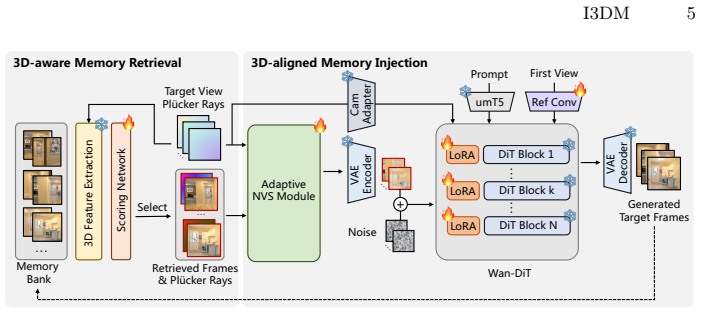
Two coupled mechanisms carry the method. First, implicit 3D-aware retrieval: for each candidate historical frame, the system runs the target-view camera rays and the frame's image and rays through the early layers of a frozen feed-forward NVS transformer, extracts shallow-layer features, and feeds them to a small CNN that predicts a spatial uncertainty map of how well that frame would synthesize the target view. A greedy maximum-coverage selection over these uncertainty maps, aggregated across all target views, picks a complementary set of frames with least redundancy. Second, adaptive 3D-aligned injection: the selected frames plus the last frame are passed through a pre-trained NVS module (
What would settle it
Run the retrieval module on a memory bank consisting entirely of generated frames (not ground-truth frames) in an out-of-distribution scene, and compare the selected frame indices against field-of-view-overlap ground truth; if selection precision collapses or the revisit PSNR on the out-of-distribution benchmark falls to the level of a naive FoV baseline, the 3D-aware retrieval claim is falsified.
Extended reading notes
Core claim
The central discovery is that the middle layers of a pre-trained feed-forward novel view synthesis network carry enough 3D correspondence information to serve as a learned relevance scorer for historical frames, making retrieval occlusion-aware without any explicit geometry. A second, equally load-bearing component is that jointly fine-tuning the warping module with the video diffusion model turns the warped memory from a rigid re-projection into an adaptive conditioning signal: reliable interpolated regions are emphasized, extrapolated or occluded regions are suppressed, so the generator falls back on its own priors. The authors claim this combination resolves revisit consistency and camera
Load-bearing premise
The entire pipeline depends on a pre-trained feed-forward novel view synthesis model, trained on a specific dataset, transferring its 3D correspondence priors to frames that are themselves generated by the diffusion model (and therefore may contain hallucinations or warped content) and to scenes outside that training distribution; if retrieval or alignment degrades on generated or out-of-distribution frames, the claimed consistency and camera-control gains vanish.
Editorial extensions
If this is right
- Interactive world models can revisit previously explored areas without maintaining persistent explicit geometry, removing scale-ambiguity failure modes from camera control.
- Retrieval based on NVS intermediate features could replace field-of-view overlap in other multi-view conditioning tasks where occlusions break naive selection.
- Jointly fine-tuning the warping module with the generator shows that optimizing the conditioning signal for the downstream generation loss can beat keeping the geometric module frozen.
- The reported overhead of retrieval is a few percent of total generation time, so the consistency mechanism is cheap enough for real-time or long-sequence use.
- The large measured gains on revisit-consistency metrics (e.g., PSNR 24.7 vs. 22.5 on the in-distribution benchmark) suggest that cycle-trajectory evaluation could become a standard test for video world models.
Reading between the lines
- The same 3D-aware relevance scorer could be reused as a consistency filter for other generative models that accept multi-view conditioning, such as inpainting or geometry-free NVS, by selecting reference frames that are actually visible rather than merely overlapping.
- Because the scoring CNN is trained with an uncertainty loss derived from the NVS model's own reconstruction error, the pipeline could be made self-supervised on arbitrary unlabeled video if approximate camera poses are available, removing the need for annotated datasets.
- The greedy maximum-coverage selection assumes information gain is additive; in scenes with reflective or transparent surfaces, the correspondence assumption may fail, suggesting a learned redundancy or plausibility term could further improve selection.
- The adaptive injection effectively learns a confidence-gated blend between geometric warp and generative prior; this principle of 'uncertainty-aware conditioning' could transfer to other diffusion-based tasks that fuse external geometric cues, such as editing or 3D-aware video inpainting.
Editorial analysis
A structured set of objections, weighed in public.
Referee Report
Summary. The paper proposes I3DM, a memory mechanism for camera-controlled video scene generation. It replaces explicit 3D reconstruction with (i) a learning-based retrieval module that scores view relevance using intermediate features of a frozen feed-forward novel-view-synthesis model (LVSM) and (ii) a 3D-aligned memory injection module that warps retrieved frames to the target view with a jointly fine-tuned NVS model and conditions a Wan2.1-based video diffusion model on the aligned signal. The method is evaluated on RealEstate10K and Tanks-and-Temples with metrics for visual quality (FID/FVD/IMQ), camera control (rotation/translation errors), and revisit consistency (PSNR/SSIM/LPIPS on cycle trajectories). The reported results show large improvements in revisit consistency and camera control over the baselines.
Significance. If the results hold, the core idea is a useful and non-obvious contribution: using intermediate NVS features for occlusion-aware memory retrieval, and fine-tuning the NVS module to produce conditioning features rather than photometrically accurate warps, is well motivated and distinct from explicit 3D-memory methods. The paper includes useful ablations, a detailed algorithm, and a supplementary study of feature-layer choice, which strengthen the presentation. However, the headline claim of superior generation fidelity is not supported by the paper's own numbers: the frozen-NVS ablation achieves better FID/FVD than the full method on RealEstate10K, and on Tanks-and-Temples WorldPlay has better FID and IMQ. The central contribution is therefore still defensible only for revisit consistency and camera control, not for the three-way superiority claimed in the abstract and contribution list.
major comments (3)
- [Abstract/§1 contribution list; Table 2 bottom; Table 1 bottom] The claim of superior 'generation fidelity' is contradicted by the reported experiments. In the Re10K ablation (Table 2, bottom), the 'w/ frozen NVS' variant achieves FID 16.019 and FVD 121.562, while the full 'w/ ft. NVS (Ours)' achieves FID 17.553 and FVD 131.657. On T&T (Table 1, bottom), WorldPlay reaches FID 95.999 and IMQ 73.94, versus Ours at FID 96.264 and IMQ 70.75. No error bars or significance tests are reported, so the differences cannot be dismissed as noise. The paper should either narrow the claim to revisit consistency and camera control, or provide multi-seed evidence that the full method is not worse in fidelity.
- [Table 2 and §4.3] Several quantitative comparisons in the ablations are very close (e.g., FID 17.553 vs 17.586, PSNR 24.732 vs 24.463, R_err 1.991 vs 2.075), and no variance or statistical testing is reported across seeds or dataset samples. Given that the paper makes strong comparative claims and the fidelity result is internally inconsistent, the absence of uncertainty quantification is load-bearing. At minimum, report standard deviations over multiple evaluation subsets or training seeds for the Re10K main comparison and the injection ablation.
- [Supplemental §5; §3.2] The method depends on LVSM, which the supplement states was 'trained exclusively on the RealEstate10K dataset,' being applied to memory-bank frames that are themselves generated by the diffusion model and to out-of-distribution scenes such as T&T. The supplement also acknowledges that 'temporal drifting... Extreme color shifting or scene distortion can also interfere with our memory mechanism.' This is a real correctness risk for the claimed occlusion-robustness and generalization. The paper should provide a direct test of retrieval robustness, such as retrieval accuracy on OOD scenes or a sensitivity analysis when the memory bank contains warped or color-shifted generated frames.
minor comments (5)
- [§3.2 vs Supplementary Algorithm 1] The main text says that for a sequence of T target views the selection maximizes the average marginal gain over all T confidence maps, but Algorithm 1 in the supplement only processes one target view and does not describe the multi-view aggregation. Please align the algorithm description with the method actually used.
- [Table 1] Vmem is reported with '-' for FVD and IMQ. The discrete-frame evaluation protocol is mentioned, but it should be clarified why these metrics cannot be computed for Vmem, especially since FVD is a video-level metric.
- [§3.2, Eq. (6)] The uncertainty loss uses the MSE of the full LVSM prediction, but inference terminates at layer l. The figure caption says the full transformer is run only during training, but the main text should state this explicitly near Eq. (6) to avoid confusion.
- [§4.1 and Supplementary §3] The backbone is called 'Wan-CamCtrl-1.3B' in the main text and 'Wan2.1-Fun-V1.1-1.3B-Control-Camera' in the supplement. Please use one consistent name.
- [§4.2] The sentence 'our method outperforms all baselines on all metrics' is true for Re10K but not for T&T, where WorldPlay has better FID and IMQ. Please qualify the statement.
Circularity Check
No significant circularity: the method is evaluated against held-out data and external baselines; no load-bearing step reduces to its own inputs.
full rationale
The paper's derivation chain is self-contained and does not rely on circular definitions, fitted predictions masquerading as forecasts, or load-bearing self-citations. The retrieval scoring network (Eq. 5) is trained with an uncertainty loss (Eq. 6) that supervises the predicted uncertainty map against the reconstruction error of the pre-trained LVSM; this is a well-defined auxiliary supervision, not an encoding of the final evaluation metrics (PSNR/SSIM/LPIPS, camera error, FID/FVD). The memory injection module is trained with the standard flow-matching objective, and the final consistency/camera-control metrics are measured on held-out RealEstate10K test scenes and the out-of-distribution Tanks-and-Temples dataset, with ablations comparing against FoV-based, geometry-based, and temporal retrieval as well as frozen-NVS injection. The use of LVSM both for retrieval features and for warping is a design coupling, but it is not an equation-level reduction: the retrieval selects frames by predicted confidence, and the downstream diffusion model is independently optimized and evaluated. Self-citations to Mvsplat, ViewCrafter, and Pi3 appear in related work or as a pose-estimation tool for evaluation; none serves as the sole justification of the central claim. The supplementary limitations explicitly acknowledge OOD generalization and temporal drift, which are correctness risks, not evidence of circularity. Therefore no circular step is identified.
Assumptions & free parameters
free parameters (2)
- K (number of retrieved reference frames) =
3
- l (LVSM feature layer used for retrieval) =
6
assumptions (5)
- domain assumption Pre-trained LVSM intermediate features encode sufficient 3D correspondence cues to score occlusion-aware view relevance.
- domain assumption LVSM novel-view synthesis, fine-tuned jointly with the diffusion model, produces conditioning that improves consistency without introducing warping artifacts that hurt generation.
- standard math Standard flow-matching objective is a valid surrogate for generation quality.
- standard math Greedy maximum coverage on confidence maps yields a near-optimal selection.
- domain assumption Pi3 pose estimator provides sufficiently accurate camera poses for evaluating generated videos.
Cite this review
Pith. "Pith review of I3DM: Implicit 3D-aware Memory Retrieval and Injection for Consistent Video Scene Generation." pith.science (2026). https://pith.science/paper/LYIOLZ45
@misc{pith2026260323413,
  author       = {Pith},
  title        = {Pith review of: I3DM: Implicit 3D-aware Memory Retrieval and Injection for Consistent Video Scene Generation},
  year         = {2026},
  howpublished = {\url{https://pith.science/paper/LYIOLZ45}},
  note         = {Machine review of arXiv:2603.23413}
}
read the original abstract
Despite remarkable progress in video generation, maintaining long-term scene consistency upon revisiting previously explored areas remains challenging. Existing solutions rely either on explicitly constructing 3D geometry, which suffers from error accumulation and scale ambiguity, or on naive camera Field-of-View (FoV) retrieval, which typically fails under complex occlusions. To overcome these limitations, we propose I3DM, a novel implicit 3D-aware memory mechanism for consistent video scene generation that bypasses explicit 3D reconstruction. At the core of our approach is a 3D-aware memory retrieval strategy, which leverages the intermediate features of a pre-trained Feed-Forward Novel View Synthesis (FF-NVS) model to score view relevance, enabling robust retrieval even in highly occluded scenarios. Furthermore, to fully utilize the retrieved historical frames, we introduce a 3D-aligned memory injection module. This module implicitly warps historical content to the target view and adaptively conditions the generation on reliable warping regions, leading to improved revisit consistency and accurate camera control. Extensive experiments demonstrate that our method outperforms state-of-the-art approaches, achieving superior revisit consistency, generation fidelity, and camera control precision.
Figures


Figures from the paper (9 more)


Reference graph
Works this paper leans on
-
[1]
In: Proceedings of the IEEE/CVF International Conference on Computer Vision
Bai, J., Xia, M., Fu, X., Wang, X., Mu, L., Cao, J., Liu, Z., Hu, H., Bai, X., Wan, P., et al.: Recammaster: Camera-controlled generative rendering from a single video. In: Proceedings of the IEEE/CVF International Conference on Computer Vision. pp. 14834–14844 (2025)
2025
-
[2]
He, H., Xu, Y., Guo, Y., Wetzstein, G., Dai, B., Li, H., Yang, C.: Cameractrl: En- ablingcameracontrolfortext-to-videogeneration.arXivpreprintarXiv:2404.02101 (2024)
arXiv 2024
-
[3]
arXiv preprint arXiv:2506.08009 (2025)
Huang, X., Li, Z., He, G., Zhou, M., Shechtman, E.: Self forcing: Bridging the train-test gap in autoregressive video diffusion. arXiv preprint arXiv:2506.08009 (2025)
arXiv 2025
-
[4]
arXiv preprint arXiv:2410.17242 (2024)
Jin, H., Jiang, H., Tan, H., Zhang, K., Bi, S., Zhang, T., Luan, F., Snavely, N., Xu, Z.: Lvsm: A large view synthesis model with minimal 3d inductive bias. arXiv preprint arXiv:2410.17242 (2024)
arXiv 2024
-
[5]
arXiv preprint arXiv:2512.19678 (2025)
Kong, H., Yang, X., Zheng, X., Wang, X.: Worldwarp: Propagating 3d geometry with asynchronous video diffusion. arXiv preprint arXiv:2512.19678 (2025)
arXiv 2025
-
[6]
arXiv preprint arXiv:2506.18903 (2025)
Li, R., Torr, P., Vedaldi, A., Jakab, T.: Vmem: Consistent interactive video scene generation with surfel-indexed view memory. arXiv preprint arXiv:2506.18903 (2025)
arXiv 2025
-
[7]
arXiv preprint arXiv:2509.25161 (2025)
Liu, K., Hu, W., Xu, J., Shan, Y., Lu, S.: Rolling forcing: Autoregressive long video diffusion in real time. arXiv preprint arXiv:2509.25161 (2025)
arXiv 2025
-
[8]
In: Proceedings of the Computer Vision and Pattern Recognition Conference
Ren, X., Shen, T., Huang, J., Ling, H., Lu, Y., Nimier-David, M., Müller, T., Keller, A., Fidler, S., Gao, J.: Gen3c: 3d-informed world-consistent video gener- ation with precise camera control. In: Proceedings of the Computer Vision and Pattern Recognition Conference. pp. 6121–6132 (2025)
2025
Show all 14 references
-
[9]
arXiv preprint arXiv:2512.14614 (2025)
Sun, W., Zhang, H., Wang, H., Wu, J., Wang, Z., Wang, Z., Wang, Y., Zhang, J., Wang, T., Guo, C.: Worldplay: Towards long-term geometric consistency for real-time interactive world modeling. arXiv preprint arXiv:2512.14614 (2025)
2025 arXiv
-
[10]
arXiv preprint arXiv:2503.20314 (2025)
Wan, T., Wang, A., Ai, B., Wen, B., Mao, C., Xie, C.W., Chen, D., Yu, F., Zhao, H., Yang, J., et al.: Wan: Open and advanced large-scale video generative models. arXiv preprint arXiv:2503.20314 (2025)
2025 arXiv
-
[11]
arXiv preprint arXiv:2507.13347 (2025)
Wang, Y., Zhou, J., Zhu, H., Chang, W., Zhou, Y., Li, Z., Chen, J., Pang, J., Shen, C., He, T.: pi3: Permutation-equivariant visual geometry learning. arXiv preprint arXiv:2507.13347 (2025)
2025 arXiv
-
[12]
arXiv preprint arXiv:2509.22622 (2025)
Yang, S., Huang, W., Chu, R., Xiao, Y., Zhao, Y., Wang, X., Li, M., Xie, E., Chen, Y., Lu, Y., et al.: Longlive: Real-time interactive long video generation. arXiv preprint arXiv:2509.22622 (2025)
2025 arXiv
-
[13]
arXiv preprint arXiv:2512.07237 (2025)
Zhang, C., Li, B., Wei, M., Cao, Y.P., Gambardella, C.C., Phung, D., Cai, J.: Unified camera positional encoding for controlled video generation. arXiv preprint arXiv:2512.07237 (2025)
2025
-
[14]
Zhou, T., Tucker, R., Flynn, J., Fyffe, G., Snavely, N.: Stereo magnification: Learn- ingviewsynthesisusingmultiplaneimages.arXivpreprintarXiv:1805.09817(2018)
2018 arXiv
Reviewed August 3, 2026 · model on record in the stance chip above.
Discussion (0). Sign in to comment.