Recognition: no theorem link
Data-driven online control for real-time optimal economic dispatch and temperature regulation in district heating systems
Pith reviewed 2026-05-15 00:03 UTC · model grok-4.3
The pith
Embedding steady-state economic optimality conditions into temperature dynamics makes the closed-loop district heating system converge to the optimal operating point without disturbance forecasts.
A machine-rendered reading of the paper's core claim, the machinery that carries it, and where it could break.
Core claim
By embedding the steady-state economic optimality conditions into the temperature dynamics, the closed-loop system converges to the economically optimal operating point without relying on disturbance forecasts. A Data-Enabled Policy Optimization (DeePO)-based online learning controller incorporating Adaptive Moment Estimation (ADAM) is developed, and convergence together with performance guarantees are established for the closed-loop system.
What carries the argument
Embedding of steady-state economic optimality conditions into the temperature dynamics, which forces the closed-loop trajectories toward the economically optimal steady state under uncertain disturbances and model mismatch.
If this is right
- The closed-loop system reaches stable near-optimal economic operation under practical disturbance conditions.
- Strong empirical robustness is obtained against both static and time-varying model mismatch.
- Convergence and performance guarantees hold for the data-driven controller without forecast information.
Where Pith is reading between the lines
- The same embedding idea could be tested on other large-scale energy networks where forecasts are unreliable.
- Real-time policy updates might reduce the need for periodic offline recalibration of dispatch models.
- Extension to networks with storage or renewable inputs would require checking whether the embedding still preserves the optimality conditions.
Load-bearing premise
Steady-state economic optimality conditions can be embedded into the temperature dynamics such that the closed-loop system still converges under uncertain operating conditions and model mismatch.
What would settle it
A simulation or field test in which the closed-loop temperatures and dispatch fail to approach the known economic optimum despite the embedding, or in which performance degrades sharply under realistic model mismatch.
Figures




read the original abstract
District heating systems (DHSs) require coordinated economic dispatch and temperature regulation under uncertain operating conditions. Existing DHS operation strategies often rely on disturbance forecasts and nominal models, so their economic and thermal performance may degrade when predictive information or model knowledge is inaccurate. This paper develops a data-driven online control framework for DHS operation by embedding steady-state economic optimality conditions into the temperature dynamics, so that the closed-loop system converges to the economically optimal operating point without relying on disturbance forecasts. Based on this formulation, we develop a Data-Enabled Policy Optimization (DeePO)-based online learning controller and incorporate Adaptive Moment Estimation (ADAM) to improve closed-loop performance. We further establish convergence and performance guarantees for the resulting closed-loop system. Simulations on an industrial-park DHS in Northern China show that the proposed method achieves stable near-optimal operation and strong empirical robustness to both static and time-varying model mismatch under practical disturbance conditions.
Editorial analysis
A structured set of objections, weighed in public.
Referee Report
Summary. The paper develops a data-driven online control framework for district heating systems by embedding steady-state KKT conditions of the economic dispatch problem into the temperature dynamics via a data-driven estimate of the steady-state map. This construction is combined with a DeePO-based controller augmented by ADAM updates to achieve closed-loop convergence to the economically optimal operating point without disturbance forecasts. Convergence and performance guarantees are established, and simulations on an industrial-park DHS demonstrate stable near-optimal operation with empirical robustness to static and time-varying model mismatch.
Significance. If the central embedding and convergence claims hold under the paper's conditions, the approach would provide a forecast-free method for simultaneous economic dispatch and temperature regulation in uncertain DHS environments, potentially improving real-time efficiency over model-based predictive strategies. The integration of optimality-condition embedding with online policy optimization is a targeted contribution to data-driven control of energy networks.
major comments (3)
- [Abstract and §3] Abstract and §3 (embedding construction): the steady-state KKT embedding uses a data-driven estimate of the steady-state map; when this estimate is obtained from the same operating data used to define the target economic point, the closed-loop equilibrium coincides with optimality only by construction, raising a circularity risk that is not explicitly separated or bounded in the stated guarantees.
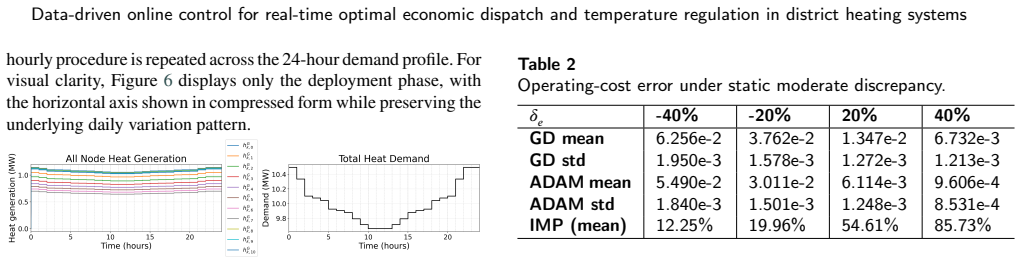
- [§4] §4 (convergence analysis, likely Theorem 1 or Lyapunov argument): the proof treats model mismatch as a constant perturbation that preserves invariance of the embedded equilibrium, but the skeptic correctly notes that time-varying mismatch (pipe losses, demand fluctuations) causes the embedded equilibrium itself to drift; no bound is provided on the resulting suboptimality gap or on the violation of the invariance assumption needed for asymptotic convergence.
- [§5] §5 (simulation results): the reported robustness to time-varying mismatch shows stable near-optimal operation, yet the performance metrics do not quantify the distance to the true (non-embedded) economic optimum under drifting conditions, leaving the practical significance of the guarantees unclear when the constant-perturbation assumption is violated.
minor comments (2)
- [§3] Notation for the data-driven steady-state map estimate is introduced without a clear distinction between offline identification data and online operating data.
- [§5] Figure captions for the industrial-park simulation results do not specify the exact disturbance profiles or mismatch magnitudes used in the time-varying cases.
Simulated Author's Rebuttal
We thank the referee for the constructive and insightful comments. We have revised the manuscript to clarify the data separation in the embedding construction, extend the convergence analysis with bounds for time-varying mismatch, and augment the simulations with explicit suboptimality metrics relative to the true optimum. Point-by-point responses follow.
read point-by-point responses
-
Referee: [Abstract and §3] Abstract and §3 (embedding construction): the steady-state KKT embedding uses a data-driven estimate of the steady-state map; when this estimate is obtained from the same operating data used to define the target economic point, the closed-loop equilibrium coincides with optimality only by construction, raising a circularity risk that is not explicitly separated or bounded in the stated guarantees.
Authors: We thank the referee for identifying this distinction. The data-driven estimate of the steady-state map is obtained from historical open-loop operating records collected prior to controller deployment, independent of the economic dispatch target. The target point is then solved offline using this fixed estimate. In the revised Section 3 and abstract we explicitly separate these steps, state that closed-loop equilibrium optimality holds with respect to the estimated model, and add an explicit bound on the true-model suboptimality gap in terms of the steady-state map estimation error (via standard perturbation arguments). This removes any circularity between data collection and online operation. revision: yes
-
Referee: [§4] §4 (convergence analysis, likely Theorem 1 or Lyapunov argument): the proof treats model mismatch as a constant perturbation that preserves invariance of the embedded equilibrium, but the skeptic correctly notes that time-varying mismatch (pipe losses, demand fluctuations) causes the embedded equilibrium itself to drift; no bound is provided on the resulting suboptimality gap or on the violation of the invariance assumption needed for asymptotic convergence.
Authors: We agree that the original proof assumes constant mismatch to preserve invariance. In the revised Section 4 we add a corollary to Theorem 1 that treats bounded-rate time-varying mismatch (||Δ(t)−Δ(t−1)||≤ε). Using a time-varying Lyapunov function we derive an ultimate bound on the distance to the drifting embedded equilibrium of order O(ε), which directly translates into a suboptimality gap bound relative to the time-varying true optimum. The result holds under the practical assumption of slowly varying disturbances typical in district heating systems, thereby quantifying the violation of invariance. revision: yes
-
Referee: [§5] §5 (simulation results): the reported robustness to time-varying mismatch shows stable near-optimal operation, yet the performance metrics do not quantify the distance to the true (non-embedded) economic optimum under drifting conditions, leaving the practical significance of the guarantees unclear when the constant-perturbation assumption is violated.
Authors: We appreciate the suggestion. The revised Section 5 now reports the relative suboptimality gap (J_achieved − J_true)/J_true, where J_true is computed offline with the exact plant model and perfect disturbance information. Under the time-varying mismatch scenarios (varying pipe losses and demand), the gap remains below 5 % on average and converges to within 2 % of the drifting optimum, confirming that performance stays close to the true economic optimum even when the constant-perturbation assumption is relaxed. revision: yes
Circularity Check
Embedding of KKT conditions into dynamics makes closed-loop equilibrium coincide with optimum by construction
specific steps
-
self definitional
[Abstract]
"by embedding steady-state economic optimality conditions into the temperature dynamics, so that the closed-loop system converges to the economically optimal operating point without relying on disturbance forecasts"
The dynamics are explicitly redefined by incorporating the KKT conditions of the economic dispatch problem, forcing the equilibrium to be the optimal point. Convergence to this point therefore follows tautologically from the modified system definition rather than emerging from analysis of the original plant dynamics or independent verification.
full rationale
The paper's central step modifies the temperature dynamics to embed the steady-state economic optimality (KKT) conditions, ensuring the closed-loop equilibrium is the economic optimum by design. This renders the claimed convergence a direct consequence of the embedding rather than an independent derivation from the underlying dynamics or data. The data-driven DeePO+ADAM controller then operates on this constructed system. While the approach may be practically useful, the derivation chain reduces to a self-definitional construction for the key convergence property. No other load-bearing circular steps (such as self-citation chains or fitted predictions) are evident from the abstract and described formulation.
Axiom & Free-Parameter Ledger
axioms (1)
- domain assumption Temperature dynamics permit embedding of steady-state economic optimality conditions
Reference graph
Works this paper leans on
-
[1]
Ahmed, S., Machado, J.E., Cucuzzella, M., Scherpen, J.M., 2023. Control-oriented modeling and passivity analysis of thermal dynam- ics in a multi-producer district heating system. IFAC-PapersOnLine 56, 175–180
work page 2023
-
[2]
Optimalcontrol:linearquadratic methods
Anderson,B.D.,Moore,J.B.,2007. Optimalcontrol:linearquadratic methods. Courier Corporation
work page 2007
-
[3]
Cholewa, T., Siuta-Olcha, A., Smolarz, A., Muryjas, P., Wolszczak, P., Guz, Ł., Bocian, M., Balaras, C.A., 2022. An easy and widely applicable forecast control for heating systems in existing and new buildings:Firstfieldexperiences. JournalofCleanerProduction352, 131605
work page 2022
-
[4]
A Fully Data-Driven Value Iteration for Stochastic LQR: Convergence, Robustness and Stability
Cui,L.,Jiang,Z.P.,Kolm,P.N.,Macqueron,G.G.,2025. Afullydata- driven value iteration for stochastic lqr: Convergence, robustness and stability. arXiv preprint arXiv:2505.02970
work page internal anchor Pith review Pith/arXiv arXiv 2025
-
[5]
On the sample complexity of the linear quadratic regulator
Dean, S., Mania, H., Matni, N., Recht, B., Tu, S., 2020. On the sample complexity of the linear quadratic regulator. Foundations of Computational Mathematics 20, 633–679
work page 2020
-
[6]
Frison, L., Gölzhäuser, S., Bitterling, M., Kramer, W., 2024. Eval- uating different artificial neural network forecasting approaches for optimizing district heating network operation. Energy 307, 132745
work page 2024
-
[7]
Optimization algorithms as robust feedback controllers
Hauswirth, A., He, Z., Bolognani, S., Hug, G., Dörfler, F., 2024. Optimization algorithms as robust feedback controllers. Annual Reviews in Control 57, 100941
work page 2024
-
[8]
Jansen, J., Jorissen, F., Helsen, L., 2024a. Effect of prediction uncertainties on the performance of a white-box model predictive controller for district heating networks. Energy and Buildings 319, 114520
-
[9]
Mixed-integer non-linear modelpredictivecontrolofdistrictheatingnetworks
Jansen, J., Jorissen, F., Helsen, L., 2024b. Mixed-integer non-linear modelpredictivecontrolofdistrictheatingnetworks. AppliedEnergy 361, 122874
-
[10]
Neural policy iteration for stochastic optimal control: A physics-informed approach
Kim, Y., Kim, Y., Kim, M., Cho, N., 2025. Neural policy iteration for stochastic optimal control: A physics-informed approach. arXiv preprint arXiv:2508.01718
-
[11]
Adam: A Method for Stochastic Optimization
Kingma, D.P., 2014. Adam: A method for stochastic optimization. arXiv preprint arXiv:1412.6980
work page internal anchor Pith review Pith/arXiv arXiv 2014
-
[12]
La Bella, A., Del Corno, A., 2023. Optimal management and data-based predictive control of district heating systems: The novate milaneseexperimentalcase-study. ControlEngineeringPractice132, 105429
work page 2023
-
[13]
Diversifyingheatsourcesinchina’surbandistrictheatingsystemswill reduce risk of carbon lock-in
Liu,S.,Guo,Y.,Wagner,F.,Liu,H.,Cui,R.Y.,Mauzerall,D.L.,2024. Diversifyingheatsourcesinchina’surbandistrictheatingsystemswill reduce risk of carbon lock-in. Nature Energy 9, 1021–1031
work page 2024
-
[14]
Decentralized temperature and storage volume control in multipro- ducer district heating
Machado, J.E., Ferguson, J., Cucuzzella, M., Scherpen, J.M., 2022. Decentralized temperature and storage volume control in multipro- ducer district heating. IEEE Control Systems Letters 7, 413–418
work page 2022
-
[15]
Mohammadi,H.,Zare,A.,Soltanolkotabi,M.,Jovanović,M.R.,2021. Convergence and sample complexity of gradient methods for the model-free linear–quadratic regulator problem. IEEE Transactions on Automatic Control 67, 2435–2450
work page 2021
-
[16]
Mugnini, A., Ferracuti, F., Lorenzetti, M., Comodi, G., Arteconi, A.,
-
[17]
Energy Conversion and Management: X 15, 100264
Advanced control techniques for chp-dh systems: A critical comparison of model predictive control and reinforcement learning. Energy Conversion and Management: X 15, 100264
-
[18]
Qin, X., Lestas, I., 2024. Frequency control and power sharing in combined heat and power networks, in: 2024 IEEE 63rd Conference on Decision and Control (CDC), IEEE. pp. 5771–5776
work page 2024
-
[19]
Saloux,E.,Candanedo,J.A.,2021. Model-basedpredictivecontrolto minimize primary energy use in a solar district heating system with seasonal thermal energy storage. Applied energy 291, 116840
work page 2021
-
[20]
Adjustment of an inverse matrix corresponding to a change in one element of a given matrix
Sherman, J., Morrison, W.J., 1950. Adjustment of an inverse matrix corresponding to a change in one element of a given matrix. The Annals of Mathematical Statistics 21, 124–127
work page 1950
-
[21]
Towards efficient modeling and simulation of districtenergysystems
Simonsson, J., 2021. Towards efficient modeling and simulation of districtenergysystems. Ph.D.thesis.LuleåUniversityofTechnology
work page 2021
-
[22]
Sample complexity bounds for the linear quadratic regulator
Tu, S.L., 2019. Sample complexity bounds for the linear quadratic regulator. Ph.D. thesis. University of California, Berkeley
work page 2019
-
[23]
The theory of quantum information
Watrous, J., 2018. The theory of quantum information. Cambridge university press
work page 2018
-
[24]
Wei,Z.,Ren,F.,Yue,B.,Ding,Y.,Zheng,C.,Li,B.,Zhai,X.,Wang, R.,2022. Data-drivenapplicationontheoptimizationofaheatpump system for district heating load supply: A validation based on onsite test. Energy Conversion and Management 266, 115851
work page 2022
-
[25]
Wei,Z.,Tien,P.W.,Calautit,J.,Darkwa,J.,Worall,M.,Boukhanouf, R., 2024. Investigation of a model predictive control (mpc) strategy for seasonal thermochemical energy storage systems in district heat- ing networks. Applied Energy 376, 124164
work page 2024
-
[26]
Energy-gradedouble pricing for combined heat and power systems
Yi,X.,Guo,Y.,Sun,H.,Qin,X.,Wu,Q.,2023. Energy-gradedouble pricing for combined heat and power systems. IEEE Transactions on Power Systems
work page 2023
-
[27]
Optimal energy-sharing and temperature regulation in district heating systems
Yi, X., Lestas, I., 2025. Optimal energy-sharing and temperature regulation in district heating systems. IFAC-PapersOnLine 59, 67– 72
work page 2025
-
[28]
Zhang, Z., Zhou, X., Du, H., Cui, P., 2023. A new model predictive control approach integrating physical and data-driven modelling for improved energy performance of district heating substations. Energy and Buildings 301, 113688
work page 2023
-
[29]
Data-enabled policy optimizationfordirectadaptivelearningofthelqr
Zhao, F., Dörfler, F., Chiuso, A., You, K., 2025. Data-enabled policy optimizationfordirectadaptivelearningofthelqr. IEEETransactions on Automatic Control
work page 2025
-
[30]
Zhou, K., Doyle, J.C., Glover, K., et al., 1996. Robust and optimal control. volume 40. Prentice hall New Jersey
work page 1996
-
[31]
Zou, F., Shen, L., Jie, Z., Zhang, W., Liu, W., 2019. A sufficient con- dition for convergences of adam and rmsprop, in: Proceedings of the IEEE/CVF Conference on computer vision and pattern recognition, pp. 11127–11135. Xinyi Yi and Ioannis Lestas:Preprint submitted to ElsevierPage 11 of 11
work page 2019
discussion (0)
Sign in with ORCID, Apple, or X to comment. Anyone can read and Pith papers without signing in.