REVIEW 3 major objections 5 minor 46 references
Inference-time Trajectory Optimization for Structure-Preserving Manga Image Editing
T0 review · 3 major / 5 minor · reviewed 2026-08-03 · deepseek-v4-flash
Pith's one-line read A training-free correction of the first few sampling steps toward an empty-prompt reconstruction adapts pretrained image editors to manga, preserving composition while local edits proceed.
desk verdict Simple, training-free trajectory correction that helps on synthetic manga text removal; the evidence is thinner than the abstract implies, but the idea is sound and worth a careful review. read the letter →
The pith
A machine-rendered reading of the paper's core claim, the machinery that carries it, and where it could break.
The reading
What carries the argument
The central mechanism is the empty-prompt correction target Z*_{t_i} = X_in - (t_N - t_i) v_theta(Z_{t_i}, t_i, empty, X_in), blended into the editing trajectory as Z_{t_i} <- (1-alpha) Z_{t_i} + alpha Z*_{t_i} during the first M timesteps. It is a local, Jacobian-skipping form of vector-field steering: it minimizes a one-step empty-prompt reconstruction objective and acts as a structural anchor while the edit prompt drives local changes. The paper shows that the update reduces the local reconstruction error by a factor of (1-alpha)^2 and that the empty prompt avoids canceling the edit direction.
What would settle it
Run the same pipeline on original manga pages containing hand-lettered, curved sound-effects text rather than synthetic overlaid text; if the correction anchors the output so strongly that edited text artifacts survive in the text regions, the central claim is refuted.
Extended reading notes
Core claim
On the author's terms, the discovery is that a Rectified Flow-based image editing model's trajectory can be corrected in its first M steps by anchoring it to an empty-prompt reconstruction trajectory, using only the input image. At each corrected step, the empty-prompt velocity predicts where the current latent would land; the target Z*_{t_i} = X_in - (t_N - t_i) v_theta(Z_{t_i}, t_i, empty, X_in) is the unique minimizer of the one-step reconstruction error, and the blend Z_{t_i} <- (1-alpha)Z_{t_i} + alpha Z*_{t_i} is exactly one gradient-descent step on that local objective. The empty prompt is central: using the edit prompt in the correction introduces a term that counteracts the edit pre
Load-bearing premise
The method's success rests on the premise that the first few generation steps carry the image's global composition, so pulling those steps toward an input-consistent reconstruction preserves layout without blocking the local edit.
Editorial extensions
If this is right
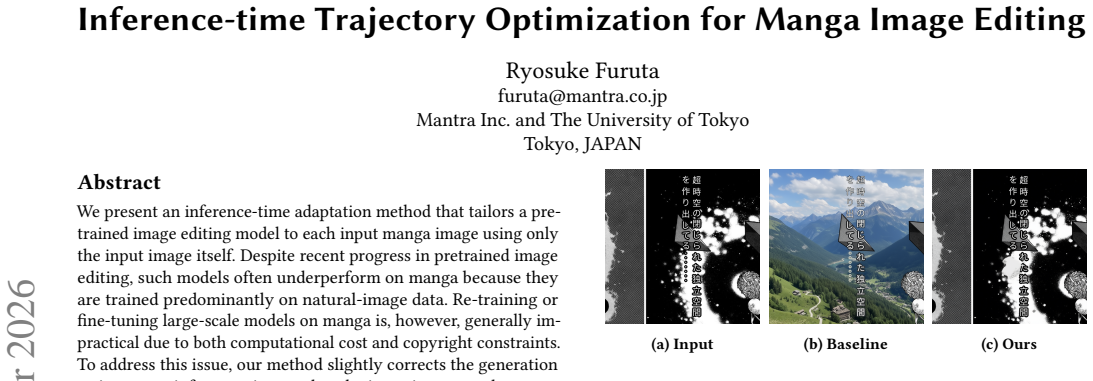
- Mask-free text removal on manga improves over the unmodified model and over a task-specific text-removal model in the text regions, with no masks or user intervention.
- The correction works across multiple Rectified Flow-based image editing models, not just the one used in the main experiments.
- Because the extra work is one parallel forward pass for the first M steps plus cheap matrix operations, the method is practical on current hardware.
- A single pretrained editing model can cover multiple manga editing tasks, such as text removal and screentone synthesis, by changing only the prompt and avoiding per-task training.
- Empty-prompt anchoring is consistently better than edit-prompt anchoring, confirming that the correction should stabilize structure without suppressing the requested edit.
Reading between the lines
- An unstated consequence is that the same empty-prompt anchor could be applied to any out-of-domain input—non-manga artwork, historical documents, sketches—where a pretrained editor tends to drift from global layout.
- A testable extension is to make M and alpha input-dependent, stopping the correction once the empty-prompt reconstruction error is small enough, which could reduce over-anchoring on easy images.
- The main experiments render synthetic text over clean manga crops; real manga pages contain hand-lettered, curved sound effects and compression artifacts, so the reported gains should be re-checked on original pages before generalizing.
- The correction does not require a mask, but combining it with a mask would let the anchor be weakened inside edited regions, potentially improving both text-region removal and composition preservation.
Editorial analysis
A structured set of objections, weighed in public.
Referee Report
Summary. The paper presents a training-free inference-time method for adapting pretrained Rectified Flow-based image editing models to manga inputs. In the first M Euler steps, the latent state is blended with a target state Z*_ti = X_in - (t_N - t_i) v_theta(Z_ti, t_i, empty, X_in), which is the one-step empty-prompt reconstruction endpoint (Algorithm 1, Eqs. 5–6). This is intended to keep the edited image's global structure close to the input while allowing local edits. The method is evaluated on two manga editing tasks: text removal and screentone synthesis, using datasets constructed from Manga109s. The text-removal results show gains over the base Qwen Image Edit model and several baselines; the screentone synthesis results show a small FID/CMMD improvement for some models. The paper also provides a mathematical interpretation of the correction as gradient descent on a local surrogate objective and connects it to FlowChef.
Significance. If the empirical claims are robust, the method is attractive: it is simple, introduces no parameter updates, and is applicable to any Rectified Flow-based editing model, which could be valuable for out-of-domain image editing. The theoretical analysis is elementary but correct, and the overhead is plausibly small when the edit-prompt and empty-prompt forward passes are batched. However, the current evidence is not yet convincing. The text-removal benchmark is synthetic and excludes the most challenging real-world manga text; the hyperparameters M and alpha are selected on the same evaluation set; and the FID improvement for the main model in screentone synthesis (36.08 → 36.07) is within noise. The paper's central claim of consistent improvements over baselines is therefore not fully supported by the presented experiments.
major comments (3)
- [§5.1] The text-removal benchmark is entirely synthetic: text-free Manga109s crops are overlaid with text rendered from 24 fonts, and crops with residual handwritten text were manually removed. This excludes hand-lettered sound effects, curved text, and compression artifacts that dominate real manga text. The failure mode of the method on such inputs is already visible in Table 5: larger M or alpha improves full-image PSNR/SSIM while text-region scores degrade, showing that stronger anchoring to the input can leave text behind. An evaluation on real manga text, or at least a more realistic benchmark, is necessary to support the claim that the method improves manga text removal in practice.
- [§5.8, Table 5] The hyperparameters M=3 and alpha=0.01 appear to be selected based on results on the same evaluation set; no validation split, error bars, or significance tests are reported. The improvement in the main screentone experiment is 36.08 → 36.07 FID (Table 7), which is within noise. The text-region PSNR gains are about 1 dB, but without confidence intervals or a held-out set it is impossible to determine whether these are robust or artifacts of hyperparameter tuning. This undercuts the 'consistently outperforms' claim in the abstract and conclusion.
- [Abstract vs §5.5] The abstract states that the method incurs '11% runtime overhead and 0.1% peak-memory overhead' when using FLUX.1 Kontext on an RTX A6000. However, Section 5.5 only reports runtime on an NVIDIA H200 for Qwen Image Edit 2509 (32.21 → 32.23 s, about 0.06% overhead), and no memory measurement appears anywhere in the body. The abstract's specific numbers are unsupported and inconsistent with the reported experiment. The authors should either add the FLUX.1 Kontext/A6000 measurement (including memory) or remove the unsupported figures from the abstract.
minor comments (5)
- [§4, Proposition 1] Proposition 1 is definitionally true: the correction target in Eq. (5) is constructed as the minimizer of the surrogate objective in Eq. (9). The paper should frame this as an observation rather than a derived result, and Proposition 2 is a direct algebraic identity. The section would be more honest if it states that the update is a single step of gradient descent on a locally defined convex surrogate, rather than implying an independent optimization derivation.
- [Tables 1–2] LPIPS values are reported without indicating they are multiplied by 100 (e.g., 41.13, 7.16, 6.00). Please add a note or state the scaling in the table caption to avoid confusion.
- [§5.4] The Noise Inversion baseline is not fully specified. 'Generation starts from (1−t_i)Z0 + t_i X_in' — it should be stated which t_i is used, how the scheduler continues from that point, and why i=1 is the best setting. This would improve reproducibility.
- [Figure 4] The three panels are labeled 'Input image', 'Edit prompt', 'Empty prompt', but the figure caption does not indicate the correspondence between panels and labels. Please clarify which panel is which.
- [General] The conference template year '2018' and the reference to the author's own 2018 paper appear to be left from the template; these should be corrected to the actual submission year and reference.
Circularity Check
No significant circularity: the correction target is derived from an explicitly stated surrogate objective, and the main empirical evaluation is against external baselines.
full rationale
The method's key formula, Eq. (5), is not presented as an unsupported prediction; it is explicitly introduced as the minimizer of a one-step empty-prompt endpoint discrepancy under the stated constant-velocity approximation (Section 3.2, Eq. (4)). Section 4 then formalizes this same surrogate objective; Proposition 1 is a direct algebraic consequence of the definition of L̃_i, and the paper does not use it as independent evidence for the method's effectiveness. Proposition 2 and Corollary 1 are mathematical equivalences, not derivations of the algorithm from first principles, and the paper explicitly notes the interpretation is local and does not guarantee global optimality. The early-timestep global-structure assumption is supported by external citations [22,28,37], and no load-bearing self-citation chain appears in the derivation. The preliminary empty-prompt reconstruction result (Table 1) is consistent with the method's design but is not tautological, since the actual multi-step trajectory and later timesteps can still diverge from the one-step approximation. The central text-removal and screentone claims are evaluated against external baselines such as SickZil-Machine, FlowChef, and FlowEdit. The choice of M=3 and α=0.01 based on the same test-set evaluations (Table 5) is a benchmarking/overfitting concern, not a derivation-level circularity, and does not make the reported equations equivalent to their inputs by construction.
Assumptions & free parameters
free parameters (2)
- M (number of corrected timesteps) =
3
- alpha (correction strength) =
0.01
assumptions (4)
- domain assumption Diffusion/flow models generate global structure in early timesteps and fine details in later timesteps.
- domain assumption Manga text removal and screentone synthesis preserve the global composition of the input while changing only local details.
- domain assumption The one-step Euler approximation with locally constant velocity is adequate to define the correction target in Eqs. (3)-(5).
- domain assumption Synthetic text rendered on text-free Manga109s crops is representative of real manga text for evaluation.
Cite this review
Pith. "Pith review of Inference-time Trajectory Optimization for Structure-Preserving Manga Image Editing." pith.science (2026). https://pith.science/paper/SNQ4CZFJ
@misc{pith2026260327790,
  author       = {Pith},
  title        = {Pith review of: Inference-time Trajectory Optimization for Structure-Preserving Manga Image Editing},
  year         = {2026},
  howpublished = {\url{https://pith.science/paper/SNQ4CZFJ}},
  note         = {Machine review of arXiv:2603.27790}
}
read the original abstract
We present a lightweight, training-free trajectory correction method that adapts a pretrained image editing model to each input manga image using only the input itself. Despite recent progress in pretrained image editing, such models often underperform on manga because they are trained predominantly on natural-image data, while re-training or fine-tuning them on manga is costly and raises copyright concerns. Many manga image editing tasks encountered in practice are structure-preserving, requiring local details to be modified while the input's global composition is retained. To support this common editing setting, our method corrects the early editing trajectory by anchoring it to an empty-prompt reconstruction trajectory. Experiments indicate improved performance in the main text-removal setting, while qualitative examples suggest better composition preservation in screentone synthesis. With FLUX.1 Kontext on an RTX A6000, the method incurs 11% runtime overhead and 0.1% peak-memory overhead; an additional runtime measurement with Qwen Image Edit 2509 on an NVIDIA H200 shows only a 0.1% increase.
Figures


Figures from the paper (2 more)


Reference graph
Works this paper leans on
- [1]
-
[2]
Kecheng Chen, Xinyu Luo, Tiexin Qin, Jie Liu, Hui Liu, Victor Ho Fun Lee, Hong Yan, and Haoliang Li. 2025. Test-time adaptation for foundation medical segmentation model without parametric updates. InProceedings of the IEEE/CVF International Conference on Computer Vision. 20075–20084
2025
-
[3]
Yingying Deng, Xiangyu He, Changwang Mei, Peisong Wang, and Fan Tang
-
[4]
Chie Furusawa, Kazuyuki Hiroshiba, Keisuke Ogaki, and Yuri Odagiri. 2017. Comicolorization: semi-automatic manga colorization. InSIGGRAPH Asia 2017 Technical Briefs. 1–4
2017
-
[5]
Maksim Golyadkin, Ianis Plevokas, and Ilya Makarov. 2025. Closing the Domain Gap in Manga Colorization via Aligned Paired Dataset. In2025 IEEE/CVF Winter Conference on Applications of Computer Vision (W ACV). IEEE, 5580–5590
2025
-
[6]
Jiayi Guo, Junhao Zhao, Chaoqun Du, Yulin Wang, Chunjiang Ge, Zanlin Ni, Shiji Song, Humphrey Shi, and Gao Huang. 2025. Everything to the synthetic: Diffusion-driven test-time adaptation via synthetic-domain alignment. InPro- ceedings of the Computer Vision and Pattern Recognition Conference. 30503–30513
2025
-
[7]
Paulina Hensman and Kiyoharu Aizawa. 2017. cGAN-based manga colorization using a single training image. In2017 14th IAPR International Conference on Document Analysis and Recognition (ICDAR), Vol. 3. IEEE, 72–77
2017
-
[8]
Vincent Tao Hu, Wei Zhang, Meng Tang, Pascal Mettes, Deli Zhao, and Cees Snoek. 2024. Latent space editing in transformer-based flow matching. InPro- ceedings of the AAAI conference on artificial intelligence, Vol. 38. 2247–2255
2024
Show all 46 references
-
[9]
Yi Huang, Jiancheng Huang, Yifan Liu, Mingfu Yan, Jiaxi Lv, Jianzhuang Liu, Wei Xiong, He Zhang, Liangliang Cao, and Shifeng Chen. 2025. Diffusion model- based image editing: A survey.IEEE Transactions on Pattern Analysis and Machine Intelligence(2025)
2025
-
[10]
Sadeep Jayasumana, Srikumar Ramalingam, Andreas Veit, Daniel Glasner, Ayan Chakrabarti, and Sanjiv Kumar. 2024. Rethinking fid: Towards a better evaluation metric for image generation. InProceedings of the IEEE/CVF conference on computer vision and pattern recognition. 9307–9315
2024
-
[11]
Yuusuke Kataoka, Takashi Matsubara, and Kuniaki Uehara. 2017. Automatic manga colorization with color style by generative adversarial nets. In2017 18th IEEE/ACIS International Conference on Software Engineering, Artificial Intelligence, Networking and Parallel/Distributed Comp...
2017
-
[12]
U-Ram Ko and Hwan-Gue Cho. 2020. SickZil-machine: a deep learning based script text isolation system for comics translation. InInternational Workshop on Document Analysis Systems. Springer, 413–425
2020
-
[13]
Vladimir Kulikov, Matan Kleiner, Inbar Huberman-Spiegelglas, and Tomer Michaeli. 2025. FlowEdit: Inversion-free text-based editing using pre-trained flow models. InProceedings of the IEEE/CVF International Conference on Computer Vision. 19721–19730
2025
-
[14]
Black Forest Labs. 2024. FLUX. https://github.com/black-forest-labs/flux
2024
-
[15]
Black Forest Labs, Stephen Batifol, Andreas Blattmann, Frederic Boesel, Saksham Consul, Cyril Diagne, Tim Dockhorn, Jack English, Zion English, Patrick Esser, et al. 2025. FLUX. 1 Kontext: Flow Matching for In-Context Image Generation and Editing in Latent Space.arXiv preprint...
2025 arXiv
-
[16]
Chengze Li, Xueting Liu, and Tien-Tsin Wong. 2017. Deep extraction of manga structural lines.ACM Transactions on Graphics (TOG)36, 4 (2017), 1–12
2017
-
[17]
Jian Liang, Ran He, and Tieniu Tan. 2025. A comprehensive survey on test-time adaptation under distribution shifts.International Journal of Computer Vision 133, 1 (2025), 31–64
2025
-
[18]
Jian Lin, Xueting Liu, Chengze Li, Minshan Xie, and Tien-Tsin Wong. 2024. Sketch2manga: Shaded manga screening from sketch with diffusion models. In 2024 IEEE International Conference on Image Processing (ICIP). IEEE, 2389–2395
2024
-
[19]
Yaron Lipman, Ricky TQ Chen, Heli Ben-Hamu, Maximilian Nickel, and Matt Le
-
[20]
Shiyu Liu, Yucheng Han, Peng Xing, Fukun Yin, Rui Wang, Wei Cheng, Jiaqi Liao, Yingming Wang, Honghao Fu, Chunrui Han, et al. 2025. Step1x-edit: A practical framework for general image editing.arXiv preprint arXiv:2504.17761(2025)
2025 arXiv
-
[21]
Xingchao Liu, Chengyue Gong, and Qiang Liu. 2023. Flow straight and fast: Learn- ing to generate and transfer data with rectified flow. InInternational Conference on Learning Representations
2023
-
[22]
Yuhang Ma, Bo Cheng, Shanyuan Liu, Hongyi Zhou, Liebucha Wu, Xiaoyu Wu, Dawei Leng, and Yuhui Yin. 2025. NAMI: Efficient Image Generation via Bridged Progressive Rectified Flow Transformers.arXiv preprint arXiv:2503.09242(2025)
2025
-
[23]
Yusuke Matsui, Kota Ito, Yuji Aramaki, Azuma Fujimoto, Toru Ogawa, Toshihiko Yamasaki, and Kiyoharu Aizawa. 2017. Sketch-based Manga Retrieval using Manga109 Dataset.Multimedia Tools and Applications76, 20 (2017), 21811–21838. doi:10.1007/s11042-016-4020-z
2017 doi
-
[24]
Yusuke Matsui, Toshihiko Yamasaki, and Kiyoharu Aizawa. 2011. Interactive manga retargeting. InACM SIGGRAPH 2011 Posters. 1–1
2011
-
[25]
Shuaicheng Niu, Jiaxiang Wu, Yifan Zhang, Yaofo Chen, Shijian Zheng, Peilin Zhao, and Mingkui Tan. 2022. Efficient test-time model adaptation without forgetting. InInternational conference on machine learning. PMLR, 16888–16905
2022
-
[26]
Maitreya Patel, Song Wen, Dimitris N Metaxas, and Yezhou Yang. 2025. FlowChef: Steering of rectified flow models for controlled generations. InProceedings of the IEEE/CVF International Conference on Computer Vision. 15308–15318
2025
-
[27]
Mihir Prabhudesai, Tsung-Wei Ke, Alex Li, Deepak Pathak, and Katerina Fragki- adaki. 2023. Diffusion-tta: Test-time adaptation of discriminative models via generative feedback.Advances in Neural Information Processing Systems36 (2023), 17567–17583
2023
-
[28]
Yurui Qian, Qi Cai, Yingwei Pan, Yehao Li, Ting Yao, Qibin Sun, and Tao Mei
-
[29]
Yingge Qu, Tien-Tsin Wong, and Pheng-Ann Heng. 2006. Manga colorization. ACM Transactions on Graphics (ToG)25, 3 (2006), 1214–1220
2006
-
[30]
Litu Rout, Yujia Chen, Nataniel Ruiz, Constantine Caramanis, Sanjay Shakkottai, and Wen-Sheng Chu. 2025. Semantic image inversion and editing using rec- tified stochastic differential equations. InInternational Conference on Learning Representations
2025
-
[31]
Kazuhiro Sato, Yusuke Matsui, Toshihiko Yamasaki, and Kiyoharu Aizawa. 2014. Reference-based manga colorization by graph correspondence using quadratic programming. InSIGGRAPH Asia 2014 Technical Briefs. 1–4
2014
-
[32]
Yelong Shen, Phillip Wallis, Zeyuan Allen-Zhu, Yuanzhi Li, Shean Wang, et al
-
[33]
Yugo Shimizu, Ryosuke Furuta, Delong Ouyang, Yukinobu Taniguchi, Ryota Hinami, and Shonosuke Ishiwatari. 2021. Painting style-aware manga colorization based on generative adversarial networks. In2021 IEEE International Conference on Image Processing (ICIP). IEEE, 1739–1743
2021
-
[34]
Meituan LongCat Team, Hanghang Ma, Haoxian Tan, Jiale Huang, Junqiang Wu, Jun-Yan He, Lishuai Gao, Songlin Xiao, Xiaoming Wei, Xiaoqi Ma, et al. 2025. Longcat-image technical report.arXiv preprint arXiv:2512.07584(2025)
2025 arXiv
-
[35]
Yun-Yun Tsai, Fu-Chen Chen, Albert YC Chen, Junfeng Yang, Che-Chun Su, Min Sun, and Cheng-Hao Kuo. 2024. Gda: Generalized diffusion for robust test-time adaptation. InProceedings of the IEEE/CVF Conference on Computer Vision and Pattern Recognition. 23242–23251
2024
-
[36]
InInternational Conference on Learning Representations
LoRA: Low-rank adaptation of large language models.. InInternational Conference on Learning Representations
-
[37]
Binxu Wang and John J Vastola. 2023. Diffusion models generate images like painters: an analytical theory of outline first, details later. InarXiv preprint arXiv:2303.02490
2023 arXiv
-
[38]
Dequan Wang, Evan Shelhamer, Shaoteng Liu, Bruno Olshausen, and Trevor Darrell. 2021. Tent: Fully Test-Time Adaptation by Entropy Minimization. In International Conference on Learning Representations
2021
-
[39]
Jiangshan Wang, Junfu Pu, Zhongang Qi, Jiayi Guo, Yue Ma, Nisha Huang, Yuxin Chen, Xiu Li, and Ying Shan. 2025. Taming Rectified Flow for Inversion and Editing. InInternational Conference on Machine Learning. PMLR, 64044–64058
2025
-
[40]
Koki Tsubota, Daiki Ikami, and Kiyoharu Aizawa. 2019. Synthesis of screentone patterns of manga characters. In2019 IEEE international symposium on multimedia (ISM). IEEE, 212–2123
2019
-
[41]
Minshan Xie, Menghan Xia, Chengze Li, Xueting Liu, and Tien-Tsin Wong. 2025. Screentone-Preserved Manga Retargeting. InComputer Graphics Forum, Vol. 44. Wiley Online Library, e70096
2025
-
[42]
Minshan Xie, Menghan Xia, Xueting Liu, Chengze Li, and Tien-Tsin Wong. 2021. Seamless manga inpainting with semantics awareness.ACM Transactions on Graphics (TOG)40, 4 (2021), 1–11
2021
-
[44]
Chenfei Wu, Jiahao Li, Jingren Zhou, Junyang Lin, Kaiyuan Gao, Kun Yan, Sheng- ming Yin, Shuai Bai, Xiao Xu, Yilei Chen, et al . 2025. Qwen-image technical report.arXiv preprint arXiv:2508.02324(2025)
2025 arXiv
-
[2023]
InInternational Conference on Learning Representations
Flow Matching for Generative Modeling. InInternational Conference on Learning Representations
-
[2024]
InProceedings of the IEEE/CVF conference on computer vision and pattern recognition
Boosting diffusion models with moving average sampling in frequency domain. InProceedings of the IEEE/CVF conference on computer vision and pattern recognition. 8911–8920
-
[2025]
In International Conference on Machine Learning
FireFlow: Fast Inversion of Rectified Flow for Image Semantic Editing. In International Conference on Machine Learning. PMLR, 13110–13128
Reviewed August 3, 2026 · model on record in the stance chip above.
Discussion (0). Sign in to comment.