Recognition: no theorem link
Exponentially cheaper coherent phase estimation via uncontrolled unitaries
Pith reviewed 2026-05-14 21:30 UTC · model grok-4.3
The pith
Using known eigenstate preparation lets quantum phase estimation swap controlled unitaries for uncontrolled ones, cutting two-qubit gates exponentially for m bits.
A machine-rendered reading of the paper's core claim, the machinery that carries it, and where it could break.
Core claim
By using information about the controlled unitary, the controlled unitary is replaced with an uncontrolled one at the cost of introducing controlled state preparations; when this modified phase kickback is used inside quantum phase estimation for an eigenstate whose preparation procedure is known, it yields an exponential reduction in the number of two-qubit gates for an m-bit phase estimation in the relevant limit.
What carries the argument
Modified phase kickback that substitutes an uncontrolled unitary for the usual controlled unitary while controlling the state-preparation circuit instead.
If this is right
- The total two-qubit gate count for m-bit coherent phase estimation drops exponentially in the relevant limit.
- Any quantum algorithm that uses phase kickback and satisfies the eigenstate-preparation assumption inherits the same gate savings.
- The technique applies directly to phase estimation subroutines inside larger algorithms such as quantum simulation or factoring.
Where Pith is reading between the lines
- When state-preparation cost is modest, the method could lower the resource threshold for running coherent phase estimation on near-term devices.
- The same substitution principle may extend to other controlled operations that appear inside larger quantum circuits.
- Small-scale numerical benchmarks on toy Hamiltonians would reveal the exact m at which the exponential advantage overtakes the added preparation overhead.
Load-bearing premise
The procedure for preparing the target eigenstate is known in advance and can itself be made controlled.
What would settle it
Construct explicit standard and modified phase-estimation circuits for a simple unitary such as a single-qubit rotation, count the two-qubit gates in each for increasing m, and check whether the modified circuit uses exponentially fewer gates than the standard one.
Figures



read the original abstract
Phase kickback is a fundamental primitive that is used in many quantum algorithms, such as quantum phase estimation. Here we observe that by using information about the controlled unitary, we can replace the controlled unitary with an uncontrolled one at the cost of introducing controlled state preparations. We then show how this modified phase kickback can be used as part of the quantum phase estimation algorithm when the goal is to estimate the phase of an eigenstate whose preparation procedure is known. We prove that this yields an exponential reduction in the number of two-qubit gates for an m-bit phase estimation in the relevant limit. Examples of applications are also presented. Naturally, this can be adapted to any algorithm that uses the phase kickback phenomenon and satisfies the assumptions.
Editorial analysis
A structured set of objections, weighed in public.
Referee Report
Summary. The manuscript proposes replacing controlled unitaries in the phase-kickback step of quantum phase estimation with uncontrolled unitaries, at the cost of adding controlled state-preparation and un-preparation circuits. Under the assumption that the eigenstate preparation procedure is known in advance and can itself be controlled, the authors claim this substitution yields an exponential reduction in the total number of two-qubit gates required for an m-bit phase estimate in a suitably defined 'relevant limit'. Examples of applications are sketched.
Significance. If the exponential gate-count reduction is rigorously established and the relevant limit is practically attainable, the result would meaningfully lower the two-qubit gate overhead of coherent phase estimation whenever controlling the target unitary is disproportionately expensive relative to the preparation circuit. This could benefit any algorithm that relies on phase kickback under the stated assumptions. The manuscript does not, however, supply explicit closed-form gate-count expressions or a precise characterization of the limit, which limits immediate assessment of its practical impact.
major comments (2)
- [abstract and the paragraph containing the substitution identity] The central claim (abstract and the proof paragraph following the substitution identity) that the modified circuit produces an exponential reduction in two-qubit gates is not supported by the counting argument: each uncontrolled U^{2^k} still contributes exactly 2^k applications of the base unitary circuit, so the sum over k = 0 … m-1 remains Θ(2^m G) where G is the gate cost of the base unitary. The controlled-preparation overhead is incurred only m times and cannot cancel this leading term unless the manuscript defines a regime in which the original controlled-U cost G_c satisfies G_c / G = Ω(2^m), which is nowhere derived from the stated assumptions.
- [paragraph introducing the controlled-preparation substitution] The load-bearing assumption that the eigenstate preparation circuit can be made controlled 'at low cost' is stated but never quantified. No gate-count comparison is given between the controlled-preparation circuit and the cost of controlling the original unitary, so it is impossible to verify that the net overhead is exponentially smaller than the standard controlled-QPE circuit.
minor comments (2)
- [abstract] The phrase 'relevant limit' is used repeatedly without a precise mathematical definition or a statement of the asymptotic regime (e.g., scaling of G_c versus G with m). Adding an explicit definition would clarify the scope of the claim.
- [main proof section] The manuscript would benefit from an explicit table or equation block that lists the total two-qubit gate count for both the standard and the modified circuits as a function of m and the base costs G and G_prep.
Simulated Author's Rebuttal
We thank the referee for the careful reading and constructive feedback. We address the two major comments below, clarifying the relevant limit and committing to revisions that supply the requested closed-form expressions and cost comparisons.
read point-by-point responses
-
Referee: [abstract and the paragraph containing the substitution identity] The central claim (abstract and the proof paragraph following the substitution identity) that the modified circuit produces an exponential reduction in two-qubit gates is not supported by the counting argument: each uncontrolled U^{2^k} still contributes exactly 2^k applications of the base unitary circuit, so the sum over k = 0 … m-1 remains Θ(2^m G) where G is the gate cost of the base unitary. The controlled-preparation overhead is incurred only m times and cannot cancel this leading term unless the manuscript defines a regime in which the original controlled-U cost G_c satisfies G_c / G = Ω(2^m), which is nowhere derived from the stated assumptions.
Authors: We agree that a precise characterization of the relevant limit is needed for the exponential claim to be fully rigorous. The limit we have in mind is the regime in which controlling the target unitary incurs an exponential overhead relative to the uncontrolled version (G_c / G = Ω(2^m)), which arises when the unitary is presented as a black-box or via a circuit whose control requires resources that scale exponentially with system size or with m (e.g., certain oracles or Hamiltonians where control must be synthesized at high cost). In this regime the standard QPE cost is Θ(2^m G_c) while the modified circuit costs Θ(2^m G + m G_prep), producing an exponential reduction. We will revise the manuscript to state this regime explicitly, derive the condition G_c / G = Ω(2^m) from the assumption that the preparation procedure is known, and supply closed-form gate-count expressions for both approaches. revision: yes
-
Referee: [paragraph introducing the controlled-preparation substitution] The load-bearing assumption that the eigenstate preparation circuit can be made controlled 'at low cost' is stated but never quantified. No gate-count comparison is given between the controlled-preparation circuit and the cost of controlling the original unitary, so it is impossible to verify that the net overhead is exponentially smaller than the standard controlled-QPE circuit.
Authors: We acknowledge that the cost comparison was left implicit. Because the preparation procedure is known in advance, its controlled version can be obtained by controlling each gate in the preparation circuit, incurring only a linear overhead O(P) where P is the uncontrolled preparation cost. In contrast, controlling the target unitary can require a much larger overhead G_c when the unitary does not admit cheap control. We will add an explicit paragraph (and a short table) comparing G_c, G, and the controlled-preparation cost in the revised manuscript, together with concrete examples (e.g., preparation of computational-basis or product states) where the controlled-preparation overhead remains polynomial while G_c grows exponentially with m. revision: yes
Circularity Check
No circularity: derivation uses explicit circuit identities under stated assumptions
full rationale
The paper derives the gate-count claim by substituting controlled-U^{2^k} with controlled-prep + uncontrolled-U^{2^k} + controlled-unprep, then summing the explicit costs of the uncontrolled powers (2^k repetitions each) plus the controlled preparation overhead. This expansion is performed directly from the circuit diagram and the assumption that the eigenstate preparation is known and controllable; no parameter is fitted to data, no result is renamed as a prediction, and no self-citation supplies a uniqueness theorem or ansatz that the present derivation depends on. The exponential reduction is asserted only in a stated limit where the preparation cost is negligible relative to the uncontrolled unitary cost, which is an independent modeling choice rather than a definitional tautology. The argument is therefore self-contained against external circuit-cost accounting and does not reduce to its own inputs by construction.
Axiom & Free-Parameter Ledger
axioms (1)
- standard math Quantum circuit model with standard controlled and uncontrolled gates
Reference graph
Works this paper leans on
-
[1]
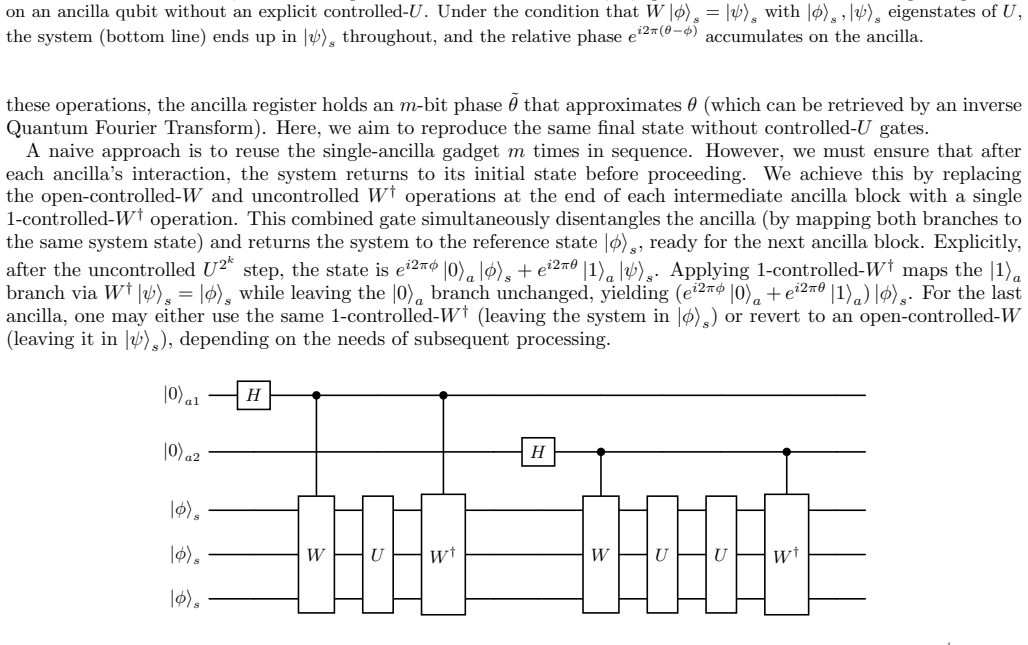
Start with the system in|ϕ⟩ s and the ancilla in|+⟩ a = (|0⟩a +|1⟩ a)/ √
-
[2]
(In practice, the ancilla is prepared by a Hadamard gateHon|0⟩ a.)
-
[3]
ApplyWto the system controlled on the ancilla being in state|1⟩ a. In other words, if the ancilla is|1⟩ a, we performW|ϕ⟩ s =|ψ⟩ s, and if the ancilla is|0⟩ a, we do nothing, leaving the system in|ϕ⟩ s. After this step, the joint state (unnormalized) is:|0⟩ a |ϕ⟩s +|1⟩ a |ψ⟩s
-
[4]
The state becomes:|0⟩ a U|ϕ⟩ s +|1⟩ a U|ψ⟩ s
ApplyUto the system (this operation is not controlled by the ancilla, unlike in standard phase kickback). The state becomes:|0⟩ a U|ϕ⟩ s +|1⟩ a U|ψ⟩ s. If|ϕ⟩ s and|ψ⟩ s are eigenstates ofUwith eigenvaluese i2πϕ ande i2πθ respectively, this state can be written as:e i2πϕ |0⟩a |ϕ⟩s +e i2πθ |1⟩a |ψ⟩s
-
[5]
This means if the ancilla is|0⟩ a, we applyWto the system, and if the ancilla is|1⟩ a, we do nothing
Now applyWto the system, this time controlled on the ancilla being in|0⟩ a (often denoted as an open- controlled gate). This means if the ancilla is|0⟩ a, we applyWto the system, and if the ancilla is|1⟩ a, we do nothing. In our state, the first term|0⟩ a |ϕ⟩s will undergoW:|ϕ⟩ s → |ψ⟩ s, while the second term is unaffected. The state becomes:e i2πϕ |0⟩a ...
-
[6]
ApplyHto the ancilla. This affects the amplitude in the superposition such that the phase difference can be observed in the measurement statistics of the outcomes obtained when measuring the ancilla qubit. The state can be written as:e i2πϕ 1+ei2π(θ−ϕ) 2 |0⟩a + 1−ei2π(θ−ϕ) 2 |1⟩a |ψ⟩s . At the conclusion of these steps, the ancilla contains the phase info...
-
[7]
The system is now in|ϕ⟩ s anda 1 is disentangled, holding phase (θ−ϕ) (mod 1)
Apply 1-controlled-W †: branch|1⟩ a1 undergoesW † |ψ⟩s =|ϕ⟩ s, while branch|0⟩ a1 (already in|ϕ⟩ s) is un- changed. The system is now in|ϕ⟩ s anda 1 is disentangled, holding phase (θ−ϕ) (mod 1). Now the system is in|ϕ⟩ s as we begin operations ona 2. Fora 2: 1.a 2 (in|+⟩) controlsW: branch|1⟩ a2 appliesWwhich maps|ϕ⟩ s to|ψ⟩ s
-
[8]
ApplyU 2 on the system
-
[9]
Now the system is|ψ⟩ s anda 2 holds phase 2(θ−ϕ)
Open-controlW: branch|0⟩ a2 also getsW(mapping|ϕ⟩ s to|ψ⟩ s) so both branches end in|ψ⟩ s. Now the system is|ψ⟩ s anda 2 holds phase 2(θ−ϕ)
-
[10]
if ancilla = 1 then applyUto its eigenstate |ψ⟩
Since this is the last ancilla in our example, we leave the system in|ψ⟩ s for further processing. If there were more bits, we would apply 1-controlled-W † to return the system to|ϕ⟩ s as was done fora 1. At this point,a 1 anda 2 each hold a phase (in the form of a superposition state). Hence the ancillas end in the product Fourier state: 4 . . . . . . . ...
- [11]
-
[12]
A. Y. Kitaev, arXiv preprint quant-ph/9511026 (1995)
work page internal anchor Pith review Pith/arXiv arXiv 1995
-
[13]
P. W. Shor, inProceedings 35th annual symposium on foundations of computer science(Ieee, 1994), pp. 124–134
work page 1994
-
[14]
L. K. Grover, inProceedings of the twenty-eighth annual ACM symposium on Theory of computing(1996), pp. 212–219
work page 1996
-
[15]
A. E. Russo, K. M. Rudinger, B. C. Morrison, and A. D. Baczewski, Physical review letters126, 210501 (2021)
work page 2021
-
[16]
Y. Matsuzaki, H. Hakoshima, K. Sugisaki, Y. Seki, and S. Kawabata, Japanese Journal of Applied Physics60, SBBI02 (2021)
work page 2021
-
[17]
H. Kuji, Y. Shingu, T. Nikuni, T. Imoto, K. Sugisaki, and Y. Matsuzaki, Physical Review A111, 042618 (2025)
work page 2025
-
[18]
N. Yoshioka, M. Amico, W. Kirby, P. Jurcevic, A. Dutt, B. Fuller, S. Garion, H. Haas, I. Hamamura, A. Ivrii, et al., arXiv preprint arXiv:2407.14431 (2024)
-
[19]
V. Giovannetti, S. Lloyd, and L. Maccone, Physical Review Letters96, 010401 (2006)
work page 2006
-
[20]
M. A. Nielsen and I. L. Chuang,Quantum Computation and Quantum Information: 10th Anniversary Edition(Cambridge University Press, Cambridge, 2010), ISBN 9781107002173
work page 2010
-
[21]
A. W. Harrow, A. Hassidim, and S. Lloyd, Physical review letters103, 150502 (2009)
work page 2009
-
[22]
Amico,uncontrolled-phase-kickback(2025), URLhttps://github.com/miamico/uncontrolled-phase-kickback
M. Amico,uncontrolled-phase-kickback(2025), URLhttps://github.com/miamico/uncontrolled-phase-kickback
work page 2025
-
[23]
Quantum amplitude amplification and estimation.Contemporary Mathematics, 305:53–74, 2002
G. Brassard, P. Hoyer, M. Mosca, and A. Tapp, arXiv preprint quant-ph/0005055 (2000)
-
[24]
A. Gily´ en, Y. Su, G. H. Low, and N. Wiebe, inProceedings of the 51st annual ACM SIGACT symposium on theory of computing(2019), pp. 193–204. Appendix A: Phase kickback |0⟩a H H |0⟩s W U FIG. 4: Circuit for phase kickback. In its original formulation, two qubit registers are considered, one register that acts as the control, usually referred to as the anc...
work page 2019
discussion (0)
Sign in with ORCID, Apple, or X to comment. Anyone can read and Pith papers without signing in.