Photon escape from the ISCO of a rotating black hole in Asymptotic Safety
Pith reviewed 2026-05-14 00:14 UTC · model grok-4.3
The pith
Quantum gravity corrections in asymptotic safety increase photon escape probability and blueshift from the ISCO of high-spin black holes despite smaller orbit radius
A machine-rendered reading of the paper's core claim, the machinery that carries it, and where it could break.
Core claim
In asymptotic safety the modified metric for rotating black holes reduces the ISCO radius with growing quantum parameter, yet for high spins the photon escape probability and maximum observable blueshift both increase as the parameter approaches its critical value, showing that quantum effects dominate the classical background at the ISCO.
What carries the argument
The asymptotic safety modified metric for rotating black holes, which introduces a quantum parameter that reduces the effective ISCO radius while altering photon trajectories from isotropic emitters there
Load-bearing premise
The asymptotic safety modified metric accurately describes spacetime near the ISCO and isotropic emission from the ISCO remains a valid model in this framework.
What would settle it
Direct measurement of photon flux or spectral shifts from the inner disk of a high-spin black hole that shows decreasing rather than increasing escape probability and blueshift as spin and the quantum parameter grow would falsify the central claim.
Figures
read the original abstract
We study isotropic emission of photons from the innermost stable circular orbit (ISCO) of a subextremal rotating black hole (BH) in asymptotic safety (AS). We calculate both the photon escape probability (PEP) and the maximum observable blueshift (MOB) of photons to reach infinity, and compare with the corresponding results for photon emission from the ISCO of a classical Kerr BH. In AS, quantum gravity effects reduce the radius of the ISCO, therefore quantum gravity effects should reduce the PEP and MOB of photons from emitters moving on the ISCO. We show that this is not the case and that, when rotating BHs with high spin are considered and the quantum parameter (which encodes the quantum gravity effects) increases towards its critical value, which is different for different spin values, the PEP and MOB also increase despite the reduction of the ISCO radius. Our results on the PEP show explicitly how quantum gravity effects start to dominate over the classical background at the level of the ISCO. We also briefly discuss the relation between these quantum gravity modifications and particular features of the shadow of a rotating BH in AS.
Editorial analysis
A structured set of objections, weighed in public.
Referee Report
Summary. The paper studies isotropic photon emission from the ISCO of subextremal rotating black holes in asymptotic safety gravity. It computes the photon escape probability (PEP) and maximum observable blueshift (MOB) to infinity, comparing them to the Kerr case. The central claim is that, for high spins, as the quantum parameter increases toward its spin-dependent critical value, both PEP and MOB increase despite the reduction in ISCO radius, indicating that quantum gravity effects dominate over the classical background at the ISCO level. The work also briefly relates these modifications to features of the black hole shadow in AS.
Significance. If the calculations hold, the result provides a concrete demonstration that asymptotic safety corrections can produce counterintuitive enhancements in photon observables near the ISCO for rapidly rotating black holes. This offers a potential strong-field signature of quantum gravity that could be relevant for interpreting emission or shadow observations, and it explicitly shows how the quantum parameter begins to dominate classical geodesic behavior.
major comments (2)
- [§3] §3 (metric and critical parameter): The manuscript asserts that the spacetimes remain subextremal black holes with a well-defined ISCO outside the horizon up to the critical quantum parameter, but provides no explicit verification (e.g., plots or tabulated values of r_h and r_ISCO versus the quantum parameter for the high-spin cases a/M = 0.9, 0.99 where the increase is claimed). Without this check, it is unclear whether the reported rise in PEP and MOB occurs in a regime where the metric still describes a black hole with an exterior ISCO, which is load-bearing for the comparison to Kerr and the claim that quantum effects dominate at the ISCO.
- [§4.2] §4.2 (PEP calculation): The escape probability is obtained by integrating over isotropic emission directions at the ISCO; however, the text does not specify how the critical quantum parameter is determined for each spin or whether the integration limits remain valid when the ISCO approaches the horizon. This affects the quantitative claim that PEP increases toward the critical value.
minor comments (2)
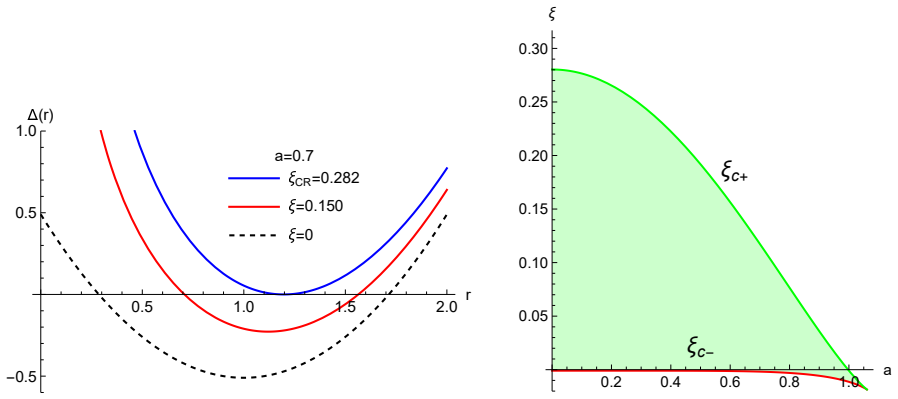
- [Figure 1] Figure 1 caption: the label 'critical value' is used without stating its numerical value or the equation used to obtain it for each spin.
- [Throughout] Notation: the quantum parameter is introduced as 'the quantum parameter' without a consistent symbol (e.g., ξ or ξ_Q) across equations and text.
Simulated Author's Rebuttal
We thank the referee for the careful reading and constructive comments, which help clarify key aspects of our analysis. We address each major point below and will incorporate the suggested additions in the revised manuscript.
read point-by-point responses
-
Referee: [§3] §3 (metric and critical parameter): The manuscript asserts that the spacetimes remain subextremal black holes with a well-defined ISCO outside the horizon up to the critical quantum parameter, but provides no explicit verification (e.g., plots or tabulated values of r_h and r_ISCO versus the quantum parameter for the high-spin cases a/M = 0.9, 0.99 where the increase is claimed). Without this check, it is unclear whether the reported rise in PEP and MOB occurs in a regime where the metric still describes a black hole with an exterior ISCO, which is load-bearing for the comparison to Kerr and the claim that quantum effects dominate at the ISCO.
Authors: We agree that explicit verification strengthens the presentation. The critical quantum parameter for each spin is the maximum value for which the metric function admits an event horizon with the ISCO located outside it, obtained by solving the horizon condition (double root of the metric lapse function) simultaneously with the ISCO equation derived from the effective potential. In the revised manuscript we will add a new figure showing r_h(ξ) and r_ISCO(ξ) for a/M = 0.9 and a/M = 0.99, confirming that r_ISCO > r_h holds up to the critical ξ and that the reported increase in PEP and MOB occurs while the spacetime remains a subextremal black hole with an exterior ISCO. revision: yes
-
Referee: [§4.2] §4.2 (PEP calculation): The escape probability is obtained by integrating over isotropic emission directions at the ISCO; however, the text does not specify how the critical quantum parameter is determined for each spin or whether the integration limits remain valid when the ISCO approaches the horizon. This affects the quantitative claim that PEP increases toward the critical value.
Authors: The critical quantum parameter is fixed for each spin by the horizon-existence condition described above. The PEP integral is performed in the local orthonormal frame at the ISCO, over the solid angle of photon directions whose conserved energy and angular momentum allow escape to infinity (determined by the turning points of the radial effective potential in the AS metric). As r_ISCO approaches r_h we have verified that the escape cone remains non-empty and the integration bounds are continuously adjusted using the local tetrad; the increase in PEP is driven by the modified redshift factor and potential barrier rather than by any breakdown of the limits. We will add a clarifying paragraph in §4.2 together with a brief statement of this numerical check. revision: yes
Circularity Check
No circularity: PEP and MOB computed from geodesic equations in AS metric with quantum parameter as independent input
full rationale
The derivation solves the geodesic equations and effective potential in the asymptotic-safety-modified Kerr metric to locate the ISCO, then integrates null geodesics for photon escape probability and maximum blueshift. The quantum parameter is varied explicitly as an external input up to its spin-dependent critical value; the reported increase in PEP and MOB is a direct numerical output of those equations, not a redefinition or fit of the input. No self-definitional steps, no fitted parameters relabeled as predictions, and no load-bearing self-citations that reduce the central claim to an unverified prior result by the same authors. The metric itself is taken from prior literature as an external ansatz, and the calculations remain independent of the target observables.
Axiom & Free-Parameter Ledger
free parameters (1)
- quantum parameter
axioms (1)
- domain assumption Asymptotic safety scenario provides a valid effective metric for subextremal rotating black holes
Lean theorems connected to this paper
-
IndisputableMonolith/Cost/FunctionalEquation.leanwashburn_uniqueness_aczel unclear?
unclearRelation between the paper passage and the cited Recognition theorem.
G(r)=G0(1-ξ/r²) ... ξc+ critical value ... rISCO obtained numerically ... PEP = 1-1/2π ∫ ... cos βi dr
-
IndisputableMonolith/Foundation/RealityFromDistinction.leanreality_from_one_distinction unclear?
unclearRelation between the paper passage and the cited Recognition theorem.
Δ=r²-2M(r,ξ)+a² ... χSPO(r,ξ) ... η1,2(r,ξ) ... Veff(r) ... escape cone bounded by critical angles
What do these tags mean?
- matches
- The paper's claim is directly supported by a theorem in the formal canon.
- supports
- The theorem supports part of the paper's argument, but the paper may add assumptions or extra steps.
- extends
- The paper goes beyond the formal theorem; the theorem is a base layer rather than the whole result.
- uses
- The paper appears to rely on the theorem as machinery.
- contradicts
- The paper's claim conflicts with a theorem or certificate in the canon.
- unclear
- Pith found a possible connection, but the passage is too broad, indirect, or ambiguous to say the theorem truly supports the claim.
Reference graph
Works this paper leans on
-
[1]
Abbott et al.(LIGO Scientific Collaboration and Virgo Collaborat ion), Phys
B.P. Abbott et al.(LIGO Scientific Collaboration and Virgo Collaborat ion), Phys. Rev. Lett. 116, 061102 (2016)
work page 2016
-
[2]
B.P. Abbott et al. (LIGO Scientific Collaboration and Virgo Collabora tion), Phys. Rev. Lett. 119, 161101 (2017)
work page 2017
-
[3]
K. Akiyama et al. (Event Horizon Telescope Collaboration), Astro phys. J. Lett. 875, L1 (2019)
work page 2019
-
[4]
K. Akiyama et al. (Event Horizon Telescope Collaboration), Astro phys. J. Lett. 930, L12 (2022)
work page 2022
- [5]
- [6]
- [7]
- [8]
-
[9]
K. Falls, D.F. Litim, K. Nikolakopoulos and C. Rahmede, Phys. Rev. D 93, 104022 (2016)
work page 2016
- [10]
- [11]
- [12]
-
[13]
Platania, in Handbook of Quantum Gravity , eds
A. Platania, in Handbook of Quantum Gravity , eds. C. Bambi, L. Modesto and I.L. Shapiro, Springer, Singapore (2023)
work page 2023
-
[14]
A. Eichhorn and A. Held, in Regular Black Holes: Towards a New Paradigm of Gravitationa l Collapse , ed. C. Bambi, Springer, Singapore (2023)
work page 2023
- [15]
- [16]
-
[17]
Y. Shi, H. Cheng, Commun. Theor. Phys. 77, 2, 025401 (2025)
work page 2025
- [18]
- [19]
- [20]
-
[21]
Z. Stuchl ´ ık, D. Charbul´ ak, J. Schee, Eur. Phys. J. C78, 180 (2018)
work page 2018
-
[22]
K. Ogasawara, T. Igata, T. Harada, U. Miyamoto, Phys. Rev. D 101, 044023 (2020)
work page 2020
- [23]
- [24]
- [25]
-
[26]
Y. Su, M. Guo, H. Yan, B. Chen, Eur. Phys. J. C 84, 733 (2024)
work page 2024
- [27]
- [28]
- [29]
-
[30]
H. Yan, Z. Hu, M. Guo, B. Chen, Phys. Rev. D 104, 124005 (2021)
work page 2021
-
[31]
H. Yan, M. Guo, B. Chen, Eur. Phys. J. C 81, 847 (2021)
work page 2021
- [32]
- [33]
-
[34]
Chandrasekhar, The Mathematical Theory of Black Holes (O xford Univ
S. Chandrasekhar, The Mathematical Theory of Black Holes (O xford Univ. Press, New York, 1992)
work page 1992
- [35]
- [36]
-
[37]
Z. Ban, J. Chen, J. Yang, Eur. Phys. J. C 85, 878 (2025)
work page 2025
- [38]
-
[39]
Cheng, Si-J Yang, arXiv: 2603.19576 [gr-qc]
P. Cheng, Si-J Yang, arXiv: 2603.19576 [gr-qc]
work page internal anchor Pith review arXiv
-
[40]
L. Foschini, A. Vecchiato, A. Bonanno, Eur. Phys. J. C, 85, 752 (2025) 17
work page 2025
discussion (0)
Sign in with ORCID, Apple, or X to comment. Anyone can read and Pith papers without signing in.