REVIEW 4 major objections 6 minor 2 cited by
Blockspace Under Pressure: An Analysis of Spam MEV on High-Throughput Blockchains
T0 review · 4 major / 6 minor · reviewed 2026-08-02 · deepseek-v4-flash
Pith's one-line read The paper claims that spam MEV volume on high-throughput blockchains is determined by a zero-profit competitive equilibrium with closed-form solutions in block capacity and gas-price floor, and that capping capacity before the plateau remov
desk verdict A useful equilibrium framework for spam MEV, but the linear opportunity-scaling assumption is load-bearing and at best weakly confirmed on Arbitrum; still worth sending to referees. read the letter →
The pith
A machine-rendered reading of the paper's core claim, the machinery that carries it, and where it could break.
The reading
What carries the argument
The workhorse is a zero-profit competitive equilibrium built on three components: the probability that a spam transaction captures a randomly positioned opportunity, S/(S+1) when S spammers are present; the clearing gas price g(S) = max(g_min, g1 + (s/beta) S) set by a linear demand curve D(g) = D0 - beta g; and the linear opportunity-scaling assumption r = r0 * Q_u / D0. Solving free entry (u(S) = 0) yields the closed-form equilibrium spam volume and a threshold B_plat = D(g_min) + (r0 D(g_min)/(D0 g_min) - s)_+ beyond which further capacity no longer helps users. The user-share derivative m_user = partial Q*_u / partial B_max is strictly decreasing in B_max, which is the mechanism behind t
What would settle it
Estimate the elasticity of realized MEV profit with respect to non-MEV volume on a chain where block capacity and gas-price floor are fixed; if the elasticity deviates substantially from 1, or if raising the gas-price floor by a known factor does not move spam volume according to the closed-form formula, the model's predictions fail. A cleaner test: make one exogenous step increase in block capacity and measure the spam share of the added capacity; the model predicts the user share of each marginal unit is strictly decreasing in B_max.
Extended reading notes
Core claim
The central claim is that in a competitive equilibrium where searchers' expected profits are driven to zero, equilibrium spam volume is a closed-form function of block capacity B_max, the minimum gas price g_min, and the linear opportunity-scaling parameter r0. Spam volume falls into one of three regimes: no entry when the opportunity value is below per-transaction cost; a slack-at-the-floor regime where spam is entirely determined by g_min; and a congested regime where spam is given by the closed-form expression S* = [sqrt((s - Delta + beta*r0/D0)^2 + 4 beta r0) - (s + Delta + beta*r0/D0)] / (2s), with Delta = D0 - B_max. Because the user share of marginal capacity m_user decreases in B_max
Load-bearing premise
The entire derivation rests on the assumption that arbitrage opportunity value scales linearly with included user gas (r = r0 * Q_u / D0); the paper's own data on one of its two rollup case studies fit this relationship poorly (elasticity ~0.82, R²=0.13).
Editorial extensions
If this is right
- If the zero-profit equilibrium is right, a designer can compute the exact spam volume that will result from any (B_max, g_min) pair and choose parameters to cap it at a target level.
- Capping block capacity slightly below B_plat is predicted to remove a disproportionate share of spam—and its network externality—while sacrificing only low-value users, a direct corollary of the decreasing marginal user share.
- Priority fee ordering is predicted to reduce spam when a large fraction of users bid for priority, and to push remaining spam to late block positions; chains with weak priority participation may see little or no benefit.
- Under demand scaling, spam's share of included gas approaches a positive plateau, so scaling alone will not dissolve the spam problem without parameter intervention.
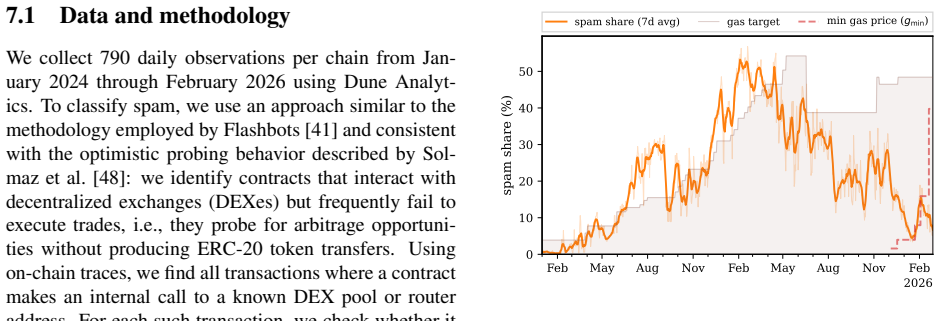
- Empirically, the model predicts spam should respond sharply to exogenous gas-target changes (the paper's case studies show a 70M-to-50M cut reduced spam 34% vs 24% for non-spam) and to gas-price floor increases.
Reading between the lines
- A testable extension: the formula implies the marginal user share is monotone decreasing in B_max; a chain with repeated capacity steps could verify this slope directly, and if the linear opportunity-scaling elasticity is far from 1, the plateau prediction fails.
- The framework suggests that raising g_min and capping B_max are substitutes with different incidence: g_min charges every probe, while a cap waives the fee but rations; the choice could depend on whether the bottleneck is execution or data availability.
- If free entry is occasionally violated—as in the paper's observation of a single entrant accounting for 51% of spam on one rollup—the equilibrium bounds may still hold as a price floor but the closed-form may under-predict transient spikes; a concentration-aware extension would be a natural next step.
- The model's externality term can be reused to price blockspace: a blockchain could set B_max where the marginal user-share equals a chosen target, turning an externality judgment into a single-parameter policy.
Editorial analysis
A structured set of objections, weighed in public.
Referee Report
Summary. This paper develops a competitive-equilibrium model of 'spam MEV' on high-throughput blockchains. Using a linear demand curve D(g)=D0−βg, a gas-limit fee mechanism, and a linear opportunity value r = r0·Q_u/D0, it derives closed-form equilibrium spam volume S* under random ordering as a function of block capacity Bmax and minimum gas price gmin, with three regimes (no entry, slack-at-floor, congested). It characterizes user welfare, validator revenue, and network externality relative to a spam-free counterfactual, and shows that the welfare loss peaks at Bmax=D(gmin). A marginal-user-share (MMUS) rule and the B_plat plateau are proposed as design guidance. The model is extended to an approximate priority-fee-ordering (PFO) setting with n sub-blocks and a fraction v of priority-bidding users. A demand-scaling analysis argues that under linear opportunity scaling, spam's share of included gas plateaus at a positive level rather than vanishing. Empirical case studies on Base and Arbitrum document spam's response to capacity changes and minimum-fee floors. Proofs are in Appendix C; the MEV-opportunity scaling regression is in Appendix D.
Significance. If the model's predictions hold, this is the first principled framework for a phenomenon that currently drives reactive protocol changes on Base, Arbitrum, and other chains. The closed-form equilibria and the B_plat and gmin design rules are concrete and falsifiable; the connection to Mazorra et al.'s timing-game lower bound in the slack regime is a strong external anchor. The empirical event studies around Base's capacity reduction and fee-floor introduction are valuable. The main weaknesses are the linear opportunity-scaling assumption (weakly supported, especially on Arbitrum), the free-entry premise (contradicted by observed concentration), and the mixed result from Arbitrum's fee-floor doubling. These are load-bearing for the design guidance, so the paper needs robustness analysis before the policy conclusions can be accepted.
major comments (4)
- [§3.1, §3.3, §5; Appendix D] The model's closed forms all assume r = r0·Q_u/D0 (γ=1). This is load-bearing: Theorem 3.3's proof (Appendix C.2) uses the free-entry condition r0D(g*)/(D0(S*+1)) = s g*, which is exactly the linear case; with r ∝ (Q_u/D0)^γ, the quadratic for S* becomes another nonlinear equation and the monotonicity of m_user is not established. The empirical support is weak: Appendix D reports γ̂ = 1.08 (R²=0.47) on Base and γ̂=0.82 (R²=0.13) on Arbitrum, and the text itself acknowledges the Arbitrum relationship is 'considerably weaker and less reliable.' Moreover, realized net cyclic arbitrage profit is an equilibrium outcome that may be attenuated by competition, so it is not a clean proxy for the primitive opportunity value. Please provide a robustness analysis for γ≠1, or at least derive the sign of m_user's derivative for γ in an empirically plausible range, and qualify the §3.3 and §5 takeaways
- [§7.4, Table 3] The competitive equilibrium assumes free entry drives spam profits to zero. Section 7.4 reports that three new contracts accounted for 51% of all Arbitrum spam gas in February 2026, going offline together, suggesting a single operator. A market where one entity controls half the spam is far from competitive, and in such periods the zero-profit condition is unlikely to hold. The paper should state the domain of validity of the free-entry assumption, describe how the number of active spam operators varies across the sample, or add a concentrated-entry model. As is, the central equilibrium may not describe the very episodes in which spam is most severe.
- [§4, Figures 8–9] The second main insight is that priority fee ordering reduces spam. But Figure 8 shows that for v=0 PFO can increase spam relative to random ordering; the text dismisses this as an artifact of the approximate model. Since v (the fraction of users who bid for priority) is not estimated, the policy conclusion is not unconditional. The n=500 sub-block discretization is also an approximation with no convergence analysis. Please characterize the (v, parameter) region in which PFO reduces spam, report sensitivity to n, and restate the takeaway as conditional on a sufficient share of users participating in the priority market.
- [§7.4, Table 3] The minimum gas price is presented as a key lever against spam, but the cleanest quasi-experiment in the paper cuts the other way. On Arbitrum, doubling gmin from 0.01 to 0.02 gwei produced a +8.6% change in spam gas and a +6.4% change in spam share (Table 3). The paper explains this as 'too small relative to spam profitability,' but no calibration is provided to support that claim. Without a quantitative reconciliation using the model's parameters, the empirical support for the gmin lever is mixed. Please derive or estimate the model's predicted effect for the Arbitrum change and discuss why the observation deviates.
minor comments (6)
- [§3.2, §A] The text refers to 'Theorem 3.2' and 'Theorem 3.3', but the displayed statements are 'Proposition 3.2' and 'Proposition 3.3'; the same issue occurs with 'Theorem A.1' versus 'Proposition A.1' in Appendix A. Please unify the numbering.
- [§3.1] The symbol ∆ is used in the congested S* formula but defined only later; define ∆ = D0 − Bmax inline.
- [Figure 4] The y-axis label 'Spam volume (gas), S s1' appears garbled; it should be 'S·s' or 'spam gas'.
- [§4.1] The main text defers the equilibrium derivation to Section B.1 but does not state the fixed-point condition for ḡ*; please include at least the equilibrium condition so the PFO equilibrium concept does not require the appendix.
- [§7.1] The spam classification heuristic depends on a 50% transfer-rate threshold and a top-100-per-month cutoff. A sensitivity analysis for these thresholds would increase confidence in the empirical results.
- [Table 2] The before-window dates are not shown in the table; adding the exact calendar dates for each window would improve reproducibility.
Circularity Check
No significant circularity: equilibrium formulas are derived from explicit primitives; the linear opportunity-scaling assumption is an empirical input, not a quantity fitted to the claimed predictions.
full rationale
The derivation chain is self-contained. Section 3.1 states the primitives r = r0*Q_u/D0, the clearing price g(S) = max(gmin, (D0-Bmax)/beta + sS/beta), and spam utility u(S) = S/(S+1)*r - S*s*g(S); setting u(S)=0 yields all three S* branches, with the congested case solving the resulting quadratic. No observed spam volume is used to fit r0 or the functional form; r0 remains a free parameter. Theorem 3.3 and the MMUS marginal-share rule are proven in Appendix C.2 from the same free-entry condition and block-full equation, not read off data. The slack-regime formula independently matches Mazorra et al. [40] (Remark 3.1), providing an external anchor. The demand-scaling section (Section 5) assumes linear opportunity growth based on Appendix D's log-log regressions (gamma-hat=1.08, R^2=0.47 on Base; gamma-hat=0.82, R^2=0.13 on Arbitrum). This is an input assumption, not a fitted version of the target prediction: the plateau result is a conditional theorem, and the paper does not estimate S* or the spam share from that same regression. The low R^2 on Arbitrum and the use of realized profit as a proxy for opportunity value are genuine robustness concerns (Appendix D explicitly says the relationship is 'considerably weaker and less reliable' on Arbitrum), but they are correctness risks, not circularity. Self-citations ([48], [16], [31]-[34], etc.) support contextual, empirical, or related-work claims; none carries the central derivation. No uniqueness theorem is imported from the authors' prior work to force the model choice. Section 7's capacity and fee-floor tests are independent observations and are not used as fitting data for the central equations. Thus no load-bearing step reduces to its own input by construction.
Assumptions & free parameters
free parameters (8)
- D0 =
1200 in figures
- beta =
6 in figures
- s =
20 in figures
- r0 =
6000 in figures
- v =
explored over {0,0.25,0.5,0.75,1}
- n =
500 for PFO figures
- c1, c2 =
not assigned
- gamma (opportunity elasticity) =
1.08 (Base), 0.82 (Arbitrum)
assumptions (8)
- domain assumption Linear demand function D(g)=D0-beta*g for non-spam users.
- domain assumption Opportunity value scales linearly with included user gas: r = r0*Q_u/D0.
- domain assumption Competitive zero-profit free entry: u(S)=0 determines equilibrium spam volume.
- domain assumption A single arbitrage opportunity is placed uniformly at random among S+1 relative positions, giving success probability S/(S+1).
- domain assumption The TFM charges for gas limit rather than gas used, and all included transactions pay a uniform clearing price in the random-ordering model.
- ad hoc to paper Approximate priority fee ordering: block split into n equal sub-blocks, random within each sub-block, and a fraction v of users bid honestly for priority.
- domain assumption Externalities are linear in provisioned and used gas: E=c1*Bmax+c2*B.
- ad hoc to paper Spam classification heuristic: contracts with DEX interactions but <50% ERC-20 transfer rate, with at least 10 interactions, are spam; only top 100 by gas per month are retained.
Cite this review
Pith. "Pith review of Blockspace Under Pressure: An Analysis of Spam MEV on High-Throughput Blockchains." pith.science (2026). https://pith.science/paper/B2A34HV7
@misc{pith2026260400234,
  author       = {Pith},
  title        = {Pith review of: Blockspace Under Pressure: An Analysis of Spam MEV on High-Throughput Blockchains},
  year         = {2026},
  howpublished = {\url{https://pith.science/paper/B2A34HV7}},
  note         = {Machine review of arXiv:2604.00234}
}
read the original abstract
On high-throughput, low-fee blockchains, a qualitatively new form of maximal extractable value (MEV) has emerged: searchers submit large volumes of speculative transactions, whose profitability is resolved only at execution time. We refer to this as spam MEV. On major rollups, it can at times consume more than half of block gas, even though only a small fraction of probes ultimately results in a trade. Despite growing awareness of this phenomenon, there is no principled framework for understanding how blockchain design parameters shape its prevalence and impact. We develop such a framework, modeling spam transactions competing for on-chain opportunities under a competitive equilibrium that drives their profits to zero, and deriving equilibrium spam volumes as a function of block capacity, minimum gas price, and the transaction fee mechanism. Empirical evidence from Base and Arbitrum supports the model: spam grew sharply as block capacity was scaled up and fell when minimum gas prices were introduced. Our analysis yields three main insights. First, spam is always costly: when block capacity is scarce, it displaces users and drives up gas prices; as block capacity grows, it increasingly consumes execution resources, raising network externality, i.e., the cost of provisioning and processing blocks. We show that spam takes an increasing share of each additional unit of block capacity, so capping it before all users are included creates a favorable trade-off: forgoing a small amount of user welfare eliminates disproportionate spam and externality. Second, we extend the analysis to priority fee ordering and show that ordering transactions by gas price helps reduce spam, as spammers must pay more to reach early block positions. Third, as user demand grows and blockspace is scaled accordingly, spam's share of block capacity plateaus rather than growing indefinitely.
Figures


Figures from the paper (10 more)




Forward citations
Cited by 2 Pith papers
-
There Will Be Spam: Characterizing State-Invariant Transactions and Speculative MEV
State-invariant transactions are ~2.6% of Ethereum but 24–37% of Optimism/Base traffic; speculative MEV dominates L2 spam yet is often unprofitable after failed-attempt fees, and address poisoning is half of Ethereum’...
-
Towards Decentralized Searcher Competition in MEV Markets
A Shapley-capped auction can improve reward fairness and decentralization in MEV searcher markets compared to the standard winner-take-all auction.
Reference graph
Works this paper leans on
-
[1]
Austin Adams, Benjamin Y Chan, Sarit Markovich, and Xin Wan. Don’t Let MEV Slip: The Costs of Swapping on the Uniswap Protocol.arXiv preprint arXiv:2309.13648, 2024. 19
arXiv 2024
-
[2]
Weighted Batched Threshold Encryption with Ap- plications to Mempool Privacy
Amit Agarwal, Kushal Babel, Sourav Das, Babak Poorebrahim Gilkalaye, Arup Mondal, Benny Pinkas, Peter Rindal, and Aayush Yadav. Weighted Batched Threshold Encryption with Ap- plications to Mempool Privacy. Cryptology ePrint Archive, Paper 2025/2115, 2025
2025
-
[3]
Efficiently-Thresholdizable Batched Identity Based Encryption, with Applications
Amit Agarwal, Rex Fernando, and Benny Pinkas. Efficiently-Thresholdizable Batched Identity Based Encryption, with Applications. InAdvances in Cryptology – CRYPTO 2025, Santa Barbara, CA, USA, 2025
2025
-
[4]
Tweet announcing minimum gas fee in- crease.https://x.com/Aptos/status/202 4216329826230392, 2026
Aptos. Tweet announcing minimum gas fee in- crease.https://x.com/Aptos/status/202 4216329826230392, 2026
2026
-
[5]
ArbOS Dia: Smoother Fees, Higher Throughput.https://blog.arbitrum.io/a rbos-dia/, January 2026
Arbitrum. ArbOS Dia: Smoother Fees, Higher Throughput.https://blog.arbitrum.io/a rbos-dia/, January 2026
2026
-
[6]
Clockwork finance: Automated analysis of economic security in smart contracts
Kushal Babel, Philip Daian, Mahimna Kelkar, and Ari Juels. Clockwork finance: Automated analysis of economic security in smart contracts. In2023 IEEE Symposium on Security and Privacy (SP), pages 2499–2516. IEEE, 2023
2023
-
[7]
PROF: Pro- tected Order Flow in a Profit-Seeking World
Kushal Babel, Nerla Jean-Louis, Yan Ji, Ujval Misra, Mahimna Kelkar, Kosala Yapa Mudiyanse- lage, Andrew Miller, and Ari Juels. PROF: Pro- tected Order Flow in a Profit-Seeking World. Cryp- tology ePrint Archive, Paper 2024/1241, 2024
2024
-
[8]
Base. Tweet announcing base minimum fee in- crease.https://x.com/buildonbase/stat us/2024306165711327610, 2026
arXiv 2026
Show all 68 references
-
[9]
Tesser- act: Real-Time Cryptocurrency Exchange Using Trusted Hardware
Iddo Bentov, Yan Ji, Fan Zhang, Lorenz Brei- denbach, Philip Daian, and Ari Juels. Tesser- act: Real-Time Cryptocurrency Exchange Using Trusted Hardware. InACM SIGSAC Conference on Computer and Communications Security (CCS), London, UK, 2019
2019
-
[10]
BEAT-MEV: Epochless Approach to Batched Threshold Encryption for MEV Pre- vention
Jan Bormet, Sebastian Faust, Hussien Othman, and Ziyan Qu. BEAT-MEV: Epochless Approach to Batched Threshold Encryption for MEV Pre- vention. In34th USENIX Security Symposium (USENIX Security 25), Seattle, WA, USA, 2025
2025
-
[11]
Enter the Hydra: Towards Prin- cipled Bug Bounties and Exploit-Resistant Smart Contracts
Lorenz Breidenbach, Phil Daian, Florian Tram `er, and Ari Juels. Enter the Hydra: Towards Prin- cipled Bug Bounties and Exploit-Resistant Smart Contracts. In27th USENIX Security Symposium, Baltimore, MD, USA, 2018
2018
-
[12]
Blockchain resource pricing, 2018
Vitalik Buterin. Blockchain resource pricing, 2018. Accessed: 2026-03-13
2018
-
[13]
EIP-7732: Enshrined proposer-builder separation.https://eips.eth ereum.org/EIPS/eip-7732, 2024
Vitalik Buterin et al. EIP-7732: Enshrined proposer-builder separation.https://eips.eth ereum.org/EIPS/eip-7732, 2024
2024
-
[14]
Quick Order Fairness
Christian Cachin, Jovana Mi ´ci´c, Nathalie Stein- hauer, and Luca Zanolini. Quick Order Fairness. InFinancial Cryptography and Data Security (FC), Grenada, 2022
2022
-
[15]
Auction- ing Time to Mitigate Latency Races: Theory and Evidence from Blockchains
Agostino Capponi and Brian Zhu. Auction- ing Time to Mitigate Latency Races: Theory and Evidence from Blockchains. arXiv preprint arXiv:2512.10094, 2025
2025
-
[16]
Monad initial specification pro- posal.https://category- labs.github.i o/category-research/monad-initial-spe c-proposal.pdf, November 2025
Category Labs. Monad initial specification pro- posal.https://category- labs.github.i o/category-research/monad-initial-spe c-proposal.pdf, November 2025. Version 2.0.1
2025
-
[17]
Mempool Privacy via Batched Threshold Encryption: Attacks and Defenses
Arka Rai Choudhuri, Sanjam Garg, Julien Piet, and Guru-Vamsi Policharla. Mempool Privacy via Batched Threshold Encryption: Attacks and Defenses. In33rd USENIX Security Symposium (USENIX Security 24), Philadelphia, PA, USA, 2024
2024
-
[18]
Practical Mem- pool Privacy via One-Time Setup Batched Thresh- old Encryption
Arka Rai Choudhuri, Sanjam Garg, Guru-Vamsi Policharla, and Mingyuan Wang. Practical Mem- pool Privacy via One-Time Setup Batched Thresh- old Encryption. In34th USENIX Security Sym- posium (USENIX Security 25), Seattle, WA, USA, 2025
2025
-
[19]
CoW Protocol Documentation.ht tps://docs.cow.fi, 2022
CoW Protocol. CoW Protocol Documentation.ht tps://docs.cow.fi, 2022
2022
-
[20]
Flashbots: Frontrunning the MEV Crisis.https://writings.flashbots .net/frontrunning-mev-crisis, 2020
Philip Daian et al. Flashbots: Frontrunning the MEV Crisis.https://writings.flashbots .net/frontrunning-mev-crisis, 2020
2020
-
[21]
Flash Boys 2.0: Fron- trunning in Decentralized Exchanges, Miner Ex- tractable Value, and Consensus Instability
Philip Daian, Steven Goldfeder, Tyler Kell, Yunqi Li, Xueyuan Zhao, Iddo Bentov, Lorenz Brei- denbach, and Ari Juels. Flash Boys 2.0: Fron- trunning in Decentralized Exchanges, Miner Ex- tractable Value, and Consensus Instability. In IEEE Symposium on Security and Privacy (SP)...
2020
-
[22]
Rollup chains by TVL.https://de fillama.com/chains/rollup
DefiLlama. Rollup chains by TVL.https://de fillama.com/chains/rollup. Accessed March 2026
2026
-
[23]
SoK: Transparent Dishonesty: Front-Running Attacks on Blockchain
Shayan Eskandari, Seyedehmahsa Moosavi, and Jeremy Clark. SoK: Transparent Dishonesty: Front-Running Attacks on Blockchain. InFinan- cial Cryptography and Data Security (FC), Kota Kinabalu, Sabah, Malaysia, 2020. 20
2020
-
[24]
Announcement of paid APIs for Base, BNB Chain, Avalanche C-Chain, and OP Mainnet
Etherscan. Announcement of paid APIs for Base, BNB Chain, Avalanche C-Chain, and OP Mainnet. https://info.etherscan.com/whats-chang ing-in-the-free-api-tier-coverage-and -why/, 2025
2025
-
[25]
TrX: Encrypted mempools in high performance BFT protocols
Rex Fernando, Guru-Vamsi Policharla, Andrei Tonkikh, and Zhuolun Xiang. TrX: Encrypted mempools in high performance BFT protocols. Cryptology ePrint Archive, Paper 2025/2032, 2025
2025
-
[26]
MEV-Boost: Proposer-Builder Separa- tion for Ethereum.https://boost.flashbots
Flashbots. MEV-Boost: Proposer-Builder Separa- tion for Ethereum.https://boost.flashbots. net, 2022
2022
-
[27]
Flashbots Protect RPC.https://docs .flashbots.net/flashbots-protect/overv iew, 2023
Flashbots. Flashbots Protect RPC.https://docs .flashbots.net/flashbots-protect/overv iew, 2023
2023
-
[28]
MEV-Boost relay documentation.http s://docs.flashbots.net/flashbots-mev-b oost/relay, 2025
Flashbots. MEV-Boost relay documentation.http s://docs.flashbots.net/flashbots-mev-b oost/relay, 2025
2025
-
[29]
Non-Atomic Arbi- trage in Decentralized Finance
Krzysztof Gogol, Manvir Schneider, Lioba Heim- bach, and Claudio Tessone. Non-Atomic Arbi- trage in Decentralized Finance. arXiv preprint arXiv:2401.01622, 2024
2024 arXiv
-
[30]
When Priority Fails: Revert-Based MEV on Fast-Finality Rollups.arXiv preprint arXiv:2506.01462, 2025
Krzysztof Gogol, Manvir Schneider, and Clau- dio Tessone. When Priority Fails: Revert-Based MEV on Fast-Finality Rollups.arXiv preprint arXiv:2506.01462, 2025
2025
-
[31]
Ethereum’s Proposer-Builder Separation: Promises and Real- ities
Lioba Heimbach, Lucianna Kiffer, Christof Fer- reira Torres, and Roger Wattenhofer. Ethereum’s Proposer-Builder Separation: Promises and Real- ities. InACM Internet Measurement Conference (IMC), Montreal, QC, Canada, 2023
2023
-
[32]
Non-Atomic Arbitrage in Decentralized Fi- nance
Lioba Heimbach, Vabuk Pahari, and Eric Scherten- leib. Non-Atomic Arbitrage in Decentralized Fi- nance. InIEEE Symposium on Security and Privacy (SP), San Francisco, CA, USA, 2024
2024
-
[33]
Eliminat- ing Sandwich Attacks with the Help of Game The- ory
Lioba Heimbach and Roger Wattenhofer. Eliminat- ing Sandwich Attacks with the Help of Game The- ory. InACM ASIA Conference on Computer and Communications Security (AsiaCCS), Nagasaki, Japan, 2022
2022
-
[34]
SoK: Pre- venting Transaction Reordering Manipulations in Decentralized Finance
Lioba Heimbach and Roger Wattenhofer. SoK: Pre- venting Transaction Reordering Manipulations in Decentralized Finance. In4th ACM Conference on Advances in Financial Technologies (AFT), Cam- bridge, MA, USA, 2022
2022
-
[35]
Tweet on indexers discussing payment terms with base.https://x.com/ijaack94/s tatus/2025499558889795735, 2026
ijaack94. Tweet on indexers discussing payment terms with base.https://x.com/ijaack94/s tatus/2025499558889795735, 2026
2026
-
[36]
Tweet on difficulty of indexing base due to spam.https://x.com/lefterisjp /status/2025312901905408305, 2026
Lefteris Karapetsas. Tweet on difficulty of indexing base due to spam.https://x.com/lefterisjp /status/2025312901905408305, 2026
2026
-
[37]
Themis: Fast, Strong Order-Fairness in Byzantine Consensus
Mahimna Kelkar, Soubhik Deb, Sishan Long, Ari Juels, and Sreeram Kannan. Themis: Fast, Strong Order-Fairness in Byzantine Consensus. InACM SIGSAC Conference on Computer and Commu- nications Security (CCS), Copenhagen, Denmark, 2023
2023
-
[38]
Order-Fairness for Byzantine Con- sensus
Mahimna Kelkar, Fan Zhang, Steven Goldfeder, and Ari Juels. Order-Fairness for Byzantine Con- sensus. InAdvances in Cryptology – CRYPTO, Santa Barbara, CA, USA, 2020
2020
-
[39]
Wendy, the Good Little Fairness Widget: Achieving Order Fairness for Blockchains
Klaus Kursawe. Wendy, the Good Little Fairness Widget: Achieving Order Fairness for Blockchains. In2nd ACM Conference on Advances in Financial Technologies (AFT), Virtual Event, 2020
2020
-
[40]
Timing Games: Probabilis- tic Backrunning and Spam
Bruno Mazorra, Christoph Schlegel, and Akaki Mamageishvili. Timing Games: Probabilis- tic Backrunning and Spam. arXiv preprint arXiv:2602.22032, 2026
2026
-
[41]
MEV and the limits of scaling.ht tps://writings.flashbots.net/mev-and-t he-limits-of-scaling, June 2025
Robert Miller. MEV and the limits of scaling.ht tps://writings.flashbots.net/mev-and-t he-limits-of-scaling, June 2025. Flashbots Writings
2025
-
[42]
FairBlock: Preventing Blockchain Front- Running with Minimal Overheads
Peyman Momeni, Sergey Gorbunov, and Bohan Zhang. FairBlock: Preventing Blockchain Front- Running with Minimal Overheads. In18th EAI In- ternational Conference on Security and Privacy in Communication Networks (SecureComm), Virtual Event, 2022
2022
-
[43]
Unity Is Strength: A Formalization of Cross- Domain Maximal Extractable Value
Alexandre Obadia, Alejo Salles, Lakshman Sankar, Tarun Chitra, Vaibhav Chellani, and Philip Da- ian. Unity Is Strength: A Formalization of Cross- Domain Maximal Extractable Value. arXiv preprint arXiv:2112.01472, 2021
2021 arXiv
-
[44]
Playing the MEV Game on a First-Come-First-Served Blockchain
Burak ¨Oz, Jonas Gebele, Parshant Singh, Filip Rez- abek, and Florian Matthes. Playing the MEV Game on a First-Come-First-Served Blockchain. arXiv preprint arXiv:2404.07169, 2024
2024 arXiv
-
[45]
Pandora’s Box: Cross-Chain Arbitrages in the Realm of Blockchain Interoperability
Burak ¨Oz, Christof Ferreira Torres, Jonas Gebele, Filip Rezabek, Bruno Mazorra, and Florian Matthes. Pandora’s Box: Cross-Chain Arbitrages in the Realm of Blockchain Interoperability. arXiv preprint arXiv:2501.17335, 2025
2025 arXiv
-
[46]
Extracting Godl [sic] from the Salt Mines: Ethereum Miners Extracting Value.arXiv preprint arXiv:2203.15930, 2022
Julien Piet, Jaiden Fairoze, and Nicholas Weaver. Extracting Godl [sic] from the Salt Mines: Ethereum Miners Extracting Value.arXiv preprint arXiv:2203.15930, 2022. 21
2022 arXiv
-
[47]
Quan- tifying Blockchain Extractable Value: How Dark is the Forest? InIEEE Symposium on Security and Privacy (SP), San Francisco, CA, USA, 2022
Kaihua Qin, Liyi Zhou, and Arthur Gervais. Quan- tifying Blockchain Extractable Value: How Dark is the Forest? InIEEE Symposium on Security and Privacy (SP), San Francisco, CA, USA, 2022
2022
-
[48]
Optimistic MEV in Ethereum Layer 2s: Why Blockspace Is Always in Demand
Ozan Solmaz, Lioba Heimbach, Yann V onlan- then, and Roger Wattenhofer. Optimistic MEV in Ethereum Layer 2s: Why Blockspace Is Always in Demand. In7th ACM Conference on Advances in Financial Technologies (AFT), Pittsburgh, PA, USA, 2025
2025
-
[49]
Adding Fair- ness to Order: Preventing Front-Running Attacks in BFT Protocols Using TEEs
Chrysoula Stathakopoulou, Signe R ¨usch, Marcus Brandenburger, and Marko Vukoli´c. Adding Fair- ness to Order: Preventing Front-Running Attacks in BFT Protocols Using TEEs. In40th Interna- tional Symposium on Reliable Distributed Systems (SRDS), Chicago, IL, USA, 2021
2021
-
[50]
Gas in Sui.https://docs.sui.io/concep ts/tokenomics/gas-in-sui, 2025
Sui. Gas in Sui.https://docs.sui.io/concep ts/tokenomics/gas-in-sui, 2025
2025
-
[51]
Frontrunner Jones and the Raiders of the Dark Forest: An Empirical Study of Frontrunning on the Ethereum Blockchain
Christof Ferreira Torres, Ramiro Camino, and Radu State. Frontrunner Jones and the Raiders of the Dark Forest: An Empirical Study of Frontrunning on the Ethereum Blockchain. In30th USENIX Se- curity Symposium, Virtual Event, 2021
2021
-
[52]
Rolling in the Shadows: Analyzing the Extraction of MEV across Layer-2 Rollups
Christof Ferreira Torres, Albin Mamuti, Ben Wein- traub, Cristina Nita-Rotaru, and Shweta Shinde. Rolling in the Shadows: Analyzing the Extraction of MEV across Layer-2 Rollups. arXiv preprint arXiv:2405.00138, 2024
2024 arXiv
-
[53]
MEV on Solana.https://ww w.umbraresearch.xyz/writings/mev-on-s olana, 2022
Umbra Research. MEV on Solana.https://ww w.umbraresearch.xyz/writings/mev-on-s olana, 2022
2022
-
[54]
Revert protection on Unichain.https: //docs.unichain.org/docs/technical-inf ormation/revert-protection, 2025
Unichain. Revert protection on Unichain.https: //docs.unichain.org/docs/technical-inf ormation/revert-protection, 2025
2025
-
[55]
Time to Bribe: Measuring Block Construction Market.arXiv preprint arXiv:2305.16468, 2023
Anton Wahrst ¨atter, Liyi Zhou, Kaihua Qin, Davor Svetinovic, and Arthur Gervais. Time to Bribe: Measuring Block Construction Market.arXiv preprint arXiv:2305.16468, 2023
2023 arXiv
-
[56]
Cyclic Arbitrage in Decentralized Exchanges
Ye Wang, Yan Chen, Haotian Wu, Liyi Zhou, Shuiguang Deng, and Roger Wattenhofer. Cyclic Arbitrage in Decentralized Exchanges. InThe Web Conference Companion (WWW), Virtual Event, 2022
2022
-
[57]
A.J. Warner. Tweet on arbitrum minimum fee in- crease.https://x.com/ajwarner90/status/ 2027048105644876069, 2025
2025
-
[58]
A Flash (Bot) in the Pan: Measuring Maximal Extractable Value in Pri- vate Pools
Ben Weintraub, Christof Ferreira Torres, Cristina Nita-Rotaru, and Radu State. A Flash (Bot) in the Pan: Measuring Maximal Extractable Value in Pri- vate Pools. InACM Internet Measurement Confer- ence (IMC), Nice, France, 2022
2022
-
[59]
F3B: A Low-Overhead Blockchain Architecture with Per-Transaction Front-Running Protection
Haoqian Zhang, Louis-Henri Merino, Ziyan Qu, Mahsa Bastankhah, Vero Estrada-Gali ˜nanes, and Bryan Ford. F3B: A Low-Overhead Blockchain Architecture with Per-Transaction Front-Running Protection. In5th ACM Conference on Advances in Financial Technologies (AFT), Princeton, NJ, ...
2023
-
[60]
On the Just-In- Time Discovery of Profit-Generating Transactions in DeFi Protocols
Liyi Zhou, Kaihua Qin, Antoine Cully, Benjamin Livshits, and Arthur Gervais. On the Just-In- Time Discovery of Profit-Generating Transactions in DeFi Protocols. InIEEE Symposium on Security and Privacy (SP), San Francisco, CA, USA, 2021
2021
-
[61]
A2MM: Mitigating Frontrunning, Transaction Re- ordering and Consensus Instability in Decentral- ized Exchanges.arXiv preprint arXiv:2106.07371, 2021
Liyi Zhou, Kaihua Qin, and Arthur Gervais. A2MM: Mitigating Frontrunning, Transaction Re- ordering and Consensus Instability in Decentral- ized Exchanges.arXiv preprint arXiv:2106.07371, 2021
2021 arXiv
-
[62]
High-Frequency Trading on Decentralized On-Chain Exchanges
Liyi Zhou, Kaihua Qin, Christof Ferreira Torres, Duc V Le, and Arthur Gervais. High-Frequency Trading on Decentralized On-Chain Exchanges. In IEEE Symposium on Security and Privacy (SP), San Francisco, CA, USA, 2021
2021
-
[63]
Quantifying the Value of Revert Protection.arXiv preprint arXiv:2410.19106, 2024
Brian Z Zhu, Xin Wan, Ciamac C Moallemi, Dan Robinson, and Brad Bachu. Quantifying the Value of Revert Protection.arXiv preprint arXiv:2410.19106, 2024. A Choosingg min for a fixedB max The discussion above fixesg min and choosesB max. In practice, the opposite situation also ...
2024 arXiv
-
[64]
In this region, lowering the gas price floor only admits additional users
If g min ≥max n D0−Bmax β , r0D0 D0s+βr 0 o ,then no spam enters andµ user =1. In this region, lowering the gas price floor only admits additional users
-
[65]
In this region, low- ering g min strictly decreases the fraction of newly admitted used capacity that goes to users
If g † min(Bmax)≤g min < r0D0 D0s+βr 0 ,then the block re- mains slack and spam enters. In this region, low- ering g min strictly decreases the fraction of newly admitted used capacity that goes to users
-
[66]
In this region, the denomina- tor in the definition ofµ user is zero
If D0−Bmax β <g min <g † min(Bmax),then the spam world is congested. In this region, the denomina- tor in the definition ofµ user is zero. The proof can be found in Section C. Theorem A.1 gives a simple refined rule for choosinggmin. Fix a target η∈(0,1]and require that at lea...
-
[67]
The success probability of spam in sub-block 2 again has two components
=0 gives the equilibrium spam volume S∗ 1 in the first sub-block. The success probability of spam in sub-block 2 again has two components. First, the opportunity may origi- nate in sub-block 2 and be captured there, contributing r0 D0 Q2(S2; ¯g) S2 S2+1 .Second, the opportunit...
-
[68]
General sub-block.For sub-blocki≥3, suppose that S∗ 1,
=0 gives the second sub-block equilib- rium. General sub-block.For sub-blocki≥3, suppose that S∗ 1, . . . ,S∗ i−1 have already been computed. The success probability again has two components: the opportunity may originate in sub-blockiand be captured there, or it may spill ove...
2024
Reviewed August 2, 2026 · model on record in the stance chip above.
Discussion (0). Sign in to comment.