Interpretable Electrophysiological Features of Resting-State EEG Capture Cortical Network Dynamics in Parkinsons Disease
Pith reviewed 2026-05-13 21:15 UTC · model grok-4.3
The pith
Interpretable EEG features distinguish Parkinsonian neural states from healthy controls and track medication effects through standard and dynamical descriptors.
A machine-rendered reading of the paper's core claim, the machinery that carries it, and where it could break.
Core claim
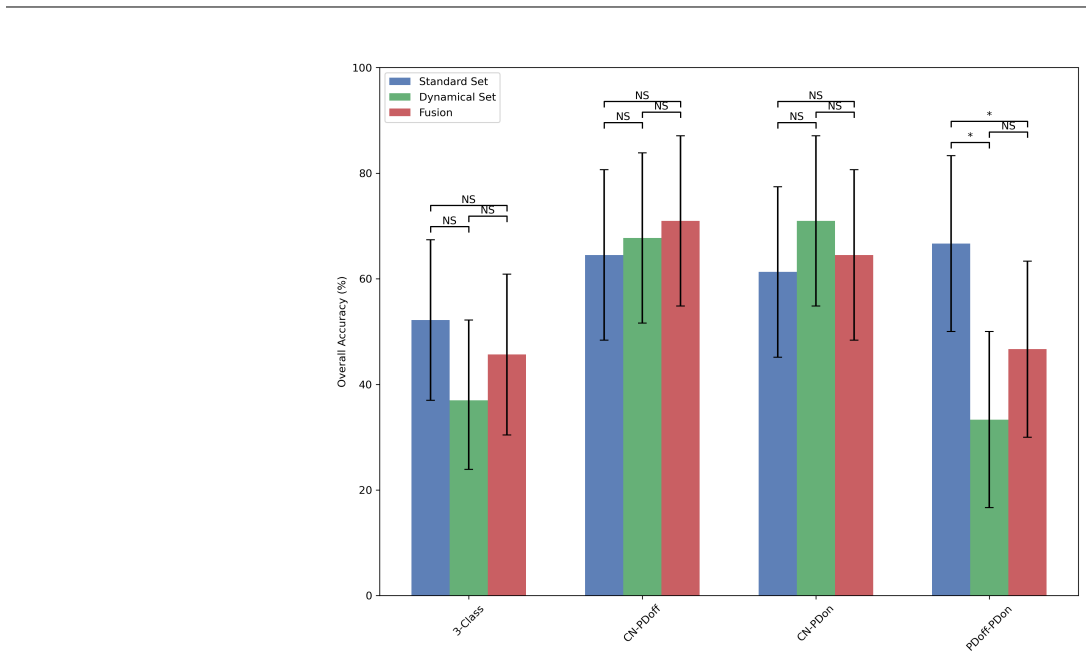
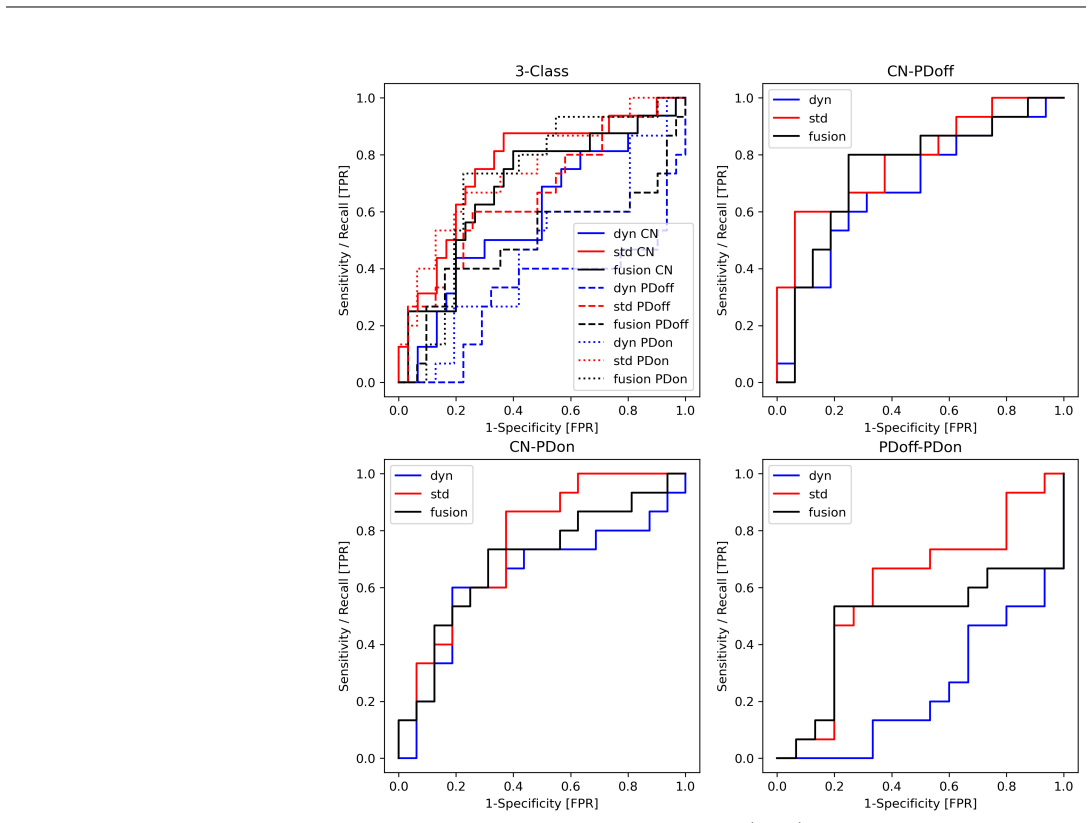
Standard descriptors primarily reflect medication-related neural modulation while dynamical descriptors reveal broader alterations in cortical network organization associated with both disease and medication state, as evidenced by classification accuracies, low feature redundancy, and specific group differences in delta power, theta synchronization, cross-frequency interactions, and neuronal avalanche statistics.
What carries the argument
The division of EEG features into Standard descriptors (spectral power, phase synchronization, time-domain statistics) and Dynamical descriptors (aperiodic activity, cross-frequency coupling, scale-free dynamics, neuronal avalanche statistics, instantaneous frequency), fed into a multi-head attention transformer classifier under leave-one-subject-out validation.
If this is right
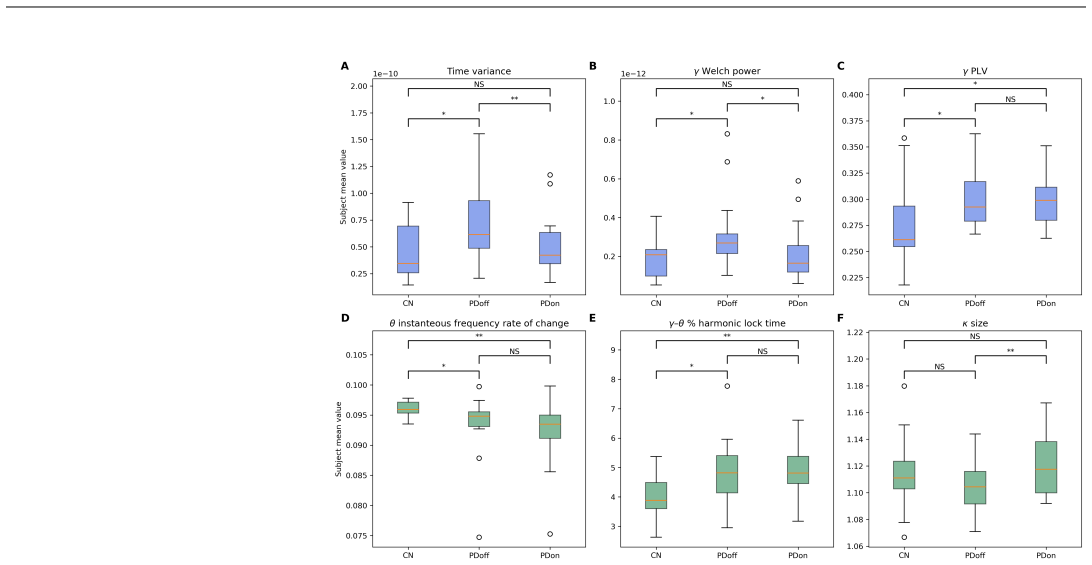
- Standard spectral and synchronization features can detect medication-induced changes such as reduced delta power and voltage variance.
- Dynamical descriptors supply complementary information that helps separate Parkinson's patients from healthy controls even when standard features fall short.
- Neuronal avalanche statistics and cross-frequency coupling show measurable shifts tied to disease presence and medication state.
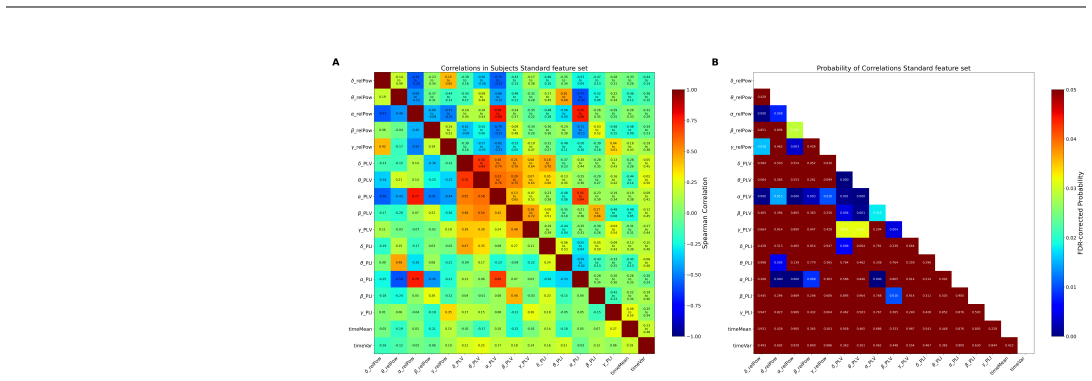
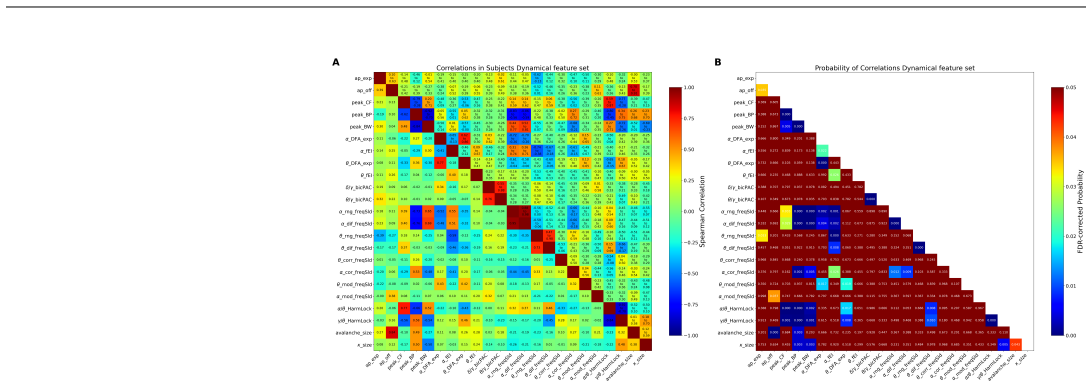
- Low correlation within each feature set supports the value of keeping both standard and dynamical groups rather than relying on any single measure.
- The overall multivariate approach indicates that resting-state EEG can track both acute medication effects and longer-term network reorganization in Parkinson's.
Where Pith is reading between the lines
- Combining the two feature groups in a single model could yield higher accuracy than either set alone for clinical biomarker development.
- The same feature framework might extend to tracking progression or treatment response in other disorders that alter cortical dynamics, such as Alzheimer's or epilepsy.
- If the dynamical descriptors prove stable across sessions, they could support repeated non-invasive monitoring in outpatient or home settings without specialized equipment.
- Future work could test whether these EEG signatures predict individual differences in motor or cognitive symptoms more closely than current clinical scales.
Load-bearing premise
The extracted features faithfully reflect true cortical network dynamics rather than being dominated by recording artifacts, volume conduction, or unaccounted individual differences in a clinical population.
What would settle it
A replication study that applies the same feature extraction and classifier to high-density EEG recordings with stricter artifact removal and finds no reliable group separation or medication-state discrimination would falsify the central claim.
Figures
read the original abstract
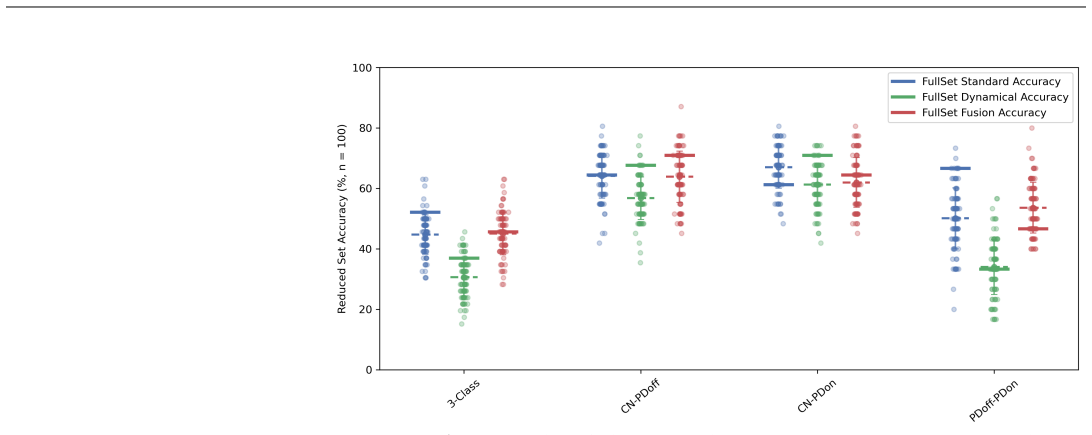
Parkinsons disease (PD) alters cortical neural dynamics, yet reliable non-invasive electrophysiological biomarkers remain elusive. This study examined whether interpretable EEG features capturing complementary aspects of neural dynamics can discriminate Parkinsonian neural states. A comprehensive set of interpretable features was extracted and grouped into Standard descriptors (spectral power, phase synchronization, time-domain statistics) and Dynamical descriptors (aperiodic activity, cross-frequency coupling, scale-free dynamics, neuronal avalanche statistics, and instantaneous frequency measures). A multi-head attention transformer classifier was trained using strict LOSO validation. Group-level comparisons were performed to identify electrophysiological differences associated with disease and medication state. Standard feature sets achieved strongest performance in discriminating medication states (PDoff vs PDon), whereas Dynamical performed competitively in contrasts between PD patients and healthy controls. Random feature ablation analyses indicated that Dynamical descriptors provide complementary information distributed across features while correlation analysis revealed low redundancy within both feature sets. Group-level comparisons revealed medication-sensitive reductions in delta power and voltage variance, modulation of neuronal avalanche statistics, persistent increases in theta phase synchronization in PD patients, and disease-related alterations in cross-frequency interactions. Traditional spectral and synchronization features primarily reflect medication-related neural modulation, whereas dynamical descriptors reveal broader alterations in cortical network organization associated with disease but also with medication. These findings support multivariate EEG representations as a promising framework for developing non-invasive biomarkers of PD.
Editorial analysis
A structured set of objections, weighed in public.
Referee Report
Summary. The manuscript extracts a comprehensive set of interpretable resting-state EEG features from PD patients and controls, grouped into standard descriptors (spectral power, phase synchronization, time-domain statistics) and dynamical descriptors (aperiodic activity, cross-frequency coupling, scale-free dynamics, neuronal avalanche statistics, instantaneous frequency). A multi-head attention transformer is trained under strict LOSO validation to discriminate PD vs. controls and off- vs. on-medication states; group-level comparisons identify medication-sensitive reductions in delta power/variance, persistent theta phase synchronization in PD, and alterations in cross-frequency interactions and avalanche statistics. The authors conclude that dynamical features provide complementary information on cortical network organization and support multivariate EEG as a framework for non-invasive PD biomarkers.
Significance. If the central discrimination and group-difference claims survive quantitative reporting and volume-conduction controls, the work would strengthen the case for interpretable, multivariate EEG biomarkers in PD by showing that dynamical descriptors add non-redundant information beyond standard spectral and synchronization measures. The LOSO protocol and random-ablation analyses are positive elements that support claims of feature complementarity.
major comments (2)
- [Methods (feature extraction)] Methods (feature extraction and preprocessing): Phase synchronization and cross-frequency coupling measures are used to support claims that dynamical descriptors capture cortical network dynamics (Abstract; Results on group comparisons), yet no source localization, current-source density, or orthogonalization is described to mitigate volume conduction. Standard scalp EEG phase metrics are known to be dominated by far-field mixing; without explicit correction, the reported disease-related synchronization and CFC differences cannot be confidently attributed to cortical network organization rather than reference or volume effects.
- [Abstract and Results] Abstract and Results: LOSO validation and group comparisons are reported, but no sample sizes (N for PDoff, PDon, controls), exact performance metrics (accuracy/AUC with error bars or confidence intervals), or precise exclusion criteria appear. This absence makes it impossible to assess the practical strength of the claim that dynamical features perform competitively for PD vs. control discrimination or that standard features excel for medication-state separation.
minor comments (2)
- [Introduction] The rationale for partitioning features into 'Standard' versus 'Dynamical' sets is stated but could be expanded in the Introduction with a brief justification of why avalanche statistics and instantaneous frequency are grouped with CFC rather than with spectral power.
- [Figures/Tables] Figure legends and table captions should explicitly state the number of subjects contributing to each contrast and whether error bars represent standard error or 95% CI.
Simulated Author's Rebuttal
We thank the referee for their constructive and detailed comments, which have helped us improve the clarity and rigor of the manuscript. We address each major comment below and have revised the paper accordingly.
read point-by-point responses
-
Referee: [Methods (feature extraction)] Methods (feature extraction and preprocessing): Phase synchronization and cross-frequency coupling measures are used to support claims that dynamical descriptors capture cortical network dynamics (Abstract; Results on group comparisons), yet no source localization, current-source density, or orthogonalization is described to mitigate volume conduction. Standard scalp EEG phase metrics are known to be dominated by far-field mixing; without explicit correction, the reported disease-related synchronization and CFC differences cannot be confidently attributed to cortical network organization rather than reference or volume effects.
Authors: We agree that volume conduction poses a challenge for interpreting phase synchronization and cross-frequency coupling at the sensor level. Our analyses were performed on standard scalp EEG without source localization, current-source density transformation, or orthogonalization. In the revised manuscript we have added an explicit limitations paragraph in the Discussion section that acknowledges this issue, discusses its potential impact on the reported group differences, and notes that the observed discriminative utility of the feature sets remains valid at the sensor level. We also clarify that the primary contribution is the demonstration of complementary information across feature families rather than definitive source-level network mapping. revision: yes
-
Referee: [Abstract and Results] Abstract and Results: LOSO validation and group comparisons are reported, but no sample sizes (N for PDoff, PDon, controls), exact performance metrics (accuracy/AUC with error bars or confidence intervals), or precise exclusion criteria appear. This absence makes it impossible to assess the practical strength of the claim that dynamical features perform competitively for PD vs. control discrimination or that standard features excel for medication-state separation.
Authors: We have revised both the Abstract and Results sections to prominently report the sample sizes (N for each group), exact performance metrics (accuracy and AUC with 95% confidence intervals), and the full exclusion criteria. These details were already present in the Methods; they are now duplicated in the main narrative and Abstract for immediate accessibility. Updated figures also include error bars where appropriate. revision: yes
Circularity Check
No significant circularity in derivation chain
full rationale
The paper is an empirical study that extracts predefined interpretable EEG feature sets (standard spectral/power/synchronization and dynamical descriptors including CFC, avalanches, and aperiodic activity), trains a multi-head attention transformer classifier under strict LOSO cross-validation on held-out subjects, and reports group-level statistical comparisons. No equations, first-principles derivations, or predictive steps are presented that reduce outputs to fitted parameters or self-citations by construction. Feature definitions and performance metrics rely on independent data splits and standard statistical tests rather than tautological renaming or self-referential fitting. Any self-citations are incidental and non-load-bearing for the central biomarker claims, which are grounded in observable classification accuracy and group differences.
Axiom & Free-Parameter Ledger
axioms (1)
- domain assumption Resting-state EEG signals reflect cortical network dynamics
discussion (0)
Sign in with ORCID, Apple, or X to comment. Anyone can read and Pith papers without signing in.