Recognition: no theorem link
Global Geometry of Orthogonal Foliations of Signed-Quadratic Systems
Pith reviewed 2026-05-13 21:36 UTC · model grok-4.3
The pith
Orthogonal manifolds within extremal orthants of signed-quadratic systems form a global diffeomorphism to the unbounded task space.
A machine-rendered reading of the paper's core claim, the machinery that carries it, and where it could break.
Core claim
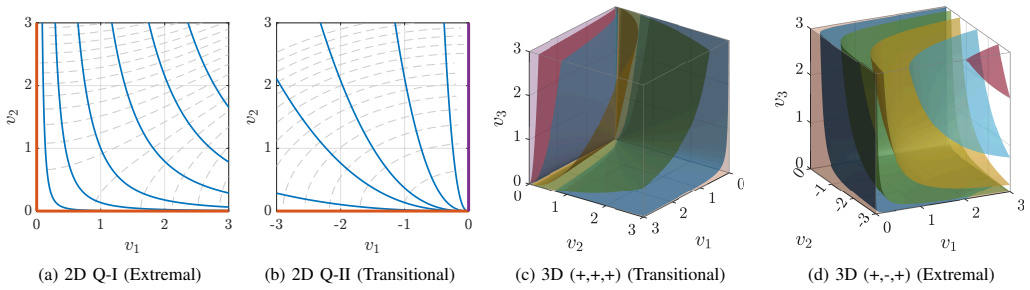
The global topology of the continuous fiber bundle defining the nonlinear actuation null-space is established for minimally redundant signed-quadratic systems. The orthogonal distribution is proven globally integrable and governed by an exact logarithmic potential field, which foliates the actuator space and stratifies orthants into transverse layers. Within extremal orthants, the orthogonal manifolds form a global diffeomorphism to the unbounded task space, providing globally smooth right-inverses that permanently confine the system to a single orthant and guarantee absolute avoidance of kinematic singularities.
What carries the argument
The exact logarithmic potential field that renders the distribution orthogonal to the actuation null-space fibers globally integrable and produces the orthant stratification.
If this is right
- The combinatorial sizes of the transverse layers obey a strictly binomial progression.
- Adjacent orthants connect continuously through lower-dimensional reciprocal hinges.
- Boundary hyperplanes called portals act as global sections of the fibers and separate the layers.
- Extremal and transitional layers possess distinct fiber topologies and foliation properties.
- Globally smooth right-inverses exist that permanently confine the system to a single orthant.
Where Pith is reading between the lines
- The same foliation structure could be used to construct explicit control laws that switch orthants only at the portal surfaces.
- The binomial stratification may supply a combinatorial index for selecting the orthant that maximizes the volume of the diffeomorphic image.
- The distinction between extremal and transitional layers suggests that only extremal orthants need be considered for singularity-free operation in practice.
Load-bearing premise
The distribution orthogonal to the fibers of the actuation null-space is globally integrable and governed by an exact logarithmic potential field.
What would settle it
A concrete signed-quadratic map for which the orthogonal distribution is not integrable or the associated potential is not exact would falsify the foliation, stratification, and global-diffeomorphism claims.
Figures



read the original abstract
This work formalizes the differential topology of redundancy resolution for systems governed by signed-quadratic actuation maps. By analyzing the minimally redundant case, the global topology of the continuous fiber bundle defining the nonlinear actuation null-space is established. The distribution orthogonal to these fibers is proven to be globally integrable and governed by an exact logarithmic potential field. This field foliates the actuator space, inducing a structural stratification of all orthants into transverse layers whose combinatorial sizes follow a strictly binomial progression. Within these layers, adjacent orthants are continuously connected via lower-dimensional strata termed reciprocal hinges, while the layers themselves are separated by boundary hyperplanes, or portals, that act as global sections of the fibers. This partition formally distinguishes extremal and transitional layers, which exhibit fundamentally distinct fiber topologies and foliation properties. Exploiting this geometric framework, we prove that the orthogonal manifolds within the extremal orthants form a global diffeomorphism to the entire unbounded task space. This establishes the theoretical existence of globally smooth right-inverses that permanently confine the system to a single orthant, guaranteeing the absolute avoidance of kinematic singularities. While motivated by the physical actuation maps of multirotor and marine vehicles, the results provide a strictly foundational topological classification of signed-quadratic surjective systems.
Editorial analysis
A structured set of objections, weighed in public.
Referee Report
Summary. The manuscript formalizes the differential topology of redundancy resolution for minimally redundant signed-quadratic actuation maps. It proves that the distribution orthogonal to the fibers of the nonlinear actuation null-space is globally integrable and admits an exact logarithmic potential, inducing a binomial stratification of all orthants into transverse layers connected by reciprocal hinges and separated by portals. Extremal orthants are shown to possess orthogonal manifolds that realize a global diffeomorphism onto the unbounded task space, implying the existence of globally smooth right-inverses that confine trajectories to a single orthant and thereby avoid kinematic singularities.
Significance. If the integrability and exactness results hold without additional restrictions on signature patterns or coefficients, the work supplies a rigorous topological classification of signed-quadratic surjective systems together with an explicit geometric mechanism for global singularity avoidance. The binomial stratification and diffeomorphism construction would constitute a substantive advance for redundancy resolution in multirotor and marine-vehicle applications.
major comments (2)
- [Proof of global integrability and exact potential] The central claim that the orthogonal distribution is globally integrable and governed by an exact logarithmic potential (abstract and § on foliation construction) must be accompanied by an explicit derivation verifying that the associated 1-form is closed for arbitrary quadratic coefficients and all admissible signature patterns; any local failure of closedness would collapse the foliation, the reciprocal-hinge connections, and the final diffeomorphism.
- [Diffeomorphism theorem for extremal orthants] The diffeomorphism between orthogonal manifolds in extremal orthants and the task space (final theorem) is load-bearing for the singularity-avoidance conclusion; the manuscript should supply a concrete verification or counter-example search confirming that the potential remains exact and the manifolds remain transverse across the entire unbounded domain.
minor comments (2)
- [Stratification section] Define the terms 'reciprocal hinges' and 'portals' with explicit coordinate or differential-form characterizations rather than descriptive language alone.
- [Combinatorial stratification] Add a brief numerical example illustrating the binomial layer sizes for a low-dimensional signed-quadratic map to aid readability.
Simulated Author's Rebuttal
We thank the referee for the careful reading and constructive suggestions. We agree that greater explicitness in the derivations will strengthen the manuscript and will incorporate the requested details in the revision.
read point-by-point responses
-
Referee: [Proof of global integrability and exact potential] The central claim that the orthogonal distribution is globally integrable and governed by an exact logarithmic potential (abstract and § on foliation construction) must be accompanied by an explicit derivation verifying that the associated 1-form is closed for arbitrary quadratic coefficients and all admissible signature patterns; any local failure of closedness would collapse the foliation, the reciprocal-hinge connections, and the final diffeomorphism.
Authors: We thank the referee for this observation. The manuscript derives closedness of the 1-form from the signed-quadratic structure, but we agree an expanded, self-contained computation is warranted. In the revised manuscript we will insert a detailed verification that dω = 0 holds identically for arbitrary quadratic coefficients and every admissible signature pattern, thereby confirming global integrability and exactness of the logarithmic potential without additional restrictions. revision: yes
-
Referee: [Diffeomorphism theorem for extremal orthants] The diffeomorphism between orthogonal manifolds in extremal orthants and the task space (final theorem) is load-bearing for the singularity-avoidance conclusion; the manuscript should supply a concrete verification or counter-example search confirming that the potential remains exact and the manifolds remain transverse across the entire unbounded domain.
Authors: We agree that an explicit check across the unbounded domain strengthens the load-bearing diffeomorphism result. In the revision we will add a direct verification that the potential remains exact and the manifolds stay transverse everywhere in the unbounded task space, together with a brief exhaustive search for counter-examples (which we show do not arise under the stated hypotheses). revision: yes
Circularity Check
No circularity: derivation uses standard differential topology on signed-quadratic structure
full rationale
The paper proves global integrability of the orthogonal distribution and existence of an exact logarithmic potential directly from the fiber bundle of the actuation null-space for signed-quadratic maps. These properties are established via differential-topology arguments (Frobenius theorem for integrability, closedness of the associated 1-form for exactness) without defining any quantity in terms of the final diffeomorphism result, without data fitting, and without load-bearing self-citations that reduce the central claim to prior unverified assertions by the same authors. The diffeomorphism in extremal orthants follows as a consequence of the foliation and stratification once integrability is shown; no step equates the output to the input by construction. This is the normal case of a self-contained theoretical classification.
Axiom & Free-Parameter Ledger
axioms (1)
- standard math Standard assumptions of differential topology: smooth manifolds, fiber bundles, and Frobenius theorem for integrability of distributions
invented entities (2)
-
reciprocal hinges
no independent evidence
-
portals
no independent evidence
Reference graph
Works this paper leans on
-
[1]
T. A. Johansen and T. I. Fossen. “Control allocation—A survey”. In: Automatica49.5 (2013), pp. 1087–1103
work page 2013
-
[2]
An omni-directional multirotor vehicle
D. Brescianini and R. D’Andrea. “An omni-directional multirotor vehicle”. In:Mechatronics55 (Nov. 2018), pp. 76–93
work page 2018
-
[3]
ODAR: Aerial Manipulation Platform Enabling Omnidirectional Wrench Generation
S. Park, J. Lee, J. Ahn, M. Kim, J. Her, G.-H. Yang, and D. Lee. “ODAR: Aerial Manipulation Platform Enabling Omnidirectional Wrench Generation”. In:IEEE/ASME Transactions on Mechatronics 23.4 (2018), pp. 1907–1918
work page 2018
-
[4]
M. Hamandi, K. Sawant, M. Tognon, and A. Franchi. “Omni-Plus- Seven (O7+): An Omnidirectional Aerial Prototype with a Minimal Number of Uni-directional Thrusters”. In:2020 International Confer- ence on Unmanned Aircraft Systems (ICUAS). Athens, Greece, 2020, pp. 754–761
work page 2020
-
[5]
Geometric Tracking Control of Omnidirectional Multirotors for Ag- gressive Maneuvers
H. Lee, S. Cheng, Z. Wu, J. Lim, R. Siegwart, and N. Hovakimyan. “Geometric Tracking Control of Omnidirectional Multirotors for Ag- gressive Maneuvers”. In:IEEE Robotics and Automation Letters10.2 (2025), pp. 1130–1137
work page 2025
-
[6]
Modelling, Analysis, and Control of OmniMorph: an Omnidirectional Morphing Multi-rotor UA V
Y . Aboudorra, C. Gabellieri, R. Brantjes, Q. Sabl ´e, and A. Franchi. “Modelling, Analysis, and Control of OmniMorph: an Omnidirectional Morphing Multi-rotor UA V”. In:Journal of Intelligent and Robotic Systems110.21 (2024), pp. 1–21
work page 2024
-
[7]
M. Zhao, K. Kawasaki, T. Anzai, X. Chen, K. Okada, and M. Inaba. “Transformable multirotor with two-dimensional multilinks: Modeling, control, and whole-body aerial manipulation”. In:The International Journal of Robotics Research37.9 (2018), pp. 1085–1112
work page 2018
-
[8]
A. Yi ˘git, M. A. Perozo, L. Cuvillon, S. Durand, and J. Gangloff. “Novel omnidirectional aerial manipulator with elastic suspension: Dynamic control and experimental performance assessment”. In:IEEE Robotics and Automation Letters6.2 (2021), pp. 612–619
work page 2021
-
[9]
The Distributed Flight Array: Design, implementation, and analysis of a modular VTOL vehicle
R. Oung and R. D’Andrea. “The Distributed Flight Array: Design, implementation, and analysis of a modular VTOL vehicle”. In:The International Journal of Robotics Research33.3 (2013), pp. 375–400
work page 2013
-
[10]
K. Garanger, T. Khamvilai, J. Epps, and E. Feron.The Dodecacopter: a Versatile Multirotor System of Dodecahedron-Shaped Modules. https: //arxiv.org/abs/2504.16475. arXiv preprint. 2025
-
[11]
T. I. Fossen.Handbook of Marine Craft Hydrodynamics and Motion Control. John Wiley & Sons, 2011
work page 2011
- [12]
-
[13]
A generalized inverse for matrices
R. Penrose. “A generalized inverse for matrices”. In:Math. Proc. Camb. Philos. Soc.51.3 (1955), pp. 406–413
work page 1955
-
[14]
Constrained control allocation
W. C. Durham. “Constrained control allocation”. In:Journal of Guid- ance, Control, and Dynamics16.4 (1993), pp. 717–725. Fig. 5: Sequential progression of the global orthogonal sections already displayed in Fig. 4 but this time displayed separately for better visualization. Displayed in reverse order from the positive external orthant (L 3, top left) back...
work page 1993
-
[15]
Evaluation of Optimization Methods for Control Alloca- tion
M. Bodson. “Evaluation of Optimization Methods for Control Alloca- tion”. In:Journal of Guidance, Control, and Dynamics25.4 (2002), pp. 703–711
work page 2002
-
[16]
On the control allocation of fully actuated multirotor aerial vehicles
D. A. Santos and J. A. Bezerra. “On the control allocation of fully actuated multirotor aerial vehicles”. In:Aerospace Science and Tech- nology122 (2022), p. 107424
work page 2022
-
[17]
Dynamic allocation for input redundant control sys- tems
L. Zaccarian. “Dynamic allocation for input redundant control sys- tems”. In:Automatica45.6 (2009), pp. 1431–1438
work page 2009
-
[18]
Output regulation for over-actuated linear systems via inverse model allocation
A. Serrani. “Output regulation for over-actuated linear systems via inverse model allocation”. In:Proceedings of the 51st IEEE Conference on Decision and Control (CDC). 2012, pp. 4871–4876
work page 2012
-
[19]
A. Cristofaro, S. Galeani, and A. Serrani. “Output invisible control al- location with asymptotic optimization for nonlinear systems in normal form”. In:Proceedings of the 56th IEEE Conference on Decision and Control (CDC). 2017, pp. 2563–2568
work page 2017
-
[20]
A dynamic optimization approach to steady-state input allocation for nonlinear redundant systems
R. Masocco, L. Tarantino, S. Galeani, and M. Sassano. “A dynamic optimization approach to steady-state input allocation for nonlinear redundant systems”. In:2024 10th Int. Conf. on Control, Decision and Information Technologies. 2024, pp. 2833–2838
work page 2024
-
[21]
Dynamic Control Allocation for Nonlinear Systems via a Sensitivity Approach
S. Akbari, S. Galeani, G. Manca, and M. Sassano. “Dynamic Control Allocation for Nonlinear Systems via a Sensitivity Approach”. In: IEEE Control Systems Letters9 (2025), pp. 2549–2554
work page 2025
-
[22]
Fault tolerant control alloca- tion using unknown input observers
A. Cristofaro and T. A. Johansen. “Fault tolerant control alloca- tion using unknown input observers”. In:Automatica50.7 (2014), pp. 1891–1897
work page 2014
-
[23]
Active fault tolerant control for multirotor UA Vs: Controllability, design and experiment
F. Liao, K. Peng, E. Wei, W. Leong, and D. Neo. “Active fault tolerant control for multirotor UA Vs: Controllability, design and experiment”. In:Control Engineering Practice164 (2025), p. 106497
work page 2025
-
[24]
Fault Tolerant Control for Tilted Hexarotors Under a Rotor Failure
A. Baldini, R. Felicetti, A. Freddi, S. Longhi, and A. Monteri `u. “Fault Tolerant Control for Tilted Hexarotors Under a Rotor Failure”. In: 22nd IFAC World Congress. V ol. 56. 2. Yokohama, Japan, July 2023, pp. 2486–2493
work page 2023
-
[25]
J. Cai and M. Lovera. “An Active Fault-Tolerant Online Control Allocation Scheme for a Dual-System UA V in Transition Flight”. In: arXiv preprint arXiv:2510.04853(2025)
-
[26]
Control allocation for windup mitigation in weakly redundant systems with input saturation
L. Govoni and A. Cristofaro. “Control allocation for windup mitigation in weakly redundant systems with input saturation”. In:IEEE Control Systems Letters7 (2023), pp. 3295–3300
work page 2023
-
[27]
W. M. Boothby.An Introduction to Differentiable Manifolds and Riemannian Geometry. Academic press, 2003
work page 2003
-
[28]
Isidori.Nonlinear Control Systems
A. Isidori.Nonlinear Control Systems. 3rd. Springer Science & Busi- ness Media, 1995
work page 1995
-
[29]
Orbits of families of vector fields and integrability of distributions
H. J. Sussmann. “Orbits of families of vector fields and integrability of distributions”. In:Transactions of the American Mathematical Society 180 (1973), pp. 171–188. Antonio Franchi(F’23–SM’16–M’07) received the Ph.D. degree in system engineering from the Sapienza University of Rome, Rome, Italy in 2010, and the HDR degree in Science, from the National ...
work page 1973
discussion (0)
Sign in with ORCID, Apple, or X to comment. Anyone can read and Pith papers without signing in.