Recognition: 2 theorem links
· Lean TheoremSpace-Efficient Quantum Algorithm for Elliptic Curve Discrete Logarithms with Resource Estimation
Pith reviewed 2026-05-13 21:17 UTC · model grok-4.3
The pith
Refined reversible modular inversion cuts ECDLP qubit count to 5n plus four log n terms.
A machine-rendered reading of the paper's core claim, the machinery that carries it, and where it could break.
Core claim
Starting from the extended Euclidean algorithm, length registers and location-controlled arithmetic yield a reversible modular inversion circuit using 3n + 4⌊log₂n⌋ + O(1) qubits and 204n² log₂n + O(n²) Toffoli gates; inserting this component into the controlled affine point-addition circuit produces an ECDLP algorithm with 5n + 4⌊log₂n⌋ + O(1) qubits and O(n³) Toffoli gates.
What carries the argument
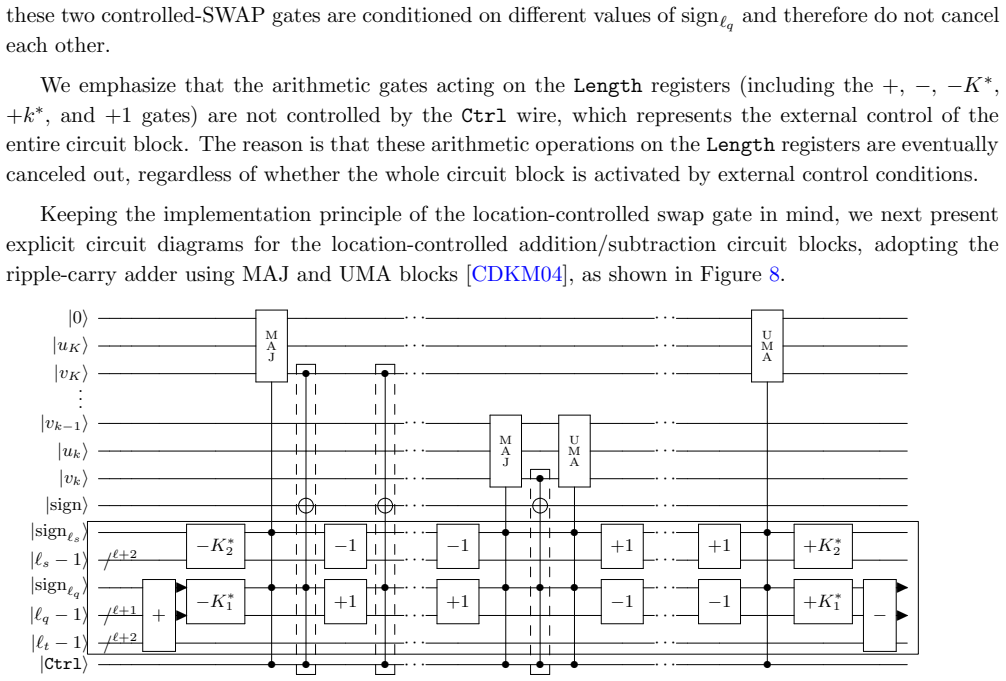
Space-efficient reversible modular inversion built from length registers and location-controlled arithmetic that stores EEA intermediates compactly throughout the computation.
If this is right
- The full ECDLP solver uses 5n + 4⌊log₂n⌋ + O(1) logical qubits and O(n³) Toffoli gates.
- For n = 256 the qubit requirement falls to 1333, below the 2124 of the prior low-width implementation.
- Modular inversion alone consumes 3n + 4⌊log₂n⌋ + O(1) qubits and 204n² log n Toffoli gates.
- The same register-sharing technique can be reused inside other controlled arithmetic operations that appear in Shor's algorithm variants.
Where Pith is reading between the lines
- The reduced width makes concrete resource estimates for breaking 256-bit elliptic-curve keys on near-term fault-tolerant machines more realistic.
- Similar length-register techniques could be tested on other number-theoretic primitives such as RSA modular exponentiation to see whether comparable savings appear.
- The concrete Toffoli counts supplied allow direct comparison against other arithmetic circuit libraries for quantum cryptanalysis.
Load-bearing premise
The optimized stepwise update rules and location-controlled arithmetic components can be realized in the standard quantum circuit model without hidden space overhead or additional ancilla qubits beyond the stated O(log n) terms.
What would settle it
An explicit circuit or resource count for the modular inversion block on a 256-bit field that requires more than 3n + 4 log n qubits would falsify the space bound.
Figures




read the original abstract
Solving the Elliptic Curve Discrete Logarithm Problem (ECDLP) is critical for evaluating the quantum security of widely deployed elliptic-curve cryptosystems. Consequently, minimizing the number of logical qubits required to execute this algorithm is a key object. In implementations of Shor's algorithm, the space complexity is largely dictated by the modular inversion operation during point addition. Starting from the extended Euclidean algorithm (EEA), we refine the register-sharing method of Proos and Zalka and propose a space-efficient reversible modular inversion algorithm. We use length registers together with location-controlled arithmetic to store the intermediate variables in a compact form throughout the computation. We then optimize the stepwise update rules and give concrete circuit constructions for the resulting controlled arithmetic components. This leads to a modular inversion circuit that uses $3n + 4\lfloor \log_2 n \rfloor + O(1)$ logical qubits and $204n^2\log_2 n + O(n^2)$ Toffoli gates. By inserting this modular inversion component into the controlled affine point-addition circuit, we obtain a space-efficient algorithm for the ECDLP with $5n + 4\lfloor \log_2 n \rfloor + O(1)$ qubits and $O(n^3)$ Toffoli gates. In particular, for a 256-bit prime-field curve, our estimate reduces the logical-qubit count to 1333, compared with 2124 in the previous low-width implementation of H\"aner et al.
Editorial analysis
A structured set of objections, weighed in public.
Referee Report
Summary. The paper claims to develop a space-efficient quantum algorithm for the Elliptic Curve Discrete Logarithm Problem (ECDLP) by refining the extended Euclidean algorithm for reversible modular inversion using length registers and location-controlled arithmetic. This results in a modular inversion circuit using 3n + 4⌊log₂ n⌋ + O(1) qubits and 204n² log₂ n + O(n²) Toffoli gates, which when integrated into the controlled affine point addition yields an overall ECDLP solver with 5n + 4⌊log₂ n⌋ + O(1) qubits and O(n³) Toffoli gates. For a 256-bit curve, this reduces the qubit count to 1333 compared to 2124 in prior work.
Significance. If the resource estimates hold, this work provides a substantial reduction in logical qubit requirements for quantum attacks on elliptic curve cryptography (1333 vs. 2124 for 256-bit curves), which is significant for assessing quantum security margins. The constructive use of standard reversible arithmetic primitives, register sharing, and explicit Toffoli counts strengthens the contribution by enabling more precise hardware resource planning.
major comments (1)
- [Abstract and modular inversion circuit description] Abstract and modular inversion section: the central qubit formula 5n + 4⌊log₂n⌋ + O(1) for the full ECDLP algorithm rests on the claim that embedding the 3n + 4⌊log₂n⌋ + O(1) inversion circuit into controlled affine point addition incurs no hidden ancilla overhead from the location-controlled arithmetic or stepwise updates; an explicit register accounting table or diagram verifying this for the EEA-based components would be required to confirm the total.
minor comments (2)
- [Abstract] Abstract: the inversion gate count 204n²log₂n + O(n²) is stated without a breakdown of the leading coefficient derivation or comparison table to prior EEA implementations; adding this would improve verifiability.
- [References] The reference to Häner et al. should include the full citation details (year, title, venue) in the bibliography for completeness.
Simulated Author's Rebuttal
We thank the referee for the careful reading, positive assessment of significance, and recommendation for minor revision. The suggestion for explicit register accounting improves clarity of the qubit claims.
read point-by-point responses
-
Referee: Abstract and modular inversion section: the central qubit formula 5n + 4⌊log₂n⌋ + O(1) for the full ECDLP algorithm rests on the claim that embedding the 3n + 4⌊log₂n⌋ + O(1) inversion circuit into controlled affine point addition incurs no hidden ancilla overhead from the location-controlled arithmetic or stepwise updates; an explicit register accounting table or diagram verifying this for the EEA-based components would be required to confirm the total.
Authors: We agree that an explicit accounting table strengthens the presentation. In the revised manuscript we have added a register accounting table (new Table 2) in the modular inversion section together with a compact diagram of register sharing. The table enumerates every register (including length registers and those used for location-controlled arithmetic) across the EEA steps and the controlled affine point addition, confirming that all intermediate values reuse the existing 3n + 4⌊log₂n⌋ + O(1) qubits with no additional ancilla. The integration therefore preserves the overall bound of 5n + 4⌊log₂n⌋ + O(1) qubits. revision: yes
Circularity Check
No significant circularity in the derivation chain
full rationale
The paper constructs an explicit reversible modular inversion circuit from the extended Euclidean algorithm by refining register-sharing techniques and introducing length registers with location-controlled arithmetic. Qubit counts (3n + 4⌊log₂n⌋ + O(1) for inversion, then 5n + 4⌊log₂n⌋ + O(1) for the full ECDLP algorithm) are obtained by direct enumeration of shared n-bit registers plus explicit O(log n) overhead terms in the stepwise update rules and controlled components. No parameters are fitted to data, no quantity is defined in terms of itself, and no load-bearing step reduces to a self-citation or imported ansatz; the comparison to Häner et al. is an external benchmark. The derivation is therefore self-contained against standard reversible-arithmetic primitives.
Axiom & Free-Parameter Ledger
axioms (1)
- standard math Quantum computation is modeled by reversible circuits composed of Toffoli gates and standard arithmetic primitives.
Reference graph
Works this paper leans on
-
[1]
A meet-in-the-middle algorithm for fast synthesis of depth-optimal quantum circuits
Matthew Amy, Dmitri Maslov, Michele Mosca, and Martin Roetteler. A meet-in-the-middle algorithm for fast synthesis of depth-optimal quantum circuits. IEEE Transactions on Computer-Aided Design of Integrated Circuits and Systems , 32(6):818--830, 2013. https://doi.org/10.1109/TCAD.2013.2244643
-
[2]
Bernstein, Iggy van Hoof, and Tanja Lange
Gustavo Banegas, Daniel J. Bernstein, Iggy van Hoof, and Tanja Lange. Concrete quantum cryptanalysis of binary elliptic curves. Cryptology ePrint Archive , 2020. https://eprint.iacr.org/2020/1296
work page 2020
-
[3]
Elaine Barker and Quynh Dang. NIST special publication 800-57 part 1, revision 5, recommendation for key management: P art 1--general. NIST, Technical Report , page 171, 2020
work page 2020
-
[4]
Elliptic curve cryptography (ECC) cipher suites for transport layer security (TLS) , 2006
Simon Blake-Wilson, Nelson Bolyard, Vipul Gupta, Chris Hawk, and Bodo Moeller. Elliptic curve cryptography (ECC) cipher suites for transport layer security (TLS) , 2006. https://www.rfc-editor.org/rfc/rfc4492.html
work page 2006
-
[5]
Simon Blake-Wilson and M. Qu. Standards for efficient cryptography (sec) 2: Recommended elliptic curve domain parameters . Certicom Research, Oct , page 25, 1999
work page 1999
-
[6]
Ryan Babbush, Adam Zalcman, Craig Gidney, Michael Broughton, Tanuj Khattar, Hartmut Neven, Thiago Bergamaschi, Justin Drake, and Dan Boneh. Securing elliptic curve cryptocurrencies against quantum vulnerabilities: Resource estimates and mitigations, 2026. arXiv:2603.28846
work page internal anchor Pith review Pith/arXiv arXiv 2026
-
[7]
A new quantum ripple-carry addition circuit
Steven A. Cuccaro, Thomas G. Draper, Samuel A. Kutin, and David Petrie Moulton. A new quantum ripple-carry addition circuit. arXiv preprint , 2004. arXiv:quant-ph/0410184
work page internal anchor Pith review Pith/arXiv arXiv 2004
-
[8]
Reducing the number of qubits in quantum factoring
Cl \'e mence Chevignard, Pierre-Alain Fouque, and Andr \'e Schrottenloher. Reducing the number of qubits in quantum factoring. In Annual International Cryptology Conference , pages 384--415. Springer, 2025. https://doi.org/10.1007/978-3-032-01878-6_13
-
[9]
Reducing the number of qubits in quantum discrete logarithms on elliptic curves
Clémence Chevignard, Pierre-Alain Fouque, and André Schrottenloher. Reducing the number of qubits in quantum discrete logarithms on elliptic curves. Cryptology ePrint Archive, Paper 2026/280, 2026. https://eprint.iacr.org/2026/280
work page 2026
-
[10]
Andrew M. Childs and Wim van Dam. Quantum algorithms for algebraic problems. Reviews of Modern Physics , 82(1):1--52, 2010. https://doi.org/10.1103/RevModPhys.82.1
-
[11]
Whitfield Diffle and Martin E. Hellman. New directions in cryptography. IEEE Transactions on Information Theory , 22(6), 1976. https://doi.org/10.1145/3549993.3550007
-
[12]
Revisiting S hor's quantum algorithm for computing general discrete logarithms, 2019
Martin Eker . Revisiting S hor's quantum algorithm for computing general discrete logarithms, 2019. arXiv:1905.09084
-
[13]
A public key cryptosystem and a signature scheme based on discrete logarithms
Taher ElGamal. A public key cryptosystem and a signature scheme based on discrete logarithms. IEEE Transactions on Information Theory , 31(4):469--472, 1985. https://doi.org/10.1109/TIT.1985.1057074
-
[14]
Fowler, Matteo Mariantoni, John M
Austin G. Fowler, Matteo Mariantoni, John M. Martinis, and Andrew N. Cleland. Surface codes: Towards practical large-scale quantum computation. Physical Review A , 86(3):032324, 2012. https://doi.org/10.1103/PhysRevA.86.032324
-
[15]
How to factor 2048 bit RSA integers in 8 hours using 20 million noisy qubits
Craig Gidney and Martin Eker . How to factor 2048 bit RSA integers in 8 hours using 20 million noisy qubits. Quantum , 5:433, 2021. https://doi.org/10.22331/q-2021-04-15-433
-
[16]
Steven D. Galbraith and Pierrick Gaudry. Recent progress on the elliptic curve discrete logarithm problem. Designs, Codes and Cryptography , 78(1):51--72, 2016. https://doi.org/10.1007/s10623-015-0146-7
-
[17]
How to factor 2048 bit RSA integers with less than a million noisy qubits
Craig Gidney. How to factor 2048 bit RSA integers with less than a million noisy qubits. arXiv preprint , 2025. arXiv:2505.15917
work page internal anchor Pith review Pith/arXiv arXiv 2048
-
[18]
Robert B. Griffiths and Chi-Sheng Niu. Semiclassical F ourier transform for quantum computation. Physical Review Letters , 76(17):3228, 1996. https://doi.org/10.1103/PhysRevLett.76.3228
-
[19]
Quan Gu, Han Ye, Junjie Chen, and Xiongfeng Ma. Resource analysis of S hor's elliptic curve algorithm with an improved quantum adder on a two-dimensional lattice. arXiv preprint arXiv:2510.23212 , 2025
-
[20]
Zur theorie der abstrakten elliptischen Funktionenk \"o rper II
Helmut Hasse. Zur theorie der abstrakten elliptischen Funktionenk \"o rper II. Automorphismen und Meromorphismen. Das Additionstheorem. Journal für die reine und angewandte Mathematik , 1936. https://doi.org/10.1515/crll.1936.175.69
-
[21]
Improved quantum circuits for elliptic curve discrete logarithms
Thomas H \"a ner, Samuel Jaques, Michael Naehrig, Martin Roetteler, and Mathias Soeken. Improved quantum circuits for elliptic curve discrete logarithms. In International Conference on Post-quantum Cryptography , pages 425--444. Springer, 2020. https://doi.org/10.1007/978-3-030-44223-1_23
-
[22]
Thomas H\" a ner, Martin Roetteler, and Krysta M. Svore. Factoring using 2n + 2 qubits with T offoli based modular multiplication. Quantum Info. Comput. , 17(7–8):673–684, June 2017. https://dl.acm.org/doi/abs/10.5555/3179553.3179560
-
[23]
Optimized implementation of quantum binary field multiplication with T offoli depth one
Kyungbae Jang, Wonwoong Kim, Sejin Lim, Yeajun Kang, Yujin Yang, and Hwajeong Seo. Optimized implementation of quantum binary field multiplication with T offoli depth one. In International Conference on Information Security Applications , pages 251--264. Springer, 2022. https://doi.org/10.1007/978-3-031-25659-2_18
-
[24]
The elliptic curve digital signature algorithm (ECDSA)
Don Johnson, Alfred Menezes, and Scott Vanstone. The elliptic curve digital signature algorithm (ECDSA) . International Journal of Information Security , 1(1):36--63, 2001. https://doi.org/10.1007/s102070100002
-
[25]
New quantum cryptanalysis of binary elliptic curves (extended version)
Kyungbae Jang, Vikas Srivastava, Anubhab Baksi, Santanu Sarkar, and Hwajeong Seo. New quantum cryptanalysis of binary elliptic curves (extended version). Cryptology ePrint Archive , 2025. https://eprint.iacr.org/2025/017
work page 2025
-
[26]
New quantum circuits for ECDLP : Breaking prime elliptic curve cryptography in minutes
Hyunji Kim, Kyungbae Jang, Siyi Wang, Anubhab Baksi, Gyeongju Song, Hwajeong Seo, and Anupam Chattopadhyay. New quantum circuits for ECDLP : Breaking prime elliptic curve cryptography in minutes. Cryptology ePrint Archive, Paper 2026/106, 2026. https://eprint.iacr.org/2026/106
work page 2026
-
[27]
Gregory D Kahanamoku-Meyer, Seyoon Ragavan, Vinod Vaikuntanathan, and Katherine van Kirk. The J acobi factoring circuit: Quantum factoring with near-linear gates and sublinear space and depth. In Proceedings of the 57th Annual ACM Symposium on Theory of Computing , pages 1496--1507, 2025. https://doi.org/10.1145/3717823.3718273
-
[28]
Neal Koblitz. Elliptic curve cryptosystems. Mathematics of Computation , 48(177):203--209, 1987. https://doi.org/10.1090/S0025-5718-1987-0866109-5
- [29]
-
[30]
Victor S. Miller. Use of elliptic curves in cryptography. In Conference on the Theory and Application of Cryptographic Techniques , pages 417--426. Springer, 1985. https://doi.org/10.1007/3-540-39799-X_31
-
[31]
Satoshi Nakamoto and A. Bitcoin. A peer-to-peer electronic cash system. Bitcoin.--URL: https://bitcoin. org/bitcoin. pdf , 4(2):15, 2008
work page 2008
-
[32]
Michael A. Nielsen and Isaac L. Chuang. Quantum computation and quantum information . Cambridge University Press, 2010
work page 2010
-
[33]
Another concrete quantum cryptanalysis of binary elliptic curves
Dedy Septono Catur Putranto, Rini Wisnu Wardhani, Harashta Tatimma Larasati, and Howon Kim. Another concrete quantum cryptanalysis of binary elliptic curves. Cryptology ePrint Archive , 2022. https://eprint.iacr.org/2022/501
work page 2022
-
[34]
Shor's discrete logarithm quantum algorithm for elliptic curves
John Proos and Christof Zalka. Shor's discrete logarithm quantum algorithm for elliptic curves. Quantum Info. Comput. , 3(4):317–344, July 2003. https://dl.acm.org/doi/abs/10.5555/2011528.2011531
-
[35]
An efficient quantum factoring algorithm
Oded Regev. An efficient quantum factoring algorithm. Journal of the ACM , 72(1):1--13, 2025. https://doi.org/10.1145/3708471
-
[36]
Martin Roetteler, Michael Naehrig, Krysta M. Svore, and Kristin Lauter. Quantum resource estimates for computing elliptic curve discrete logarithms. In International Conference on the Theory and Application of Cryptology and Information Security , pages 241--270. Springer, 2017. https://doi.org/10.1007/978-3-319-70697-9_9
-
[37]
Rivest, Adi Shamir, and Leonard Adleman
Ronald L. Rivest, Adi Shamir, and Leonard Adleman. A method for obtaining digital signatures and public-key cryptosystems. Communications of the ACM , 21(2):120--126, 1978. https://doi.org/10.1145/359340.359342
-
[38]
Space-efficient and noise-robust quantum factoring
Seyoon Ragavan and Vinod Vaikuntanathan. Space-efficient and noise-robust quantum factoring. In Annual International Cryptology Conference , pages 107--140. Springer, 2024. https://doi.org/10.1007/978-3-031-68391-6_4
-
[39]
Elliptic curve algorithm integration in the secure shell transport layer, 2009
Douglas Stebila and Jon Green. Elliptic curve algorithm integration in the secure shell transport layer, 2009. https://www.rfc-editor.org/rfc/rfc5656
work page 2009
-
[40]
Peter W. Shor. Algorithms for quantum computation: discrete logarithms and factoring. In Proceedings 35th Annual Symposium on Foundations of Computer Science , pages 124--134. IEEE, 1994. https://doi.org/10.1109/SFCS.1994.365700
-
[41]
Concrete quantum cryptanalysis of binary elliptic curves via addition chain
Ren Taguchi and Atsushi Takayasu. Concrete quantum cryptanalysis of binary elliptic curves via addition chain. In Cryptographers’ Track at the RSA Conference , pages 57--83. Springer, 2023. https://doi.org/10.1007/978-3-031-30872-7_3
discussion (0)
Sign in with ORCID, Apple, or X to comment. Anyone can read and Pith papers without signing in.