Recognition: 2 theorem links
· Lean TheoremReVAR: A Data-Driven Algorithm for Generating Aero-Optic Phase Screens
Pith reviewed 2026-05-13 20:49 UTC · model grok-4.3
The pith
ReVAR generates synthetic aero-optic phase screens whose statistics match measured turbulent boundary layer data better than conventional methods or single-lag autoregressive models.
A machine-rendered reading of the paper's core claim, the machinery that carries it, and where it could break.
Core claim
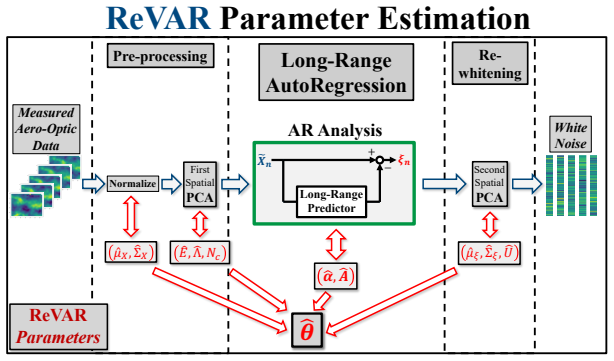
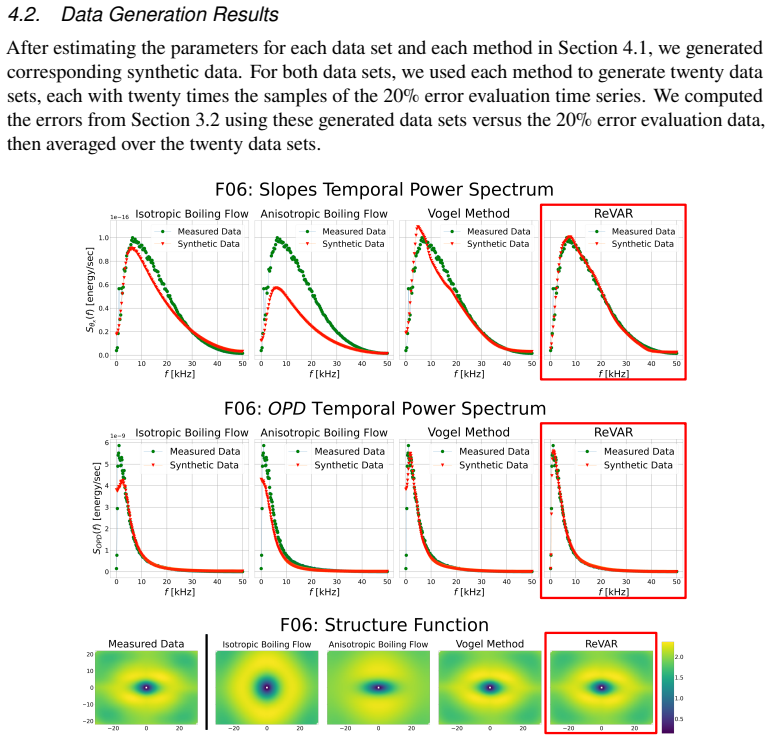
ReVAR converts measured aero-optic phase screen data into temporally and spatially uncorrelated white noise using Long-Range AutoRegression together with a spatial re-whitening step. Synthetic data is generated by reversing the same steps on white noise input. On two measured turbulent boundary layer datasets, the resulting screens match the temporal power spectrum and other key statistics more closely than two conventional phase screen methods and an existing single time-lag autoregressive model.
What carries the argument
Long-Range AutoRegression combined with spatial re-whitening, a linear model that augments standard autoregression with low-pass filters to fit both short-range and long-range temporal statistics before decorrelating the data.
If this is right
- Large quantities of aero-optic data can be produced efficiently once the model is fit to a modest measured set.
- The generated screens exhibit temporal power spectra closer to real measurements than prior phase screen algorithms.
- ReVAR avoids the high cost and limited scale of direct experiments or full computational fluid dynamics runs.
- The approach improves upon existing single time-lag autoregressive models by explicitly handling longer temporal correlations.
Where Pith is reading between the lines
- The same conversion-to-white-noise pipeline could be tested on other optical turbulence datasets, such as atmospheric scintillation, to check transferability.
- If the re-whitening step proves robust, researchers could explore controlled variation of the input noise statistics to study specific turbulence regimes.
- Adapting the low-pass filter bank might allow synthesis tuned to different aircraft speeds or altitudes without refitting the entire model.
Load-bearing premise
That the long-range autoregressive fit plus spatial re-whitening fully captures the joint spatio-temporal statistics of the measured aero-optic data without losing non-stationary features or adding artifacts.
What would settle it
Compare the temporal power spectrum of ReVAR-generated screens against a fresh independent set of measured turbulent boundary layer data at frequencies below the lowest filter cutoff; a systematic mismatch at those scales would show the model fails to generalize.
Figures




read the original abstract
The propagation of light through a turbulent flow field around an aircraft results in optical distortions commonly known as aero-optic effects. The development of methods to mitigate these effects requires large amounts of realistic aero-optic data. However, methods for obtaining this data, including experiment, computational fluid dynamics, and simple phase screen algorithms (e.g., boiling flow), each have significant drawbacks such as high cost, high computation, limited quantity, and/or inaccurate statistics. More recently, data-driven algorithms have been proposed that are computationally efficient and can synthesize aero-optic data to match the statistics of measured data, but these approaches still have drawbacks including limited quality, inaccurate statistics, and the use of complicated algorithms. In this paper, we introduce ReVAR (Re-whitened Vector AutoRegression), a data-driven algorithm for generating synthetic aero-optic data that matches the statistics of measured data. A key contribution in this algorithm is Long-Range AutoRegression, a linear predictive model that combines a standard autoregression with a set of low-pass filters of the data to fit both short-range and long-range temporal statistics. ReVAR uses Long-Range AR together with a spatial re-whitening step to convert measured aero-optic data to temporally and spatially un-correlated white noise. ReVAR can then generate synthetic aero-optic data by reversing this process using white noise input. Using two measured turbulent boundary layer data sets, we demonstrate that ReVAR better matches the measured data's temporal power spectrum and other key metrics than do two conventional phase screen generation methods and an existing single time-lag autoregressive model.
Editorial analysis
A structured set of objections, weighed in public.
Referee Report
Summary. The manuscript introduces ReVAR, a data-driven algorithm for generating synthetic aero-optic phase screens from measured turbulent boundary layer data. It combines Long-Range AutoRegression (standard AR augmented by low-pass filters to capture short- and long-range temporal statistics) with a spatial re-whitening step that converts the data to uncorrelated white noise; synthetic screens are then produced by reversing the process with white-noise input. On two real datasets the authors report that ReVAR matches the measured temporal power spectrum and other key metrics more closely than two conventional phase-screen methods and an existing single-lag AR model.
Significance. If the performance claims are substantiated by rigorous statistical validation, ReVAR would supply an efficient, scalable source of realistic aero-optic data, overcoming the cost and quantity limitations of experiments and CFD while improving on the statistical fidelity of simpler boiling-flow or single-lag models. The explicit reversal of a whitening transform is a clean architectural choice that, if shown to preserve joint spatio-temporal statistics, could be adopted more broadly in turbulence simulation.
major comments (3)
- [Results] Results section: the abstract and experimental claims state that ReVAR 'better matches' the temporal power spectrum and other metrics, yet no quantitative error bars, confidence intervals, or statistical significance tests (e.g., paired t-tests or Kolmogorov-Smirnov comparisons) against the baselines are reported, leaving the magnitude and reliability of the improvement difficult to assess.
- [§3.2] §3.2 (Long-Range AutoRegression): the linear stationary predictor fits only time-averaged second-order moments. No diagnostics are presented for residual non-stationarity (slow drifts in local intensity or spatially varying correlation lengths) or for higher-order statistics (skewness, kurtosis, space-time cross-bispectra) in the synthesized screens; if these features are present in the measured data, the generated screens may reproduce the reported spectrum while still missing critical turbulence structure.
- [§4] §4 (Validation procedure): parameters (AR order, low-pass cutoffs) are fitted to the same two datasets used for performance evaluation. The manuscript should explicitly state whether any hold-out or cross-validation strategy was employed and, if not, discuss the implications for distinguishing in-sample fitting from genuine generalization of the joint spatio-temporal statistics.
minor comments (2)
- [Abstract] The abstract refers to 'other key metrics' without enumerating them; the specific quantities (e.g., spatial correlation length, phase variance, etc.) should be listed explicitly in both the abstract and the results summary.
- [§3] Notation for the low-pass filter cutoffs and the re-whitening matrix should be introduced once in §3 and used consistently; occasional re-definition of symbols in later sections reduces readability.
Simulated Author's Rebuttal
We thank the referee for the constructive review and specific suggestions to improve the statistical rigor and clarity of the manuscript. We address each major comment below and have revised the paper to incorporate additional validation, diagnostics, and discussion as appropriate.
read point-by-point responses
-
Referee: [Results] Results section: the abstract and experimental claims state that ReVAR 'better matches' the temporal power spectrum and other metrics, yet no quantitative error bars, confidence intervals, or statistical significance tests (e.g., paired t-tests or Kolmogorov-Smirnov comparisons) against the baselines are reported, leaving the magnitude and reliability of the improvement difficult to assess.
Authors: We agree that quantitative uncertainty measures and formal statistical tests would strengthen the claims. In the revised manuscript we now report error bars as the standard deviation across 100 independent realizations for each metric (temporal power spectrum, RMS, and correlation lengths). We have also added Kolmogorov-Smirnov tests comparing the empirical distributions of these metrics between ReVAR and the baseline methods, with p-values included in the updated results tables and text. revision: yes
-
Referee: [§3.2] §3.2 (Long-Range AutoRegression): the linear stationary predictor fits only time-averaged second-order moments. No diagnostics are presented for residual non-stationarity (slow drifts in local intensity or spatially varying correlation lengths) or for higher-order statistics (skewness, kurtosis, space-time cross-bispectra) in the synthesized screens; if these features are present in the measured data, the generated screens may reproduce the reported spectrum while still missing critical turbulence structure.
Authors: The Long-Range AR component is deliberately constructed around second-order temporal statistics, which govern the dominant aero-optic phase distortions. To address the referee's concern we have added a new subsection with diagnostics: time-windowed variance and local correlation-length estimates to check for residual non-stationarity, plus direct comparison of skewness and kurtosis between measured and synthesized screens. These quantities are now shown to be statistically consistent. Space-time bispectra are not computed in the current work because they are not required for standard aero-optic propagation models, but we note this limitation and the possibility of future extension. revision: yes
-
Referee: [§4] §4 (Validation procedure): parameters (AR order, low-pass cutoffs) are fitted to the same two datasets used for performance evaluation. The manuscript should explicitly state whether any hold-out or cross-validation strategy was employed and, if not, discuss the implications for distinguishing in-sample fitting from genuine generalization of the joint spatio-temporal statistics.
Authors: No hold-out or cross-validation was performed; parameters were selected to best reproduce the joint statistics of the two provided measured datasets, which is the intended use case for generating large quantities of synthetic data that match a given experimental realization. In the revised manuscript we have added an explicit statement to this effect in §4 together with a short discussion of the implications: the current validation demonstrates faithful reproduction of the supplied data's statistics, while generalization to unseen flow conditions would benefit from cross-validation or separate tuning datasets. revision: yes
Circularity Check
ReVAR is a self-contained data-driven generative algorithm with no circular derivation
full rationale
The paper describes an algorithm that estimates Long-Range AR coefficients and a spatial whitening transform directly from measured aero-optic data, then generates new screens by inverting the process with white-noise input. Validation consists of empirical comparison of generated statistics (temporal power spectrum and other metrics) against the same measured data sets and against separate baseline methods. No step in the provided abstract or description reduces a claimed prediction or first-principles result to its own fitted inputs by construction; the relative improvement over boiling-flow, conventional phase-screen, and single-lag AR baselines is not tautological. No self-citations, uniqueness theorems, or ansatzes are invoked as load-bearing steps. The derivation chain is therefore self-contained as a standard fitted generative model.
Axiom & Free-Parameter Ledger
free parameters (2)
- AR model order
- Low-pass filter cutoffs
axioms (1)
- domain assumption Aero-optic phase data can be treated as a wide-sense stationary process for the purpose of autoregressive modeling.
Lean theorems connected to this paper
-
IndisputableMonolith/Cost/FunctionalEquation.leanwashburn_uniqueness_aczel unclear?
unclearRelation between the paper passage and the cited Recognition theorem.
ReVAR uses Long-Range AutoRegression together with a spatial re-whitening step to convert measured aero-optic data to temporally and spatially un-correlated white noise... Long-Range AR... combines a standard autoregression with a set of low-pass filters
-
IndisputableMonolith/Foundation/RealityFromDistinction.leanreality_from_one_distinction unclear?
unclearRelation between the paper passage and the cited Recognition theorem.
We use the normalized root-mean squared error (NRMSE) to compare the TPS and structure function... NRMSE(Ŝ_θx, Sdata_θx)
What do these tags mean?
- matches
- The paper's claim is directly supported by a theorem in the formal canon.
- supports
- The theorem supports part of the paper's argument, but the paper may add assumptions or extra steps.
- extends
- The paper goes beyond the formal theorem; the theorem is a base layer rather than the whole result.
- uses
- The paper appears to rely on the theorem as machinery.
- contradicts
- The paper's claim conflicts with a theorem or certificate in the canon.
- unclear
- Pith found a possible connection, but the passage is too broad, indirect, or ambiguous to say the theorem truly supports the claim.
Reference graph
Works this paper leans on
-
[1]
Physics and computation of aero-optics,
M. Wang, A. Mani, and S. Gordeyev, “Physics and computation of aero-optics,” Annu. Rev. Fluid Mech.44, 299–321 (2012)
work page 2012
-
[2]
Physics and measurement of aero-optical effects: Past and present,
E. J. Jumper and S. Gordeyev, “Physics and measurement of aero-optical effects: Past and present,” Annu. Rev. Fluid Mech.49, 419–441 (2017). Approved for public release; distribution is unlimited. Public Affairs release approval # AFRL-2026-0858 . 19
work page 2017
-
[3]
The optical distortion mechanism in a nearly incompressible free shear layer,
E. J. Fitzgerald and E. J. Jumper, “The optical distortion mechanism in a nearly incompressible free shear layer,” J. Fluid Mech.512, 153–189 (2004)
work page 2004
-
[4]
E. J. Jumper, S. Gordeyev, and M. R. Whiteley, “Aero-optical effects,” inAero-Optical Effects,(John Wiley & Sons, Incorporated, United States, 2023)
work page 2023
-
[5]
Aero-optical foundations and applications,
G. W. Sutton, “Aero-optical foundations and applications,” AIAA J.23, 1525–1537 (1985)
work page 1985
-
[6]
Recent advances in aero-optics,
E. J. Jumper and E. J. Fitzgerald, “Recent advances in aero-optics,” Prog. Aerosp. Sci.37, 299–339 (2001)
work page 2001
-
[7]
Effect of flow excitation on aero-optical aberration,
M. R. Visbal and D. P. Rizzetta, “Effect of flow excitation on aero-optical aberration,” in46th AIAA Aerospace Sciences Meeting and Exhibit,(American Institute of Aeronautics and Astronautics, 2008), p. 1074
work page 2008
-
[8]
Aero-optical effects, part I. system-level considerations: tutorial,
M. Kalensky, S. Gordeyev, M. R. Kemnetzet al., “Aero-optical effects, part I. system-level considerations: tutorial,” J. Opt. Soc. Am. A41, 2163–2174 (2024)
work page 2024
-
[9]
Optical investigation of large-scale boundary-layer structures,
M. R. Kemnetz and S. Gordeyev, “Optical investigation of large-scale boundary-layer structures,” in54th AIAA Aerospace Sciences Meeting,(2016), p. 1460
work page 2016
-
[10]
J. M. Geary,Introduction to Wavefront Sensors, vol. TT18 ofTutorial texts in optical engineering(SPIE Optical Engineering Press, Bellingham, Washington, 1995)
work page 1995
-
[11]
Adaptive optics for directed energy: Fundamentals and methodology,
R. B. Holmes, “Adaptive optics for directed energy: Fundamentals and methodology,” AIAA J.60, 5633–5644 (2022)
work page 2022
-
[12]
Fluidic control of a turret wake, part II: Aero-optical effects,
S. Gordeyev, E. Jumper, B. Vukasinovicet al., “Fluidic control of a turret wake, part II: Aero-optical effects,” in 47th AIAA Aerospace Sciences Meeting including The New Horizons Forum and Aerospace Exposition,(American Institute of Aeronautics and Astronautics, 2009)
work page 2009
-
[13]
Flow control for aero-optics application,
B. Vukasinovic, A. Glezer, S. Gordeyev,et al., “Flow control for aero-optics application,” Exps. Fluids54, 1492 (2013)
work page 2013
-
[14]
Hybrid control of a turret wake,
B. Vukasinovic, A. Glezer, S. Gordeyevet al., “Hybrid control of a turret wake,” AIAA J.49, 1240–1255 (2011)
work page 2011
-
[15]
Airborne aero-optics laboratory,
E. J. Jumper, M. A. Zenk, S. V. Gordeyevet al., “Airborne aero-optics laboratory,” Opt. Eng.52, 071408 (2013)
work page 2013
-
[16]
Airborne aero-optics laboratory - transonic (AAOL-T),
E. J. Jumper, S. Gordeyev, D. Cavalieriet al., “Airborne aero-optics laboratory - transonic (AAOL-T),” in53rd AIAA Aerospace Sciences Meeting,(2015)
work page 2015
-
[17]
Predictive modeling of wavefront error using dynamic mode decomposition,
B. D. Shaffer, A. J. McDaniel, and C. C. Wilcox, “Predictive modeling of wavefront error using dynamic mode decomposition,”inInterferometryXX,vol.11490M.B.N.Morris,K.Creath,andR.Porras-Aguilar,eds.,International Society for Optics and Photonics (SPIE, 2020), p. 114900E
work page 2020
-
[18]
Dynamicmodedecompositionforaero-opticwavefrontcharacterization,
S.Sahba,D.Sashidhar,C.C.Wilcoxetal.,“Dynamicmodedecompositionforaero-opticwavefrontcharacterization,” Opt. Eng.61, 013105 (2022)
work page 2022
-
[19]
Estimation of aero-optical wavefronts using optical and non-optical measurements,
R. Burns, S. Gordeyev, E. Jumperet al., “Estimation of aero-optical wavefronts using optical and non-optical measurements,” in52nd AIAA Aerospace Sciences Meeting - AIAA Science and Technology Forum and Exposition, SciTech 2014,(2014), p. 0319
work page 2014
-
[20]
B.D.Shaffer,A.J.McDaniel,C.C.Wilcoxetal.,“Dynamicmodedecompositionbasedpredictivemodelperformance on supersonic and transonic aero-optical wavefront measurements,” Appl. Opt.60, G170–G180 (2021)
work page 2021
-
[21]
Physics-informed machine-learning for modeling aero-optics,
J. N. Kutz, D. Sashidhar, S. Sahbaet al., “Physics-informed machine-learning for modeling aero-optics,” inApplied Optical Metrology IV,vol. 11817 E. Novak, J. D. Trolinger, and C. C. Wilcox, eds., International Society for Optics and Photonics (SPIE, 2021), p. 118170E
work page 2021
-
[22]
Neural network forecasting of transonic turbulent flow for adaptive optics control,
B. D. Shaffer, J. R. Vorenberg, C. C. Wilcoxet al., “Neural network forecasting of transonic turbulent flow for adaptive optics control,” inUnconventional Imaging and Adaptive Optics 2022,vol. 12239 J. J. Dolne and M. F. Spencer, eds., International Society for Optics and Photonics (SPIE, 2022), p. 122390H
work page 2022
-
[23]
A latency-tolerant architecture for airborne adaptive optic systems,
R. Burns, E. Jumper, and S. Gordeyev, “A latency-tolerant architecture for airborne adaptive optic systems,” in53rd AIAA Aerospace Sciences Meeting,(2015), p. 0679
work page 2015
-
[24]
A robust modification of a predictive adaptive-optic control method for aero-optics,
R. Burns, E. Jumper, and S. Gordeyev, “A robust modification of a predictive adaptive-optic control method for aero-optics,” in47th AIAA Plasmadynamics and Lasers Conference,(2016), p. 3529
work page 2016
-
[25]
Optical characterization of nozzle-wall Mach-6 boundary layers,
S. Gordeyev and T. J. Juliano, “Optical characterization of nozzle-wall Mach-6 boundary layers,” in54th AIAA Aerospace Sciences Meeting,(2016)
work page 2016
-
[26]
Optical measurements of transitional events in a Mach-6 laminar boundary layer,
S. Gordeyev and T. J. Juliano, “Optical measurements of transitional events in a Mach-6 laminar boundary layer,” in 46th AIAA Fluid Dynamics Conference,(2016)
work page 2016
-
[27]
NASA Langley aerothermodynamics laboratory: Hypersonic testing capabilities,
K. T. Berger, K. E. Hollingsworth, S. A. Wrightet al., “NASA Langley aerothermodynamics laboratory: Hypersonic testing capabilities,” in53rd AIAA Aerospace Sciences Meeting,(2015)
work page 2015
-
[28]
Hybrid flow control of a turret wake, part II: Aero-optical effects,
S. Gordeyev, E. Jumper, B. Vukasinovicet al., “Hybrid flow control of a turret wake, part II: Aero-optical effects,” in 48th AIAA Aerospace Sciences Meeting Including the New Horizons Forum and Aerospace Exposition,(American Institute of Aeronautics and Astronautics, 2010)
work page 2010
-
[29]
Aero-optics of subsonic turbulent boundary layers,
K. Wang and M. Wang, “Aero-optics of subsonic turbulent boundary layers,” J. Fluid Mech.696, 122–151 (2012)
work page 2012
-
[30]
Computation of aero-optical distortions over a cylindrical turret with passive flow control,
K. Wang, M. Wang, S. Gordeyevet al., “Computation of aero-optical distortions over a cylindrical turret with passive flow control,” in41st Plasmadynamics and Lasers Conference,(American Institute of Aeronautics and Astronautics, 2010), p. 4498
work page 2010
-
[31]
Computation of the aero-optical environment of a helicopter using prescribed- wake methods,
C. Porter, M. Rennie, and E. Jumper, “Computation of the aero-optical environment of a helicopter using prescribed- wake methods,” AIAA J.53, 532–541 (2015)
work page 2015
-
[32]
Boiling flow estimation for aero-optic phase screen generation
J. W. Utley, G. T. Buzzard, C. A. Boumanet al., “Boiling flow estimation for aero-optic phase screen generation,” (2026). ArXiv:2601.12171 [eess.SP]
work page internal anchor Pith review Pith/arXiv arXiv 2026
-
[33]
Fluid dynamics and aero-optical environment around turrets,
S. Gordeyev and E. Jumper, “Fluid dynamics and aero-optical environment around turrets,” in40th AIAA Plasmady- Approved for public release; distribution is unlimited. Public Affairs release approval # AFRL-2026-0858 . 20 namics and Lasers Conference,(American Institute of Aeronautics and Astronautics, 2009), p. 4224
work page 2026
-
[34]
Fluid dynamics and aero-optics of turrets,
S. Gordeyev and E. Jumper, “Fluid dynamics and aero-optics of turrets,” Prog. Aerosp. Sci.46, 388–400 (2010)
work page 2010
-
[35]
L. Poyneer, M. van Dam, and J.-P. Véran, “Experimental verification of the frozen flow atmospheric turbulence assumption with use of astronomical adaptive optics telemetry,” J. Opt. Soc. Am. A26, 833–846 (2009)
work page 2009
-
[36]
S. Srinath, L. A. Poyneer, A. R. Rudyet al., “Computationally efficient autoregressive method for generating phase screens with frozen flow and turbulence in optical simulations,” Opt. Express23, 33335–33349 (2015)
work page 2015
-
[37]
Boiling flow parameter estimation from boundary layer data,
J. W. Utley, G. T. Buzzard, C. A. Boumanet al., “Boiling flow parameter estimation from boundary layer data,” inUnconventional Imaging, Sensing, and Adaptive Optics 2025,vol. 13619 J. J. Dolne, S. R. Bose-Pillai, and M. Kalensky, eds., International Society for Optics and Photonics (SPIE, 2025), p. 136190L
work page 2025
-
[38]
Propagation through atmospheric turbulence,
J. D. Schmidt, “Propagation through atmospheric turbulence,” inNumerical Simulation of Optical Wave Propagation with Examples in MATLAB,vol. PM199 (SPIE, United States, 2010), chap. 9, pp. 149–184
work page 2010
-
[39]
G. I. Taylor, “The spectrum of turbulence,” Proc. R. Soc. Lond. A164, 476–490 (1938)
work page 1938
-
[40]
C. R. Vogel, G. A. Tyler, and D. J. Wittich, “Spatial-temporal-covariance-based modeling, analysis, and simulation of aero-optics wavefront aberrations,” J. Opt. Soc. Am. A31, 1666–1679 (2014)
work page 2014
-
[41]
Atmospheric propagation vs. aero-optics,
J. P. Siegenthaler, E. J. Jumper, and S. Gordeyev, “Atmospheric propagation vs. aero-optics,” in46th AIAA Aerospace Sciences Meeting and Exhibit,(American Institute of Aeronautics and Astronautics, 2008), p. 1076
work page 2008
-
[42]
Identified state-space prediction model for aero-optical wavefronts,
A. Faghihi, J. Tesch, and S. Gibson, “Identified state-space prediction model for aero-optical wavefronts,” Opt. Eng. 52, 071419 (2013)
work page 2013
-
[43]
Subspace system identification using a multichannel lattice filter,
N.-N. Chen and J. Gibson, “Subspace system identification using a multichannel lattice filter,” in2004 American Control Conference Proceedings; Volume 1 of 6,vol. 1 (IEEE, Piscataway NJ, 2004), pp. 855–860 vol.1
work page 2004
-
[44]
Data-driven synthetic wavefront generation for boundary layer data,
J. W. Utley, G. T. Buzzard, C. A. Boumanet al., “Data-driven synthetic wavefront generation for boundary layer data,” inUnconventional Imaging, Sensing, and Adaptive Optics 2024,vol. 13149 J. J. Dolne, S. R. Bose-Pillai, and M. Kalensky, eds., International Society for Optics and Photonics (SPIE, 2024), p. 131490A
work page 2024
- [45]
-
[46]
An introduction to the proper orthogonal decomposition,
A. Chatterjee, “An introduction to the proper orthogonal decomposition,” Curr. Sci.78, 808–817 (2000)
work page 2000
-
[47]
The proper orthogonal decomposition in the analysis of turbulent flows,
G. Berkooz, P. Holmes, and J. L. Lumley, “The proper orthogonal decomposition in the analysis of turbulent flows,” Annu. Rev. Fluid Mech.25, 539–575 (1993)
work page 1993
-
[48]
Lütkepohl,New Introduction to Multiple Time Series Analysis(Springer-Verlag, Berlin, Germany, 2005)
H. Lütkepohl,New Introduction to Multiple Time Series Analysis(Springer-Verlag, Berlin, Germany, 2005)
work page 2005
-
[49]
C. A. Bouman,Foundations of Computational Imaging: A Model-Based Approach(Society for Industrial and Applied Mathematics, Philadelphia, PA, 2022)
work page 2022
-
[50]
Dataset for: Optical investigation of large-scale boundary-layer structures,
M. R. Kemnetz and S. Gordeyev, “Dataset for: Optical investigation of large-scale boundary-layer structures,” Purdue University Research Computing Data Depot (2016). https://www.datadepot.rcac.purdue.edu/bouman/
work page 2016
-
[51]
Analysisoftheaero-opticalcomponentofthejitterusingthestitchingmethod,
M.Kemnetz,“Analysisoftheaero-opticalcomponentofthejitterusingthestitchingmethod,”Ph.D.thesis,University of Notre Dame (2019)
work page 2019
-
[52]
Predictive wavefront control for adaptive optics with arbitrary control loop delays,
L. Poyneer and J. P. Véran, “Predictive wavefront control for adaptive optics with arbitrary control loop delays,” J. Opt. Soc. Am. A25, 1486–1496 (2008)
work page 2008
-
[53]
Toward Strehl-optimizing adaptive optics controllers,
D. T. Gavel and D. Wiberg, “Toward Strehl-optimizing adaptive optics controllers,” inAdaptive Optical System Technologies II,vol. 4839 P. L. Wizinowich and D. Bonaccini, eds. (International Society for Optics and Photonics, United States, 2003), pp. 890–901
work page 2003
-
[54]
R. N. Paschall and D. J. Anderson, “Linear quadratic Gaussian control of a deformable mirror adaptive optics system with time-delayed measurements,” Appl. Opt.32, 6347–6358 (1993)
work page 1993
-
[55]
Efficacy of predictive wavefront control for compensating aero-optical aberrations,
D. J. Goorskey, J. Schmidt, and M. R. Whiteley, “Efficacy of predictive wavefront control for compensating aero-optical aberrations,” Opt. Eng.52, 071418–071418 (2013)
work page 2013
-
[56]
Shear layers and aperture effects for aero-optics,
J. P. Siegenthaler, S. Gordeyev, and E. Jumper, “Shear layers and aperture effects for aero-optics,” in36th AIAA Plasmadynamics and Lasers Conference,(2005), p. 4772
work page 2005
-
[57]
Aero-optical measurements in a turbulent, subsonic boundary layer at different elevation angles,
J. Cress, S. Gordeyev, M. Postet al., “Aero-optical measurements in a turbulent, subsonic boundary layer at different elevation angles,” in39th Plasmadynamics and Lasers Conference,(American Institute of Aeronautics and Astronautics, 2005)
work page 2005
-
[58]
M.Pourahmadi,FoundationsofTimeSeriesAnalysisandPredictionTheory, Wileyseriesinprobabilityandstatistics (Wiley, New York, 2001)
work page 2001
-
[59]
Experimental studies of aero-optical properties of subsonic turbulent boundary layers,
S. Gordeyev, A. E. Smith, J. A. Cresset al., “Experimental studies of aero-optical properties of subsonic turbulent boundary layers,” J. Fluid Mech.740, 214–253 (2014)
work page 2014
-
[60]
A. V. Oppenheim, R. W. Schafer, and J. R. Buck,Discrete-Time Signal Processing, Prentice Hall signal processing series (Prentice Hall, Upper Saddle River, N.J, 1999), 2nd ed
work page 1999
-
[61]
N. B. Jones and J. D. M. Watson,Digital Signal Processing: Principles, Devices and Applications, IEE control engineering series ; 42 (Peregrinus on behalf of the Institution and Electrical Engineers, London, 1990)
work page 1990
-
[62]
E. Anderson, Z. Bai, C. Bischofet al.,LAPACK Users’ Guide(Society for Industrial and Applied Mathematics, 1999), 3rd ed
work page 1999
-
[63]
G. H. Golub and C. F. Van Loan,Matrix Computations, Johns Hopkins Studies in the Mathematical Sciences (The Johns Hopkins University Press, Baltimore, MD, 1996), 3rd ed. Approved for public release; distribution is unlimited. Public Affairs release approval # AFRL-2026-0858 . 21
work page 1996
discussion (0)
Sign in with ORCID, Apple, or X to comment. Anyone can read and Pith papers without signing in.