Recognition: no theorem link
Quantum Optimisation for Transport Vulnerability Identification
Pith reviewed 2026-05-13 19:48 UTC · model grok-4.3
The pith
Reformulating transport vulnerability analysis as a QUBO enables quantum optimization to solve for simultaneous link failures on networks with thousands of links in minutes.
A machine-rendered reading of the paper's core claim, the machinery that carries it, and where it could break.
Core claim
The bi-level mixed-integer nonlinear program for identifying critical link sets in transport networks can be exactly recast as a quadratic unconstrained binary optimization model whose quadratic terms directly encode the nonlinear interaction costs of simultaneous failures. When solved on D-Wave quantum annealers for networks ranging from 914 to 6018 links, the approach yields optimal or near-optimal disruption scenarios within 2.8 to 31.2 minutes, representing a one-to-two order of magnitude speedup over classical metaheuristic solvers while preserving the nonlinear effects.
What carries the argument
The QUBO reformulation of the bi-level MINLP vulnerability model, which maps link failure decisions to binary variables and nonlinear interaction effects to quadratic penalty terms.
If this is right
- Multiple simultaneous link failures can now be evaluated without combinatorial explosion limiting the analysis to small numbers of links.
- Nonlinear interaction effects between failures are captured directly rather than approximated by linear sums.
- Large real-world networks become solvable on current quantum hardware in practical run times.
- Hybrid quantum-classical workflows can validate results on small instances before scaling to full networks.
Where Pith is reading between the lines
- If quantum hardware continues to scale, the same framework could handle national or continental transport systems.
- The QUBO structure may transfer to vulnerability analysis in power grids or communication networks with similar failure interactions.
- Future extensions could incorporate uncertainty in demand or repair times by adding stochastic terms to the quadratic objective.
Load-bearing premise
The transformation from the original bi-level MINLP to QUBO preserves the exact nonlinear interaction effects without distortion from penalty coefficients or hardware embedding.
What would settle it
Compare the disruption scenarios and total travel-time impacts returned by the quantum solver against those from an exhaustive classical enumeration on a small network or a high-precision nonlinear solver on a medium network; mismatch beyond numerical tolerance would falsify the equivalence.
Figures




read the original abstract
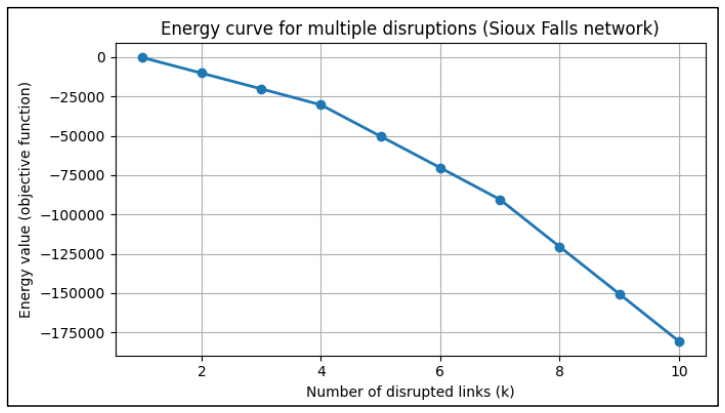
Transport network vulnerability analysis plays a crucial role in safeguarding urban resilience. Traditional vulnerability identification approaches have provided valuable insights, yet they face two major limitations. First, the number of disruption scenarios increases combinatorially with the number of disrupted links considered simultaneously, making classical approaches computationally prohibitive. Second, most studies approximate the impacts of multiple simultaneous link failures through linear aggregation, which fails to capture the nonlinear interaction effects observed in real networks. To address these gaps, we reformulate the bi-level Mixed-Integer Nonlinear Programming (MINLP) model into a quantum-compatible Quadratic Unconstrained Binary Optimisation (QUBO) structure, enabling parallel exploration of complex disruption scenarios while incorporating nonlinear interaction effects. We develop a hybrid optimisation framework that integrates the quantum optimisation algorithm with the Frank-Wolfe method to validate the model's effectiveness on the small-scale network. Then, we further verify the framework through the D-Wave hardware across benchmark networks of different scales, including Sioux Falls, Anaheim, Chicago Sketch, and Berlin Full, to examine scalability and feasibility. The results show that this framework achieves strong solvability and stability. In particular, optimisation for large and larger networks is completed within minutes (Approximately 2.8 minutes for the 914-link, 9.8 minutes for the 2950-link, and 31.2 minutes for the 6018-link on D-Wave), demonstrating a computational efficiency improvement by one to two orders of magnitude compared with classical metaheuristic algorithms. These findings highlight the feasibility and potential of applying quantum computing to network vulnerability identification and open a new avenue for resilience-oriented planning.
Editorial analysis
A structured set of objections, weighed in public.
Referee Report
Summary. The paper claims to reformulate a bi-level MINLP model for transport network vulnerability identification—capturing nonlinear interaction effects of simultaneous link failures—into an equivalent QUBO form. It develops a hybrid quantum-classical framework (integrating quantum optimization with the Frank-Wolfe method) and demonstrates it on D-Wave hardware for benchmark networks (Sioux Falls, Anaheim, Chicago Sketch, Berlin Full), reporting runtimes of minutes (e.g., 2.8 min for 914 links, 9.8 min for 2950 links, 31.2 min for 6018 links) and 1–2 orders of magnitude speedup over classical metaheuristics.
Significance. If the QUBO reformulation is shown to be faithful to the original MINLP, the work would provide a concrete demonstration of quantum annealing applied to a combinatorially hard network resilience problem, enabling analysis of larger disruption scenarios than classical methods allow. The explicit hardware runtimes and hybrid validation on real benchmarks constitute a practical contribution to quantum optimization in transportation.
major comments (2)
- [QUBO reformulation and hybrid framework sections] The central claim that the bi-level MINLP is reformulated into an equivalent QUBO without material error from penalty terms or embedding is not supported by any side-by-side comparison of optimal link sets or objective values against an exact classical MINLP solver on small instances (e.g., Sioux Falls) that both methods can solve to optimality. This verification is required to confirm that nonlinear interaction effects are preserved.
- [Numerical experiments and results] Section reporting D-Wave results (including the 2.8 min / 9.8 min / 31.2 min runtimes) provides no quantitative error analysis (e.g., objective-value gap or Hamming distance between quantum and classical solutions) or details on penalty-coefficient selection and minor-embedding overhead, leaving the accuracy of the reported speedups unverified.
minor comments (2)
- [Model formulation] Notation for the upper- and lower-level variables and the penalty terms in the QUBO should be introduced with explicit definitions and cross-references to the original MINLP constraints.
- [Abstract and results] The abstract and results text should clarify which networks correspond to the cited link counts (914, 2950, 6018) and whether the reported times include embedding or only annealing.
Simulated Author's Rebuttal
We thank the referee for the constructive comments, which identify key areas where additional validation will strengthen the manuscript. We address each major comment below and will incorporate the suggested revisions to improve the rigor of the QUBO equivalence claims and experimental reporting.
read point-by-point responses
-
Referee: [QUBO reformulation and hybrid framework sections] The central claim that the bi-level MINLP is reformulated into an equivalent QUBO without material error from penalty terms or embedding is not supported by any side-by-side comparison of optimal link sets or objective values against an exact classical MINLP solver on small instances (e.g., Sioux Falls) that both methods can solve to optimality. This verification is required to confirm that nonlinear interaction effects are preserved.
Authors: We agree that a direct side-by-side comparison with an exact classical MINLP solver on small instances such as Sioux Falls is necessary to rigorously confirm equivalence and preservation of nonlinear effects. The manuscript validates the hybrid quantum-Frank-Wolfe framework on small networks but does not include exact MINLP solver comparisons. In the revised version, we will add this analysis for Sioux Falls, reporting optimal link sets, objective values, and any discrepancies between the original MINLP (solved to optimality) and the QUBO formulation. revision: yes
-
Referee: [Numerical experiments and results] Section reporting D-Wave results (including the 2.8 min / 9.8 min / 31.2 min runtimes) provides no quantitative error analysis (e.g., objective-value gap or Hamming distance between quantum and classical solutions) or details on penalty-coefficient selection and minor-embedding overhead, leaving the accuracy of the reported speedups unverified.
Authors: We acknowledge that quantitative error metrics and implementation details are required to verify the accuracy of the D-Wave results and speedups. The current manuscript reports runtimes and overall comparisons but omits error analysis and specifics on penalties and embedding. We will revise the numerical experiments section to include objective-value gaps, Hamming distances where relevant, penalty-coefficient selection methodology, and minor-embedding overhead details for the benchmark networks. revision: yes
Circularity Check
No significant circularity; reformulation and external benchmarks are independent
full rationale
The paper presents a mathematical reformulation of a bi-level MINLP model into QUBO form, followed by hybrid validation on small networks and D-Wave runs on standard benchmark networks (Sioux Falls, Anaheim, etc.). Runtimes are compared directly to external classical metaheuristic algorithms, with no fitted parameters, self-definitional loops, or load-bearing self-citations that reduce the claimed speedup or equivalence to a tautology by construction. The derivation chain remains self-contained against external benchmarks.
Axiom & Free-Parameter Ledger
axioms (1)
- domain assumption The bi-level MINLP for vulnerability identification admits an exact or sufficiently accurate QUBO encoding that preserves nonlinear interaction effects.
Reference graph
Works this paper leans on
-
[1]
Bilevel optimization with sustainability perspective: A survey on applications
Bilevel optimization with sustainability perspective: a survey on applications. arXiv preprint arXiv:2406.07184. Chen, A., Yang, C., Kongsomsaksakul, S. & Lee, M
work page internal anchor Pith review Pith/arXiv arXiv
-
[2]
arXiv preprint arXiv:1811.11538
A tutorial on formulating and using QUBO models. arXiv preprint arXiv:1811.11538. Glover, F., Kochenberger, G., Hennig, R. and Du, Y.,
-
[3]
Journal of Advanced Transportation, 2021, 5513311
Analysing the vulnerability of public transport networks. Journal of Advanced Transportation, 2021, 5513311. Nitheesh, K. & Bhavathrathan, B
work page 2021
-
[4]
Transportmetrica A: Transport Science, 1-31
Disaster -resilient transport network design considering risk -averse evacuation traffic demand. Transportmetrica A: Transport Science, 1-31. Niu, C., Irannezhad, E., Myers, C. & Dixit, V. 2025a. Quantum Computing in Transport Science: A Review. arXiv preprint arXiv:2503.21302. Niu, C., Rastogi, P., Soman, J., Tamuli, K. & Dixit, V. 2025b. Applying Quantu...
-
[5]
Larger networks Extend to Sioux Falls and other bigger benchmark networks, assess scalability. Research Outputs BackgroundQuestionContent In this research In this research In this research Figure A. Overall research technical approach framework diagram. Page 34 of 46 Appendix B: Steps and pseudocode for executing a hybrid optimisation algorithm Hybrid qua...
discussion (0)
Sign in with ORCID, Apple, or X to comment. Anyone can read and Pith papers without signing in.