Engineering Electrochromism in Ni-Deficient NiO through Defect, Dopant, and Strain Coupling
Pith reviewed 2026-05-13 18:14 UTC · model grok-4.3
The pith
Dopants can reverse the electrochromic response in Ni-deficient NiO by trapping injected electrons at the dopant site.
A machine-rendered reading of the paper's core claim, the machinery that carries it, and where it could break.
Core claim
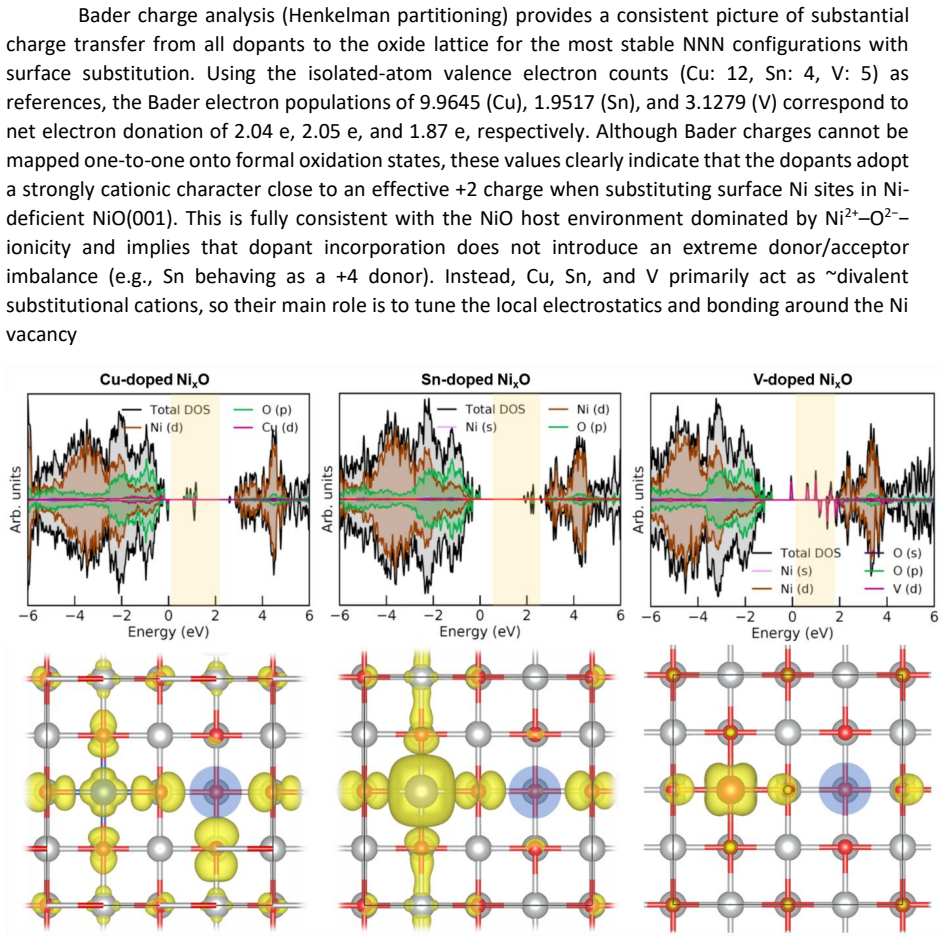
The electrochromic response of Ni-deficient NiO is governed by vacancy-mediated electronic processes that can be strongly influenced by dopant chemistry and lattice deformation. Li insertion proceeds as nearly complete ionic electron donation, but V-doping preserves framework-dominated charge compensation and leads to conventional bleaching through filling of vacancy-associated hole states. In contrast, Sn actively traps the injected charge, generating dopant-assisted optical transitions and reversing the electrochromic response, while Cu produces an intermediate spectral redistribution without significant dopant reduction. Substitution of Li by Na or K in the V-doped system does not alter t
What carries the argument
Dopant identity controlling the fate of the electron donated by alkali insertion at surface nickel vacancies, either filling vacancy hole states or enabling dopant-assisted optical transitions.
If this is right
- V-doping maintains conventional bleaching by filling vacancy hole states.
- Sn-doping traps injected charge to produce reversed electrochromic response through new dopant-assisted transitions.
- Cu-doping yields intermediate spectral redistribution without strong dopant reduction.
- Na or K insertion follows the same vacancy-filling mechanism as Li in V-doped material.
- Biaxial tensile strain improves insertion energetics but reduces optical contrast by altering defect electronic structure.
Where Pith is reading between the lines
- Sn doping paired with controlled strain could enable devices with inverted or tunable switching for targeted electrochromic applications.
- Thin-film deposition methods that naturally introduce surface strain and vacancies may amplify the dopant effects observed here.
- The charge-trapping distinction among dopants could guide similar engineering in other transition-metal oxides used for electrochromic or battery electrodes.
- Selecting dopants by their tendency to localize injected charge offers a route to predict and design electrochromic behavior without extensive trial synthesis.
Load-bearing premise
The density functional theory electronic structures and optical transitions accurately describe the real defect states and charge compensation when alkali ions insert at the NiO surface.
What would settle it
Direct measurement of optical absorption spectra during lithium insertion into tin-doped versus vanadium-doped Ni-deficient NiO thin films to check whether the tin case shows inverted spectral changes.
Figures


read the original abstract
The electrochromic response of Ni-deficient NiO is governed by vacancy-mediated electronic processes that can be strongly influenced by dopant chemistry and lattice deformation. Using density functional theory, we systematically investigated Cu-, Sn-, and V-doped Ni-deficient NiO(001) surfaces and examined alkali-ion insertion at surface Ni vacancies. Li insertion proceeds as nearly complete ionic electron donation (~+0.9 e), but the fate of the injected electron depends on dopant identity. V-doping preserves framework-dominated charge compensation and leads to conventional bleaching through filling of vacancy-associated hole states. In contrast, Sn actively traps the injected charge, generating dopant-assisted optical transitions and reversing the electrochromic response, while Cu produces an intermediate spectral redistribution without significant dopant reduction. Substitution of Li by Na or K in the V-doped system does not alter the switching mechanism, confirming that vacancy-state filling governs the optical behavior. Biaxial tensile strain enhances the energetics of Li insertion but reduces optical contrast by altering the defect electronic structure. These results establish dopant activity, vacancy stabilization, and lattice strain as key parameters controlling electrochromism in NiO-based materials.
Editorial analysis
A structured set of objections, weighed in public.
Referee Report
Summary. The manuscript uses density functional theory to examine Ni-deficient NiO(001) surfaces doped with Cu, Sn, or V, focusing on alkali-ion (Li, Na, K) insertion at surface vacancies. It reports that V-doping preserves vacancy-hole filling for conventional bleaching, Sn-doping traps injected charge to reverse the electrochromic response, Cu yields intermediate spectral redistribution, and biaxial tensile strain enhances insertion energetics while reducing optical contrast. Dopant activity, vacancy stabilization, and strain are identified as controlling parameters.
Significance. If the DFT-derived charge-fate distinctions and optical trends hold, the work provides a systematic framework for tuning electrochromism in NiO via defect-dopant-strain coupling, with potential to guide synthesis of improved electrochromic films. The explicit comparison of three dopants and the demonstration of response reversal constitute clear strengths, though the absence of computed spectra or experimental benchmarks limits immediate impact.
major comments (3)
- [Computational Methods] Computational Methods: Standard DFT+U is applied to NiO, a strongly correlated Mott insulator; the choice of U values and lack of comparison to hybrid functionals or GW calculations risks misplacement of vacancy and dopant defect levels, directly undermining the predicted Sn-induced reversal and strain-induced contrast reduction.
- [Results] Results, optical transitions subsection: Claims of bleaching, reversal, and spectral redistribution rest on electronic density-of-states and charge-density analysis without explicit computation of dielectric functions, absorption spectra, or transition matrix elements; this leaves the connection between charge compensation and observable electrochromic contrast indirect.
- [Strain Effects] Strain section: Biaxial tensile strain is reported to reduce optical contrast by altering defect electronic structure, yet no quantitative shifts in transition energies or explicit comparison of strained vs. unstrained density of states are provided to support the magnitude of the effect.
minor comments (2)
- [Abstract] Abstract: The Bader charge value of ~+0.9 e for Li insertion should reference the specific table or figure containing the full charge analysis for all dopants.
- [Figures] Figure captions: Ensure consistent labeling of supercell sizes, dopant substitution sites, and strain percentages across all panels to improve clarity.
Simulated Author's Rebuttal
We thank the referee for the insightful comments on our manuscript. We address each major comment point by point below, indicating where revisions will be made to improve the work.
read point-by-point responses
-
Referee: [Computational Methods] Standard DFT+U is applied to NiO, a strongly correlated Mott insulator; the choice of U values and lack of comparison to hybrid functionals or GW calculations risks misplacement of vacancy and dopant defect levels, directly undermining the predicted Sn-induced reversal and strain-induced contrast reduction.
Authors: We agree that the choice of U in DFT+U calculations for NiO requires careful justification due to the material's strongly correlated nature. Our calculations used U = 6.3 eV for Ni, a value widely adopted in the literature to match the experimental bandgap of NiO. While we recognize that hybrid functionals or GW approximations could offer more accurate defect level positions, performing such calculations for the large supercell models of doped surfaces with alkali insertions is computationally intensive and beyond the scope of the current study. In the revised manuscript, we will expand the Computational Methods section to include a detailed justification of the U value, reference to its validation in prior works on NiO, and a note on the robustness of the observed trends (such as Sn-induced reversal) to small variations in U. This addresses the concern without altering the core findings. revision: partial
-
Referee: [Results] Results, optical transitions subsection: Claims of bleaching, reversal, and spectral redistribution rest on electronic density-of-states and charge-density analysis without explicit computation of dielectric functions, absorption spectra, or transition matrix elements; this leaves the connection between charge compensation and observable electrochromic contrast indirect.
Authors: The referee is correct that our conclusions on electrochromic behavior are based on analysis of the electronic density of states and charge density distributions rather than direct computation of optical spectra. Explicit calculation of the dielectric function would provide a more direct link to experimental observables but requires significant additional computational effort, including the use of denser k-grids and potentially more advanced methods. We believe the charge compensation mechanisms we identify—vacancy hole filling for bleaching versus dopant trapping for reversal—provide a solid foundation for interpreting the optical response, consistent with established interpretations in the electrochromism literature. In the revision, we will add a paragraph in the Results section explicitly connecting the DOS changes to expected shifts in absorption, including schematic illustrations of the optical transitions. This will make the connection less indirect while maintaining the focus of the study. revision: partial
-
Referee: [Strain Effects] Strain section: Biaxial tensile strain is reported to reduce optical contrast by altering defect electronic structure, yet no quantitative shifts in transition energies or explicit comparison of strained vs. unstrained density of states are provided to support the magnitude of the effect.
Authors: We acknowledge that the strain section would benefit from more quantitative support. In the revised manuscript, we will include side-by-side comparisons of the density of states for the unstrained and strained systems, with annotations highlighting the shifts in the positions of vacancy-associated states and dopant levels. This will allow readers to see the quantitative changes in electronic structure that lead to the reported reduction in optical contrast. We will also report the specific shifts in relevant energy levels to better quantify the effect. revision: yes
Circularity Check
No significant circularity: direct DFT computations of defect states and optical transitions
full rationale
The paper's central results derive from standard DFT total-energy minimizations, Bader charge analysis, and electronic-structure calculations on doped NiO(001) surfaces with alkali insertion. No equations reduce a computed quantity to a fitted parameter defined inside the work, no self-citation chain supplies a uniqueness theorem or ansatz that is then treated as external, and no optical contrast or charge-compensation outcome is obtained by renaming or re-fitting prior data. The derivation chain is therefore self-contained against the external benchmark of the chosen DFT functional and surface model; any concerns about accuracy (e.g., Mott-insulator limitations) belong to correctness risk rather than circularity.
Axiom & Free-Parameter Ledger
axioms (1)
- domain assumption DFT with chosen functional and pseudopotentials yields reliable relative energies and charge distributions for NiO surface defects and dopants
Reference graph
Works this paper leans on
-
[1]
1 G. A. Niklasson and C. G. Granqvist, Electrochromics for smart windows: Thin films of tungsten oxide and nickel oxide, and devices based on these, J. Mater. Chem., 2007, 17, 127–
work page 2007
-
[2]
2 F. Zhao, T. Chen, Y. Zeng, J. Chen, J. Zheng, Y. Liu and G. Han, Nickel oxide electrochromic films: mechanisms, preparation methods, and modification strategies–a review, J. Mater. Chem. C Mater., 2024, 12, 7126–7145. 3 G. Boschloo and A. Hagfeldt, Spectroelectrochemistry of Nanostructured NiO, Journal of Physical Chemistry B, 2001, 105, 3039–3044. 4 G....
work page 2024
-
[3]
12 L. Zhang, C. Pan, H. Zeng, K. Han and Y. Gao, Amorphous and porous C/N-doped NiO for electrochromic smart windows applications, Opt. Mater. (Amst)., 2025, 167, 117338. 13 I. Naskar, S. Roy, P. Ghosal and M. Deepa, Long-Lasting Panchromatic Electrochromic Device and Energy-Dense Supercapacitor Based on Zn-Doped NiO Microstars and a Redox-Active Gel, ACS...
work page 2025
discussion (0)
Sign in with ORCID, Apple, or X to comment. Anyone can read and Pith papers without signing in.