Recognition: 2 theorem links
· Lean TheoremHow pore-scale disorder controls fluid stretching in porous media
Pith reviewed 2026-05-13 18:17 UTC · model grok-4.3
The pith
Pore-scale disorder makes fluid stretching grow quadratically with time in porous media.
A machine-rendered reading of the paper's core claim, the machinery that carries it, and where it could break.
Core claim
Fluid stretching is strongly localized near solid boundaries. The mean stretching grows linearly in time for ordered media and quadratically for disordered media, while the stretching distributions are approximately log-normal. An analytical description of the stretching produced by flow around an isolated cylinder, embedded in a random-walk model, reproduces the observed stretching statistics in random media.
What carries the argument
Analytical description of stretching around an isolated cylinder, embedded in a random-walk model of particle paths through the medium.
If this is right
- Disordered media accelerate mixing of reactants, contaminants, or nutrients relative to ordered media.
- Stretching distributions remain approximately log-normal for both ordered and disordered arrangements.
- The results supply a quantitative connection between porous-medium structure and fluid-stretching statistics.
- The approach moves beyond the common mean-field description of stretching in two-dimensional media as simple shear flow.
Where Pith is reading between the lines
- Natural geological media, which are typically disordered, may produce substantially faster mixing than laboratory ordered-pack models predict.
- Because stretching localizes at solid surfaces, the chemical or roughness properties of the grains could exert stronger control on overall mixing rates than bulk permeability does.
- The random-walk construction could be tested by applying it to non-cylindrical grain shapes or to three-dimensional pore networks.
Load-bearing premise
Near-wall flow around individual cylinders dominates stretching statistics, so a random-walk model built only from isolated-cylinder analytics captures the full statistics without explicit multi-cylinder interactions.
What would settle it
A measurement in a controlled disordered medium that shows linear rather than quadratic mean stretching growth, or a direct comparison showing the random-walk model deviates systematically once cylinder interactions are included in the flow field.
Figures



read the original abstract
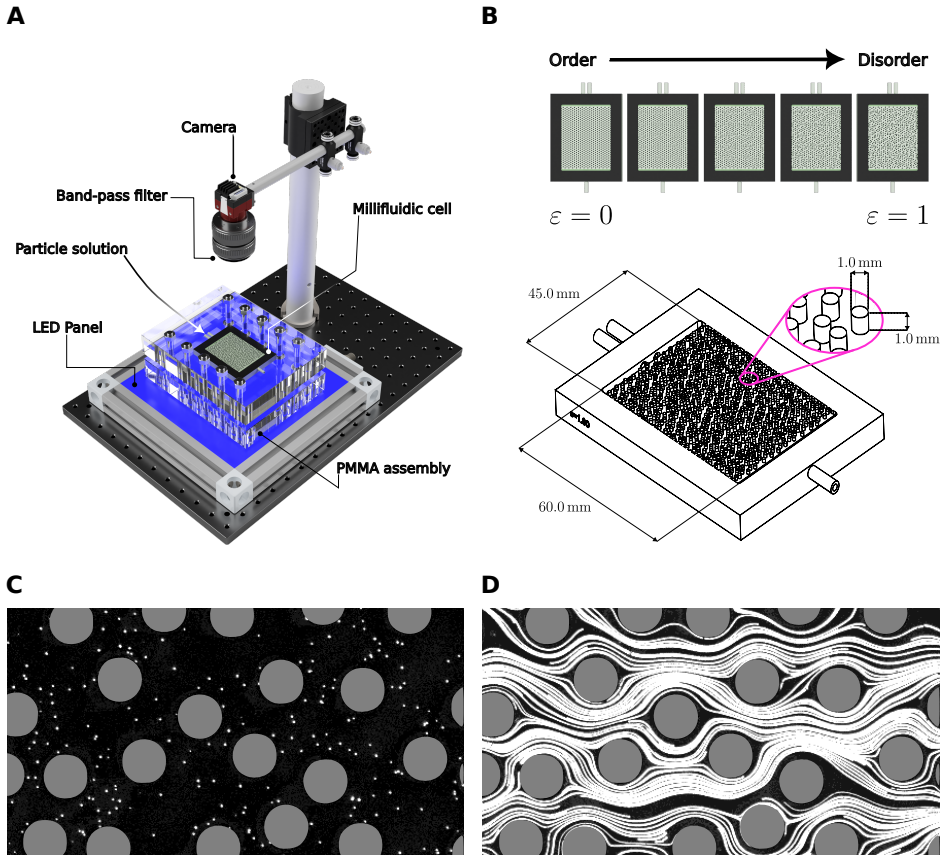
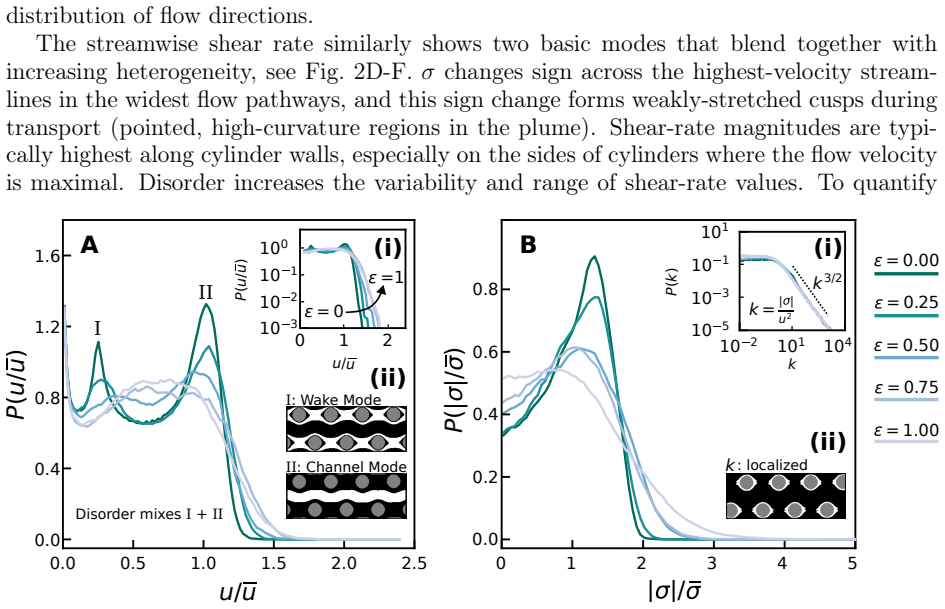
Fluid stretching in porous media governs the mixing of reactants, contaminants, and nutrients, yet how the solid microstructure controls the stretching statistics remains poorly understood. We investigate how porous-medium heterogeneity controls stretching using (i) particle-tracking velocimetry experiments in 3D-printed millifluidic cells, (ii) numerical simulations of solute-plume deformation in the measured flow fields, and (iii) analytical calculations of fluid stretching. The cells contain arrays of cylindrical rods with systematically-varying disorder levels, from ordered to random. Velocity and shear-rate measurements reveal that fluid deformation is strongly localized near solid boundaries for all disorder levels, suggesting that near-wall flow is the main driver of stretching. The mean stretching grows linearly in time for ordered media and quadratically for disordered media, while the stretching distributions are approximately log-normal. We analytically describe the stretching produced by flow around an isolated cylinder and embed this description in a random-walk model that reproduces the observed stretching statistics in random media. These results provide the first quantitative connection between porous-medium structure and fluid-stretching statistics, revealing the extent to which disordered media accelerate mixing relative to ordered media and enabling progress beyond the common mean-field description of stretching in two-dimensional media as a simple shear flow.
Editorial analysis
A structured set of objections, weighed in public.
Referee Report
Summary. The manuscript investigates how pore-scale disorder controls fluid stretching in porous media using particle-tracking velocimetry experiments in 3D-printed millifluidic cells containing cylindrical rod arrays with varying disorder levels, numerical simulations of solute-plume deformation, and analytical calculations. It reports that deformation is localized near solid boundaries for all disorder levels, with mean stretching growing linearly in time for ordered media and quadratically for disordered media, and stretching distributions approximately log-normal. An analytical description of stretching around an isolated cylinder is embedded in a random-walk model that reproduces the observed statistics in random media, providing a quantitative link between microstructure and stretching beyond mean-field shear-flow descriptions.
Significance. If the central results hold, the work establishes the first quantitative connection between porous-medium disorder and fluid-stretching statistics, showing that disordered media accelerate mixing relative to ordered ones. The combination of experiments, simulations, and an analytical random-walk model is a strength, offering a concrete alternative to mean-field models and enabling better predictions of mixing in heterogeneous porous media.
major comments (2)
- [random-walk model description] The random-walk model (described after the isolated-cylinder analytics) assumes statistically independent stretching increments dominated by near-wall shear around isolated cylinders. In finite-porosity random arrays this neglects hydrodynamic interactions from neighboring no-slip boundaries, which can modify local strain rates and introduce correlations. The manuscript reports that the model reproduces observed statistics but does not quantify the interaction strength via two-body or full-array comparisons; such a test is needed to confirm that the quadratic scaling and log-normal form are not artifacts of the approximation.
- [results on mean stretching growth] The central claim of quadratic mean-stretching growth in disordered media rests on the random-walk embedding of the isolated-cylinder solution. If multi-cylinder perturbations alter the tail of the stretching-rate distribution (as suggested by the skeptic note), the predicted scaling would change. A direct comparison of stretching increments extracted from full-array simulations versus the isolated-cylinder analytics should be added to bound the error.
minor comments (2)
- [abstract] The abstract states that velocity and shear-rate measurements reveal near-wall localization but does not specify the quantitative threshold or distance used to define 'near-wall' regions; this should be clarified for reproducibility.
- [figures] Figure captions for stretching statistics should explicitly state error-bar definitions, number of trajectories, and any data-selection criteria, consistent with the reader's note on verification needs.
Simulated Author's Rebuttal
We thank the referee for the careful reading of our manuscript and the constructive comments. We address each major point below and have revised the manuscript to incorporate the suggested comparisons, which strengthen the presentation of the random-walk model and the quadratic scaling result.
read point-by-point responses
-
Referee: The random-walk model (described after the isolated-cylinder analytics) assumes statistically independent stretching increments dominated by near-wall shear around isolated cylinders. In finite-porosity random arrays this neglects hydrodynamic interactions from neighboring no-slip boundaries, which can modify local strain rates and introduce correlations. The manuscript reports that the model reproduces observed statistics but does not quantify the interaction strength via two-body or full-array comparisons; such a test is needed to confirm that the quadratic scaling and log-normal form are not artifacts of the approximation.
Authors: We agree that the random-walk model is an approximation that neglects hydrodynamic interactions between cylinders. However, the model was constructed precisely because the full-array simulations and experiments show that stretching is strongly localized near solid boundaries for all disorder levels, making the isolated-cylinder contribution the dominant effect. The close quantitative match between model predictions and both experimental particle-tracking data and full numerical simulations of the disordered arrays already provides indirect validation. To directly quantify the approximation error as requested, we have added a new comparison (now Figure 5c) of the probability density functions of stretching increments extracted from the full-array flow fields versus those predicted by the isolated-cylinder analytics. The distributions agree closely over the central range and most of the tails, with only small deviations at the extreme tails that do not change the quadratic scaling of the mean or the log-normal form. We have updated the text in Section 4 to discuss this comparison and the resulting bounds on interaction effects. revision: yes
-
Referee: The central claim of quadratic mean-stretching growth in disordered media rests on the random-walk embedding of the isolated-cylinder solution. If multi-cylinder perturbations alter the tail of the stretching-rate distribution (as suggested by the skeptic note), the predicted scaling would change. A direct comparison of stretching increments extracted from full-array simulations versus the isolated-cylinder analytics should be added to bound the error.
Authors: We concur that an explicit error bound on the stretching increments is useful for supporting the central claim. The comparison we have added (Figure 5c and accompanying text) directly addresses this by showing that the stretching-rate distribution from the full-array simulations is statistically indistinguishable from the isolated-cylinder prediction for the relevant strain rates. Consequently, the quadratic growth of the mean stretching and the log-normal character of the distributions are preserved, with the relative error in the mean stretching rate remaining below approximately 8% across the porosities examined. This addition confirms that multi-cylinder perturbations do not alter the scaling in the regimes studied. revision: yes
Circularity Check
Derivation chain is self-contained; isolated-cylinder analytics provide independent input to random-walk model
full rationale
The paper derives an analytical description of stretching from the known flow field around an isolated cylinder (first-principles Navier-Stokes solution in the near-wall region) and inserts it into a random-walk construction whose step statistics are taken directly from that analytics. The resulting quadratic scaling and log-normal form for disordered media are outputs of the model, not inputs; the model is then compared to independent experimental and simulation data. No equation reduces to its own target by construction, no fitted parameter is relabeled as a prediction, and no load-bearing step relies on a self-citation whose content is itself unverified. The central claim therefore rests on external validation rather than tautology.
Axiom & Free-Parameter Ledger
axioms (1)
- domain assumption Flow around an isolated cylinder admits an analytical description of local stretching that can be embedded in a random-walk model
Lean theorems connected to this paper
-
IndisputableMonolith/Cost/FunctionalEquation.leanwashburn_uniqueness_aczel unclear?
unclearRelation between the paper passage and the cited Recognition theorem.
We analytically describe the stretching produced by flow around an isolated cylinder and embed this description in a random-walk model
-
IndisputableMonolith/Foundation/RealityFromDistinction.leanreality_from_one_distinction unclear?
unclearRelation between the paper passage and the cited Recognition theorem.
mean stretching grows linearly in time for ordered media and quadratically for disordered media
What do these tags mean?
- matches
- The paper's claim is directly supported by a theorem in the formal canon.
- supports
- The theorem supports part of the paper's argument, but the paper may add assumptions or extra steps.
- extends
- The paper goes beyond the formal theorem; the theorem is a base layer rather than the whole result.
- uses
- The paper appears to rely on the theorem as machinery.
- contradicts
- The paper's claim conflicts with a theorem or certificate in the canon.
- unclear
- Pith found a possible connection, but the passage is too broad, indirect, or ambiguous to say the theorem truly supports the claim.
Reference graph
Works this paper leans on
-
[1]
Brinkman approximation and trajectories in the inner region To describe the single-cylinder stretching analytically, we note the Brinkman flow field has bothinnerandouterregions: thereisaStokes-likeinnerregionwhereshearissignificant, and there is a Darcy-like outer region where shear can be neglected [58]. We non-dimensionalize the flow field with the cyl...
-
[2]
Elongation through an inner-region transit Wedescribeamateriallineintheinnerregionasacollectionoflamellaeatinitiallocations (δ0, ηθ0)indexed byη∈[−1,1]. The line has initial lengthℓ 0 =aθ 0, whereθ 0 ≪1, and the stretching vectorsz(t|η)are conditional onη. Each lamella hasz ∥(0|η) = 0and z⊥(0|η) =δℓ 0. Here and in the following equations, the units have b...
-
[3]
For incomplete transits, we setRO =δ(ρ)e −λt andR I(ρ, t) = [(τ /t)2I(t≥τ) +I(t < τ)]δ(ρ−ρ ∗(t/τ) 3), meaning deformation accumulates exactly when lamellae exit the inner layer. The probability fluxesjI(ρ, t)andj O(ρ, t)between states obey the renewal equations [60, 62, 87]: jO(ρ, t) =δ(ρ−1)δ(t) + Z ρ 0 dρ′ Z t 0 dt′jI(ρ′, t′)RI(ρ−ρ ′, t−t ′) jI(ρ, t) = Z...
-
[4]
P. K. Kitanidis and P. L. McCarty, eds.,Delivery and Mixing in the Subsurface, SERDP/ESTCP Environmental Remediation Technology, Vol. 4 (Springer, New York, NY, 2012)
work page 2012
-
[5]
A. J. Valocchi, D. Bolster, and C. J. Werth, Mixing-limited reactions in porous media, Trans- port in Porous Media130, 157 (2019)
work page 2019
-
[6]
M.RolleandT.LeBorgne,Mixingandreactivefrontsinthesubsurface,ReviewsinMineralogy and Geochemistry85, 111 (2019)
work page 2019
- [7]
-
[8]
R. Turuban, G. Noselli, A. Beran, and A. DeSimone, Cooperative mixing through hydrody- namic interactions in Stylonychia Lemnae, Proceedings of the National Academy of Sciences 122, e2500588122 (2025)
work page 2025
-
[9]
M. L. Szulczewski, C. W. MacMinn, H. J. Herzog, and R. Juanes, Lifetime of carbon capture and storage as a climate-change mitigation technology, Proceedings of the National Academy of Sciences109, 5185 (2012)
work page 2012
-
[10]
S. Ó. Snæbjörnsdóttir, B. Sigfússon, C. Marieni, D. Goldberg, S. R. Gislason, and E. H. Oelkers, Carbon dioxide storage through mineral carbonation, Nature Reviews Earth & Envi- ronment1, 90 (2020)
work page 2020
-
[11]
J. M. Ottino,The Kinematics of Mixing: Stretching, Chaos, and Transport, 1st ed., Cambridge Texts in Applied Mathematics (Cambridge Univ. Pr, Cambridge, 2004)
work page 2004
-
[12]
Villermaux, Mixing versus stirring, Annual Review of Fluid Mechanics51, 245 (2019)
E. Villermaux, Mixing versus stirring, Annual Review of Fluid Mechanics51, 245 (2019)
work page 2019
-
[13]
T. Le Borgne, M. Dentz, and E. Villermaux, The lamellar description of mixing in porous media, Journal of Fluid Mechanics770, 458 (2015)
work page 2015
- [14]
-
[15]
W. E. Ranz, Applications of a stretch model to mixing, diffusion, and reaction in laminar and turbulent flows, AIChE Journal25, 41 (1979)
work page 1979
-
[16]
J. M. Ottino, W. E. Ranz, and C. W. Macosko, A framework for description of mechanical mixing of fluids, AIChE Journal27, 565 (1981). 23
work page 1981
-
[17]
P. Meunier and E. Villermaux, How vortices mix, Journal of Fluid Mechanics476, 213 (2003)
work page 2003
-
[18]
P. E. Dimotakis and H. J. Catrakis, Turbulence, fractals, and mixing, inMixing: Chaos and Turbulence, edited by H. Chaté, E. Villermaux, and J.-M. Chomaz (Springer US, Boston, MA,
- [19]
-
[20]
J. M. Ottino, The mixing of fluids, Scientific American260, 56 (1989)
work page 1989
-
[21]
Hinch, Mixing: Turbulence and chaos - An introduction, inMixing: Chaos and Turbulence, edited by E
E. Hinch, Mixing: Turbulence and chaos - An introduction, inMixing: Chaos and Turbulence, edited by E. Villermaux and J.-M. Chomaz (Springer US, Boston, MA, 1999) pp. 37–58
work page 1999
- [22]
-
[23]
D. R. Lester, M. Dentz, T. L. Borgne, and F. P. J. de Barros, Fluid deformation in random steady three-dimensional flow, Journal of Fluid Mechanics855, 770 (2018)
work page 2018
-
[24]
P. D. Anna, J. Jimenez-Martinez, H. Tabuteau, R. Turuban, T. Le Borgne, M. Derrien, and Y. Méheust, Mixing and reaction kinetics in porous media: An experimental pore scale quan- tification, Environmental Science & Technology48, 508 (2014)
work page 2014
- [25]
- [26]
-
[27]
K. Alim, S. Parsa, D. A. Weitz, and M. P. Brenner, Local pore size correlations determine flow distributions in porous media, Physical Review Letters119, 144501 (2017)
work page 2017
-
[28]
I. Ben-Noah, J. J. Hidalgo, and M. Dentz, Pore network models to determine the flow statistics and structural controls for single-phase flow in partially saturated porous media, Advances in Water Resources193, 104809 (2024)
work page 2024
-
[29]
T. W. Willingham, C. J. Werth, and A. J. Valocchi, Evaluation of the effects of porous media structure on mixing-controlled reactions using pore-scale modeling and micromodel experi- ments, Environmental Science & Technology42, 3185 (2008)
work page 2008
- [30]
- [31]
-
[32]
O. Borgman, R. Turuban, B. Géraud, T. Le Borgne, and Y. Méheust, Solute front shear and coalescence control concentration gradient dynamics in porous micromodel, Geophysical Research Letters50, e2022GL101407 (2023)
work page 2023
-
[33]
P. Shafabakhsh, T. Le Borgne, F. Renard, and G. Linga, Resolving pore-scale concentration gradients for transverse mixing and reaction in porous media, Advances in Water Resources 192, 104791 (2024)
work page 2024
-
[34]
P. Shafabakhsh, B. Cordonnier, T. Le Borgne, J. Mathiesen, G. Linga, A. Pluymakers, A. Kaestner, A. Tengattini, and F. Renard, Coupling neutron and x-ray imaging of fluid mixing and precipitation in rocks: Challenges and opportunities, Water Resources Research 61, e2025WR041911 (2025)
work page 2025
-
[35]
T. Le Borgne and J. Heyman, Fluid deformation and mixing in porous media as drivers for chemical and biological processes, Annual Review of Fluid Mechanics58, 443 (2025). 24
work page 2025
-
[36]
J. Jiménez-Martínez, T. Le Borgne, H. Tabuteau, and Y. Méheust, Impact of saturation on dispersion and mixing in porous media: Photobleaching pulse injection experiments and shear- enhanced mixing model, Water Resources Research53, 1457 (2017)
work page 2017
- [37]
-
[38]
R. Turuban, D. R. Lester, T. Le Borgne, and Y. Méheust, Space-group symmetries generate chaotic fluid advection in crystalline granular media, Physical Review Letters120, 024501 (2018)
work page 2018
-
[39]
R. Turuban, D. R. Lester, J. Heyman, T. L. Borgne, and Y. Méheust, Chaotic mixing in crystalline granular media, Journal of Fluid Mechanics871, 562 (2019)
work page 2019
-
[40]
D. R. Lester, J. Heyman, Y. Méheust, and T. Le Borgne, A unified theory of pore-scale chaotic advection, Journal of Fluid Mechanics1017, A13 (2025)
work page 2025
-
[41]
R. H. Kraichnan, Convection of a passive scalar by a quasi-uniform random straining field, Journal of Fluid Mechanics64, 737 (1974)
work page 1974
-
[42]
I. T. Drummond and W. Münch, Turbulent stretching of line and surface elements, Journal of Fluid Mechanics215, 45 (1990)
work page 1990
- [43]
-
[44]
V. L. Morales, M. Dentz, M. Willmann, and M. Holzner, Stochastic dynamics of intermit- tent pore-scale particle motion in three-dimensional porous media: Experiments and theory, Geophysical Research Letters44, 9361 (2017)
work page 2017
- [45]
-
[46]
R. Lindken, M. Rossi, S. Große, and J. Westerweel, Micro-Particle Image Velocimetry (µPIV): Recent developments, applications, and guidelines, Lab on a Chip9, 2551 (2009)
work page 2009
-
[47]
C. J. Kähler, S. Scharnowski, and C. Cierpka, On the resolution limit of digital particle image velocimetry, Experiments in Fluids52, 1629 (2012)
work page 2012
-
[48]
J.Heyman,TracTrac: Afastmulti-objecttrackingalgorithmformotionestimation,Computers & Geosciences128, 11 (2019)
work page 2019
-
[49]
S. van der Walt, J. L. Schönberger, J. Nunez-Iglesias, F. Boulogne, J. D. Warner, N. Yager, E. Gouillart, and T. Yu, Scikit-image: Image processing in Python, PeerJ2, e453 (2014)
work page 2014
-
[50]
C. Wang, Q. Gao, R. Wei, T. Li, and J. Wang, Weighted divergence correction scheme and its fast implementation, Experiments in Fluids58, 44 (2017)
work page 2017
-
[51]
J. Gallego-Posada, J. Ramirez, M. Hashemizadeh, and S. Lacoste-Julien, Cooper: A library for constrained optimization in deep learning (2025), arXiv:2504.01212 [cs]
-
[52]
PyTorch: An Imperative Style, High-Performance Deep Learning Library
A. Paszke, S. Gross, F. Massa, A. Lerer, J. Bradbury, G. Chanan, T. Killeen, Z. Lin, N. Gimelshein, L. Antiga, A. Desmaison, A. Köpf, E. Yang, Z. DeVito, M. Raison, A. Te- jani, S. Chilamkurthy, B. Steiner, L. Fang, J. Bai, and S. Chintala, PyTorch: An imperative style, high-performance deep learning library (2019), arXiv:1912.01703 [cs]
work page internal anchor Pith review Pith/arXiv arXiv 2019
-
[53]
L. G. Leal,Advanced Transport Phenomena: Fluid Mechanics and Convective Transport Pro- cesses, Cambridge Series in Chemical Engineering (Cambridge University Press, Cambridge, 2007)
work page 2007
- [54]
-
[55]
W. J. Cocke, Turbulent hydrodynamic line stretching: Consequences of isotropy, The Physics of Fluids12, 2488 (1969)
work page 1969
-
[56]
Adachi, Calculation of strain histories in Protean coordinate systems, Rheologica Acta22, 326 (1983)
K. Adachi, Calculation of strain histories in Protean coordinate systems, Rheologica Acta22, 326 (1983)
work page 1983
-
[57]
Lester, Mixing of Gaussian solute plumes (2025), arXiv:2506.20387 [physics]
D. Lester, Mixing of Gaussian solute plumes (2025), arXiv:2506.20387 [physics]
-
[58]
H. H. Winter, Modelling of strain histories for memory integral fluids in steady axisymmetric flows, Journal of Non-Newtonian Fluid Mechanics10, 157 (1982)
work page 1982
-
[59]
P. Meunier and E. Villermaux, The diffusive strip method for scalar mixing in two dimensions, Journal of Fluid Mechanics662, 134 (2010)
work page 2010
-
[60]
N. J. Giordano,Computational Physics(Prentice Hall, Upper Saddle River, NJ, 2006)
work page 2006
- [61]
-
[62]
L. Jasinski and M. Dabrowski, The effective transmissivity of a plane-walled fracture with circular cylindrical obstacles, Journal of Geophysical Research: Solid Earth123, 242 (2018)
work page 2018
-
[63]
Weiss,Aspects and Applications of the Random Walk, Random Materials and Processes No
G. Weiss,Aspects and Applications of the Random Walk, Random Materials and Processes No. 1 (North-Holland, Amsterdam, 1994)
work page 1994
-
[64]
E. R. Weeks, J. Urbach, and H. L. Swinney, Anomalous diffusion in asymmetric random walks with a quasi-geostrophic flow example, Physica D: Nonlinear Phenomena97, 291 (1996)
work page 1996
-
[65]
V. Zaburdaev, S. Denisov, and J. Klafter, Lévy walks, Reviews of Modern Physics87, 483 (2015)
work page 2015
-
[66]
J.D.HymanandC.L.Winter,Stochasticgenerationofexplicitporestructuresbythresholding Gaussian random fields, Journal of Computational Physics277, 16 (2014)
work page 2014
-
[67]
B. Berkowitz and H. Scher, Anomalous Transport in Random Fracture Networks, Physical Review Letters79, 4038 (1997)
work page 1997
-
[68]
P. K. Kang, M. Dentz, T. Le Borgne, and R. Juanes, Anomalous transport on regular fracture networks: Impact of conductivity heterogeneity and mixing at fracture intersections, Physical Review E92, 022148 (2015)
work page 2015
-
[69]
P. De Anna, B. Quaife, G. Biros, and R. Juanes, Prediction of the low-velocity distribution from the pore structure in simple porous media, Physical Review Fluids2, 124103 (2017)
work page 2017
-
[70]
A. Cenedese and P. Viotti, Lagrangian analysis of nonreactive pollutant dispersion in porous media by means of the particle image velocimetry technique, Water Resources Research32, 2329 (1996)
work page 1996
-
[71]
A. Sederman and L. Gladden, Magnetic resonance visualisation of single- and two-phase flow in porous media, Magnetic Resonance Imaging19, 339 (2001)
work page 2001
-
[72]
A. Y. L. Huang, M. Y. F. Huang, H. Capart, and R.-H. Chen, Optical measurements of pore geometry and fluid velocity in a bed of irregularly packed spheres, Experiments in Fluids45, 309 (2008)
work page 2008
- [73]
-
[74]
G. K. Batchelor, The effect of homogeneous turbulence on material lines and surfaces, Pro- ceedings of the Royal Society of London. Series A. Mathematical and Physical Sciences213, 349 (1952)
work page 1952
-
[75]
D. V. Khakhar and J. M. Ottino, Fluid mixing (stretching) by time periodic sequences for weak flows, The Physics of Fluids29, 3503 (1986)
work page 1986
-
[76]
S. S. Girimaji and S. B. Pope, Material-element deformation in isotropic turbulence, Journal of Fluid Mechanics220, 427 (1990). 26
work page 1990
- [77]
-
[78]
P. E. Arratia and J. P. Gollub, Statistics of stretching fields in experimental fluid flows ex- hibiting chaotic advection, Journal of Statistical Physics121, 805 (2005)
work page 2005
-
[79]
N. Subramanian, L. H. Kellogg, and D. L. Turcotte, Statistics of advective stretching in three- dimensional incompressible flows, Journal of Statistical Physics136, 926 (2009)
work page 2009
- [80]
discussion (0)
Sign in with ORCID, Apple, or X to comment. Anyone can read and Pith papers without signing in.