Embedding transmission problems for Maxwell's equations into elliptic theory
Pith reviewed 2026-05-13 18:33 UTC · model grok-4.3
The pith
Maxwell's time-harmonic boundary value problems can be turned into elliptic ones by adding two scalar functions and extra boundary conditions.
A machine-rendered reading of the paper's core claim, the machinery that carries it, and where it could break.
Core claim
Introducing two new scalar functions to the electromagnetic field and imposing additional boundary conditions transforms general boundary value problems for the time-harmonic Maxwell equations into elliptic problems. For transmission problems and problems in bounded or unbounded domains, specific relations between the right-hand side inhomogeneities are established to guarantee that every solution of the elliptic problem corresponds uniquely to a solution of the Maxwell problem and vice versa.
What carries the argument
The augmented system formed by adding two scalar functions to the electromagnetic field together with extra boundary conditions, which makes the problem elliptic while preserving the original solutions through bijective mapping.
If this is right
- The method allows solving Maxwell transmission problems using standard elliptic theory tools.
- Relations between inhomogeneities ensure no loss or addition of solutions in the correspondence.
- Applicability extends to both bounded and unbounded domains without change in the embedding procedure.
- General boundary conditions for Maxwell can be handled by suitable choice of the added conditions.
Where Pith is reading between the lines
- This embedding may enable the use of elliptic regularity results to obtain higher smoothness for Maxwell solutions.
- Similar augmentations could potentially apply to other first-order systems like those in elasticity or acoustics.
- Computational implementations might benefit from elliptic solvers' efficiency for these transformed problems.
Load-bearing premise
It is possible to select the two scalar functions and the additional boundary conditions so that the resulting system is elliptic and the correspondence with Maxwell solutions is bijective without introducing spurious solutions.
What would settle it
A counterexample consisting of a specific Maxwell boundary value problem for which no such two scalars and conditions exist that produce an elliptic system with exact one-to-one solution correspondence would disprove the embedding.
Figures
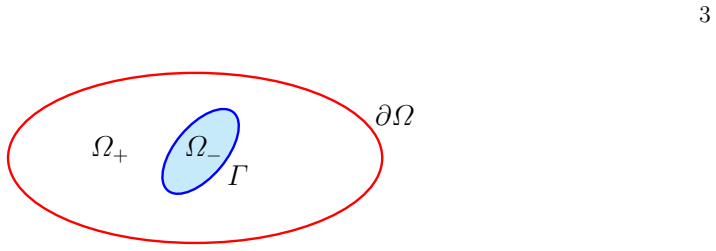
read the original abstract
We embed general boundary value problems for the time-harmonic Maxwell equations into the elliptic boundary value theory. This is achieved by introducing two new scalar functions to the electromagnetic field and imposing additional boundary conditions, after which the problem becomes elliptic. The results are applied to general problems for Maxwell's equations in bounded and unbounded domains, as well as to the transmission problem with inhomogeneities on the right-hand side of the equations and at all boundaries. Relations between the inhomogeneities of the elliptic problem are established that provide a one-to-one correspondence between the solutions of Maxwell's problem and the solutions of the elliptic boundary value problem.
Editorial analysis
A structured set of objections, weighed in public.
Referee Report
Summary. The manuscript proposes a method to embed general boundary value problems for the time-harmonic Maxwell equations—including transmission problems with inhomogeneities—into elliptic boundary-value theory. This is achieved by augmenting the electromagnetic field with two additional scalar functions, imposing extra boundary and interface conditions to restore ellipticity, and deriving explicit linear relations among the inhomogeneities of the augmented system that are asserted to yield a one-to-one correspondence between solutions of the original Maxwell problem and the elliptic problem. The construction is applied to bounded and unbounded domains as well as transmission settings.
Significance. If the claimed bijective embedding holds with the stated relations, the work would allow direct transfer of standard elliptic regularity, Fredholm theory, and index results to Maxwell transmission problems, which is potentially useful for analysis in inhomogeneous media. The constructive augmentation and explicit inhomogeneity relations are concrete strengths that could facilitate numerical and analytical applications, provided the correspondence excludes spurious solutions.
major comments (1)
- [Transmission problem section] Transmission-problem section: the linear relations imposed on the inhomogeneities are stated to guarantee bijectivity and absence of spurious solutions from the added scalars, yet the argument that these relations simultaneously enforce the correct jump conditions, divergence-free constraints, and preservation of the Fredholm index of the original Maxwell operator is not independently verified for arbitrary coefficients and interface data; an explicit check that the augmented operator remains Fredholm with the same index is required.
minor comments (2)
- Clarify the precise functional spaces in which the two scalar functions are sought and state whether the augmentation preserves the original Maxwell divergence constraints pointwise or only in a weak sense.
- Add a brief remark on how the construction specializes when the transmission coefficients are constant, to illustrate the relations explicitly.
Simulated Author's Rebuttal
We appreciate the referee's detailed review and the suggestion to strengthen the verification of the embedding's properties for transmission problems. We address the major comment as follows.
read point-by-point responses
-
Referee: [Transmission problem section] Transmission-problem section: the linear relations imposed on the inhomogeneities are stated to guarantee bijectivity and absence of spurious solutions from the added scalars, yet the argument that these relations simultaneously enforce the correct jump conditions, divergence-free constraints, and preservation of the Fredholm index of the original Maxwell operator is not independently verified for arbitrary coefficients and interface data; an explicit check that the augmented operator remains Fredholm with the same index is required.
Authors: We thank the referee for this observation. The manuscript establishes the one-to-one correspondence between the solutions of the Maxwell transmission problem and the augmented elliptic problem in the transmission section by deriving the necessary linear relations on the inhomogeneities. This correspondence is shown to enforce the correct interface jump conditions through the additional boundary and interface conditions imposed on the scalar functions, and the divergence-free constraints are preserved by the specific choice of the augmentation. Since the correspondence is bijective, the Fredholm index is automatically preserved. Nevertheless, to address the request for an independent verification for arbitrary coefficients and data, we will include in the revised manuscript an explicit check demonstrating that the augmented operator is Fredholm with the same index as the original Maxwell operator. This will be achieved by relating the kernels and cokernels directly via the bijective map and verifying ellipticity of the principal symbol independently. revision: yes
Circularity Check
Direct constructive augmentation with no self-referential reductions
full rationale
The paper presents an explicit construction: two scalar functions are added to the electromagnetic fields together with extra boundary/interface conditions so that the resulting system is elliptic; linear relations among the inhomogeneities are then imposed to recover a one-to-one correspondence with the original Maxwell transmission problem. This chain is forward and self-contained; it applies standard elliptic boundary-value theory to the augmented operator and does not reduce any claimed result to a quantity defined by the result itself, nor does it rely on load-bearing self-citations or fitted inputs renamed as predictions. No quoted step equates the output to its own input by construction.
Axiom & Free-Parameter Ledger
axioms (1)
- standard math The domains are sufficiently smooth for elliptic regularity and boundary trace theorems to apply.
invented entities (1)
-
Two additional scalar functions added to the electromagnetic field
no independent evidence
Lean theorems connected to this paper
-
IndisputableMonolith/Foundation/AlexanderDuality.leanalexander_duality_circle_linking unclear?
unclearRelation between the paper passage and the cited Recognition theorem.
We embed general boundary value problems for the time-harmonic Maxwell equations into the elliptic boundary value theory. This is achieved by introducing two new scalar functions to the electromagnetic field and imposing additional boundary conditions, after which the problem becomes elliptic.
-
IndisputableMonolith/Cost/FunctionalEquation.leanwashburn_uniqueness_aczel unclear?
unclearRelation between the paper passage and the cited Recognition theorem.
Relations between the inhomogeneities of the elliptic problem are established that provide a one-to-one correspondence between the solutions of Maxwell’s problem and the solutions of the elliptic boundary value problem.
What do these tags mean?
- matches
- The paper's claim is directly supported by a theorem in the formal canon.
- supports
- The theorem supports part of the paper's argument, but the paper may add assumptions or extra steps.
- extends
- The paper goes beyond the formal theorem; the theorem is a base layer rather than the whole result.
- uses
- The paper appears to rely on the theorem as machinery.
- contradicts
- The paper's claim conflicts with a theorem or certificate in the canon.
- unclear
- Pith found a possible connection, but the passage is too broad, indirect, or ambiguous to say the theorem truly supports the claim.
Reference graph
Works this paper leans on
-
[1]
M¨ uller, Foundations of the mathematical theory of electromagnetic waves, Vol
C. M¨ uller, Foundations of the mathematical theory of electromagnetic waves, Vol. 155 of Die Grundlehren der mathematischen Wissenschaften, Springer-Verlag, New York-Heidelberg, 1969, revised and enlarged translation from the German
work page 1969
-
[2]
C. Weber, Regularity theorems for Maxwell’s equations, Mathematical Methods in the Ap- plied Sciences 3 (1) (1981) 523–536.doi:https://doi.org/10.1002/mma.1670030137
-
[3]
G. S. Alberti, Y. Capdeboscq, Elliptic regularity theory applied to time harmonic anisotropic Maxwell’s equations with less than Lipschitz complex coefficients, SIAM J. Math. Analysis 46 (1) (2014) 998–1016.doi:10.1137/130929539
-
[4]
G. S. Alberti, Holder regularity for Maxwell’s equations under minimal assumptions on the coefficients, Calculus of Variations and Partial Differential Equations 57 (3).doi:10.1007/ s00526-018-1358-2
- [5]
-
[6]
Picard, On a structural observation in electromagnetic theory, J
R. Picard, On a structural observation in electromagnetic theory, J. Math. Analysis Appl. 113 (1) (1986) 208–224.doi:10.1016/0022-247X(86)90273-3
-
[7]
Costabel, A coercive bilinear form for Maxwell’s equations, J
M. Costabel, A coercive bilinear form for Maxwell’s equations, J. Math. Anal. Appl. 157 (2) (1991) 527–541.doi:10.1016/0022-247X(91)90104-8
-
[8]
Weck, Maxwell’s boundary value problems on Riemannian manifolds with nonsmooth boundaries, J
N. Weck, Maxwell’s boundary value problems on Riemannian manifolds with nonsmooth boundaries, J. Math. Analysis Appl. 46 (1974) 410–437.doi:10.1016/0022-247X(89) 90229-2
-
[9]
M. S. Birman, M. Z. Solomyak, L 2-theory of the Maxwell operator in arbitrary domains, Rus- sian Mathematical Surveys 42 (6) (1987) 75–96.doi:10.1070/RM1987v042n06ABEH001505
-
[10]
M. S. Birman, M. Z. Solomyak, The selfadjoint Maxwell operator in arbitrary domains, Algebra i Analiz 1 (1) (1989) 96–110. 11
work page 1989
-
[11]
Monk, Finite Element Methods for Maxwell’s Equations, Oxford University Press, 2003
P. Monk, Finite Element Methods for Maxwell’s Equations, Oxford University Press, 2003
work page 2003
-
[12]
Y. B. Lopatinskij, On a method of reducing boundary problems for a system of differential equations of elliptic type to regular integral equations, Ukrain. Mat. Zh. 5 (1953) 123–151, (in Russian)
work page 1953
-
[13]
Z. Y. Shapiro, On general boundary problems for equations of elliptic type, Izv. Akad. Nauk SSSR Ser. Mat. 17 (1953) 539–562, (in Russian)
work page 1953
discussion (0)
Sign in with ORCID, Apple, or X to comment. Anyone can read and Pith papers without signing in.