Novel permanent magnet array geometries for scalable trapped-ion quantum computing in a laser-free entanglement architecture
Pith reviewed 2026-05-13 19:14 UTC · model grok-4.3
The pith
A novel permanent magnet array generates localized asymmetric magnetic fields to enable scalable ion transport in trapped-ion quantum computers.
A machine-rendered reading of the paper's core claim, the machinery that carries it, and where it could break.
Core claim
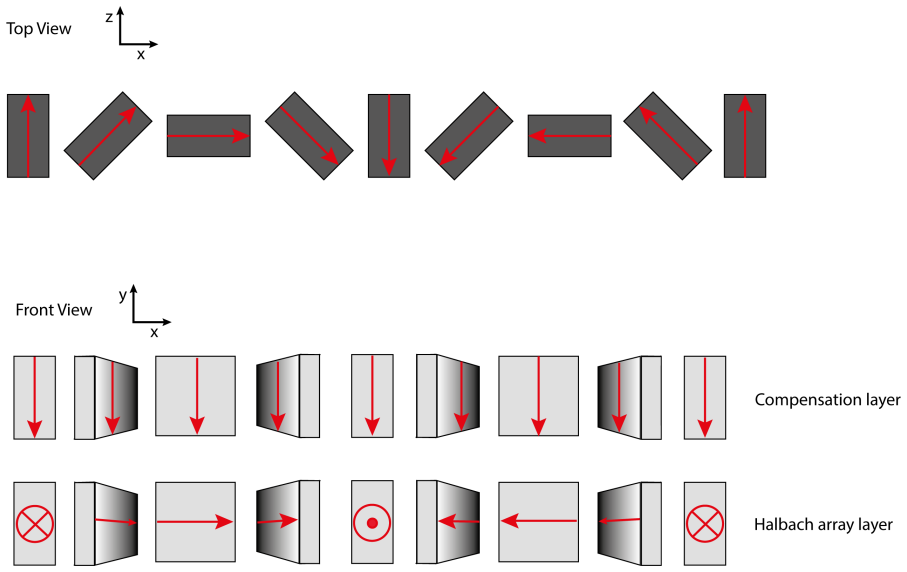
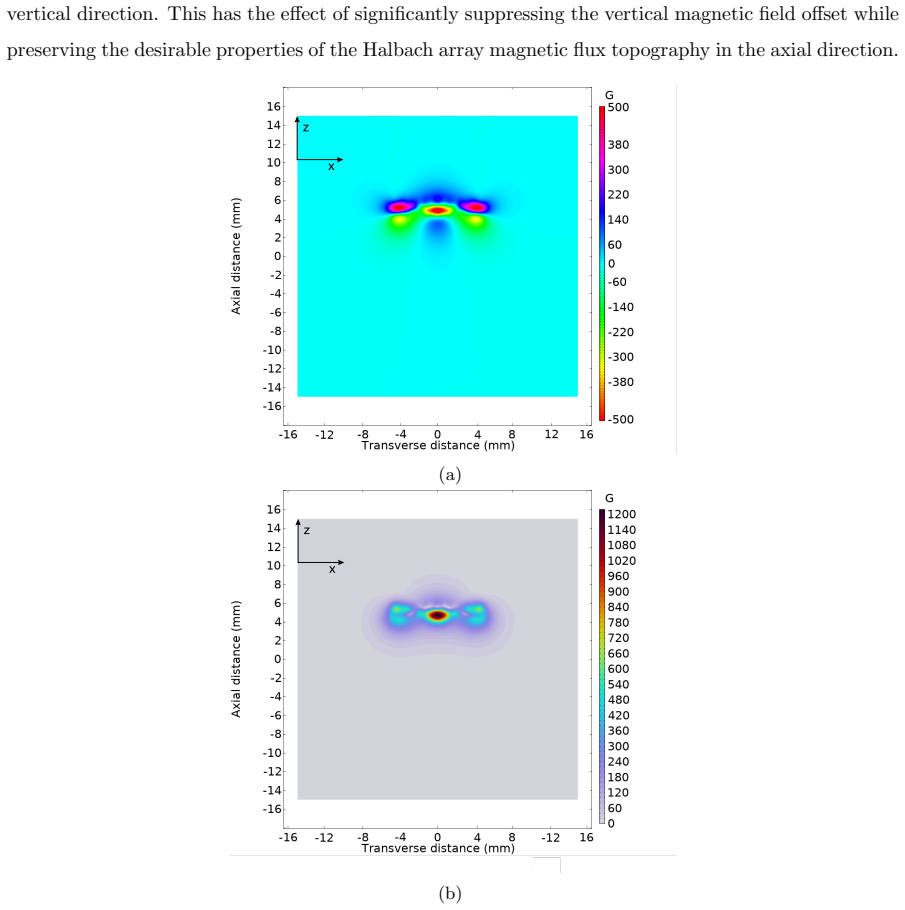
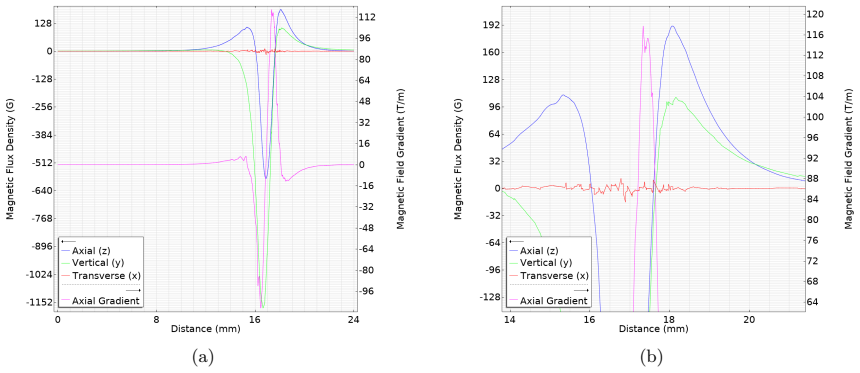
This configuration generates a localized, asymmetric magnetic field, yielding a region for ion transport into and out of a strong magnetic field gradient, while minimizing the absolute field experienced by the ion. This offers a distinct improvement for scalability over dipolar magnet geometries.
What carries the argument
The novel permanent magnet array geometry that produces a localized asymmetric magnetic field for ion transport applications.
If this is right
- Ions can be shuttled into regions of strong magnetic gradient for entanglement operations without exposure to high absolute fields in three dimensions.
- Alignment of the magnet array tolerates greater misalignment in two dimensions compared to prior designs.
- Scalable QCCD systems can implement magnetic field gradients without relying on large electrical currents.
- The design supports integration into architectures using long-wavelength radiation for laser-free entanglement.
Where Pith is reading between the lines
- Such arrays could facilitate the construction of much larger ion trap arrays by reducing power and cooling demands associated with current-based gradients.
- Improved tolerance to misalignment might simplify assembly of multi-zone quantum processors.
- Experimental validation in small-scale devices would test the transport path's effectiveness for maintaining qubit coherence.
Load-bearing premise
The proposed magnet geometry can be fabricated with sufficient precision and integrated into a QCCD system without introducing unacceptable magnetic noise or field instabilities.
What would settle it
A direct measurement showing that the absolute magnetic field in the transport region exceeds acceptable limits for ion coherence or that the gradient is insufficient for reliable entanglement would disprove the claimed benefits.
Figures
read the original abstract
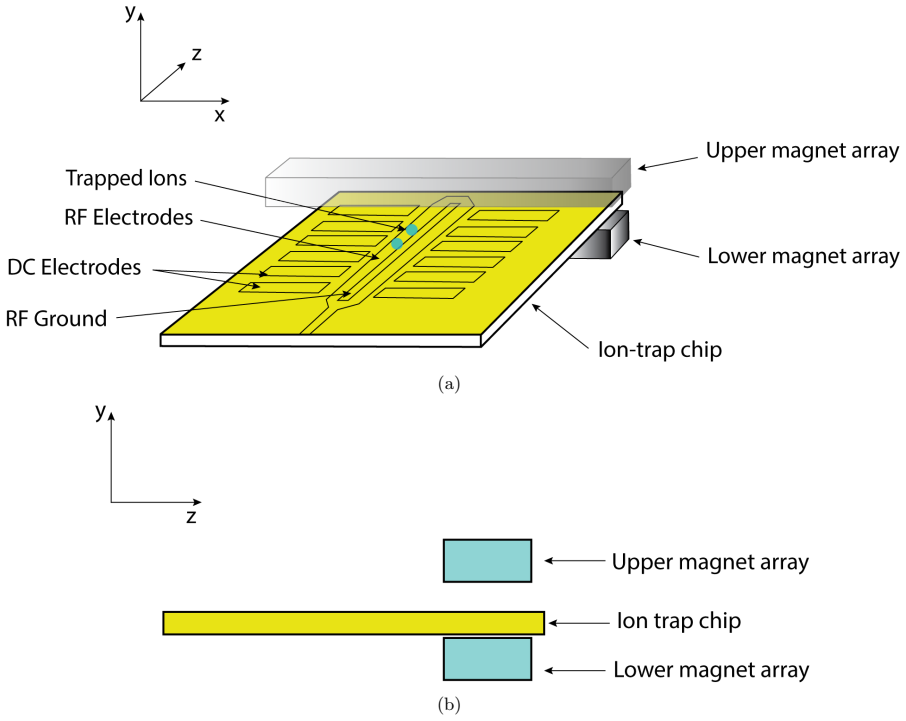
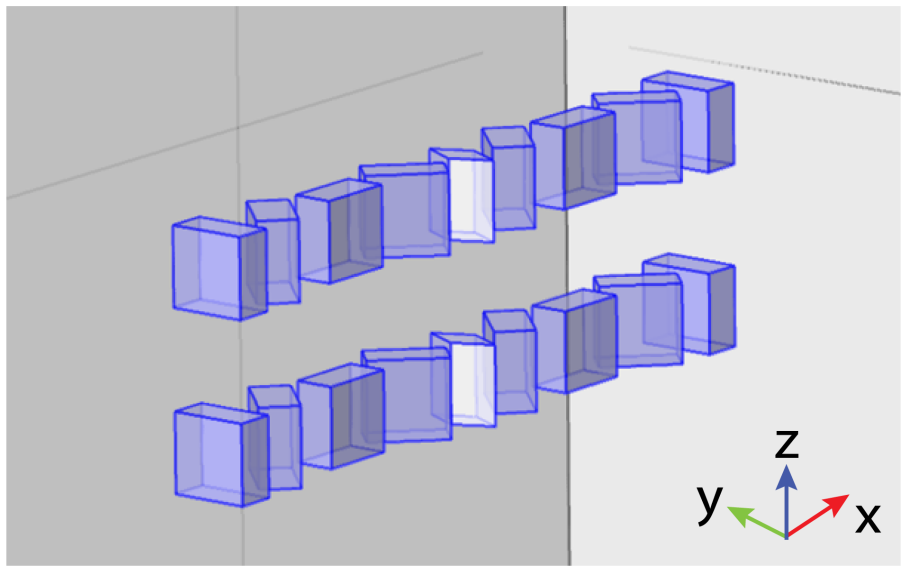
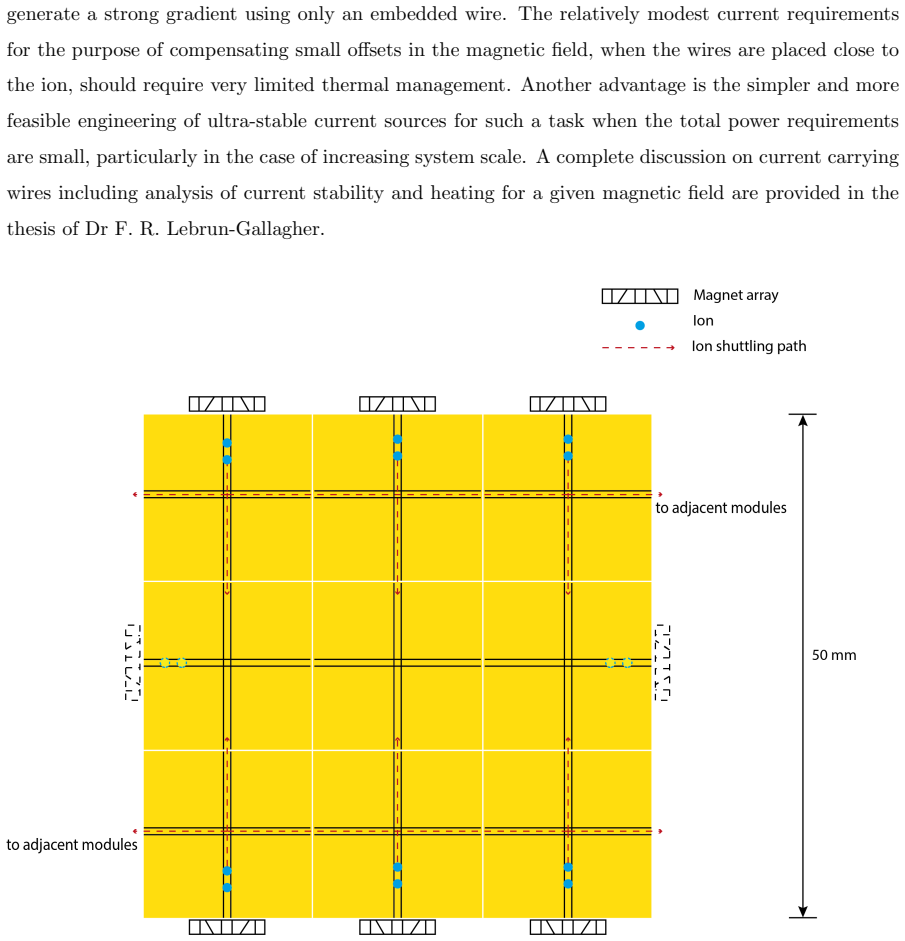
A novel design is presented for a permanent magnet array to address specific challenges with scalable trapped-ion quantum computing systems. Design and optimization of this magnet geometry is motivated by concepts for large-scale Quantum Charge-Coupled Device (QCCD) architectures. This proposal is relevant to magnetic field gradient schemes for laser-free entanglement using long-wavelength radiation, and individual addressing based on spatially dependent, magnetic field sensitive qubits. This configuration generates a localized, asymmetric magnetic field, yielding a region for ion transport into and out of a strong magnetic field gradient, while minimizing the absolute field experienced by the ion. This is a distinct improvement for scalability over dipolar magnet geometries where a strong magnetic field surrounds a magnetic field nil in three dimensions, which is problematic for ion transport applications. The design also relaxes the alignment constraints for experimental setup by allowing greater tolerance to misalignment in two dimensions. Additionally, the potential to scale a permanent magnet scheme in QCCD systems circumvents engineering challenges associated with using large electrical currents to generate the field gradient. Finally, a conceptual discussion is given for incorporating the design into a scalable QCCD type architecture.
Editorial analysis
A structured set of objections, weighed in public.
Referee Report
Summary. The manuscript presents a novel permanent magnet array geometry for scalable trapped-ion quantum computing in a laser-free entanglement architecture. It claims that this configuration generates a localized, asymmetric magnetic field enabling ion transport into and out of strong gradients while minimizing the absolute field experienced by the ion, offering distinct scalability improvements over dipolar magnet geometries, relaxed alignment tolerances in two dimensions, and circumvention of high-current engineering challenges in QCCD systems.
Significance. If the claimed field properties hold under quantitative validation, the design could provide a practical route to incorporating permanent-magnet gradients into large-scale QCCD processors, simplifying implementation of magnetic-field-sensitive qubit addressing and laser-free entanglement while reducing reliance on high-current coils.
major comments (2)
- The central claims of field localization, asymmetry, absolute-field minimization, and resulting transport/alignment benefits are stated conceptually in the abstract and design description but are unsupported by any analytical derivations, finite-element simulations, numerical field profiles, or error analysis. This absence directly undermines evaluation of the asserted scalability advantage over dipolar geometries.
- No quantitative assessment of fabrication precision, magnetic noise, field stability, or integration tolerances is provided in the QCCD incorporation discussion, leaving the feasibility claims unverified despite being load-bearing for the proposal's practicality.
minor comments (2)
- The abstract repeats the scalability and transport benefits across multiple sentences; condensing would improve readability.
- The manuscript would benefit from explicit section headings separating the magnet geometry description from the conceptual QCCD integration discussion.
Simulated Author's Rebuttal
We thank the referee for their detailed and constructive report. The comments correctly identify that the original manuscript was primarily conceptual. We have revised the manuscript to incorporate quantitative validation through simulations and assessments, which we believe substantially strengthens the proposal. Our point-by-point responses follow.
read point-by-point responses
-
Referee: The central claims of field localization, asymmetry, absolute-field minimization, and resulting transport/alignment benefits are stated conceptually in the abstract and design description but are unsupported by any analytical derivations, finite-element simulations, numerical field profiles, or error analysis. This absence directly undermines evaluation of the asserted scalability advantage over dipolar geometries.
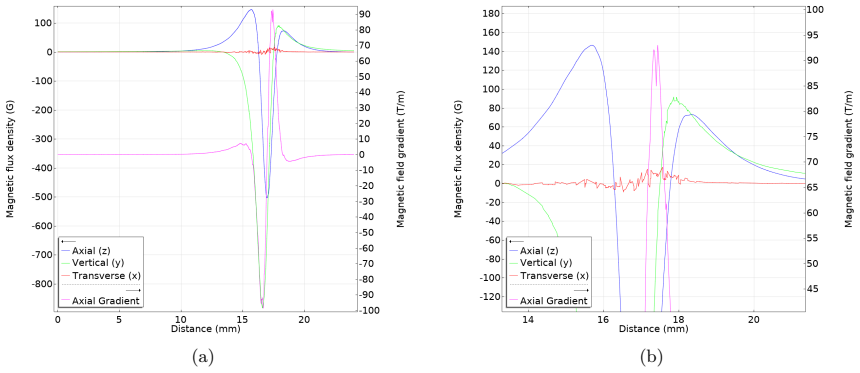
Authors: We agree that the original manuscript presented the geometry and its intended benefits at a conceptual level without supporting quantitative analysis. In the revised version we have added a new section containing finite-element simulations of the magnetic field for the proposed asymmetric array geometry. These provide explicit numerical field profiles that confirm localization of the gradient region, the asymmetry that permits ion transport into and out of the strong-gradient zone while keeping the absolute field low, and direct comparison with a standard dipolar geometry. We have also included analytical expressions for the leading field components near the ion trajectory and a brief error-propagation analysis showing the relaxed two-dimensional alignment tolerances. These additions directly support the claimed scalability advantages. revision: yes
-
Referee: No quantitative assessment of fabrication precision, magnetic noise, field stability, or integration tolerances is provided in the QCCD incorporation discussion, leaving the feasibility claims unverified despite being load-bearing for the proposal's practicality.
Authors: We acknowledge that the original discussion of QCCD integration remained qualitative. The revised manuscript now contains a dedicated subsection that supplies order-of-magnitude quantitative estimates for each of the listed items: (i) fabrication precision tolerances derived from the qubit frequency sensitivity to field inhomogeneity, (ii) expected magnetic noise spectral density using established models for sintered NdFeB magnets, (iii) long-term field stability based on temperature-coefficient data and shielding considerations, and (iv) two-dimensional integration tolerances enabled by the asymmetric design. These estimates are anchored to published experimental values from existing trapped-ion setups and are presented with explicit assumptions so that readers can assess practicality. revision: yes
Circularity Check
No significant circularity; conceptual design proposal with no self-referential derivations
full rationale
The manuscript is a forward design proposal for a permanent magnet array, motivated by standard electromagnetic principles and QCCD architecture concepts. No equations, fitted parameters, or derivations are presented that reduce any claim to its own inputs by construction. Claims about field localization, asymmetry, and scalability improvements over dipolar geometries are asserted conceptually without analytical steps, simulations, or self-citations that create circularity. The work contains no load-bearing self-referential logic, uniqueness theorems from prior author work, or renamings of known results as new derivations. This is a standard non-circular engineering proposal.
Axiom & Free-Parameter Ledger
axioms (1)
- standard math Standard electromagnetic field equations govern the behavior of permanent magnet arrays in vacuum
invented entities (1)
-
Asymmetric permanent magnet array geometry
no independent evidence
Lean theorems connected to this paper
-
IndisputableMonolith/Foundation/RealityFromDistinction.leanreality_from_one_distinction unclear?
unclearRelation between the paper passage and the cited Recognition theorem.
This configuration generates a localized, asymmetric magnetic field, yielding a region for ion transport into and out of a strong magnetic field gradient, while minimizing the absolute field experienced by the ion.
-
IndisputableMonolith/Foundation/AlexanderDuality.leanalexander_duality_circle_linking unclear?
unclearRelation between the paper passage and the cited Recognition theorem.
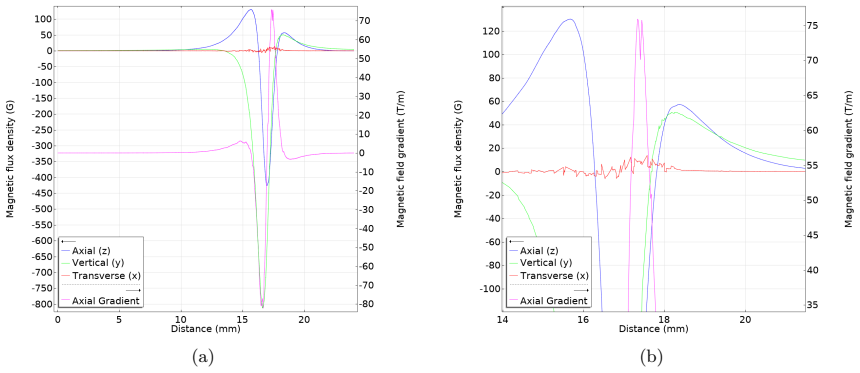
All simulations herein were generated using the COMSOL Multiphysics® software package, AC/DC module; a numerical modeling tool employing a Finite Element Method (FEM).
What do these tags mean?
- matches
- The paper's claim is directly supported by a theorem in the formal canon.
- supports
- The theorem supports part of the paper's argument, but the paper may add assumptions or extra steps.
- extends
- The paper goes beyond the formal theorem; the theorem is a base layer rather than the whole result.
- uses
- The paper appears to rely on the theorem as machinery.
- contradicts
- The paper's claim conflicts with a theorem or certificate in the canon.
- unclear
- Pith found a possible connection, but the passage is too broad, indirect, or ambiguous to say the theorem truly supports the claim.
Reference graph
Works this paper leans on
-
[1]
C. Gidney and M. Eker˚ a. How to factor 2048 bit rsa integers in 8 hours using 20 million noisy qubits.Quantum, 5:433, 2021
work page 2048
-
[2]
I. D Kivlichan, C. Gidney, D. W Berry, N. Wiebe, J. McClean, W. Sun, Z. Jiang, N. Rubin, A. Fowler, A. Aspuru-Guzik, et al. Improved fault-tolerant quantum simulation of condensed- phase correlated electrons via trotterization.Quantum, 4:296, 2020
work page 2020
- [3]
-
[4]
Y. Zhao, Y. Ye, H. Huang, Y. Zhang, D. Wu, H. Guan, Q. Zhu, Z. Wei, T. He, S. Cao, et al. Real- ization of an error-correcting surface code with superconducting qubits.Physical Review Letters, 129(3):030501, 2022
work page 2022
-
[5]
S. Krinner, N. Lacroix, A. Remm, A. Di Paolo, E. Genois, C. Leroux, C. Hellings, S. Lazar, F. Swiadek, J. Herrmann, et al. Realizing repeated quantum error correction in a distance-three surface code.Nature, 605(7911):669–674, 2022
work page 2022
-
[6]
C. Ryan-Anderson, J. G. Bohnet, K. Lee, D. Gresh, A. Hankin, J. P. Gaebler, D. Francois, A. Cher- noguzov, D. Lucchetti, N. C. Brown, et al. Realization of real-time fault-tolerant quantum error correction.Physical Review X, 11(4):041058, 2021
work page 2021
-
[7]
L. Egan, D. M Debroy, C. Noel, A. Risinger, D. Zhu, D. Biswas, M. Newman, M. Li, K. R. Brown, M. Cetina, et al. Fault-tolerant control of an error-corrected qubit.Nature, 598(7880):281–286, 2021
work page 2021
-
[8]
C. D. Bruzewicz, J. Chiaverini, R. McConnell, and J. M. Sage. Trapped-ion quantum computing: Progress and challenges.Applied Physics Reviews, 6(2):021314, 05 2019
work page 2019
-
[9]
L. Henriet, L. Beguin, A. Signoles, T. Lahaye, A. Browaeys, G. Reymond, and C. Jurczak. Quantum computing with neutral atoms.Quantum, 4:327, Sep 2020
work page 2020
-
[10]
M. Kjaergaard, M. E. Schwartz, J. Braum¨ uller, P. Krantz, J. I.-J. Wang, S. Gustavsson, and W. D. Oliver. Superconducting qubits: Current state of play.Annual Review of Condensed Matter Physics, 11(1):369–395, 2020. 25
work page 2020
-
[11]
D. J. Wineland and C. Monroe. Experimental issues in coherent quantum-state manipulation of trapped atomic ions.Journal of research of the National Institute of Standards and Technology, 103(3):259–328, 1998
work page 1998
-
[12]
C. Monroe and J. Kim. Scaling the ion trap quantum processor.Science, 339(6124):1164–1169, 2013
work page 2013
-
[13]
Bjoern Lekitsch, Sebastian Weidt, Austin G. Fowler, Klaus Mølmer, Simon J. Devitt, Christof Wunderlich, and Winfried K. Hensinger. Blueprint for a microwave trapped ion quantum computer. Science Advances, 3(2):e1601540, 2017
work page 2017
-
[14]
T. P. Harty, D. T.C. Allcock, C. J. Ballance, L. Guidoni, H. A. Janacek, N. M. Linke, D. N. Stacey, and D. M. Lucas. High-fidelity preparation, gates, memory, and readout of a trapped-ion quantum bit.Physical Review Letters, 113(22):2–6, 2014
work page 2014
-
[15]
C. J. Ballance, T. P. Harty, N. M. Linke, M. A. Sepiol, and D. M. Lucas. High-fidelity quantum logic gates using trapped-ion hyperfine qubits.Phys. Rev. Lett., 117:060504, Aug 2016
work page 2016
-
[16]
P. Wang, C. Luan, M. Qiao, M. Um, J. Zhang, Y. Wang, X. Yuan, M. Gu, J. Zhang, and K. Kim. Single ion qubit with estimated coherence time exceeding one hour.Nature Communications, 12(1):233, Jan 2021
work page 2021
- [17]
-
[18]
D. Wineland, C. Monroe, Wayne Itano, D. Leibfried, B. King, and D. Meekhof. Experimental issues in coherent quantum-state manipulation of trapped atomic ions.Journal of Research of the National Institute of Standards and Technology, 103, 11 1997
work page 1997
-
[19]
D. J. Heinzen and D. J. Wineland. Quantum-limited cooling and detection of radio-frequency oscillations by laser-cooled ions.Phys. Rev. A, 42:2977–2994, Sep 1990
work page 1990
-
[20]
S. Debnath, N. M. Linke, C. Figgatt, K. A. Landsman, K. Wright, and C. Monroe. Demonstration of a small programmable quantum computer with atomic qubits.Nature, 536(7614):63–66, Aug 2016. 26
work page 2016
- [21]
-
[22]
F. Mintert and C. Wunderlich. Ion-trap quantum logic using long-wavelength radiation.Physical Review Letters, 87(25):257904–1–257904–4, 2001
work page 2001
-
[23]
C. Ospelkaus, C. E. Langer, J. M. Amini, K. R. Brown, D. Leibfried, and D. J. Wineland. Trapped- ion quantum logic gates based on oscillating magnetic fields.Physical Review Letters, 101, 8 2008
work page 2008
-
[24]
K. Lake, S. Weidt, J. Randall, E. D. Standing, S. C. Webster, and W. K. Hensinger. Generation of spin-motion entanglement in a trapped ion using long-wavelength radiation.Physical Review A - Atomic, Molecular, and Optical Physics, 91(1):1–5, 2015
work page 2015
-
[25]
R. Srinivas, S. C. Burd, H. M. Knaack, R. T. Sutherland, A. Kwiatkowski, S. Glancy, E. Knill, D. J. Wineland, D. Leibfried, A. C. Wilson, D. T. C. Allcock, and D. H. Slichter. High-fidelity laser-free universal control of trapped ion qubits.Nature, 597(7875):209–213, Sep 2021
work page 2021
-
[26]
K. Yuji, S. Kenji, N. Atsushi, U. Shinji, and T. Utako. Surface-electrode trap with an integrated permanent magnet for generating a magnetic-field gradient at trapped ions.Journal of Physics B: Atomic, Molecular and Optical Physics, 50(2):025501, dec 2016
work page 2016
-
[27]
M. Johanning, A. Braun, N. Timoney, V. Elman, W. Neuhauser, and Chr Wunderlich. Individual addressing of trapped ions and coupling of motional and spin states using rf radiation.Physical Review Letters, 102(7):1–4, 2009
work page 2009
- [28]
- [29]
-
[30]
V. Kaushal, B. Lekitsch, A. Stahl, J. Hilder, D. Pijn, C. Schmiegelow, A. Bermudez, M. M¨ uller, F. Schmidt-Kaler, and U. Poschinger. Shuttling-based trapped-ion quantum information pro- cessing.AVS Quantum Science, 2(1):014101, 2020. 27
work page 2020
- [31]
-
[32]
M. G. Peaks.Strong magnetic field gradients for scalable trapped ion quantum logic. PhD thesis, University of Sussex, 9 2023
work page 2023
- [33]
-
[34]
L. J. Stephenson, D. P. Nadlinger, B. C. Nichol, S. An, P. Drmota, T. G. Ballance, K. Thirumalai, J. F. Goodwin, D. M. Lucas, and C. J. Ballance. High-rate, high-fidelity entanglement of qubits across an elementary quantum network.Phys. Rev. Lett., 124:110501, Mar 2020
work page 2020
-
[35]
D. F. Murgia.Microchip ion traps with high magnetic field gradients for microwave quantum logic. PhD thesis, Imperial College London, 2017
work page 2017
-
[36]
M. Siegele-Brown, S. Hong, F. R. Lebrun-Gallagher, S. J. Hile, S. Weidt, and W. K. Hensinger. Fabrication of surface ion traps with integrated current carrying wires enabling high magnetic field gradients.Quantum Science and Technology, 7(3):034003, May 2022
work page 2022
-
[37]
Bautista-Salvador.Integrated Electromagnets and Radiofrequency Spectroscopy in a Planar Paul Trap
A. Bautista-Salvador.Integrated Electromagnets and Radiofrequency Spectroscopy in a Planar Paul Trap. PhD thesis, Universit¨ at Ulm Institut f¨ ur Quanteninformationsverarbeitung, Johannes Gutenberg-Universit¨ at Mainz Institut f¨ ur Physik, 2015
work page 2015
- [38]
- [39]
discussion (0)
Sign in with ORCID, Apple, or X to comment. Anyone can read and Pith papers without signing in.