Recognition: no theorem link
An Algebraic Method for Full-Rank Characterization in Binary Linear Coding
Pith reviewed 2026-05-13 18:31 UTC · model grok-4.3
The pith
An algebraic algorithm converts full-rank constraints on binary symbolic matrices into simple triangular equality conditions.
A machine-rendered reading of the paper's core claim, the machinery that carries it, and where it could break.
Core claim
The BCSFR algorithm computes characteristic sets over the binary field such that the zeros of these sets are exactly the assignments of the symbolic variables that make the given matrices full rank. The resulting triangular-form equalities therefore provide an explicit algebraic description of every feasible linear coding scheme that satisfies the rank requirements for decodability or other coding properties.
What carries the argument
The BCSFR algorithm, which iteratively computes characteristic sets of the ideal generated by the rank-minor conditions to produce triangular equality systems equivalent to full rank.
If this is right
- Full-rank constraints in an optimization problem can be replaced directly by the triangular equality constraints from the characteristic sets.
- All feasible linear coding schemes for a given network or storage problem become explicitly enumerable or searchable via the zeros of the computed sets.
- The method applies uniformly to problems such as linear network coding and distributed storage coding whenever full-rank conditions appear on symbolic matrices.
- Optimization over the coding variables becomes a standard algebraic problem once the rank conditions are rewritten as equalities.
Where Pith is reading between the lines
- The triangular representations may reduce the search space for optimal codes more effectively than generic rank checks in software implementations.
- If the method scales, it could serve as a preprocessing step before applying numerical or heuristic solvers to larger coding design tasks.
- The same algebraic reduction might apply to other rank-constrained problems in coding theory that stay within the binary field.
Load-bearing premise
The characteristic-set computation over the binary field produces compact triangular sets whose zeros match the full-rank locus exactly, without missing solutions or introducing extraneous ones.
What would settle it
Run BCSFR on a small symbolic matrix known to have a computable full-rank locus over GF(2); the output characteristic sets must have zeros that differ from the actual solutions obtained by direct enumeration of the rank conditions.
Figures


read the original abstract
In this paper, we develop a characteristic set (CS)-based method for deriving full-rank equivalence conditions of symbolic matrices over the binary field. Such full-rank conditions are of fundamental importance for many linear coding problems in communication and information theory. Building on the developed CS-based method, we present an algorithm called Binary Characteristic Set for Full Rank (BCSFR), which efficiently derives the full-rank equivalence conditions as the zeros of a series of characteristic sets. In other words, the BCSFR algorithm can characterize all feasible linear coding schemes for certain linear coding problems (e.g., linear network coding and distributed storage coding), where full-rank constraints are imposed on several symbolic matrices to guarantee decodability or other properties of the codes. The derived equivalence conditions can be used to simplify the optimization of coding schemes, since the intractable full-rank constraints in the optimization problem are explicitly characterized by simple triangular-form equality constraints.
Editorial analysis
A structured set of objections, weighed in public.
Referee Report
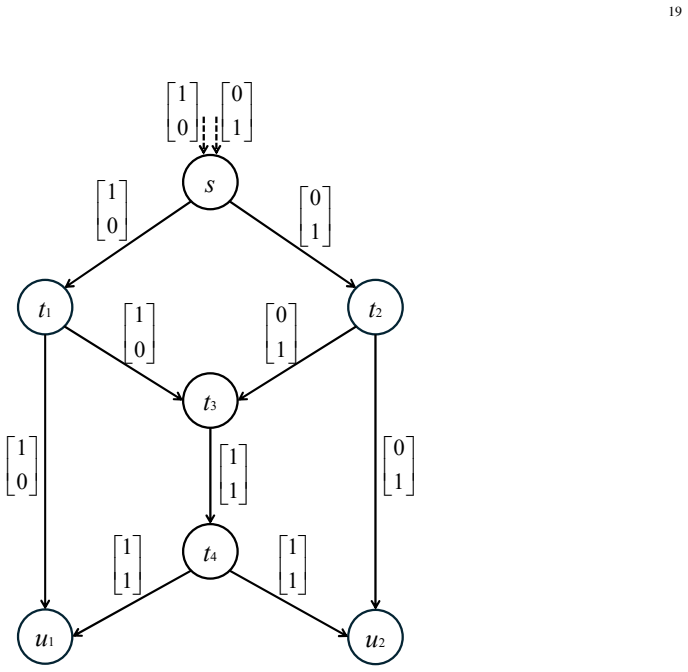
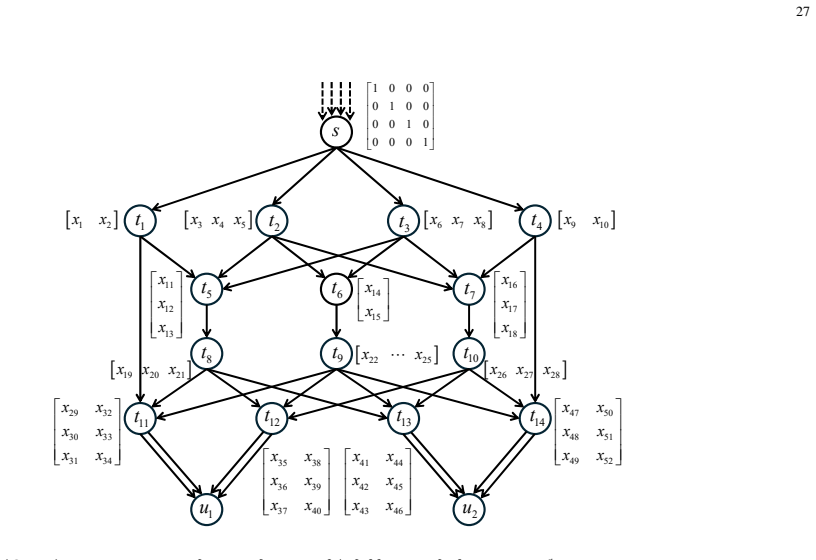
Summary. The paper develops a characteristic set (CS)-based algebraic method for deriving full-rank equivalence conditions of symbolic matrices over GF(2). Building on this, it introduces the BCSFR algorithm that computes a series of characteristic sets in triangular form whose zeros explicitly characterize the assignments making the matrices full rank; these conditions are then applied to simplify optimization problems in linear network coding and distributed storage coding by replacing determinant-based full-rank constraints with simple equality constraints.
Significance. If the BCSFR characteristic sets are shown to have solution sets that coincide exactly with the full-rank assignments over GF(2) (i.e., the variety of the ideal generated by det(M)-1 together with the field equations x^2+x=0), the method would provide a useful algebraic tool for information-theoretic coding problems, enabling more tractable optimization of coding schemes without enumerating or fitting parameters.
major comments (2)
- [§3.2] §3.2, Algorithm 1 (BCSFR): the central claim that the zeros of the output characteristic sets exactly match the full-rank locus over GF(2) is load-bearing for all applications, yet the manuscript provides no formal argument that the CS decomposition of the ideal (det(M_i)-1, {x_j^2 + x_j}) introduces neither extraneous zeros nor misses solutions; a correctness proof or explicit reduction to the variety is required.
- [§5.1] §5.1, Example 1 (network coding): the derived triangular constraints are presented as equivalent, but no verification (e.g., enumeration of the 2^k solutions or direct comparison against the determinant conditions) is given to confirm that every zero satisfies full rank and vice versa; this leaves the utility claim unsupported.
minor comments (2)
- [§2] The definition of 'characteristic set' and the precise triangular form used by BCSFR should be restated in §2 with explicit reference to the Wu-Ritt or other standard CS properties over finite fields.
- [Figure 3] Figure 3 (flowchart of BCSFR) lacks labels on the decision branches for the 'split' and 'reduce' steps; adding these would clarify the control flow.
Simulated Author's Rebuttal
We thank the referee for the careful reading and constructive feedback on our manuscript. We agree that explicit correctness arguments and verifications are important to support the central claims. We will revise the paper to include a formal proof for the BCSFR algorithm and explicit checks for the example, as detailed in the point-by-point responses below.
read point-by-point responses
-
Referee: [§3.2] §3.2, Algorithm 1 (BCSFR): the central claim that the zeros of the output characteristic sets exactly match the full-rank locus over GF(2) is load-bearing for all applications, yet the manuscript provides no formal argument that the CS decomposition of the ideal (det(M_i)-1, {x_j^2 + x_j}) introduces neither extraneous zeros nor misses solutions; a correctness proof or explicit reduction to the variety is required.
Authors: We acknowledge that the manuscript does not contain a self-contained formal proof of the equivalence between the zeros of the characteristic sets and the full-rank assignments. The BCSFR algorithm is constructed using the standard triangular decomposition properties of characteristic sets for polynomial ideals over GF(2), which in principle preserve the variety when adjoining the field equations x_j^2 + x_j = 0. However, to address the concern directly, we will add a new Theorem 3.2 in Section 3.2 that explicitly proves the zero-set equivalence. The proof will proceed by showing that the ideal generated by det(M)-1 together with the field polynomials is radical and that the characteristic set decomposition (via Wu's method or Ritt's decomposition) yields an irredundant triangular representation whose solutions coincide exactly with the points satisfying det(M) = 1 over GF(2). We will include a brief reduction argument referencing the fact that no extraneous zeros are introduced because the decomposition is regular and the base field is perfect. This revision will be marked as a new subsection. revision: yes
-
Referee: [§5.1] §5.1, Example 1 (network coding): the derived triangular constraints are presented as equivalent, but no verification (e.g., enumeration of the 2^k solutions or direct comparison against the determinant conditions) is given to confirm that every zero satisfies full rank and vice versa; this leaves the utility claim unsupported.
Authors: We agree that the example would benefit from explicit verification to confirm equivalence. In the revised manuscript we will augment §5.1 with a verification paragraph that enumerates all feasible assignments for the small network coding instance (with a modest number of variables, e.g., 4–6 symbols). For each assignment we will directly evaluate both the original determinant condition over GF(2) and the derived triangular equations, showing that the solution sets coincide exactly. This enumeration can be performed exhaustively because the search space is 2^k with small k; the results will be tabulated to demonstrate that every zero of the triangular sets yields a full-rank matrix and conversely. The added verification will strengthen the utility claim for replacing determinant constraints with simple equality constraints in optimization. revision: yes
Circularity Check
No circularity: algebraic derivation from standard characteristic-set theory
full rationale
The paper constructs the BCSFR algorithm by applying the Ritt-Wu characteristic-set decomposition directly to the polynomial ideal generated by the equations det(M_i) - 1 = 0 together with the field relations x^2 + x = 0 over GF(2). The resulting triangular sets are asserted to have zero sets that coincide with the full-rank assignments precisely because of the algebraic properties of characteristic sets (zero-dimensional decomposition and triangular form), which are invoked as external, independently established facts rather than derived within the paper. No parameter is fitted to data and then relabeled as a prediction, no self-citation supplies a uniqueness theorem that forces the method, and no ansatz is smuggled in; the equivalence claim follows from the definition of the ideal and the algorithm's termination properties. The derivation is therefore self-contained and does not reduce any load-bearing step to its own inputs by construction.
Axiom & Free-Parameter Ledger
axioms (1)
- domain assumption Characteristic sets over GF(2) can be computed to yield exact equivalence conditions for the full-rank property of symbolic matrices.
Reference graph
Works this paper leans on
- [1]
-
[2]
R. W. Yeung,Information theory and network coding. Springer Science & Business Media, 2008
work page 2008
-
[3]
T. Richardson and R. Urbanke,Modern Coding Theory. New York, NY: Cambridge University Press, 2008
work page 2008
-
[4]
Network coding for distributed storage systems,
A. G. Dimakis, P. B. Godfrey, Y . Wu, M. J. Wainwright, and K. Ramchandran, “Network coding for distributed storage systems,”IEEE transactions on information theory, vol. 56, no. 9, pp. 4539–4551, Sept. 2010
work page 2010
-
[5]
On the locality of codeword symbols,
P. Gopalan, C. Huang, H. Simitci, and S. Yekhanin, “On the locality of codeword symbols,”IEEE Transactions on Information Theory, vol. 58, no. 11, pp. 6925–6934, Nov. 2012
work page 2012
-
[6]
D. S. Papailiopoulos and A. G. Dimakis, “Locally repairable codes,”IEEE Transactions on Information Theory, vol. 60, no. 10, pp. 5843–5855, Oct. 2014
work page 2014
-
[7]
Speeding up distributed machine learning using codes,
K. Lee, M. Lam, R. Pedarsani, D. Papailiopoulos, and K. Ramchandran, “Speeding up distributed machine learning using codes,”IEEE Transactions on Information Theory, vol. 64, no. 3, pp. 1514–1529, Mar. 2018
work page 2018
-
[8]
Lagrange coded computing: Optimal design for resiliency, security, and privacy,
Q. Yu, S. Li, N. Raviv, S. M. M. Kalan, M. Soltanolkotabi, and S. A. Avestimehr, “Lagrange coded computing: Optimal design for resiliency, security, and privacy,” inThe 22nd International Conference on Artificial Intelligence and Statistics. PMLR, 2019, pp. 1215–1225
work page 2019
-
[9]
S.-Y . Li, R. W. Yeung, and N. Cai, “Linear network coding,”IEEE Trans. Inf. Theory, vol. 49, no. 2, pp. 371–381, Feb. 2003
work page 2003
-
[10]
An algebraic approach to network coding,
R. Koetter and M. M ´edard, “An algebraic approach to network coding,”IEEE/ACM Trans. Networking, vol. 11, no. 5, pp. 782–795, Oct. 2003
work page 2003
-
[11]
Polynomial time algorithms for multicast network code construction,
S. Jaggi, P. Sanders, P. Chou, M. Effros, S. Egner, K. Jain, and L. Tolhuizen, “Polynomial time algorithms for multicast network code construction,”IEEE Transactions on Information Theory, vol. 51, no. 6, pp. 1973–1982, Jun. 2005
work page 1973
-
[12]
The encoding complexity of network coding,
M. Langberg, A. Sprintson, and J. Bruck, “The encoding complexity of network coding,”IEEE Transactions on Information Theory, vol. 52, no. 6, pp. 2386–2397, Jun. 2006. April 6, 2026 DRAFT 35
work page 2006
-
[13]
Basic principles of mechanical theorem proving in elementary geometrics,
W.-T. Wu, “Basic principles of mechanical theorem proving in elementary geometrics,”J. Autom. Reason., vol. 2, no. 3, p. 221–252, Aug. 1986. [Online]. Available: https://doi.org/10.1007/BF02328447
-
[14]
An elimination method for polynomial systems,
D. Wang, “An elimination method for polynomial systems,”J. Symb. Comput., vol. 16, no. 2, p. 83–114, Aug. 1993. [Online]. Available: https://doi.org/10.1006/jsco.1993.1035
-
[15]
Some results on theorem proving in geometry over finite fields,
D. Lin and Z. Liu, “Some results on theorem proving in geometry over finite fields,” inProceedings of the 1993 International Symposium on Symbolic and Algebraic Computation, ser. ISSAC ’93. New York, NY , USA: Association for Computing Machinery, 1993, p. 292–300. [Online]. Available: https://doi.org/10.1145/164081.164143
-
[16]
A new method for solving algebraic systems of positive dimension,
D. Lazard, “A new method for solving algebraic systems of positive dimension,”Discrete Applied Mathematics, vol. 33, no. 1, pp. 147–160, 1991. [Online]. Available: https://www.sciencedirect.com/science/article/pii/0166218X9190113B
-
[17]
A generalized euclidean algorithm for computing triangular representations of algebraic varieties,
M. Kalkbrener, “A generalized euclidean algorithm for computing triangular representations of algebraic varieties,”Journal of Symbolic Computation, vol. 15, no. 2, pp. 143–167, 1993. [Online]. Available: https://www.sciencedirect.com/science/article/pii/S0747717183710114
work page 1993
-
[18]
Ritt-wu’s decomposition algorithm and geometry theorem proving,
S.-C. Chou and X.-S. Gao, “Ritt-wu’s decomposition algorithm and geometry theorem proving,” in10th International Conference on Automated Deduction, M. E. Stickel, Ed. Berlin, Heidelberg: Springer Berlin Heidelberg, 1990, pp. 207–220
work page 1990
-
[19]
On the theories of triangular sets,
P. Aubry, D. Lazard, and M. M. Maza, “On the theories of triangular sets,”J. Symb. Comput., vol. 28, no. 1, p. 105–124, Jul. 1999
work page 1999
-
[20]
F. CHAI, X.-S. GAO, and C. YUAN, “A characteristic set method for solving boolean equationsand applications in cryptanalysis of stream ciphers,”Journal of Systems Science and Complexity, vol. 21, no. 2, pp. 191–208, 2008. [Online]. Available: https://sysmath.cjoe.ac.cn/jssc/EN/Y2008/V21/I2/191
work page 2008
-
[21]
Characteristic set algorithms for equation solving in finite fields,
X.-S. Gao and Z. Huang, “Characteristic set algorithms for equation solving in finite fields,”Journal of Symbolic Computation, vol. 47, no. 6, pp. 655–679, 2012, advances in Mathematics Mechanization. [Online]. Available: https://www.sciencedirect.com/science/article/pii/ S0747717111002185
work page 2012
-
[22]
On the efficiency of solving boolean polynomial systems with the characteristic set method,
Z. Huang, Y . Sun (c), and D. Lin, “On the efficiency of solving boolean polynomial systems with the characteristic set method,” Journal of Symbolic Computation, vol. 103, pp. 66–94, 2021. [Online]. Available: https://www.sciencedirect.com/science/article/pii/ S0747717119301373
work page 2021
-
[23]
Pbcs: an efficient parallel characteristic set method for solving boolean polynomial systems,
J. Zhao, J. Song, M. Zhu, J. Li, Z. Huang, X. Li, and X. Ren, “Pbcs: an efficient parallel characteristic set method for solving boolean polynomial systems,” inProceedings of the 47th International Conference on Parallel Processing. Association for Computing Machinery, 2018
work page 2018
-
[24]
Chordal graphs in triangular decomposition in top-down style,
C. Mou, Y . Bai, and J. Lai, “Chordal graphs in triangular decomposition in top-down style,”Journal of Symbolic Computation, vol. 102, pp. 108–131, 2021. [Online]. Available: https://www.sciencedirect.com/science/article/pii/S0747717119301191
work page 2021
-
[25]
Erasure coding in windows azure storage,
C. Huang, H. Simitci, Y . Xu, A. Ogus, B. Calder, P. Gopalan, J. Li, and S. Yekhanin, “Erasure coding in windows azure storage,” inProc. 2012 USENIX Annual Technical Conference (USENIX ATC 12), 2012, pp. 15–26
work page 2012
-
[26]
Xoring elephants: novel erasure codes for big data,
M. Sathiamoorthy, M. Asteris, D. Papailiopoulos, A. G. Dimakis, R. Vadali, S. Chen, and D. Borthakur, “Xoring elephants: novel erasure codes for big data,” inProc. Very Large Data Bases Endowment, vol. 6, no. 5, Mar. 2013, pp. 325–336
work page 2013
-
[27]
Parallelized progressive network coding with hardware acceleration,
H. Shojania and B. Li, “Parallelized progressive network coding with hardware acceleration,” in2007 Fifteenth IEEE International Workshop on Quality of Service, 2007, pp. 47–55
work page 2007
-
[28]
1.1 computing’s energy problem (and what we can do about it),
M. Horowitz, “1.1 computing’s energy problem (and what we can do about it),” in2014 IEEE International Solid-State Circuits Conference Digest of Technical Papers (ISSCC), 2014, pp. 10–14
work page 2014
-
[29]
RC2: an efficient MaxSAT solver,
A. Ignatiev, A. Morgado, and J. Marques-Silva, “RC2: an efficient MaxSAT solver,”Journal on Satisfiability, Boolean Modelling and Computation, vol. 11, no. 1, pp. 53–64, 2019. April 6, 2026 DRAFT
work page 2019
discussion (0)
Sign in with ORCID, Apple, or X to comment. Anyone can read and Pith papers without signing in.