Unambiguous arbitrary high-dimensional Bell states analyzer via indefinite causal order
Pith reviewed 2026-05-13 17:32 UTC · model grok-4.3
The pith
An indefinite causal order switch with tuned local gates distinguishes any set of high-dimensional Bell states completely and deterministically.
A machine-rendered reading of the paper's core claim, the machinery that carries it, and where it could break.
Core claim
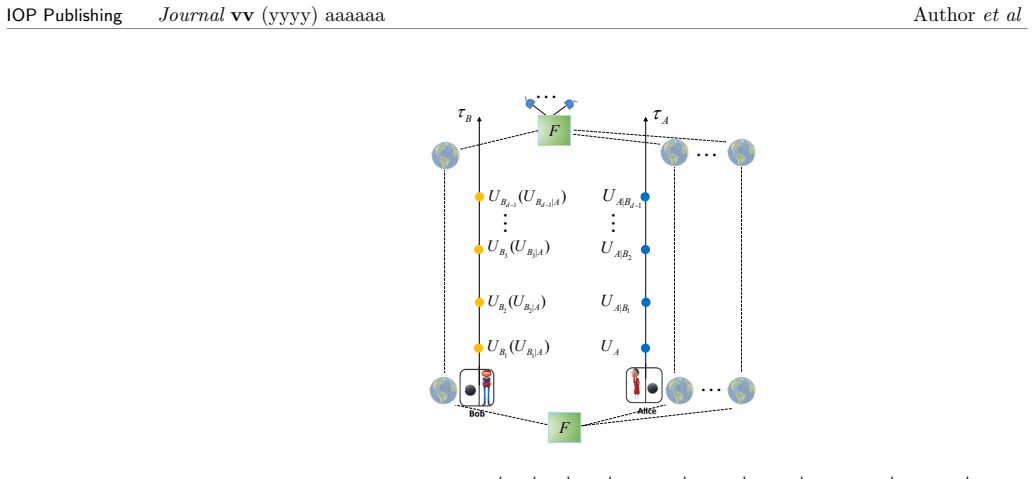
Exploiting the gravitational indefinite causal order as the sole resource, the scheme places local single-qudit gates within the ICO switch. Adjusting the form of these gates allows the measurement outcomes of each qudit in the {|0>, |1>, ..., |d-1>} basis to map bijectively onto the labels of the generalized Bell states, achieving complete and deterministic discrimination independent of dimension d >= 3. The process does not consume the indefinite causal structure, permitting a nondestructive analyzer by iterating the process for two rounds.
What carries the argument
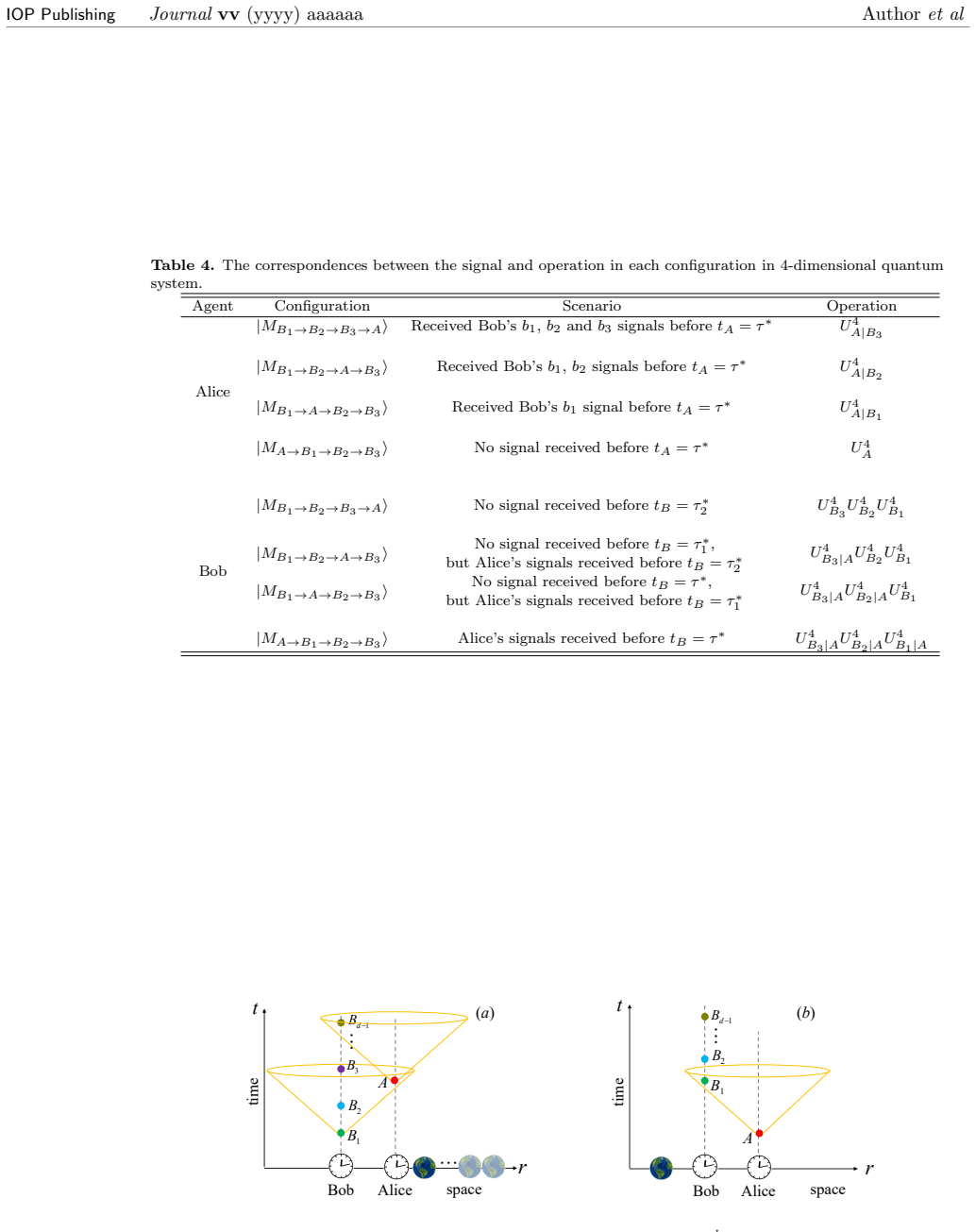
The indefinite causal order switch embedding adjustable local single-qudit gates, which superposes different causal orders to enable the discrimination mapping.
If this is right
- Quantum communication protocols using high-dimensional entanglement gain a practical Bell-state analyzer.
- The analyzer works for arbitrary dimensions without redesign.
- Two iterations yield a completely nondestructive measurement of the Bell state.
- Bit and phase information are extracted simultaneously rather than sequentially.
Where Pith is reading between the lines
- Integrating this analyzer could simplify high-dimensional quantum key distribution setups.
- Experimental tests with photonic qudits might verify the ICO realization for d=3 or d=4.
- Extensions to multipartite high-dimensional states could follow similar causal-order strategies.
Load-bearing premise
That an indefinite causal order switch can be physically realized and that suitable local single-qudit gates exist to produce a bijective mapping from measurement outcomes to Bell-state labels for every dimension.
What would settle it
For a specific dimension d=3, prepare one of the generalized Bell states, apply the proposed ICO circuit with chosen gates, and check whether the four possible measurement outcome pairs uniquely identify each state without overlap or missing cases.
Figures
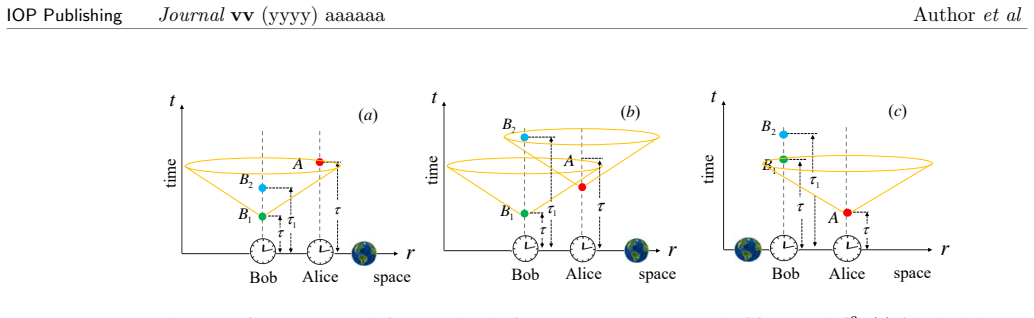
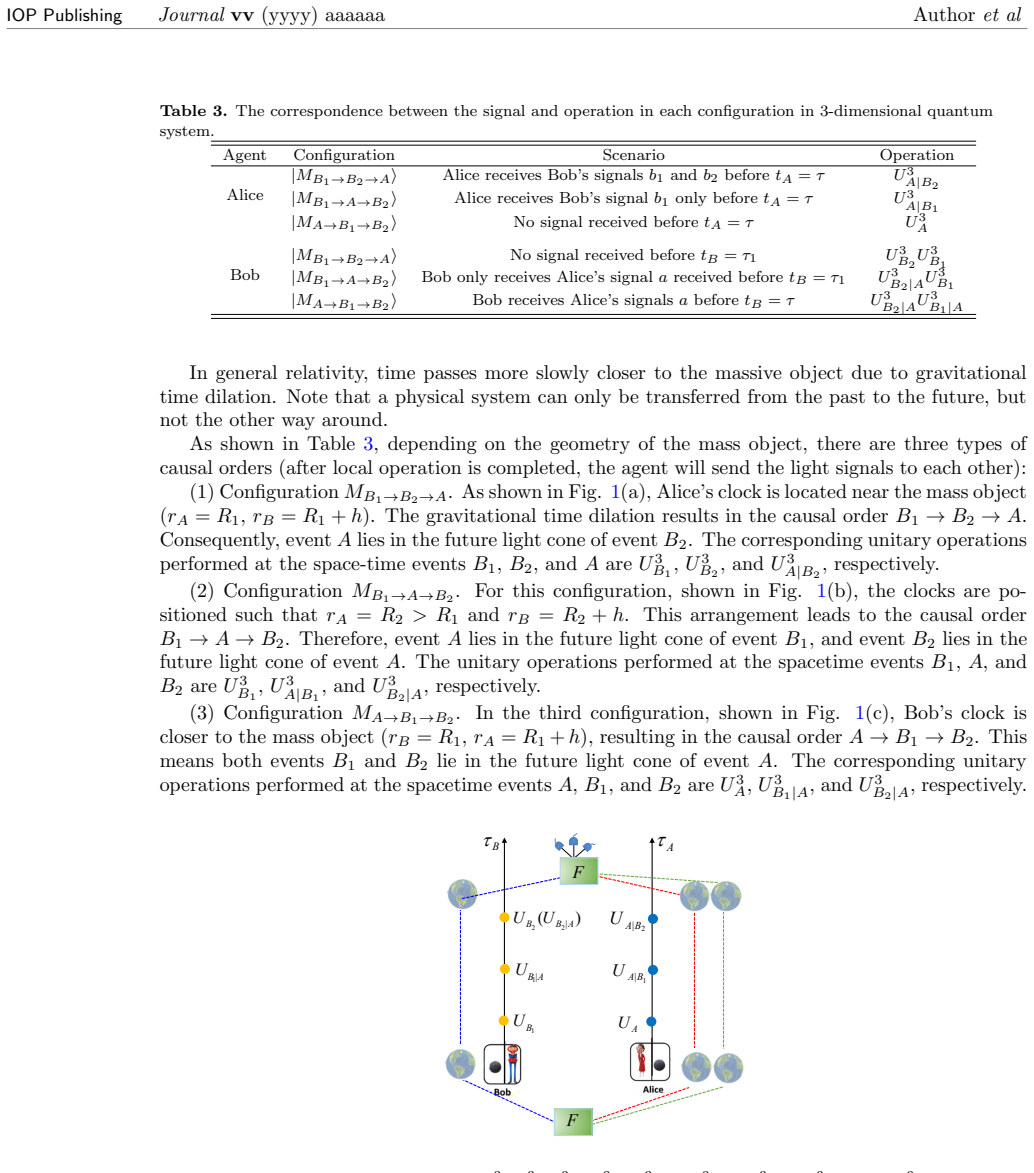
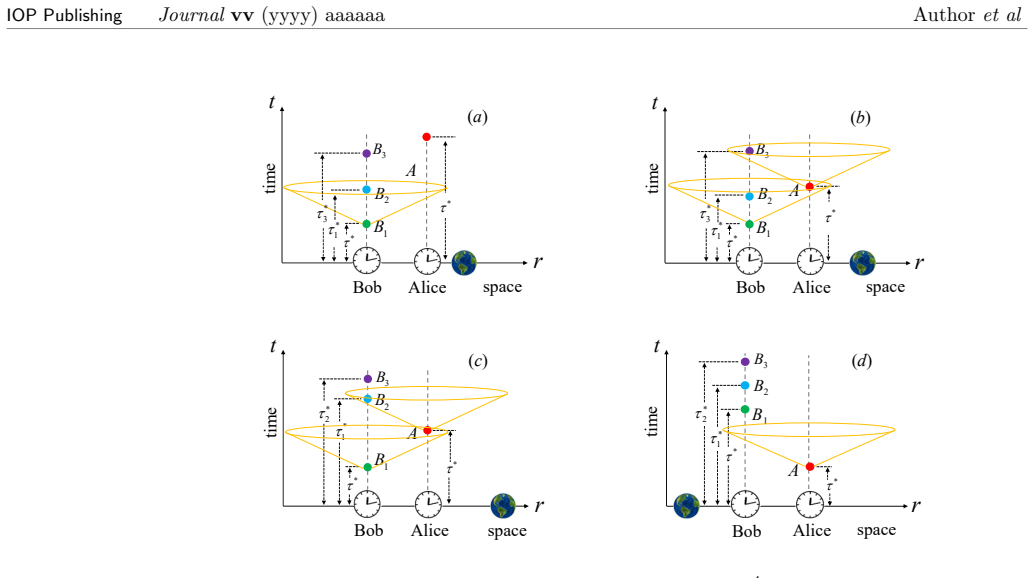
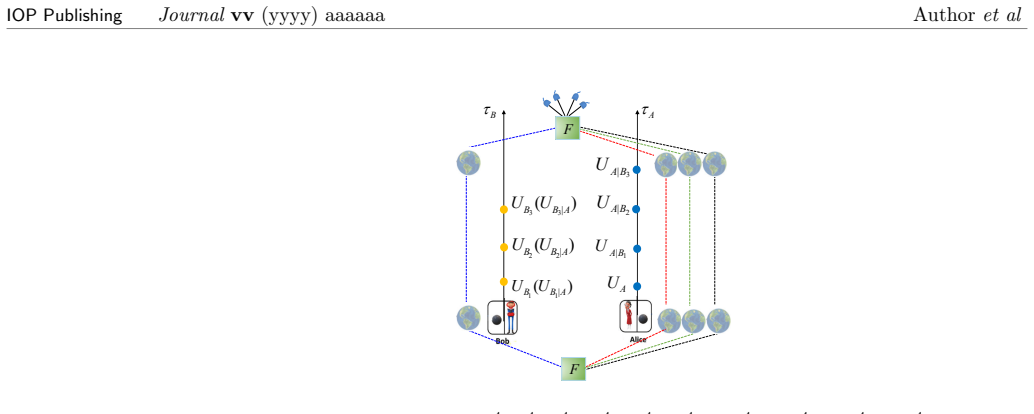
read the original abstract
High-dimensional quantum systems greatly outperform their two-dimensional counterparts in channel capacity, quantum complexity and efficiency, quantum communication security, etc. Bell-state analyzer (BSA) is a crucial prerequisite for a number of quantum communication protocols. We propose an approach for completely and deterministically distinguishing a set of arbitrary $d$-dimensional ($d \geq 3$) Bell states via indefinite causal order (ICO). In previous schemes, bit and phase information are discriminated in succession. Exploiting the gravitational ICO as the sole resource, we propose some high-dimensional BSA schemes. Independent of the dimensions, a set of generalized Bell states are completely and deterministically discriminated by adjusting the form of the embedded local single-qudit gates within ICO switch and measuring each qudit in the $\{|0\rangle, |1\rangle, \cdots, |d-1\rangle\}$ basis. Notably, in our high-dimensional BSA process, the indefinite causal structure is not consumed. Hence a completely nondestructive high-dimensional BSA can be achieved by iterating the indefinite causal structure process for two rounds.
Editorial analysis
A structured set of objections, weighed in public.
Referee Report
Summary. The manuscript proposes a protocol for unambiguous, complete, and deterministic discrimination of arbitrary d-dimensional (d ≥ 3) generalized Bell states using indefinite causal order (ICO) realized via a gravitational switch. Local single-qudit gates are embedded in the switch; their form is adjusted so that, after the ICO process, measurement of both qudits in the computational basis {|0⟩, …, |d−1⟩} maps each Bell state |Φ_{k,l}⟩ onto a unique outcome pair. Because the ICO resource is not consumed, the scheme can be iterated for nondestructive analysis.
Significance. If the central mapping is shown to be bijective and dimension-independent, the result supplies a resource-efficient, nondestructive high-dimensional Bell-state analyzer. This would directly benefit high-d quantum communication, teleportation, and dense-coding protocols that require reliable Bell-state discrimination without destroying the entangled resource.
major comments (2)
- [Abstract / ICO-switch protocol] Abstract and protocol section: the claim that there exist fixed local single-qudit unitaries U, V (independent of d) such that the ICO channel maps every generalized Bell state |Φ_{k,l}⟩ bijectively onto a distinct computational-basis state |m⟩|n⟩ is load-bearing, yet the manuscript supplies neither the explicit gate construction nor the algebraic verification that the resulting Kraus operators produce mutually orthogonal outputs exhausting the d²-dimensional space. Without this, the bijectivity asserted for arbitrary d remains unverified.
- [Indefinite causal order switch] Indefinite-causal-order realization: the protocol treats gravitational ICO as a physically realizable, non-consumable resource that can be embedded with the required gates; a concrete feasibility argument or reference to an explicit experimental implementation for d > 2 is needed, as this assumption underpins both the discrimination and the nondestructive iteration claim.
minor comments (2)
- Define the generalized Bell states |Φ_{k,l}⟩ explicitly (including normalization and phase conventions) at first use rather than assuming the standard two-qudit form.
- Clarify whether the measurement is performed on the two output ports after the ICO switch or on the original qudits; the current wording leaves the causal structure of the final measurement ambiguous.
Simulated Author's Rebuttal
We thank the referee for the careful reading and constructive comments on our manuscript. We address each major comment point by point below.
read point-by-point responses
-
Referee: [Abstract / ICO-switch protocol] Abstract and protocol section: the claim that there exist fixed local single-qudit unitaries U, V (independent of d) such that the ICO channel maps every generalized Bell state |Φ_{k,l}⟩ bijectively onto a distinct computational-basis state |m⟩|n⟩ is load-bearing, yet the manuscript supplies neither the explicit gate construction nor the algebraic verification that the resulting Kraus operators produce mutually orthogonal outputs exhausting the d²-dimensional space. Without this, the bijectivity asserted for arbitrary d remains unverified.
Authors: We clarify that the manuscript does not assert unitaries that are completely fixed and independent of d; rather, their form is adjusted with d (as stated in the protocol) to ensure the mapping works for arbitrary dimensions. We will add the explicit construction of the d-dependent single-qudit gates (phase-shift operators with roots of unity) together with the algebraic verification that the ICO Kraus operators map each |Φ_{k,l}⟩ to a unique computational-basis pair, confirming bijectivity and exhaustion of the d² space. This material will be inserted into the protocol section. revision: yes
-
Referee: [Indefinite causal order switch] Indefinite-causal-order realization: the protocol treats gravitational ICO as a physically realizable, non-consumable resource that can be embedded with the required gates; a concrete feasibility argument or reference to an explicit experimental implementation for d > 2 is needed, as this assumption underpins both the discrimination and the nondestructive iteration claim.
Authors: The gravitational switch is invoked as a theoretical resource whose causal indefiniteness is dimension-independent in principle. We will add a short feasibility paragraph citing existing theoretical frameworks for gravitational ICO and noting that single-qudit gates can be embedded using multi-level systems, while acknowledging that concrete experimental realizations for d>2 remain future work. This supports the nondestructive iteration claim since the ICO structure itself is not consumed. revision: partial
Circularity Check
No significant circularity; proposal is self-contained in ICO properties
full rationale
The paper advances a theoretical construction for high-dimensional Bell-state discrimination by embedding adjustable local single-qudit gates inside an ICO switch and measuring in the computational basis. No equations appear that equate a claimed prediction to a fitted input by construction, no self-citation is invoked as the sole justification for the existence of the required gates, and the central mapping is asserted as a direct consequence of ICO superposition rather than a renaming or re-derivation of prior results. The scheme therefore remains independent of its own outputs.
Axiom & Free-Parameter Ledger
axioms (1)
- domain assumption Indefinite causal order can be implemented as a controllable quantum switch without destroying the resource after use.
Reference graph
Works this paper leans on
-
[1]
Ekert A K 1991 Quantum cryptography based on Bell’s theoremPhys. Rev. Lett.67661
work page 1991
-
[2]
Liu J, Lin Z, Liu D, Feng X, Liu F, Cui K and Zhang W 2023 High-dimensional quantum key distribution using energy-time entanglement over 242 km partially deployed fiberQuantum Sci. Technol.9015003
work page 2023
-
[3]
Bennett C H and Wiesner S J 1992 Communication via one-and two-particle operators on Einstein-Podolsky-Rosen statesPhys. Rev. Lett.692881
work page 1992
-
[4]
Guo H, Liu N, Li Z, Yang R, Sun H, Liu K and Gao J 2022 Generation of continuous-variable high-dimensional entanglement with three degrees of freedom and multiplexing quantum dense codingPhotonics Res.102828
work page 2022
-
[5]
Bennett C H, Brassard G, Cr´ epeau C, Jozsa R, Peres A and Wootters W K 1993 Teleporting an unknown quantum state via dual classical and Einstein-Podolsky-Rosen channelsPhys. Rev. Lett.701895
work page 1993
-
[6]
Hu X M, Guo Y, Liu B H, Li C F and Guo G C 2023 Progress in quantum teleportationNat. Rev. Phys.5339
work page 2023
-
[7]
Hillery M, Buˇ zek V and Berthiaume A 1999 Quantum secret sharingPhys. Rev. A591829
work page 1999
-
[8]
Karlsson A, Koashi M and Imoto N 1999 Quantum entanglement for secret sharing and secret splittingPhys. Rev. A59162
work page 1999
-
[9]
Zukowski M, Zeilinger A, Horne M and Ekert A K 1993 Event-ready-detectors Bell experiment via entanglement swappingPhys. Rev. Lett.714287
work page 1993
-
[10]
Zhao H and Shan C 2024 Robustness and symmetry of deterministic quantum entanglement swappingPhys. Rev. A110032618
work page 2024
-
[11]
Kwiat P G and Weinfurter H 1998 Embedded Bell state analysisPhys. Rev. A58R2623
work page 1998
-
[12]
Liu T, Lai J, Li Z and Li T 2025 Measurement-device-independent quantum-secret-sharing networks with linear Bell-state analysisPhys. Rev. Appl.23034057
work page 2025
-
[13]
Liu Q and Zhang M 2015 Generation and complete nondestructive analysis of hyperentanglement assisted by nitrogen-vacancy centers in resonatorsPhys. Rev. A91062321 14 IOP PublishingJournalvv(yyyy) aaaaaa Authoret al
work page 2015
-
[14]
Guo F Q, Wu J L, Zhu X Y, Jin Z, Zeng Y, Zhang S and Su S L 2020 Complete and nonde- structive distinguishment of many-body Rydberg entanglement via robust geometric quantum operationsPhys. Rev. A102062410
work page 2020
- [15]
-
[16]
Walgate J, Short A J, Hardy L and Vedral V 2000 Local distinguishability of multipartite orthogonal quantum statesPhys. Rev. Lett.854972
work page 2000
-
[17]
Virmani S, Sacchi M F, Plenio M B and Markham D 2001 Optimal local discrimination of two multipartite pure statesPhys. Lett. A28862-68
work page 2001
-
[18]
Hayashi M, Markham D, Murao M, Owari M and Virmani S 2006 Bounds on Multipartite entangled orthogonal state discrimination using local operations and classical communication Phys. Rev. Lett.96040501
work page 2006
-
[19]
Owari M and Hayashi M 2006 Local copying and local discrimination as a study for nonlocality of a set of statesPhys. Rev. A74032108
work page 2006
-
[20]
Mattle K, Weinfurter H, Kwiat P G and Zeilinger A 1996 Dense coding in experimental quantum communicationPhys. Rev. Lett.764656
work page 1996
-
[21]
Cao C, Zhang L, Han Y H, Yin P P, Fan L, Duan Y W and Zhang R 2020 Complete and faithful hyperentangled-Bell-state analysis of photon systems using a failure-heralded and fidelity-robust quantum gateOpt. Express282857
work page 2020
-
[22]
Sheng Y B, Deng F G and Long G L 2010 Complete hyperentangled-Bell-state analysis for quantum communicationPhys. Rev. A82032318
work page 2010
-
[23]
Kang Y H, Chen Y H, Shi Z C, Huang B H, Song J and Xia Y 2017 Complete Bell-state analysis for superconducting-quantum-interference-device qubits with a transitionless tracking algorithm Phys. Rev. A96022304
work page 2017
-
[24]
Ghosal P, Ghosal A, Das D and Maity A G 2023 Quantum superposition of causal structures as a universal resource for local implementation of nonlocal quantum operationsPhys. Rev. A 107022613
work page 2023
-
[25]
Walborn S P, P´ adua S P and Monken C H 2003 Hyperentanglement-assisted Bell-state analysis Phys. Rev. A68042313
work page 2003
-
[26]
Li X H and Ghose S 2017 Hyperentangled Bell-state analysis and hyperdense coding assisted by auxiliary entanglementPhys. Rev. A96020303
work page 2017
-
[27]
Schuck C, Huber G, Kurtsiefer C and Weinfurter H 2006 Complete deterministic linear optics Bell state analysisPhys. Rev. Lett.96190501
work page 2006
-
[28]
Olivo A and Grosshans F 2018 Ancilla-assisted linear optical Bell measurements and their optimalityPhys. Rev. A98042323
work page 2018
-
[29]
Kong L J, Li Y, Liu R, Qi W R, Wang Q, Wang Z X and Wang H T 2019 Complete measurement and multiplexing of orbital angular momentum Bell statesPhys. Rev. A100023822
work page 2019
-
[30]
Oreshkov O, Costa F and Brukner C 2012 Quantum correlations with no causal orderNat. Commun.31092
work page 2012
-
[31]
Rubino G, Rozema L A, Feix A, Ara´ ujo M, Zeuner J M, Procopio L Met al2017 Experimental verification of an indefinite causal orderSci. Adv.3e1602589
-
[32]
Antesberger M, Quintino M T, Walther P and Rozema L A 2024 Higher-order process matrix tomography of a passively-stable quantum switchPRX Quantum5010325
work page 2024
-
[33]
Cao H, Bavaresco J, Wang N N, Rozema L A, Zhang C, Huang Y Fet al2023 Semi-device- independent certification of indefinite causal order in a photonic quantum switchOptica10561
-
[34]
Feix A, Ara´ ujo M and Brukner ˇC 2015 Quantum superposition of the order of parties as a communication resourcePhys. Rev. A92052326 15 IOP PublishingJournalvv(yyyy) aaaaaa Authoret al
work page 2015
-
[35]
Chiribella G 2012 Perfect discrimination of no-signalling channels via quantum superposition of causal structuresPhys. Rev. A86040301
work page 2012
-
[36]
Escand´ on-Monardes J, Delgado A and Walborn S P 2023 Practical computational advantage from the quantum switch on a generalized family of promise problemsQuantum7945
work page 2023
-
[37]
Gu´ erin P A, Feix A, Ara´ ujo M and Brukner ˇC 2016 Exponential communication complexity advantage from quantum superposition of the direction of communicationPhys. Rev. Lett.117 100502
work page 2016
-
[38]
Wei K, Tischler N, Zhao S R, Li Y H, Arrazola J M, Liu Yet al2019 Experimental quantum switching for exponentially superior quantum communication complexityPhys. Rev. Lett.122 120504
-
[39]
Rubino G, Rozema L A, Ebler D, Kristj´ ansson H, Salek S, Gu´ erin P Aet al2021 Experimental quantum communication enhancement by superposing trajectoriesPhys. Rev. Res.3013093
-
[40]
Yin P, Zhao X, Yang Y, Guo Y, Zhang W H, Li G Cet al2023 Experimental super-Heisenberg quantum metrology with indefinite gate orderNat. Phys.191122
-
[41]
Agrawal G, Halder P and SenDe A 2025 Indefinite time directed quantum metrologyQuantum 91785
work page 2025
-
[42]
Dieguez P R, Lisboa V F and Serra R M 2023 Thermal devices powered by generalized mea- surements with indefinite causal orderPhys. Rev. A107012423
work page 2023
-
[43]
Xi C, Liu X, Liu H, Huang K, Long X, Ebler Det al2024 Experimental validation of enhanced information capacity by quantum switch in accordance with thermodynamic lawsPhys. Rev. Lett.133040401
-
[44]
W. Q. Liu, Z. Meng, B. W. Song, J. Li, Q. Y. Wu, X. X. Chen,et al, Experimentally demon- strating indefinite causal order algorithms to solve the generalized Deutsch’s problem, Adv. Quantum Technol.7, 2400181 (2024)
work page 2024
-
[45]
Miguel-Ramiro J, Shi Z, Dellantonio L, Chan A, Muschik C A and D¨ ur W 2023 Superposed quantum error mitigationPhys. Rev. Lett.131230601
work page 2023
-
[46]
Spencer-Wood H 2025 Indefinite causal key distributionJ Phys A-Math TheorAccepted
work page 2025
-
[47]
Liu W Q and Wei H R 2025 Deterministic generation of multiqubit entangled states among distant parties using indefinite causal orderPhys. Rev. Appl.23054075
work page 2025
-
[48]
Zuo Z, Hanks M and Kim M S 2023 Coherent control of the causal order of entanglement distillationPhys. Rev. A108062601
work page 2023
-
[49]
Chiribella G, D’Ariano G M, Perinotti P and Valiron B 2013 Quantum computations without definite causal structurePhys. Rev. A88022318
work page 2013
-
[50]
Marletto C and Vedral V 2017 Gravitationally induced entanglement between two massive particles is sufficient evidence of quantum effects in gravityPhys. Rev. Lett.119240402
work page 2017
-
[51]
Zych M, Costa F, Pikovski I and Brukner ˇC 2019 Bell’s theorem for temporal orderNat. Com- mun.103772 16
work page 2019
discussion (0)
Sign in with ORCID, Apple, or X to comment. Anyone can read and Pith papers without signing in.