Interaction of twisted light with free twisted atoms
Pith reviewed 2026-05-13 17:23 UTC · model grok-4.3
The pith
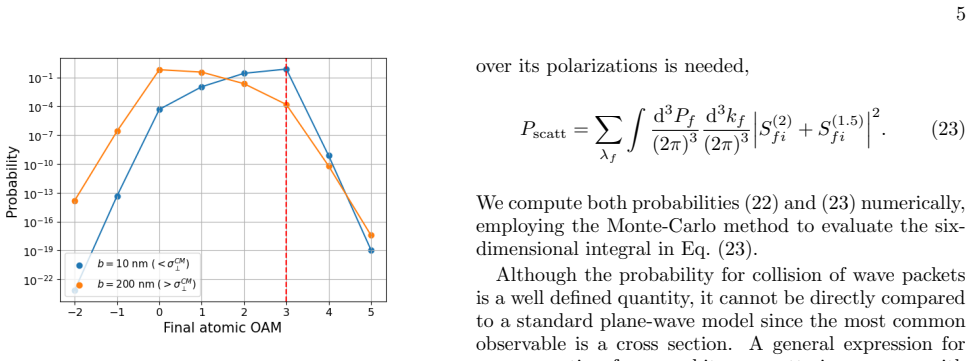
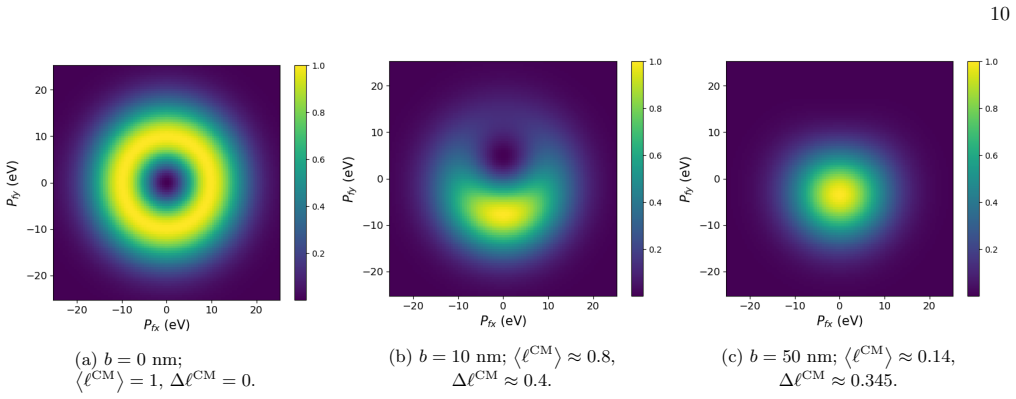
Vortex photons transfer orbital angular momentum to atomic centers of mass with near-perfect efficiency when the collision impact parameter is smaller than the atomic coherence length.
A machine-rendered reading of the paper's core claim, the machinery that carries it, and where it could break.
Core claim
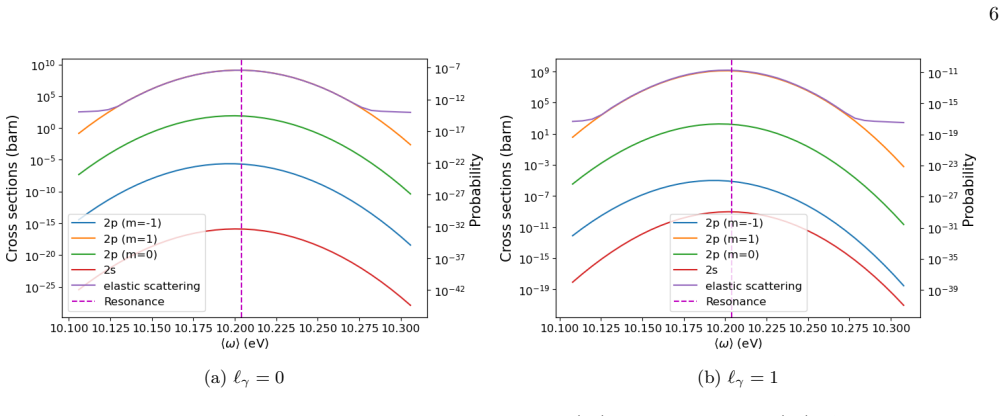
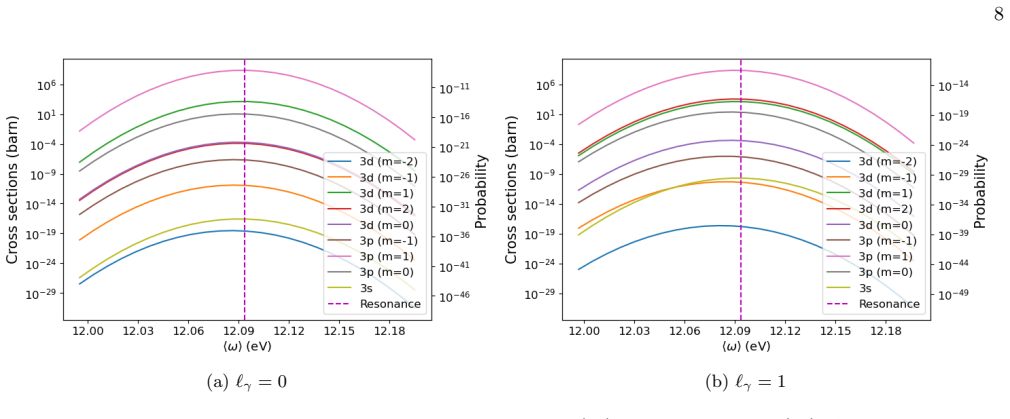
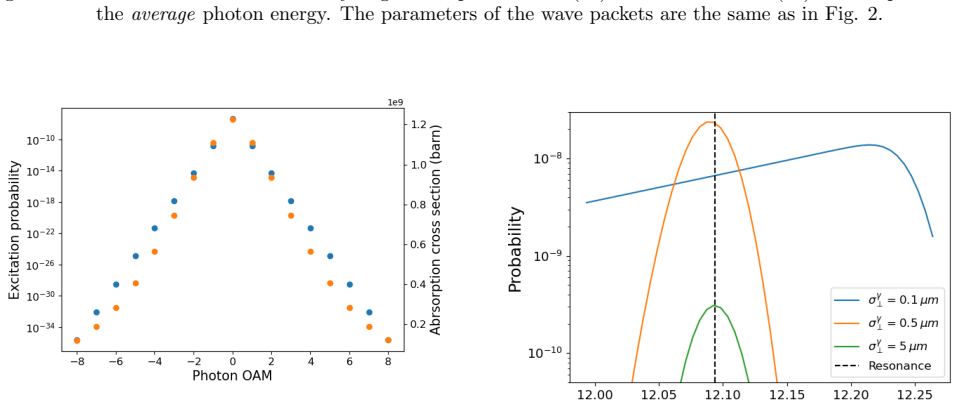
Vortex photons can transfer their orbital angular momentum to the atomic center of mass with near-perfect efficiency in head-on collisions when the impact parameter b is smaller than the atomic transverse coherence length σ. Larger offsets produce a shifted mean OAM and finite variance controlled by b/σ. The wave-packet nature enables selection-rule-violating transitions with dipole dominance. Femtosecond pulses show resonant absorption line shaping due to finite spatial coherence. Transverse recoil phenomena, the superkick and selfkick, arise from the interaction geometry.
What carries the argument
The comparison of the photon's impact parameter b to the atomic transverse coherence length σ, which determines the efficiency and statistics of orbital angular momentum transfer between spatially localized wave packets.
If this is right
- Near-perfect OAM transfer occurs for b smaller than σ in head-on collisions
- Mean OAM shifts and variance increases with the ratio b/σ for larger offsets
- Electronic transitions violating standard selection rules become possible, though weaker than dipole
- Femtosecond pulses experience measurable reshaping of absorption lines from photon coherence
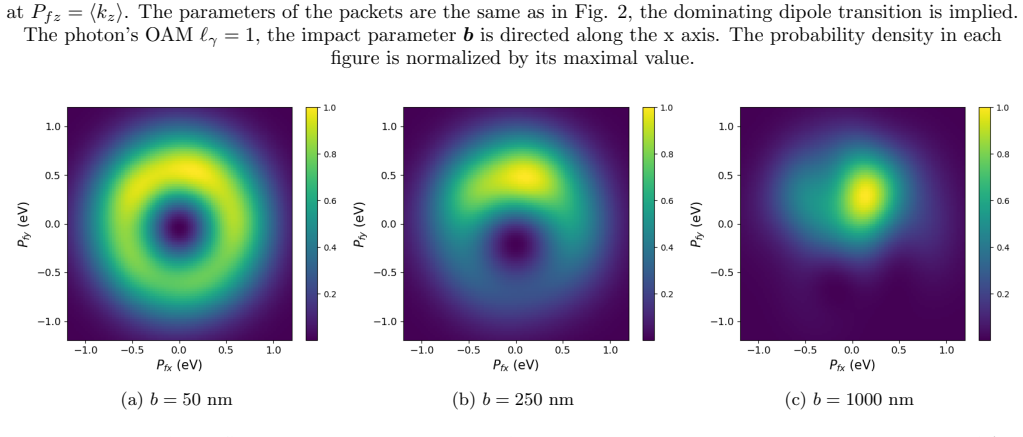
- Atoms experience transverse recoil called superkick near photonic vortices, with a dual selfkick for twisted atoms
Where Pith is reading between the lines
- This interaction could enable preparation of non-Gaussian atomic wave packets for quantum simulation or sensing applications
- Experiments with cold atomic beams or ions in traps could map OAM transfer fidelity directly against measured coherence length
- The same wave-packet treatment might generalize to other structured light beams for controlling atomic momentum without lattices
- Combining the superkick with Penning traps offers a path to generate and manipulate twisted atomic packets in vacuum
Load-bearing premise
The photon and the atomic center of mass behave as spatially localized wave packets whose transverse coherence length sets the scale for interaction outcomes.
What would settle it
A direct measurement of the atomic center-of-mass OAM distribution after absorption showing near-zero variance and near-100 percent transfer efficiency for b much smaller than σ.
Figures
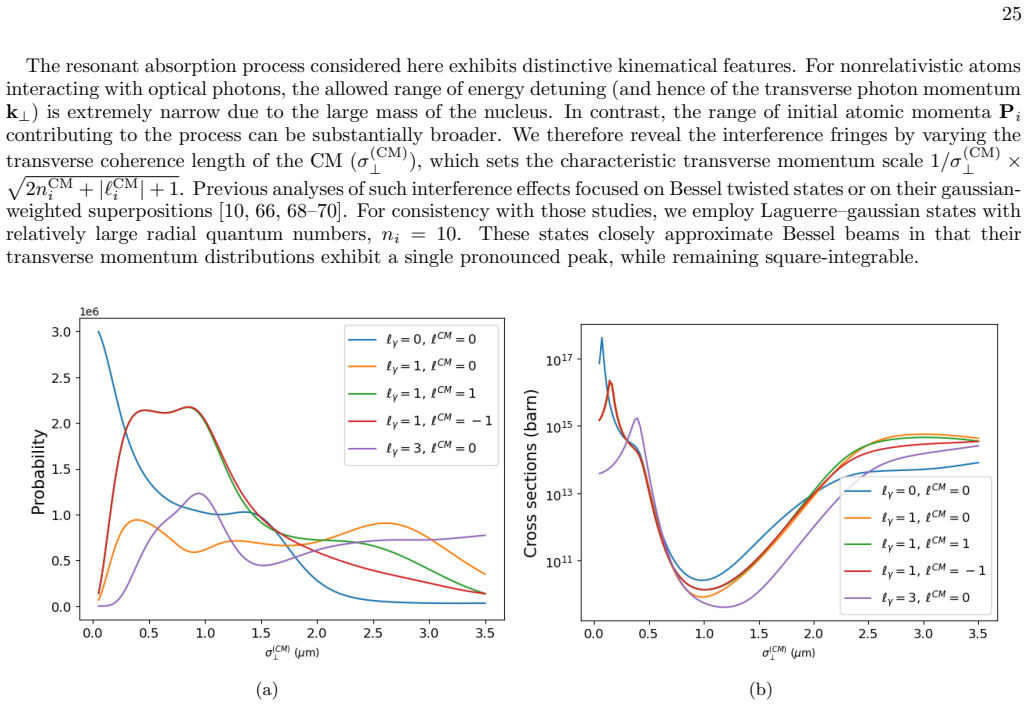


read the original abstract
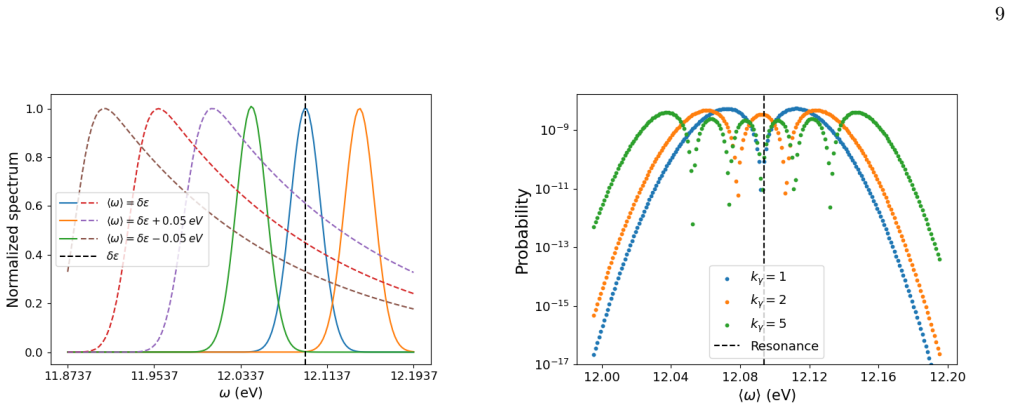
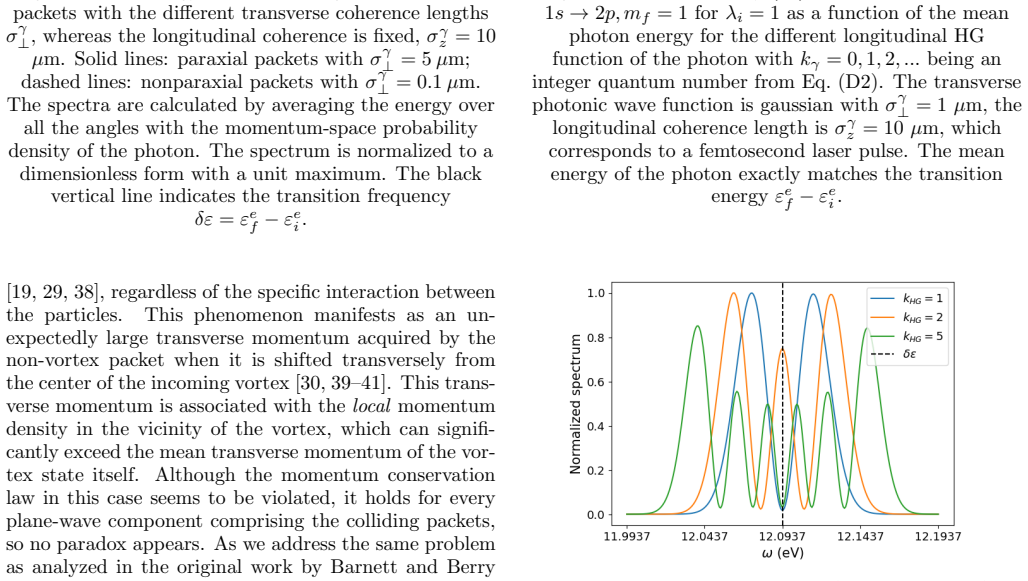
We investigate absorption and scattering of structured light by atoms, treating the photon and the atomic center of mass as spatially localized wave packets. We show that vortex photons can transfer orbital angular momentum (OAM) to the atomic center of mass with near-perfect efficiency in head-on collisions when the impact parameter $b$ is smaller than the atomic transverse coherence length $\sigma$, which ranges from nanometers to sub-micrometer scales. Larger offsets result in a shifted mean OAM and a finite variance, both controlled by the ratio $b/\sigma$. The wave-packet nature of light enables electronic transitions that violate standard selection rules, albeit with a clear hierarchy where the dipole transition dominates. For femtosecond pulses, the finite spatial coherence of the photon leads to measurable shaping of the resonant absorption lines. We demonstrate a transverse recoil of the atom in a vicinity of the photonic vortex, dubbed "the superkick", and its dual effect - "the selfkick" - when an initially twisted atomic packet experiences recoil upon absorbing a gaussian photon. These phenomena are within reach of experimental capabilities using structured light in combination with cold atomic beams and ions in Penning traps, providing a route to the controlled generation and manipulation of non-gaussian atomic packets.
Editorial analysis
A structured set of objections, weighed in public.
Referee Report
Summary. The paper investigates absorption and scattering of structured (vortex) light by free atoms, modeling both the photon and atomic center-of-mass motion as spatially localized wave packets. It claims that vortex photons transfer orbital angular momentum (OAM) to the atomic center of mass with near-perfect efficiency in head-on collisions when the impact parameter b is smaller than the atomic transverse coherence length σ; larger b produces a shifted mean OAM and finite variance controlled by the ratio b/σ. The wave-packet treatment is said to enable electronic transitions that violate standard selection rules (with dipole still dominant), to produce measurable reshaping of resonant absorption lines for femtosecond pulses, and to generate a transverse “superkick” recoil near the photonic vortex together with its dual “selfkick” for an initially twisted atomic packet. These effects are asserted to be experimentally accessible with cold atomic beams and trapped ions.
Significance. If the central overlap calculation is verified and the factorization assumptions hold, the work would provide a concrete route to controlled generation of non-Gaussian atomic wave packets via OAM transfer from structured light, extending existing studies of twisted-light–atom interactions into the regime of spatially localized packets. The predicted b/σ scaling of mean OAM and variance, together with the superkick/selfkick phenomena, would constitute falsifiable signatures measurable with current cold-atom and ion-trap technology.
major comments (2)
- [Abstract] Abstract and main text: the headline claim of “near-perfect efficiency” for OAM transfer when b ≪ σ is presented without an explicit evaluation or analytic bound on the transverse overlap integral between a realistic Laguerre-Gaussian (or Bessel) photon wave packet and the atomic Gaussian packet. The skeptic note correctly flags that finite radial support and any longitudinal momentum spread could cause the integral to saturate below unity even at b = 0; this integral is load-bearing for the efficiency statement and must be shown.
- [Main text] Main text (wave-packet model section): the assumption that longitudinal and radial degrees of freedom factorize without introducing phase averaging is stated but not justified by an explicit calculation or error estimate. If the photon mode has finite radial extent or the atomic packet has longitudinal spread, the claimed unit OAM transfer is at risk; a concrete bound or numerical check against these corrections is required.
minor comments (1)
- Notation: the symbols b and σ are introduced in the abstract but their precise definitions (e.g., whether σ is the 1/e width or rms width of the atomic packet) should be stated at first use for reproducibility.
Simulated Author's Rebuttal
We thank the referee for the careful and constructive review of our manuscript. The comments highlight important points regarding the substantiation of our central claims on OAM transfer efficiency and the validity of the wave-packet factorization. We address each major comment below and will revise the manuscript to incorporate explicit calculations and bounds as requested.
read point-by-point responses
-
Referee: [Abstract] Abstract and main text: the headline claim of “near-perfect efficiency” for OAM transfer when b ≪ σ is presented without an explicit evaluation or analytic bound on the transverse overlap integral between a realistic Laguerre-Gaussian (or Bessel) photon wave packet and the atomic Gaussian packet. The skeptic note correctly flags that finite radial support and any longitudinal momentum spread could cause the integral to saturate below unity even at b = 0; this integral is load-bearing for the efficiency statement and must be shown.
Authors: We agree that the claim of near-perfect efficiency requires explicit support via the transverse overlap integral. The manuscript derives the OAM transfer from the overlap of the photon and atomic wave packets under the assumption that the packets are well-localized and the impact parameter satisfies b ≪ σ, leading to near-unit overlap in the paraxial regime. However, we acknowledge that a concrete analytic evaluation and bounds were not provided. In the revised manuscript we will add an explicit calculation of the overlap integral for Laguerre-Gaussian photon packets with the atomic Gaussian packet. This will include the analytic form, demonstration that the integral approaches unity for b = 0 under the stated conditions, and quantitative bounds on deviations arising from finite radial support and longitudinal momentum spread, confirming that saturation below unity remains negligible within the parameter range of the paper. revision: yes
-
Referee: [Main text] Main text (wave-packet model section): the assumption that longitudinal and radial degrees of freedom factorize without introducing phase averaging is stated but not justified by an explicit calculation or error estimate. If the photon mode has finite radial extent or the atomic packet has longitudinal spread, the claimed unit OAM transfer is at risk; a concrete bound or numerical check against these corrections is required.
Authors: We accept that the factorization assumption between longitudinal and radial degrees of freedom needs explicit justification and error estimation. The model treats the packets as factorizable under the paraxial and narrow-bandwidth approximations, but no detailed error analysis was included. In the revision we will supply an explicit calculation of the phase-averaging corrections, together with analytic bounds on the resulting deviation from unit OAM transfer. These bounds will be evaluated for realistic radial extents and longitudinal spreads, supplemented by numerical checks for representative parameter values, to demonstrate that the corrections remain small and do not invalidate the central results. revision: yes
Circularity Check
Derivation self-contained; no circular reductions identified
full rationale
The paper constructs its results on OAM transfer efficiency, superkick, and selection-rule violations directly from the wave-packet overlap integrals and the interaction Hamiltonian in the transverse coherence basis. No equation reduces a claimed prediction to a fitted parameter or to a self-citation whose content is itself the target result. The statements about near-unit transfer for b ≪ σ and the b/σ scaling of mean and variance are explicit consequences of the Gaussian-Laguerre overlap rather than definitions or renamings. The model is presented as an ansatz whose consequences are computed, with no load-bearing uniqueness theorem imported from the authors' prior work. The derivation therefore remains independent of its own outputs.
Axiom & Free-Parameter Ledger
free parameters (1)
- b/σ ratio
axioms (1)
- domain assumption Photon and atomic center-of-mass degrees of freedom can be treated as independent spatially localized wave packets
Lean theorems connected to this paper
-
IndisputableMonolith/Cost/FunctionalEquation.leanwashburn_uniqueness_aczel unclear?
unclearRelation between the paper passage and the cited Recognition theorem.
vortex photons can transfer orbital angular momentum (OAM) to the atomic center of mass with near-perfect efficiency in head-on collisions when the impact parameter b is smaller than the atomic transverse coherence length σ
What do these tags mean?
- matches
- The paper's claim is directly supported by a theorem in the formal canon.
- supports
- The theorem supports part of the paper's argument, but the paper may add assumptions or extra steps.
- extends
- The paper goes beyond the formal theorem; the theorem is a base layer rather than the whole result.
- uses
- The paper appears to rely on the theorem as machinery.
- contradicts
- The paper's claim conflicts with a theorem or certificate in the canon.
- unclear
- Pith found a possible connection, but the passage is too broad, indirect, or ambiguous to say the theorem truly supports the claim.
Reference graph
Works this paper leans on
-
[1]
We can explain them analytically for most relevant regime in experiment, whereb≪σ γ ⊥ andσ (CM) ⊥ ≪σ γ ⊥ and hence the asymptotics of Bessel functions can be used. In this case,the probability for the CM to carry the OAM valueofℓ 0 +mis approximately P(ℓ 0 +m) = " b 2σγ ⊥ |m| |m|! σ(CM) ⊥ 2σγ ⊥ !|ℓ0+m| |ℓ0 +m|! #2 .(14) From this, we obtain the ratio P(ℓ ...
-
[2]
We refer to this as“the selfkick” effect. The rele- vant parameter regime, however, differs from that of the conventional superkick. The selfkick becomes significant only for impact parameters comparable to the width of the photon packet - that is, at least hundreds of nanome- ters - and it becomes more pronounced as the CM packet expands. Qualitatively, ...
- [3]
-
[4]
I. P. Ivanov, Progress in Particle and Nuclear Physics127, 103987 (2022)
work page 2022
-
[5]
B. A. Knyazev and V. Serbo, Physics-Uspekhi61, 449 (2018)
work page 2018
- [6]
-
[7]
H. Rubinsztein-Dunlop, A. Forbes, M. V. Berry, M. R. Dennis, D. L. Andrews, M. Mansuripur, C. Denz, C. Alpmann, P. Banzer, T. Bauer, et al., Journal of Optics19, 013001 (2016)
work page 2016
-
[8]
K. Y. Bliokh, E. Karimi, M. J. Padgett, M. A. Alonso, M. R. Dennis, A. Dudley, A. Forbes, S. Zahedpour, S. W. Hancock, H. M. Milchberg, et al., Journal of Optics25, 103001 (2023)
work page 2023
-
[9]
C. T. Schmiegelow, J. Schulz, H. Kaufmann, T. Ruster, U. G. Poschinger, and F. Schmidt-Kaler, Nature communications 7, 12998 (2016)
work page 2016
-
[10]
K. Mukherjee, S. Majumder, P. K. Mondal, and B. Deb, Journal of Physics B: Atomic, Molecular and Optical Physics51, 015004 (2018)
work page 2018
- [11]
-
[12]
I. P. Ivanov, Annalen der Physik534, 2100128 (2022)
work page 2022
-
[13]
P. Maslennikov, A. Volotka, and S. Baturin, Physical Review A109, 052805 (2024)
work page 2024
- [14]
-
[15]
Helseth, Physical Review A69, 015601 (2004)
L. Helseth, Physical Review A69, 015601 (2004)
work page 2004
-
[16]
A. G. Hayrapetyan, O. Matula, A. Surzhykov, and S. Fritzsche, The European Physical Journal D67, 167 (2013)
work page 2013
-
[17]
V. Lembessis, D. Ellinas, M. Babiker, and O. Al-Dossary, Physical Review A89, 053616 (2014)
work page 2014
-
[18]
V. E. Lembessis, Physical Review A96, 013622 (2017)
work page 2017
-
[19]
D. V. Karlovets and V. G. Serbo, Physical Review D101, 076009 (2020)
work page 2020
-
[20]
D. V. Karlovets, Journal of High Energy Physics2017, 1 (2017)
work page 2017
-
[21]
S. M. Barnett and M. Berry, Journal of Optics15, 125701 (2013)
work page 2013
-
[22]
A. Fuhrmanek, A. M. Lance, C. Tuchendler, P. Grangier, Y. R. Sortais, and A. Browaeys, New Journal of Physics12, 053028 (2010)
work page 2010
-
[23]
A. Fuhrmanek, Y. R. Sortais, P. Grangier, and A. Browaeys, Physical Review A—Atomic, Molecular, and Optical Physics 82, 023623 (2010)
work page 2010
-
[24]
D. Karlovets, S. Baturin, G. Geloni, G. Sizykh, and V. Serbo, The European Physical Journal C83, 372 (2023)
work page 2023
-
[25]
D. Karlovets, S. Baturin, G. Geloni, G. Sizykh, and V. Serbo, The European Physical Journal C82, 1008 (2022)
work page 2022
- [26]
-
[27]
Messiah,Quantum mechanics(Courier Corporation, 2014)
A. Messiah,Quantum mechanics(Courier Corporation, 2014)
work page 2014
-
[28]
J. Sakurai,Advanced Quantum Mechanics, A-W series in advanced physics (Addison-Wesley Publishing Company, 1967), ISBN 9780201067101, URLhttps://books.google.ru/books?id=ZXEsAAAAYAAJ
work page 1967
-
[29]
A. D. Chaikovskaia, D. V. Karlovets, and V. Serbo, Physical Review A109, 012222 (2024)
work page 2024
- [30]
- [31]
-
[32]
Z. Li, S. Liu, B. Liu, L. Ji, and I. P. Ivanov, Physical Review Letters133, 265001 (2024)
work page 2024
- [33]
-
[34]
A. Shchepkin, D. Grosman, I. Shkarupa, and D. Karlovets, The European Physical Journal C85, 11 (2025)
work page 2025
-
[35]
L. Mandel and E. Wolf,Optical Coherence and Quantum Optics(Cambridge University Press, 1995)
work page 1995
-
[36]
M. Scully and M. Zubairy,Quantum optics(Cambridge university press, 1997)
work page 1997
-
[37]
D. Karlovets, New J. Phys.23, 033048 (2021), URLhttps://dx.doi.org/10.1088/1367-2630/abeacc
-
[38]
V. S. Melezhik and S. Shadmehri, The Journal of Chemical Physics162(2025)
work page 2025
-
[39]
M. Fedorov, M. Efremov, A. Kazakov, K. Chan, C. Law, and J. Eberly, Physical Review A—Atomic, Molecular, and Optical Physics72, 032110 (2005)
work page 2005
-
[40]
I. P. Ivanov, B. Liu, and P. Zhang, Physical Review A105, 013522 (2022)
work page 2022
-
[41]
A. Afanasev, C. E. Carlson, and A. Mukherjee, Physical Review Research3, 023097 (2021)
work page 2021
-
[42]
A. Afanasev, C. E. Carlson, and A. Mukherjee, Physical Review A105, L061503 (2022)
work page 2022
-
[43]
S. Liu, B. Liu, I. P. Ivanov, and L. Ji, Physical Review A112, 032814 (2025)
work page 2025
-
[44]
K. R. Anton, S. L. Kaufman, W. Klempt, G. Moruzzi, R. Neugart, E. W. Otten, and B. Schinzler, Phys. Rev. Lett.40, 642 (1978), URLhttps://link.aps.org/doi/10.1103/PhysRevLett.40.642
-
[45]
K. K¨ onig, K. Minamisono, J. Lantis, S. Pineda, and R. Powel, Phys. Rev. A103, 032806 (2021), URLhttps://link. aps.org/doi/10.1103/PhysRevA.103.032806
-
[46]
U. Even, J. Jortner, D. Noy, N. Lavie, and C. Cossart-Magos, The Journal of Chemical Physics112, 8068 (2000)
work page 2000
-
[47]
P. K. Mondal, B. Deb, and S. Majumder, Physical Review A89, 063418 (2014)
work page 2014
-
[48]
A. Muthukrishnan and C. Stroud Jr, Journal of Optics B: Quantum and Semiclassical Optics4, S73 (2002)
work page 2002
-
[49]
A. Peshkov, Y. Bidasyuk, R. Lange, N. Huntemann, E. Peik, and A. Surzhykov, Physical Review A107, 023106 (2023)
work page 2023
-
[50]
A. V. Afanasev, D. Karlovets, and V. Serbo, Physical Review C100, 051601 (2019)
work page 2019
-
[51]
A. Afanasev, D. Karlovets, and V. Serbo, Physical Review C103, 054612 (2021)
work page 2021
- [52]
-
[53]
F. An, D. Bai, H. Cai, S. Chen, X. Chen, H. Duyang, L. Gao, S. Ge, J. He, J. Huang, et al., Chinese Physics Letters42, 110102 (2025)
work page 2025
-
[54]
N. Geerits, S. Sponar, K. E. Steffen, W. M. Snow, S. R. Parnell, G. Mauri, G. N. Smith, R. M. Dalgliesh, and V. de Haan, Physical Review Research7, 013046 (2025)
work page 2025
-
[55]
B. Barrett, R. Geiger, I. Dutta, M. Meunier, B. Canuel, A. Gauguet, P. Bouyer, and A. Landragin, Comptes Rendus. Physique15, 875 (2014). 29
work page 2014
- [56]
- [57]
- [58]
-
[59]
A. Nicolas, L. Veissier, L. Giner, E. Giacobino, D. Maxein, and J. Laurat, Nature Photonics8, 234 (2014)
work page 2014
-
[60]
Y.-H. Ye, L. Zeng, M.-X. Dong, W.-H. Zhang, E.-Z. Li, D.-C. Li, G.-C. Guo, D.-S. Ding, and B.-S. Shi, Physical Review Letters129, 193601 (2022)
work page 2022
-
[61]
C. D. Bruzewicz, J. Chiaverini, R. McConnell, and J. M. Sage, Applied physics reviews6(2019)
work page 2019
-
[62]
D. Karlovets,Source of relativistic electrons with angular momentum, the russian science foundation project no. 23-62- 10026(2023), URLhttps://rscf.ru/en/project/23-62-10026/
work page 2023
-
[63]
V. B. Berestetskii, E. M. Lifshitz, and L. P. Pitaevskii,Quantum Electrodynamics: Volume 4, vol. 4 (Butterworth- Heinemann, 1982)
work page 1982
-
[64]
Karlovets, Physical Review A98, 012137 (2018)
D. Karlovets, Physical Review A98, 012137 (2018)
work page 2018
-
[65]
H. Scholz-Marggraf, S. Fritzsche, V. Serbo, A. Afanasev, and A. Surzhykov, Physical Review A90, 013425 (2014)
work page 2014
-
[66]
D. A. Varshalovich, A. N. Moskalev, and V. K. Khersonskii,Quantum Theory of Angular Momentum(1988), URLhttps: //api.semanticscholar.org/CorpusID:117798939
work page 1988
-
[67]
I. I. Pavlov, A. D. Chaikovskaia, and D. V. Karlovets, Phys. Rev. A110, L031101 (2024), URLhttps://link.aps.org/ doi/10.1103/PhysRevA.110.L031101
-
[68]
I. P. Ivanov, Physical Review D—Particles, Fields, Gravitation, and Cosmology83, 093001 (2011)
work page 2011
-
[69]
D. Karlovets, A. Chaikovskaia, D. Grosman, D. Kargina, A. Shchepkin, and G. Sizykh, Communications Physics8, 192 (2025)
work page 2025
- [70]
-
[71]
I. P. Ivanov, D. Seipt, A. Surzhykov, and S. Fritzsche, Phys. Rev. D94, 076001 (2016), URLhttps://link.aps.org/doi/ 10.1103/PhysRevD.94.076001
-
[72]
I. P. Ivanov, N. Korchagin, A. Pimikov, and P. Zhang, Physical Review D101, 016007 (2020)
work page 2020
discussion (0)
Sign in with ORCID, Apple, or X to comment. Anyone can read and Pith papers without signing in.