Recognition: 2 theorem links
· Lean TheoremMMP-Refer: Multimodal Path Retrieval-augmented LLMs For Explainable Recommendation
Pith reviewed 2026-05-13 17:24 UTC · model grok-4.3
The pith
Multimodal retrieval paths and a lightweight collaborative adapter let LLMs generate personalized, explainable recommendations from user-item data.
A machine-rendered reading of the paper's core claim, the machinery that carries it, and where it could break.
Core claim
MMP-Refer obtains multimodal embeddings with a sequential recommendation model that uses joint residual coding, extracts informative retrieval paths via heuristic search over those embeddings, and injects a lightweight collaborative adapter that maps the encodings of interaction subgraphs into the LLM's semantic space as soft prompts, thereby allowing the language model to reason over both semantic and collaborative information for generating explanations.
What carries the argument
Multimodal retrieval paths produced by heuristic search on joint-residual-coded embeddings, integrated via a trainable lightweight collaborative adapter that supplies subgraph encodings as soft prompts to the LLM.
If this is right
- Explanations become grounded in concrete multimodal user-item paths rather than abstract graph structures.
- Collaborative signals reach the LLM without requiring full retraining or complex alignment steps.
- Sequential models with residual coding can directly supply the embeddings needed for path retrieval.
- The adapter keeps the LLM's core parameters frozen while still incorporating interaction data.
Where Pith is reading between the lines
- The same path-retrieval plus adapter pattern could be tested on non-recommendation tasks that need both semantic and relational context.
- Scaling the heuristic search to very large item sets may require additional pruning rules not detailed here.
- If the multimodal embeddings capture complementary signals well, performance should improve most on items with rich visual or textual side information.
Load-bearing premise
The heuristic search over multimodal embeddings produces retrieval paths that are both informative to the LLM and faithful to the underlying user-item interactions.
What would settle it
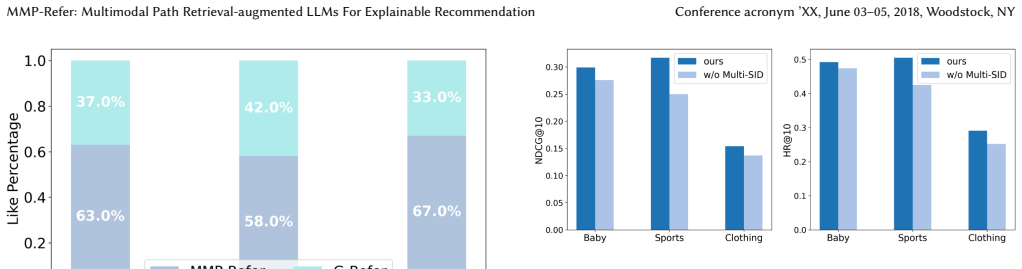
Running the same LLM generation pipeline with the retrieval paths or the collaborative adapter removed and observing no drop in recommendation accuracy or explanation faithfulness on standard metrics would show the components add no value.
Figures



read the original abstract
Explainable recommendations help improve the transparency and credibility of recommendation systems, and play an important role in personalized recommendation scenarios. At present, methods for explainable recommendation based on large language models(LLMs) often consider introducing collaborative information to enhance the personalization and accuracy of the model, but ignore the multimodal information in the recommendation dataset; In addition, collaborative information needs to be aligned with the semantic space of LLM. Introducing collaborative signals through retrieval paths is a good choice, but most of the existing retrieval path collection schemes use the existing Explainable GNN algorithms. Although these methods are effective, they are relatively unexplainable and not be suitable for the recommendation field. To address the above challenges, we propose MMP-Refer, a framework using \textbf{M}ulti\textbf{M}odal Retrieval \textbf{P}aths with \textbf{Re}trieval-augmented LLM \textbf{F}or \textbf{E}xplainable \textbf{R}ecommendation. We use a sequential recommendation model based on joint residual coding to obtain multimodal embeddings, and design a heuristic search algorithm to obtain retrieval paths by multimodal embeddings; In the generation phase, we integrated a trainable lightweight collaborative adapter to map the graph encoding of interaction subgraphs to the semantic space of the LLM, as soft prompts to enhance the understanding of interaction information by the LLM. Extensive experiments have demonstrated the effectiveness of our approach. Codes and data are available at https://github.com/pxcstart/MMP-Refer.
Editorial analysis
A structured set of objections, weighed in public.
Referee Report
Summary. The manuscript proposes MMP-Refer, a framework for explainable recommendation that obtains multimodal embeddings via a joint residual coding sequential model, applies an unspecified heuristic search to derive retrieval paths, and feeds graph encodings of interaction subgraphs through a trainable lightweight collaborative adapter as soft prompts to an LLM. The central claim is that this pipeline improves both accuracy and explainability over prior LLM-based and GNN-based methods by incorporating multimodal information while aligning collaborative signals with the LLM's semantic space; the authors state that extensive experiments confirm effectiveness.
Significance. If the empirical claims hold after addressing the gaps below, the work would offer a practical route to multimodal explainable recommendation that avoids the opacity of GNN path generators while leveraging retrieval-augmented LLMs. The combination of residual-coded multimodal embeddings with an adapter-based prompt mechanism is a plausible way to inject interaction structure without full fine-tuning, and the public code release would support reproducibility.
major comments (3)
- [3.2] Section 3.2 (heuristic search): the retrieval-path construction is described only at a high level with no formal objective function, pseudocode, or termination criterion. Without an explicit fidelity metric (e.g., path overlap with observed user-item sequences or multimodal consistency score), it is impossible to verify that the paths reflect genuine collaborative signals rather than embedding-space artifacts.
- [4] Section 4 (experiments): no ablation isolates the heuristic search component (e.g., versus random walks, GNN-derived paths, or direct embedding retrieval). Given that the central accuracy and explainability claims rest on the quality of these paths, the absence of such controls leaves open the possibility that gains derive primarily from the adapter or the base LLM rather than the multimodal path mechanism.
- [4.3] Section 4.3 (evaluation metrics): the abstract asserts positive outcomes but the reported results lack quantitative tables, statistical significance tests, or error analysis comparing path faithfulness to held-out interactions. This weakens the ability to judge whether the adapter successfully compensates for any unfaithful paths.
minor comments (2)
- [Abstract] Abstract: the sentence 'not be suitable for the recommendation field' contains a grammatical error and should read 'not suitable'.
- [3.3] Notation: the distinction between 'multimodal embeddings' and 'graph encoding of interaction subgraphs' is introduced without an explicit mapping equation or diagram, making the adapter input unclear.
Simulated Author's Rebuttal
We thank the referee for the constructive and detailed comments. We agree that clarifying the heuristic search procedure and strengthening the experimental analysis will improve the manuscript. Below we respond point-by-point to the major comments and indicate the revisions we will make.
read point-by-point responses
-
Referee: [3.2] Section 3.2 (heuristic search): the retrieval-path construction is described only at a high level with no formal objective function, pseudocode, or termination criterion. Without an explicit fidelity metric (e.g., path overlap with observed user-item sequences or multimodal consistency score), it is impossible to verify that the paths reflect genuine collaborative signals rather than embedding-space artifacts.
Authors: We agree that Section 3.2 provides only a high-level description. In the revised manuscript we will add: (1) a formal objective function that maximizes multimodal consistency and path overlap with observed user-item sequences, (2) complete pseudocode for the heuristic search algorithm, and (3) an explicit termination criterion based on a fidelity threshold. We will also report the fidelity metric on held-out data to demonstrate that the retrieved paths capture genuine collaborative signals. revision: yes
-
Referee: [4] Section 4 (experiments): no ablation isolates the heuristic search component (e.g., versus random walks, GNN-derived paths, or direct embedding retrieval). Given that the central accuracy and explainability claims rest on the quality of these paths, the absence of such controls leaves open the possibility that gains derive primarily from the adapter or the base LLM rather than the multimodal path mechanism.
Authors: We acknowledge the value of isolating the contribution of the heuristic search. The revised manuscript will include a new ablation study that replaces our heuristic search with (a) random walks on the same graph, (b) paths generated by a standard GNN explainer, and (c) direct top-k embedding retrieval. These results will be added to Section 4 to show that the multimodal path mechanism is responsible for the observed gains in accuracy and explainability. revision: yes
-
Referee: [4.3] Section 4.3 (evaluation metrics): the abstract asserts positive outcomes but the reported results lack quantitative tables, statistical significance tests, or error analysis comparing path faithfulness to held-out interactions. This weakens the ability to judge whether the adapter successfully compensates for any unfaithful paths.
Authors: The current manuscript contains quantitative tables in Section 4.3, but we agree that statistical significance testing and path-faithfulness error analysis are missing. In the revision we will add paired t-tests and Wilcoxon tests across all metrics, plus an error analysis that measures path overlap with held-out user-item sequences and reports how often the adapter compensates for lower-fidelity paths. These additions will be placed in Section 4.3 and the appendix. revision: yes
Circularity Check
No significant circularity in derivation chain
full rationale
The paper proposes MMP-Refer as an empirical framework: multimodal embeddings are obtained from a sequential joint residual coding model, a heuristic search produces retrieval paths, and a trainable collaborative adapter maps subgraph encodings to LLM prompts. No equations, derivations, or first-principles results are presented that reduce any claimed prediction or output to the inputs by construction. Effectiveness is asserted via experiments on held-out recommendation metrics rather than self-referential fits or self-citation chains. The approach is self-contained against external benchmarks with no load-bearing circular steps.
Axiom & Free-Parameter Ledger
axioms (1)
- domain assumption Multimodal embeddings from joint residual coding preserve both item semantics and user interaction structure.
Lean theorems connected to this paper
-
IndisputableMonolith/Cost/FunctionalEquation.leanwashburn_uniqueness_aczel unclear?
unclearRelation between the paper passage and the cited Recognition theorem.
We use a sequential recommendation model based on joint residual coding to obtain multimodal embeddings, and design a heuristic search algorithm to obtain retrieval paths by multimodal embeddings
-
IndisputableMonolith/Foundation/ArithmeticFromLogic.leanLogicNat_equivNat unclear?
unclearRelation between the paper passage and the cited Recognition theorem.
we integrated a trainable lightweight collaborative adapter to map the graph encoding of interaction subgraphs to the semantic space of the LLM
What do these tags mean?
- matches
- The paper's claim is directly supported by a theorem in the formal canon.
- supports
- The theorem supports part of the paper's argument, but the paper may add assumptions or extra steps.
- extends
- The paper goes beyond the formal theorem; the theorem is a base layer rather than the whole result.
- uses
- The paper appears to rely on the theorem as machinery.
- contradicts
- The paper's claim conflicts with a theorem or certificate in the canon.
- unclear
- Pith found a possible connection, but the passage is too broad, indirect, or ambiguous to say the theorem truly supports the claim.
Reference graph
Works this paper leans on
-
[1]
Heng Chang, Jie Cai, and Jia Li. 2023. Knowledge graph completion with counter- factual augmentation. InProceedings of the ACM Web Conference 2023. 2611–2620
work page 2023
-
[2]
Heng Chang, Jiangnan Ye, Alejo Lopez-Avila, Jinhua Du, and Jia Li. 2024. Path- based explanation for knowledge graph completion. InProceedings of the 30th ACM SIGKDD Conference on Knowledge Discovery and Data Mining. 231–242
work page 2024
-
[3]
Hanxiong Chen, Shaoyun Shi, Yunqi Li, and Yongfeng Zhang. 2021. Neural collaborative reasoning. InProceedings of the web conference 2021. 1516–1527
work page 2021
-
[4]
Nuo Chen, Yuhan Li, Jianheng Tang, and Jia Li. 2024. Graphwiz: An instruction- following language model for graph computational problems. InProceedings of the 30th ACM SIGKDD Conference on Knowledge Discovery and Data Mining. 353–364
work page 2024
-
[5]
Qiang Cui, Shu Wu, Qiang Liu, Wen Zhong, and Liang Wang. 2018. MV-RNN: A multi-view recurrent neural network for sequential recommendation.IEEE Transactions on Knowledge and Data Engineering32, 2 (2018), 317–331
work page 2018
-
[6]
Li Dong, Shaohan Huang, Furu Wei, Maria Lapata, Ming Zhou, and Ke Xu. 2017. Learning to generate product reviews from attributes. In15th EACL 2017 Software Demonstrations. Association for Computational Linguistics, 623–632
work page 2017
-
[7]
Gérard Hamiache and Florian Navarro. 2020. Associated consistency, value and graphs.International Journal of Game Theory49 (2020), 227–249
work page 2020
-
[8]
Ruining He and Julian McAuley. 2016. VBPR: visual bayesian personalized ranking from implicit feedback. InProceedings of the AAAI conference on artificial intelligence, Vol. 30
work page 2016
-
[9]
Qiang Huang, Makoto Yamada, Yuan Tian, Dinesh Singh, and Yi Chang. 2022. Graphlime: Local interpretable model explanations for graph neural networks. IEEE Transactions on Knowledge and Data Engineering35, 7 (2022), 6968–6972
work page 2022
-
[10]
TN Kipf. 2016. Semi-supervised classification with graph convolutional networks. arXiv preprint arXiv:1609.02907(2016)
work page internal anchor Pith review Pith/arXiv arXiv 2016
-
[11]
Jia Li, Xiangguo Sun, Yuhan Li, Zhixun Li, Hong Cheng, and Jeffrey Xu Yu
-
[12]
In Proceedings of the 30th ACM SIGKDD Conference on Knowledge Discovery and Data Mining
Graph intelligence with large language models and prompt learning. In Proceedings of the 30th ACM SIGKDD Conference on Knowledge Discovery and Data Mining. 6545–6554
-
[13]
Lei Li, Li Chen, and Ruihai Dong. 2021. Caesar: context-aware explanation based on supervised attention for service recommendations.Journal of Intelligent Information Systems57, 1 (2021), 147–170
work page 2021
- [14]
-
[15]
Lei Li, Yongfeng Zhang, and Li Chen. 2023. Personalized prompt learning for explainable recommendation.ACM Transactions on Information Systems41, 4 (2023), 1–26
work page 2023
-
[16]
Piji Li, Zihao Wang, Zhaochun Ren, Lidong Bing, and Wai Lam. 2017. Neural rating regression with abstractive tips generation for recommendation. InProceed- ings of the 40th International ACM SIGIR conference on Research and Development in Information Retrieval. 345–354
work page 2017
- [17]
-
[18]
Yuhan Li, Xinni Zhang, Linhao Luo, Heng Chang, Yuxiang Ren, Irwin King, and Jia Li. 2025. G-Refer: Graph Retrieval-Augmented Large Language Model for Explainable Recommendation. InProceedings of the ACM on Web Conference 2025. 240–251
work page 2025
-
[19]
Chin-Yew Lin. 2004. Rouge: A package for automatic evaluation of summaries. InText summarization branches out. 74–81
work page 2004
-
[20]
Wanyu Lin, Hao Lan, and Baochun Li. 2021. Generative causal explanations for graph neural networks. InInternational Conference on Machine Learning. PMLR, 6666–6679
work page 2021
-
[21]
Wanyu Lin, Hao Lan, Hao Wang, and Baochun Li. 2022. Orphicx: A causality- inspired latent variable model for interpreting graph neural networks. InPro- ceedings of the IEEE/CVF Conference on Computer Vision and Pattern Recognition. 13729–13738
work page 2022
-
[22]
Ana Lucic, Maartje A Ter Hoeve, Gabriele Tolomei, Maarten De Rijke, and Fabrizio Silvestri. 2022. Cf-gnnexplainer: Counterfactual explanations for graph neural networks. InInternational Conference on Artificial Intelligence and Statistics. PMLR, 4499–4511
work page 2022
-
[23]
Dongsheng Luo, Wei Cheng, Dongkuan Xu, Wenchao Yu, Bo Zong, Haifeng Chen, and Xiang Zhang. 2020. Parameterized explainer for graph neural network. Advances in neural information processing systems33 (2020), 19620–19631
work page 2020
-
[24]
Sichun Luo, Yuanzhang Xiao, Yang Liu, Congduan Li, and Linqi Song. 2022. Towards communication efficient and fair federated personalized sequential rec- ommendation. In2022 5th International Conference on Information Communication and Signal Processing (ICICSP). IEEE, 1–6
work page 2022
-
[25]
Sichun Luo, Yuanzhang Xiao, and Linqi Song. 2022. Personalized federated recommendation via joint representation learning, user clustering, and model adaptation. InProceedings of the 31st ACM international conference on information & knowledge management. 4289–4293
work page 2022
-
[26]
Sichun Luo, Yuanzhang Xiao, Xinyi Zhang, Yang Liu, Wenbo Ding, and Linqi Song. 2024. Perfedrec++: Enhancing personalized federated recommendation with self-supervised pre-training.ACM Transactions on Intelligent Systems and Technology15, 5 (2024), 1–24
work page 2024
-
[27]
Sichun Luo, Xinyi Zhang, Yuanzhang Xiao, and Linqi Song. 2022. HySAGE: A hybrid static and adaptive graph embedding network for context-drifting recommendations. InProceedings of the 31st ACM International Conference on Information & Knowledge Management. 1389–1398
work page 2022
- [28]
-
[29]
Kishore Papineni, Salim Roukos, Todd Ward, and Wei-Jing Zhu. 2002. Bleu: a method for automatic evaluation of machine translation. InProceedings of the 40th annual meeting of the Association for Computational Linguistics. 311–318
work page 2002
-
[30]
Georgina Peake and Jun Wang. 2018. Explanation mining: Post hoc interpretabil- ity of latent factor models for recommendation systems. InProceedings of the 24th ACM SIGKDD International Conference on Knowledge Discovery & Data Mining. 2060–2069
work page 2018
-
[31]
Jakub Raczyński, Mateusz Lango, and Jerzy Stefanowski. 2023. The problem of coherence in natural language explanations of recommendations. InECAI 2023. IOS Press, 1922–1929
work page 2023
- [32]
-
[33]
Lloyd S Shapley et al. 1953. A value for n-person games. (1953)
work page 1953
-
[34]
Petar Veličković, Guillem Cucurull, Arantxa Casanova, Adriana Romero, Pietro Lio, and Yoshua Bengio. 2017. Graph attention networks.arXiv preprint arXiv:1710.10903(2017)
work page internal anchor Pith review Pith/arXiv arXiv 2017
-
[35]
Minh Vu and My T Thai. 2020. Pgm-explainer: Probabilistic graphical model explanations for graph neural networks.Advances in neural information processing systems33 (2020), 12225–12235
work page 2020
- [36]
-
[37]
Suhang Wang, Yilin Wang, Jiliang Tang, Kai Shu, Suhas Ranganath, and Huan Liu
-
[38]
InProceedings of the 26th international conference on world wide web
What your images reveal: Exploiting visual contents for point-of-interest recommendation. InProceedings of the 26th international conference on world wide web. 391–400
-
[39]
Keyulu Xu, Weihua Hu, Jure Leskovec, and Stefanie Jegelka. 2018. How powerful are graph neural networks?arXiv preprint arXiv:1810.00826(2018)
work page internal anchor Pith review Pith/arXiv arXiv 2018
-
[40]
Yang Xu, Lei Zhu, Zhiyong Cheng, Jingjing Li, Zheng Zhang, and Huaxiang Zhang. 2021. Multi-modal discrete collaborative filtering for efficient cold-start recommendation.IEEE Transactions on Knowledge and Data Engineering35, 1 (2021), 741–755
work page 2021
-
[41]
Zhitao Ying, Dylan Bourgeois, Jiaxuan You, Marinka Zitnik, and Jure Leskovec
-
[42]
Gnnexplainer: Generating explanations for graph neural networks.Ad- vances in neural information processing systems32 (2019)
work page 2019
-
[43]
Hao Yuan, Haiyang Yu, Jie Wang, Kang Li, and Shuiwang Ji. 2021. On explain- ability of graph neural networks via subgraph explorations. InInternational conference on machine learning. PMLR, 12241–12252
work page 2021
-
[44]
Weizhe Yuan, Graham Neubig, and Pengfei Liu. 2021. Bartscore: Evaluating generated text as text generation.Advances in neural information processing systems34 (2021), 27263–27277
work page 2021
-
[45]
Shichang Zhang, Yozen Liu, Neil Shah, and Yizhou Sun. 2022. Gstarx: Explaining graph neural networks with structure-aware cooperative games.Advances in neural information processing systems35 (2022), 19810–19823
work page 2022
-
[46]
Shichang Zhang, Jiani Zhang, Xiang Song, Soji Adeshina, Da Zheng, Christos Faloutsos, and Yizhou Sun. 2023. PaGE-Link: Path-based graph neural network explanation for heterogeneous link prediction. InProceedings of the ACM web conference 2023. 3784–3793. Conference acronym ’XX, June 03–05, 2018, Woodstock, NY Trovato et al
work page 2023
-
[47]
Tianyi Zhang, Varsha Kishore, Felix Wu, Kilian Q Weinberger, and Yoav Artzi. 2019. Bertscore: Evaluating text generation with bert.arXiv preprint arXiv:1904.09675(2019)
work page internal anchor Pith review Pith/arXiv arXiv 2019
-
[48]
Yongfeng Zhang, Xu Chen, et al. 2020. Explainable recommendation: A survey and new perspectives.Foundations and Trends®in Information Retrieval14, 1 (2020), 1–101
work page 2020
-
[49]
Yongfeng Zhang, Guokun Lai, Min Zhang, Yi Zhang, Yiqun Liu, and Shaoping Ma. 2014. Explicit factor models for explainable recommendation based on phrase-level sentiment analysis. InProceedings of the 37th international ACM SIGIR conference on Research & development in information retrieval. 83–92
work page 2014
-
[50]
Yaxin Zhu, Yikun Xian, Zuohui Fu, Gerard De Melo, and Yongfeng Zhang. 2021. Faithfully explainable recommendation via neural logic reasoning.arXiv preprint arXiv:2104.07869(2021). A Technique Details A.1 RQ-V AE Residual Quantized Variational Autoencoder (RQ-VAE) aims to tokenize and generate the semantic IDs of the original embedding in a hierarchical ma...
discussion (0)
Sign in with ORCID, Apple, or X to comment. Anyone can read and Pith papers without signing in.