HistoFusionNet: Histogram-Guided Fusion and Frequency-Adaptive Refinement for Nighttime Image Dehazing
Pith reviewed 2026-05-13 17:20 UTC · model grok-4.3
The pith
HistoFusionNet groups features by dynamic range in transformer blocks and refines them with frequency cues to restore nighttime hazy images.
A machine-rendered reading of the paper's core claim, the machinery that carries it, and where it could break.
Core claim
Histogram transformer blocks that group features by dynamic-range characteristics enable better aggregation of degraded regions, while a frequency-adaptive refinement branch exploits complementary low- and high-frequency information to suppress artifacts and recover details, together forming a single model suited to the mixture of degradations found in nighttime hazy images.
What carries the argument
Histogram transformer blocks that group features by dynamic-range characteristics, paired with a frequency-aware refinement branch inside a multi-scale encoder-decoder.
If this is right
- Nighttime dehazing no longer needs separate modules for each degradation type.
- Scene structures and local textures recover more reliably by explicit low- and high-frequency balancing.
- The same architecture can process varied real-world nighttime conditions without domain-specific tuning.
- Competitive benchmark rankings follow directly from the unified handling of mixed degradations.
Where Pith is reading between the lines
- Similar histogram grouping could be tested on other intensity-varying tasks such as low-light enhancement.
- The frequency branch might reduce flickering when applied to video sequences of moving scenes.
- Autonomous-vehicle perception at night could gain from feeding these restored frames into downstream detectors.
- The approach suggests that intensity-range clustering is a general lever for any restoration problem dominated by non-uniform lighting.
Load-bearing premise
Grouping features solely by intensity range and splitting refinement by frequency bands is enough to capture the interactions among haze, glow, uneven light, color distortion, and noise without extra priors.
What would settle it
A held-out set of real nighttime hazy images containing strong localized glow and sensor noise where the restored outputs show more visible artifacts or lost detail than a standard multi-scale baseline would falsify the claim that the histogram and frequency components provide the necessary advantage.
Figures


read the original abstract
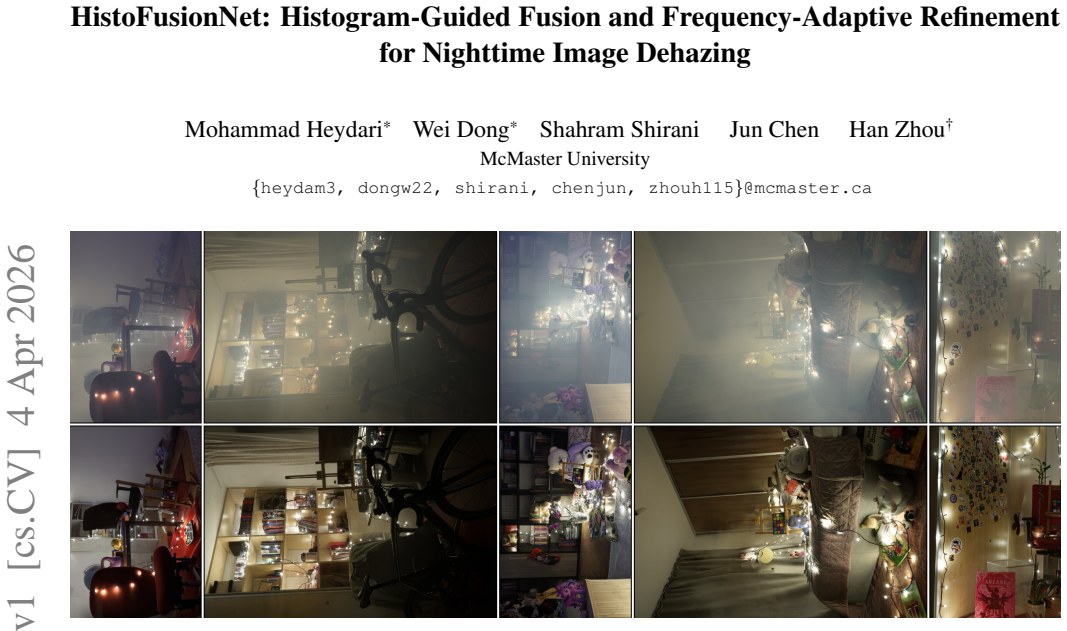
Nighttime image dehazing remains a challenging low-level vision problem due to the joint presence of haze, glow, non-uniform illumination, color distortion, and sensor noise, which often invalidate assumptions commonly used in daytime dehazing. To address these challenges, we propose HistoFusionNet, a transformer-enhanced architecture tailored for nighttime image dehazing by combining histogram-guided representation learning with frequency-adaptive feature refinement. Built upon a multi-scale encoder-decoder backbone, our method introduces histogram transformer blocks that model long-range dependencies by grouping features according to their dynamic-range characteristics, enabling more effective aggregation of similarly degraded regions under complex nighttime lighting. To further improve restoration fidelity, we incorporate a frequency-aware refinement branch that adaptively exploits complementary low- and high-frequency cues, helping recover scene structures, suppress artifacts, and enhance local details. This design yields a unified framework that is particularly well suited to the heterogeneous degradations encountered in real nighttime hazy scenes. Extensive experiments and highly competitive performance of our method on the NTIRE 2026 Nighttime Image Dehazing Challenge benchmark demonstrate the effectiveness of the proposed method. Our team ranked 1st among 22 participating teams, highlighting the robustness and competitive performance of HistoFusionNet. The code is available at: https://github.com/heydarimo/Night-Time-Dehazing
Editorial analysis
A structured set of objections, weighed in public.
Referee Report
Summary. The manuscript introduces HistoFusionNet, a transformer-enhanced multi-scale encoder-decoder architecture for nighttime image dehazing. It incorporates histogram transformer blocks that group features by dynamic-range characteristics to model long-range dependencies among similarly degraded regions, together with a frequency-aware refinement branch that adaptively combines low- and high-frequency cues. The method is evaluated on the NTIRE 2026 Nighttime Image Dehazing Challenge benchmark, where the authors report a first-place ranking among 22 participating teams.
Significance. If the reported ranking is supported by rigorous controls, the work supplies a unified framework explicitly designed for the joint degradations (haze, glow, non-uniform illumination, color distortion, sensor noise) that invalidate standard daytime dehazing priors. The open-sourced code at the provided GitHub link strengthens reproducibility and allows the community to verify the claimed robustness on real nighttime scenes.
major comments (2)
- [Experiments and Results] The central claim that the histogram-guided and frequency-adaptive components specifically address heterogeneous nighttime degradations rests on the NTIRE 2026 ranking, yet the manuscript provides no ablation that removes either the histogram transformer blocks or the frequency-aware refinement branch while keeping the backbone, training schedule, and data augmentation fixed. Without these controls, the performance gain cannot be isolated from the encoder-decoder architecture itself.
- [Experiments and Results] Table 1 (or equivalent quantitative comparison table) reports only the final ranking and aggregate metrics; it does not include per-component PSNR/SSIM deltas or comparisons against a plain multi-scale transformer baseline trained under identical conditions. This omission leaves open the possibility that the reported advantage is attributable to training details rather than the proposed modules.
minor comments (2)
- [Method] The abstract states that the histogram transformer blocks 'enable more effective aggregation of similarly degraded regions' but does not define the dynamic-range grouping operation mathematically; a short equation or pseudocode in §3 would clarify the implementation.
- [Experiments and Results] Figure 4 (qualitative results) would benefit from zoomed insets highlighting recovery of fine structures and suppression of glow artifacts, as the current scale makes it difficult to assess local fidelity.
Simulated Author's Rebuttal
We thank the referee for the constructive feedback and positive assessment of the work's significance and reproducibility. We agree that the current experiments would benefit from explicit ablations to isolate module contributions and will incorporate these in the revision.
read point-by-point responses
-
Referee: [Experiments and Results] The central claim that the histogram-guided and frequency-adaptive components specifically address heterogeneous nighttime degradations rests on the NTIRE 2026 ranking, yet the manuscript provides no ablation that removes either the histogram transformer blocks or the frequency-aware refinement branch while keeping the backbone, training schedule, and data augmentation fixed. Without these controls, the performance gain cannot be isolated from the encoder-decoder architecture itself.
Authors: We agree that dedicated ablations are necessary to isolate the contributions. In the revised manuscript we will add experiments that remove the histogram transformer blocks and the frequency-aware refinement branch individually while freezing the multi-scale encoder-decoder backbone, training schedule, optimizer, and all data augmentations. We will report the resulting PSNR/SSIM drops on the NTIRE 2026 test set to quantify the specific gains attributable to each module. revision: yes
-
Referee: [Experiments and Results] Table 1 (or equivalent quantitative comparison table) reports only the final ranking and aggregate metrics; it does not include per-component PSNR/SSIM deltas or comparisons against a plain multi-scale transformer baseline trained under identical conditions. This omission leaves open the possibility that the reported advantage is attributable to training details rather than the proposed modules.
Authors: We acknowledge the omission. The revised manuscript will expand the quantitative table (or add a dedicated ablation table) to include (i) per-component PSNR/SSIM deltas for each removed module and (ii) direct comparison against a plain multi-scale transformer baseline trained from scratch under identical conditions, hyperparameters, and data. This will rule out training-detail confounds and clearly attribute performance differences to the proposed histogram-guided and frequency-adaptive components. revision: yes
Circularity Check
No circularity: empirical architecture validated on external benchmark
full rationale
The paper proposes HistoFusionNet as a transformer-based architecture with histogram-guided blocks and frequency-adaptive refinement for nighttime dehazing. No mathematical derivation chain, fitted parameters, or first-principles predictions are present in the provided text. The central claim of suitability for heterogeneous degradations is supported solely by empirical ranking (1st on NTIRE 2026 benchmark), which is an external outcome rather than a quantity defined in terms of the model's own components or self-citations. No self-definitional reductions, uniqueness theorems, or ansatzes imported via prior work appear; the design choices are presented as motivated engineering decisions validated experimentally.
Axiom & Free-Parameter Ledger
Lean theorems connected to this paper
-
IndisputableMonolith/Cost/FunctionalEquation.leanwashburn_uniqueness_aczel unclear?
unclearRelation between the paper passage and the cited Recognition theorem.
histogram transformer blocks that model long-range dependencies by grouping features according to their dynamic-range characteristics
-
IndisputableMonolith/Foundation/RealityFromDistinction.leanreality_from_one_distinction unclear?
unclearRelation between the paper passage and the cited Recognition theorem.
frequency-aware refinement branch that adaptively exploits complementary low- and high-frequency cues
What do these tags mean?
- matches
- The paper's claim is directly supported by a theorem in the formal canon.
- supports
- The theorem supports part of the paper's argument, but the paper may add assumptions or extra steps.
- extends
- The paper goes beyond the formal theorem; the theorem is a base layer rather than the whole result.
- uses
- The paper appears to rely on the theorem as machinery.
- contradicts
- The paper's claim conflicts with a theorem or certificate in the canon.
- unclear
- Pith found a possible connection, but the passage is too broad, indirect, or ambiguous to say the theorem truly supports the claim.
Reference graph
Works this paper leans on
-
[1]
Ancuti, Cosmin Ancuti, Radu Timofte, Luc Van Gool, Lei Zhang, and Ming-Hsuan Yang
Codruta O. Ancuti, Cosmin Ancuti, Radu Timofte, Luc Van Gool, Lei Zhang, and Ming-Hsuan Yang. Ntire 2019 image dehazing challenge report. InProceedings of the IEEE Con- ference on Computer Vision and Pattern Recognition Work- shops (CVPR Workshops), 2019
work page 2019
-
[2]
Ancuti, Cosmin Ancuti, and Radu Timofte
Codruta O. Ancuti, Cosmin Ancuti, and Radu Timofte. Nh- haze: An image dehazing benchmark with nonhomogeneous hazy and haze-free images. InProceedings of the IEEE Con- ference on Computer Vision and Pattern Recognition Work- shops (CVPR Workshops), 2020
work page 2020
-
[3]
Ancuti, Cosmin Ancuti, Florin-Alexandru Vasluianu, Radu Timofte, et al
Codruta O. Ancuti, Cosmin Ancuti, Florin-Alexandru Vasluianu, Radu Timofte, et al. Ntire 2020 challenge on non- homogeneous dehazing. InProceedings of the IEEE Con- ference on Computer Vision and Pattern Recognition Work- shops (CVPR Workshops), 2020
work page 2020
-
[4]
Ancuti, Cosmin Ancuti amd Florin- Alexandru Vasluianu, and Radu Timofte
Codruta O. Ancuti, Cosmin Ancuti amd Florin- Alexandru Vasluianu, and Radu Timofte. Ntire 2021 nonhomogeneous dehazing challenge report. InProceedings of the IEEE Conference on Computer Vision and Pattern Recognition Workshops (CVPR Workshops), 2021
work page 2021
-
[5]
Ancuti, Cosmin Ancuti, Florin-Alexandru Vasluianu, and Radu Timofte
Codruta O. Ancuti, Cosmin Ancuti, Florin-Alexandru Vasluianu, and Radu Timofte. Ntire 2021 nonhomogeneous dehazing challenge report. InProceedings of the IEEE Con- ference on Computer Vision and Pattern Recognition Work- shops (CVPR Workshops), 2021
work page 2021
-
[6]
Ancuti, Cosmin Ancuti, Florin-Alexandru Vasluianu, Radu Timofte, et al
Codruta O. Ancuti, Cosmin Ancuti, Florin-Alexandru Vasluianu, Radu Timofte, et al. Ntire 2023 hr nonhomo- geneous dehazing challenge report. InProceedings of the IEEE Conference on Computer Vision and Pattern Recogni- tion Workshops (CVPR Workshops), 2023
work page 2023
-
[7]
Codruta O. Ancuti et al. Ntire 2026 nighttime image de- hazing challenge report. InProceedings of the IEEE Con- ference on Computer Vision and Pattern Recognition Work- shops (CVPR Workshops), 2026
work page 2026
-
[8]
Codruta O. Ancuti et al. A benchmark dataset for realistic night-time image dehzing. InProceedings of the IEEE Con- ference on Computer Vision and Pattern Recognition Work- shops (CVPR Workshops), 2026
work page 2026
-
[9]
Dana Berman, Tali Treibitz, and Shai Avidan. Non-local im- age dehazing. InProceedings of the IEEE Conference on Computer Vision and Pattern Recognition (CVPR), 2016
work page 2016
-
[10]
Bolun Cai, Xiangmin Xu, Kui Jia, Chunmei Qing, and Dacheng Tao. Dehazenet: An end-to-end system for single image haze removal.IEEE Transactions on Image Process- ing (TIP), 2016
work page 2016
-
[11]
Psd: Principled synthetic-to-real dehazing guided by physical priors
Zhitong Chen, Yang Wang, Yang Yang, Ding Liu, Junjie Cao, Yuemei Ren, Ming-Ming Cheng, Qian Wang, and Bain- ing Guo. Psd: Principled synthetic-to-real dehazing guided by physical priors. InProceedings of the IEEE Conference on Computer Vision and Pattern Recognition (CVPR), 2021
work page 2021
-
[12]
Ancuti, Florin-Alexandru Vasluianu, Radu Timofte, and et al
Cosmin Ancuti Codruta O. Ancuti, Florin-Alexandru Vasluianu, Radu Timofte, and et al. Ntire 2024 dense and non-homogeneous dehazing challenge report. InProceed- ings of the IEEE Conference on Computer Vision and Pattern Recognition Workshops (CVPR Workshops), 2024
work page 2024
-
[13]
Xiaofeng Cong, Jie Gui, Jing Zhang, Junming Hou, and Hao Shen. A semi-supervised nighttime dehazing baseline with spatial-frequency aware and realistic brightness constraint. InProceedings of the IEEE Conference on Computer Vision and Pattern Recognition (CVPR), 2024
work page 2024
-
[14]
Selective frequency network for image restoration
Yuning Cui, Yi Tao, Zhenshan Bing, Wenqi Ren, Xinwei Gao, Xiaochun Cao, Kai Huang, and Alois Knoll. Selective frequency network for image restoration. InProceedings of the International Conference on Learning Representations (ICLR), 2023
work page 2023
-
[15]
Adair: Adaptive all-in-one image restoration via frequency mining and mod- ulation
Yuning Cui, Syed Waqas Zamir, Salman Khan, Alois Knoll, Mubarak Shah, and Fahad Shahbaz Khan. Adair: Adaptive all-in-one image restoration via frequency mining and mod- ulation. InProceedings of the International Conference on Learning Representations (ICLR), 2025
work page 2025
-
[16]
Deformable convolutional networks
Jifeng Dai, Haozhi Qi, Yuwen Xiong, Yi Li, Guodong Zhang, Han Hu, and Yichen Wei. Deformable convolutional networks. InProceedings of the IEEE International Confer- ence on Computer Vision (ICCV), 2017
work page 2017
-
[17]
Multi-scale boosted de- hazing network with dense feature fusion
Hang Dong, Jinshan Pan, Lei Xiang, Zhe Hu, Xinyi Zhang, Fei Wang, and Ming-Hsuan Yang. Multi-scale boosted de- hazing network with dense feature fusion. InProceedings of the IEEE Conference on Computer Vision and Pattern Recognition (CVPR), 2020
work page 2020
-
[18]
Shadowrefiner: Towards mask-free shadow removal via fast fourier trans- former
Wei Dong, Han Zhou, Yuqiong Tian, Jingke Sun, Xiao- hong Liu, Guangtao Zhai, and Jun Chen. Shadowrefiner: Towards mask-free shadow removal via fast fourier trans- former. InProceedings of the IEEE Conference on Computer Vision and Pattern Recognition Workshops (CVPR Work- shops), 2024
work page 2024
-
[19]
Dehazedct: Towards effective non- homogeneous dehazing via deformable convolutional trans- former
Wei Dong, Han Zhou, Ruiyi Wang, Xiaohong Liu, Guang- tao Zhai, and Jun Chen. Dehazedct: Towards effective non- homogeneous dehazing via deformable convolutional trans- former. InProceedings of the IEEE Conference on Computer Vision and Pattern Recognition Workshops (CVPR Work- shops), 2024
work page 2024
-
[20]
Wei Dong, Han Zhou, Yulun Zhang, Xiaohong Liu, and Jun Chen. Ecmamba: Consolidating selective state space model with retinex guidance for efficient multiple exposure correc- tion.Advances in Neural Information Processing Systems, 2024
work page 2024
-
[21]
To- wards scale-aware low-light enhancement via structure- guided transformer design
Wei Dong, Yan Min, Han Zhou, and Jun Chen. To- wards scale-aware low-light enhancement via structure- guided transformer design. InProceedings of the IEEE Con- ference on Computer Vision and Pattern Recognition Work- shops (CVPR Workshops), 2025
work page 2025
-
[22]
Retinex-guided histogram transformer for mask-free shadow removal
Wei Dong, Han Zhou, Seyed Amirreza Mousavi, and Jun Chen. Retinex-guided histogram transformer for mask-free shadow removal. InProceedings of the IEEE Conference on Computer Vision and Pattern Recognition Workshops (CVPR Workshops), 2025
work page 2025
-
[23]
Wei Dong, Han Zhou, Terry Ji, and Jun Chen. Towards adap- tive adverse weather removal via semantic and low-level vi- sual perceptual priors.Machine Learning and Knowledge Extraction, 2026
work page 2026
-
[24]
Wei Dong, Han Zhou, Junwei Lin, and Jun Chen. Zero- reference joint low-light enhancement and deblurring via vi- sual autoregressive modeling with vlm-derived modulation. 9 InProceedings of the AAAI Conference on Artificial Intelli- gence (AAAI), 2026
work page 2026
-
[25]
Single image dehazing.ACM Transactions on Graphics (TOG), 27(3):72:1–72:9, 2008
Raanan Fattal. Single image dehazing.ACM Transactions on Graphics (TOG), 27(3):72:1–72:9, 2008
work page 2008
-
[26]
Image dehazing transformer with transmission-aware 3d position embedding
Chun-Le Guo, Qixin Yan, Saeed Anwar, Runmin Cong, Wenqi Ren, and Chongyi Li. Image dehazing transformer with transmission-aware 3d position embedding. InProceed- ings of the IEEE Conference on Computer Vision and Pattern Recognition (CVPR), 2022
work page 2022
-
[27]
Single image haze removal using dark channel prior
Kaiming He, Jian Sun, and Xiaoou Tang. Single image haze removal using dark channel prior. InProceedings of the IEEE Conference on Computer Vision and Pattern Recog- nition (CVPR), 2009
work page 2009
-
[28]
Focal frequency loss for image reconstruction and synthe- sis
Liming Jiang, Bo Dai, Wayne Wu, and Chen Change Loy. Focal frequency loss for image reconstruction and synthe- sis. InProceedings of the IEEE International Conference on Computer Vision (ICCV), 2021
work page 2021
-
[29]
When fast fourier transform meets transformer for image restoration
Xingyu Jiang, Xiuhui Zhang, Ning Gao, and Yue Deng. When fast fourier transform meets transformer for image restoration. InProceedings of the European Conference on Computer Vision (ECCV), 2024
work page 2024
-
[30]
Aod-net: All-in-one dehazing network
Boyi Li, Xiulian Peng, Zhangyang Wang, Jizheng Xu, and Dan Feng. Aod-net: All-in-one dehazing network. InPro- ceedings of the IEEE International Conference on Computer Vision (ICCV), 2017
work page 2017
-
[31]
Boyi Li, Wenqi Ren, Dengpan Fu, Dacheng Tao, Dan Feng, Wenjun Zeng, and Zhangyang Wang. Benchmarking single- image dehazing and beyond.IEEE Transactions on Image Processing (TIP), 28(1):492–505, 2019
work page 2019
-
[32]
Yu Li, Robby T. Tan, and Michael S. Brown. Nighttime haze removal with glow and multiple light colors. InProceedings of the IEEE International Conference on Computer Vision (ICCV), 2015
work page 2015
-
[33]
Swinir: Image restoration using swin transformer
Jingyun Liang, Jiezhang Cao, Guolei Sun, Kai Zhang, Luc Van Gool, and Radu Timofte. Swinir: Image restoration using swin transformer. InProceedings of the IEEE Inter- national Conference on Computer Vision Workshops (ICCV Workshops), 2021
work page 2021
-
[34]
Beibei Lin, Yeying Jin, Wending Yan, Wei Ye, Yuan Yuan, and Robby T. Tan. Nighthaze: Nighttime image dehazing via self-prior learning. InProceedings of the AAAI Conference on Artificial Intelligence (AAAI), 2025
work page 2025
-
[35]
Frequency domain-based diffusion model for unpaired image dehazing
Chengxu Liu, Lu Qi, Jinshan Pan, Xueming Qian, and Ming- Hsuan Yang. Frequency domain-based diffusion model for unpaired image dehazing. InProceedings of the IEEE Inter- national Conference on Computer Vision (ICCV), 2025
work page 2025
-
[36]
Jing Liu, Yuan Xie Haiyan Wu, Yanyun Qu, and Lizhuang Ma. Trident dehazing network. InProceedings of the IEEE Conference on Computer Vision and Pattern Recognition Workshops (CVPR Workshops), 2020
work page 2020
-
[37]
Grid- dehazenet: Attention-based multi-scale network for image dehazing
Xiaohong Liu, Yongrui Ma, Zhihao Shi, and Jun Chen. Grid- dehazenet: Attention-based multi-scale network for image dehazing. InProceedings of the IEEE International Confer- ence on Computer Vision (ICCV), 2019
work page 2019
-
[38]
Nighttime image dehazing based on variational decom- position model
Yun Liu, Zhongsheng Yan, Aimin Wu, Tian Ye, and Yuche Li. Nighttime image dehazing based on variational decom- position model. InProceedings of the IEEE Conference on Computer Vision and Pattern Recognition Workshops (CVPR Workshops), 2022
work page 2022
-
[39]
Swin transformer: Hierarchical vision transformer using shifted windows
Ze Liu, Yutong Lin, Yue Cao, Han Hu, Yixuan Wei, Zheng Zhang, Stephen Lin, and Baining Guo. Swin transformer: Hierarchical vision transformer using shifted windows. In Proceedings of the IEEE International Conference on Com- puter Vision (ICCV), 2021
work page 2021
-
[40]
W. E. K. Middleton.Vision through the atmosphere. Univer- sity of Toronto Press, 1952
work page 1952
-
[41]
Ffa-net: Feature fusion attention network for single image dehazing
Xu Qin, Zhilin Wang, Yuanchao Bai, Xiaodong Xie, and Huizhu Jia. Ffa-net: Feature fusion attention network for single image dehazing. InProceedings of the AAAI Confer- ence on Artificial Intelligence (AAAI), 2020
work page 2020
-
[42]
Gated fusion net- work for single image dehazing
Wenqi Ren, Lin Ma, Jiawei Zhang, Jinshan Pan, Xiaochun Cao, Wei Liu, and Ming-Hsuan Yang. Gated fusion net- work for single image dehazing. InProceedings of the IEEE Conference on Computer Vision and Pattern Recognition (CVPR), 2018
work page 2018
-
[43]
Spatial frequency modulation network for efficient image dehazing
Hao Shen, Henghui Ding, Yulun Zhang, Zhong-Qiu Zhao, and Xudong Jiang. Spatial frequency modulation network for efficient image dehazing. InIEEE Transactions on Image Processing (TIP), 2025
work page 2025
-
[44]
Vision transformers for single image dehazing.IEEE Transactions on Image Processing (TIP), 2023
Yuda Song, Zhuqing He, Hui Qian, and Xin Du. Vision transformers for single image dehazing.IEEE Transactions on Image Processing (TIP), 2023
work page 2023
-
[45]
Restoring images in adverse weather conditions via histogram transformer
Shangquan Sun, Wenqi Ren, Xinwei Gao, Rui Wang, and Xi- aochun Cao. Restoring images in adverse weather conditions via histogram transformer. InProceedings of the European Conference on Computer Vision (ECCV), 2024
work page 2024
-
[46]
Towards image ambi- ent lighting normalization
Florin-Alexandru Vasluianu, Tim Seizinger, Zongwei Wu, Rakesh Ranjan, and Radu Timofte. Towards image ambi- ent lighting normalization. InProceedings of the European Conference on Computer Vision (ECCV), 2024
work page 2024
-
[47]
Internim- age: Exploring large-scale vision foundation models with de- formable convolutions
Wenhai Wang, Jifeng Dai, Zhe Chen, Zhenhang Huang, Zhiqi Li, Xizhou Zhu, Xiaowei Hu, Tong Lu, Lewei Lu, Hongsheng Li, Xiaogang Wang, and Yu Qiao. Internim- age: Exploring large-scale vision foundation models with de- formable convolutions. InProceedings of the IEEE Confer- ence on Computer Vision and Pattern Recognition (CVPR), 2023
work page 2023
-
[48]
Chan, Ke Yu, Chao Dong, and Chen Change Loy
Xintao Wang, Kelvin C.K. Chan, Ke Yu, Chao Dong, and Chen Change Loy. Edvr: Video restoration with enhanced deformable convolutional networks. InProceedings of the IEEE Conference on Computer Vision and Pattern Recogni- tion Workshops (CVPR Workshops), 2019
work page 2019
-
[49]
Light field im- age super-resolution using deformable convolution
Yingqian Wang, Jungang Yang, Longguang Wang, Xinyi Ying, Tianhao Wu, Wei An, and Yulan Guo. Light field im- age super-resolution using deformable convolution. InIEEE Transactions on Image Processing (TIP), 2021
work page 2021
-
[50]
Uformer: A gen- eral u-shaped transformer for image restoration
Zhendong Wang, Xiaodong Cun, Jianmin Bao, Wengang Zhou, Jianzhuang Liu, and Houqiang Li. Uformer: A gen- eral u-shaped transformer for image restoration. InProceed- ings of the IEEE Conference on Computer Vision and Pattern Recognition (CVPR), 2022
work page 2022
-
[51]
Con- trastive learning for compact single image dehazing
Haiyan Wu, Yanyun Qu, Shaohui Lin, Jian Zhou, Ruizhi Qiao, Zhizhong Zhang, Yuan Xie, and Lizhuang Ma. Con- trastive learning for compact single image dehazing. InPro- 10 ceedings of the IEEE Conference on Computer Vision and Pattern Recognition (CVPR), 2021
work page 2021
-
[52]
Efficient de- formable convnets: Rethinking dynamic and sparse operator for vision applications
Yuwen Xiong, Zhiqi Li, Yuntao Chen, Feng Wang, Xizhou Zhu, Jiapeng Luo, Wenhai Wang, Tong Lu, Hongsheng Li, Yu Qiao, Lewei Lu, Jie Zhou, and Jifeng Dai. Efficient de- formable convnets: Rethinking dynamic and sparse operator for vision applications. InProceedings of the IEEE Confer- ence on Computer Vision and Pattern Recognition (CVPR), 2024
work page 2024
-
[53]
Wavelet u-net and the chromatic adaptation transform for single image dehazing
Hao-Hsiang Yang and Yanwei Fu. Wavelet u-net and the chromatic adaptation transform for single image dehazing. In Proceedings of the IEEE International Conference on Image Processing (ICIP), 2019
work page 2019
-
[54]
Frequency and spatial dual guidance for image dehazing
Hu Yu, Naishan Zheng, Man Zhou, Jie Huang, Zeyu Xiao, and Feng Zhao. Frequency and spatial dual guidance for image dehazing. InProceedings of the European Conference on Computer Vision (ECCV), 2022
work page 2022
-
[55]
Restormer: Efficient transformer for high-resolution image restoration
Syed Waqas Zamir, Aditya Arora, Salman Khan, Mu- nawar Hayat, Fahad Shahbaz Khan, and Ming-Hsuan Yang. Restormer: Efficient transformer for high-resolution image restoration. InProceedings of the IEEE Conference on Com- puter Vision and Pattern Recognition (CVPR), 2022
work page 2022
-
[56]
He Zhang and Vishal M. Patel. Densely connected pyramid dehazing network. InProceedings of the IEEE Conference on Computer Vision and Pattern Recognition (CVPR), 2018
work page 2018
-
[57]
Han Zhou, Wei Dong, Yangyi Liu, and Jun Chen. Break- ing through the haze: An advanced non-homogeneous de- hazing method based on fast fourier convolution and con- vnext. InProceedings of the IEEE Conference on Computer Vision and Pattern Recognition Workshops (CVPR Work- shops), 2023
work page 2023
-
[58]
Glare: Low light image enhancement via generative latent feature based codebook retrieval
Han Zhou, Wei Dong, Xiaohong Liu, Shuaicheng Liu, Xiongkuo Min, Guangtao Zhai, and Jun Chen. Glare: Low light image enhancement via generative latent feature based codebook retrieval. InProceedings of the European Confer- ence on Computer Vision (ECCV), 2024
work page 2024
-
[59]
Han Zhou, Wei Dong, and Jun Chen. Lita-gs: Illumination- agnostic novel view synthesis via reference-free 3d gaus- sian splatting and physical priors. InProceedings of the IEEE Conference on Computer Vision and Pattern Recog- nition (CVPR), 2025
work page 2025
-
[60]
Low-light image enhancement via generative perceptual priors
Han Zhou, Wei Dong, Xiaohong Liu, Yulun Zhang, Guang- tao Zhai, and Jun Chen. Low-light image enhancement via generative perceptual priors. InProceedings of the AAAI Conference on Artificial Intelligence (AAAI), 2025
work page 2025
-
[61]
De- formable convnets v2: More deformable, better results
Xizhou Zhu, Stephen Lin Han Hu, and Jifeng Dai. De- formable convnets v2: More deformable, better results. In Proceedings of the IEEE Conference on Computer Vision and Pattern Recognition (CVPR), 2019. 11
work page 2019
discussion (0)
Sign in with ORCID, Apple, or X to comment. Anyone can read and Pith papers without signing in.