pith. sign in

arxiv: 2604.03861 · v1 · submitted 2026-04-04 · 🧮 math.CV · math-ph· math.MP

Electrostatic skeletons and condition of strict descent

Pith reviewed 2026-05-13 16:41 UTC · model grok-4.3

classification 🧮 math.CV math-phmath.MP
keywords electrostatic skeletonEremenko conjectureconvex quadrilateralsconformal geometryequipotential curvestrict descent conditionpositive measuresymmetric domains
0
0 comments X p. Extension

The pith

Convex quadrilaterals with a line of symmetry have a unique electrostatic skeleton.

A machine-rendered reading of the paper's core claim, the machinery that carries it, and where it could break.

The paper proves Eremenko's conjecture on unique electrostatic skeletons for the case of convex quadrilaterals that possess a line of symmetry. It reduces the problem using conformal mappings that preserve the symmetry, mapping the quadrilateral to a domain such as a triangle where uniqueness is already known. A reader would care because this shows how the boundary can be realized as an equipotential surface generated by a single positive measure supported on an acyclic set inside the domain. The work also introduces a condition of strict descent that ensures existence of such skeletons for broader classes of precompact domains.

Core claim

For any convex quadrilateral with a line of symmetry, there exists a unique electrostatic skeleton: a positive measure inside the quadrilateral, supported on a set containing no simple loops, such that the boundary becomes an equipotential curve for the potential generated by the measure. The proof uses conformal geometry to reduce the symmetric quadrilateral to a simpler domain whose skeleton is already known to be unique.

What carries the argument

The electrostatic skeleton, a positive measure supported on a loop-free set inside the domain that makes the boundary an equipotential curve; the line of symmetry enables conformal reduction to a previously solved case.

If this is right

  • Eremenko's conjecture holds for every convex quadrilateral possessing reflection symmetry.
  • The condition of strict descent guarantees existence of an electrostatic skeleton for any precompact domain satisfying it.
  • The support of the skeleton is always a connected acyclic graph.
  • Uniqueness follows whenever the domain admits a symmetry-respecting conformal map to a solved case.

Where Pith is reading between the lines

These are editorial extensions of the paper, not claims the author makes directly.

  • Symmetry may be the key property that allows reduction arguments to work for a larger class of polygons.
  • The strict descent condition could be checked algorithmically to locate skeletons in irregular polygons.
  • Non-symmetric cases might require different tools, such as variational methods, to settle uniqueness.

Load-bearing premise

The quadrilateral has a line of symmetry that permits conformal reduction to a domain with already-established unique skeleton.

What would settle it

A convex quadrilateral with a line of symmetry that admits either no electrostatic skeleton or at least two distinct ones would disprove the uniqueness claim.

Figures

Figures reproduced from arXiv: 2604.03861 by Linhang Huang.

Figure 1
Figure 1. Figure 1: Electrostatic skeletons for a triangle and the regular pentagon, with level sets of the logarithmic potentials in blue. 1 arXiv:2604.03861v1 [math.CV] 4 Apr 2026 [PITH_FULL_IMAGE:figures/full_fig_p001_1.png] view at source ↗
Figure 2
Figure 2. Figure 2: Electrostatic skeletons for a kite shape and an isosceles trapezoid, with level sets of the logarithmic potentials in blue 1.2. Geometric Results. We prove the existence of electrostatic skeletons for symmetric convex quadrilaterals: we will first show that the convex kite shapes (convex quadrilaterals symmetric with respect to one of their diagonals) admit electrostatic skeletons (see [PITH_FULL_IMAGE:fi… view at source ↗
Figure 3
Figure 3. Figure 3: Level sets of g1 and g3 are highlighted in red and blue respectively. The wedge W1,4 is gray area between ℓ1 and ℓ3 that contains the polygon. 3 [PITH_FULL_IMAGE:figures/full_fig_p003_3.png] view at source ↗
Figure 4
Figure 4. Figure 4: Electrostatic skeleton for a heptagon and its corre￾sponding partition of (regular) heptagon. 4 [PITH_FULL_IMAGE:figures/full_fig_p004_4.png] view at source ↗
Figure 5
Figure 5. Figure 5: The case where ℓi and ℓj are parallel Proof. Note that in the case when ℓi and ℓj intersects at zi,j , we have −gi(zi,j ) = −gj (zi,j ) = g(zi,j ). Thus we have zi,j ∈ Si,j . Given any z ∈ (ℓi ∩ Wi,j )\ {zi,j}, we set z ′ to be the reflection of z with respect to ℓj (see [PITH_FULL_IMAGE:figures/full_fig_p006_5.png] view at source ↗
Figure 6
Figure 6. Figure 6: Idea behind the proof of Lemma 2.4. Since u is harmonic on Wi,j\∂C and satisfies the mean value inequality on ∂C for sufficiently small r > 0: u(z) = 0 ≤ 1 2π Z 2π 0 u(z + reiθ)dr. We have that u is a subharmonic function vanishes on the sector boundary ∂Wi,j and satisfies the logarithmic growth condition u(z) = O(log |z|). By the Phragm´en-Lindel¨of theorem for subharmonic functions (see [11]), we have th… view at source ↗
Figure 7
Figure 7. Figure 7: Sketch of the proof for Theorem 1.1. Left: skeleton constructed from Si,j ’s on the left. Right: subharmonic extension of g that generates the skeleton. which we denote by Ωi , which we denote by ˜g. Note that on Ωi ∪ Ωi+1, ˜g coincides max(gi , gi+1) as Ωi and Ωi+1 are contained in different nodal regions of gi − gi+1, which is Wi,i+1\Si,i+1. It follows that ˜g satisfies the mean value inequality on K for… view at source ↗
Figure 8
Figure 8. Figure 8: Sketch of proof of Lemma 3.1. If t0 is a critical point of the real function g1 ◦ γ1 = g2 ◦ γ1 and γ1(t) is on the left of ℓ, then the level sets g −1 1 (c), g −1 2 (c) and g −1 4 (c) will intersect tangentially for c = g1(γ1(t0)). This is geometrically impossible. Proof. Without loss of generality, we assume that z1 and z4 are symmetric vertices for Ω. Suppose for the contradiction that there exists a cri… view at source ↗
Figure 9
Figure 9. Figure 9: First case. Left: Skeleton. Right: Subharmonic exten￾sion. Now we consider the case when S1 intersects S2. Note that if S1 and S2 only intersect on ℓ, it can fall under the previous case such that w1 and w2 are the same point. Thus we assume otherwise. Since γ1 and γ2 are monotone on S1 and S2 respectively, we can order the points in S1 ∩ S2 in terms of the value of g1 ◦ γ1. We denote the point with the la… view at source ↗
Figure 10
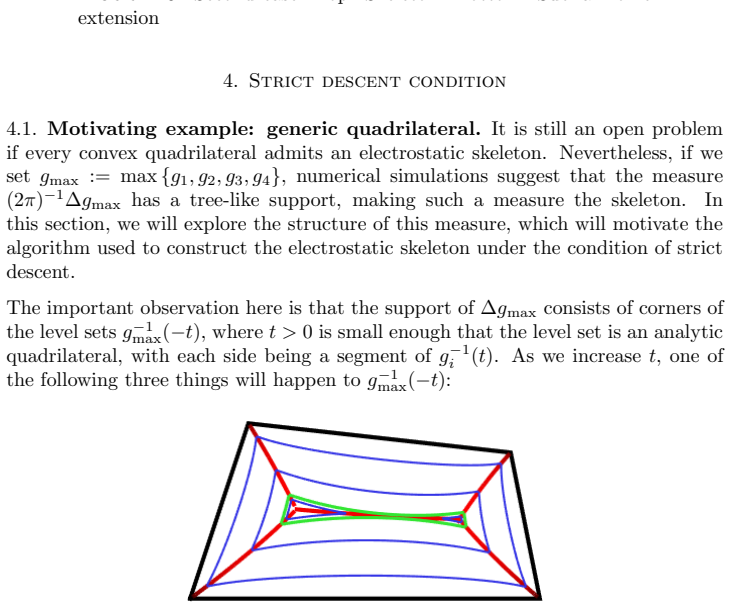
Figure 10. Figure 10: Second case. Top: Skeleton. Bottom: Subharmonic extension 4. Strict descent condition 4.1. Motivating example: generic quadrilateral. It is still an open problem if every convex quadrilateral admits an electrostatic skeleton. Nevertheless, if we set gmax := max {g1, g2, g3, g4}, numerical simulations suggest that the measure (2π) −1∆gmax has a tree-like support, making such a measure the skeleton. In this… view at source ↗
Figure 11
Figure 11. Figure 11: Shrinking level sets in a thin quadrilateral, phase transition highlighted in green 11 [PITH_FULL_IMAGE:figures/full_fig_p011_11.png] view at source ↗
Figure 12
Figure 12. Figure 12: Shrinking level sets in a quadrilateral with a signifi￾cantly shorter side, phase transition highlighted in green It is worth paying attention to the critical time when the phase transitions of the latter two cases happen. For the second case, the phase transition happens when two non-adjacent analytic arcs meet. For the third case, it happens when two adjacent vertices meet. In either case, the vertices … view at source ↗
Figure 13
Figure 13. Figure 13: Multiple phase transitions occur when shrinking the level sets inside the pentagon The condition of strict descent is posed to assure that during the shrinking, the internal angles of the loops remain strictly less than π. This, in practice, always happens for the level sets of max {g1, . . . , gn}. However, showing such a property for max {g1, . . . , gn} (or any subharmonic extensions of g) is difficult… view at source ↗
Figure 14
Figure 14. Figure 14: Sketch of J γ i,j (t) and U γ i,j (t) (3) When t > ti,j and ηi,j (t) is well-defined, g −1 i (−t) consists of one segment connecting ℓi to γi,j (t), one segment connecting ℓi to ηi,j (t) and one con￾necting γi,j (t) and ηi,j (t). The first two segments are separated from the last by Si,j . (4) When t > ti,j and t is outside the domain of ηi,j , g −1 i (−t) consists of one segment connecting ℓi to γi,j (t)… view at source ↗
Figure 15
Figure 15. Figure 15: Sketch of J γ i,j (t) and U γ i,j (t) Note that J β i,j is a continuous function on the space of compact sets on C under the Hausdorff topology. Moreover, J β i,j (ti,j ) := limt↓ti,j J β i,j (t) is either Li ∪ Lj (when Li and Lj are adjacent), or consisting of parts of g −1 i (−ti,j ) and g −1 j (−ti,j ) forming a cusp. The next lemma gives us some geometric intuition about the curve J β i,j and domain U… view at source ↗
Figure 16
Figure 16. Figure 16: Coordinate plane by Ti,j (t) and Ni,j (t). Note that ∇gi and ∇gj do not necessarily lie in different quadrants It follows that in the coordinate plane (Ti,j (t), Ni,j (t)), ∇gi(βi,j (t)) has the same x-coordinate as ∇gj (βi,j (t)) but strictly larger y-coordinate (see [PITH_FULL_IMAGE:figures/full_fig_p016_16.png] view at source ↗
Figure 17
Figure 17. Figure 17: Sketch of (t, βi,j , gj , βj,k), in the case when i + 1 = j = k − 1 Similarly, we can define (t, γi,j , gj , ηj,k) and (t, ηi,j , gj , γi,k). We set (t, βi0,i1 , gi1 , βi1,i2 , gi2 , . . . , βin−1,in , gin , βin,in+1 ) = [n k=1 (t, βik−1,ik , gik , βik,ik+1 (1) ), where β ∈ {γ, η} and we assume t is in the domain of each βik,ik+1 . When βi0,i1 = βin,in+1 , this is a loop that consists of segments of level… view at source ↗
Figure 18
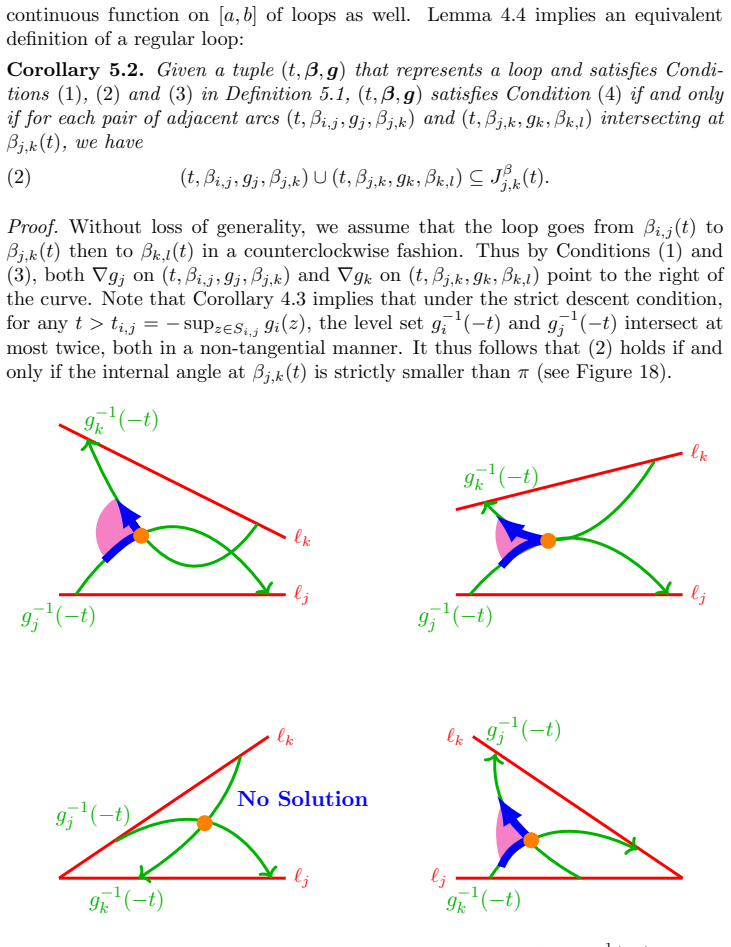
Figure 18. Figure 18: The unique solution for a curve going from g −1 j (−t) to g −1 k (−t) at βj,k(t) (highlighted in orange), assuming ∇gj and ∇gk point to the right of the curve and that the left turn angle is less than π, is J β j,k(t). □ Lemma 5.3. Under the strict descent condition, given a regular loop (t0, β, g), there exists ε > 0 such that for all t ∈ (t0, t0 + ε), the curve (t, β, g) is a regular loop inside (t0, β,… view at source ↗
Figure 19
Figure 19. Figure 19: Lt is highlighted in red and (t, β, g) is highlighted in green over t, (1) the first and last linear segments of Lt have lower-bounded length, and (2) all other segments in between vanish. Now we note that the inside of (t0, β, g) is precompact, and that βi,j ’s are continu￾ous and ∇gi ’s are smooth. Therefore, by uniform continuity, there exist ε0, δ0 > 0 such that for all t ∈ [t0, tc], (1) The angle any… view at source ↗
Figure 20
Figure 20. Figure 20: Identifying the phase transition with a partition of polygon. Note that g[i] stands for the i-component of g (not to be confused with gi). Each regular loop in (tc, β, g) corresponds to a sub-polygon in the partition (color matched). Proof. Note that we have a conformal map f : D → Cb continuous on D such that f(∂D) = (tc, β, g), f(D) = exterior of (tc, β, g), |f −1 (z)| ∈ {1, 2} , for all z ∈ (tc, β, g).… view at source ↗
Figure 21
Figure 21. Figure 21: ) to be the Jordan domain enclosed by (t0, βi,j , gj , βj,k) ∪ βi,j ([t0, tc]) ∪ (tc, βi,j , gj , βj,k) ∪ βj,k([t0, tc]). (t0, βi,j , gj , βj,k) SQ(t0, βi,j , gj , βj,k) (tc, β, g) [PITH_FULL_IMAGE:figures/full_fig_p025_21.png] view at source ↗
Figure 22
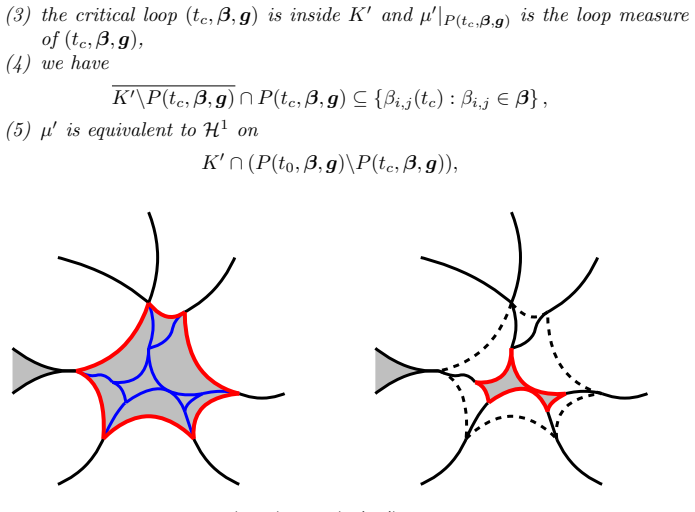
Figure 22. Figure 22: Replace (K, µ) with (K′ , µ′ ) where the loop measures on (t0, β, g) and (tc, β, g) are highlighted in red Proof. The idea here is illustrated by [PITH_FULL_IMAGE:figures/full_fig_p027_22.png] view at source ↗
read the original abstract

Given a precompact domain $\Omega \subseteq\mathbb{R}^2$, the electrostatic skeleton of $\Omega$ is defined as a positive measure inside $\Omega$, supported on a set with no simple loops, which generates $\partial \Omega$ as an equipotential curve. Eremenko conjectured that every convex polygon admits a unique electrostatic skeleton. This conjecture has since been proven for triangles and regular polygons. In this paper, we will prove the conjecture for quadrilaterals with a line of symmetry using arguments from conformal geometry. We will also discuss a natural condition that implies the existence of electrostatic skeletons.

Editorial analysis

A structured set of objections, weighed in public.

Desk editor's note, referee report, simulated authors' rebuttal, and a circularity audit. Tearing a paper down is the easy half of reading it; the pith above is the substance, this is the friction.

Referee Report

0 major / 2 minor

Summary. The manuscript proves Eremenko's conjecture on the existence and uniqueness of electrostatic skeletons for convex quadrilaterals possessing a line of symmetry. The argument reduces the problem via the Riemann mapping theorem and reflection across the symmetry axis to a half-domain potential problem, constructs the skeleton measure explicitly along the axis, verifies that the resulting potential is constant on the boundary, and confirms that the support is a tree (acyclic). A separate sufficient condition (strict descent) for existence of skeletons is also discussed and shown to be independent of the uniqueness argument.

Significance. If the central arguments hold, the result extends the known cases (triangles and regular polygons) to a nontrivial family of quadrilaterals and supplies an explicit conformal-geometric construction that may serve as a template for further cases. The separation of the strict-descent criterion as a sufficient (not necessary) condition and the direct verification that any competing measure would violate the equipotential property are concrete strengths.

minor comments (2)
  1. [Section 3] The definition of the reflected domain in the reduction step (around the application of the Riemann mapping theorem) would benefit from an explicit diagram or additional sentence clarifying the identification of the symmetry axis with the real line after mapping.
  2. [Section 4] A brief remark on how the tree property of the support is preserved under the conformal map would help readers unfamiliar with the interaction between harmonic measures and conformal invariance.

Simulated Author's Rebuttal

0 responses · 0 unresolved

We thank the referee for the positive and accurate summary of our manuscript, as well as for recommending acceptance. The report correctly identifies the main contributions: the proof of Eremenko's conjecture for convex quadrilaterals with a line of symmetry via conformal mapping and explicit construction of the skeleton measure, together with the discussion of the strict-descent condition.

Circularity Check

0 steps flagged

No significant circularity detected

full rationale

The derivation reduces the symmetric quadrilateral case to a half-domain via the Riemann mapping theorem and reflection, then constructs the skeleton measure explicitly along the symmetry axis and verifies the equipotential and tree-support conditions using standard harmonic-function uniqueness. No equation or claim reduces to a fitted parameter, self-definition, or load-bearing self-citation; the strict-descent condition is introduced separately as a sufficient criterion whose verification is independent of the uniqueness argument. The proof is self-contained against external conformal-geometry benchmarks.

Axiom & Free-Parameter Ledger

0 free parameters · 1 axioms · 0 invented entities

The central claim rests on the definition of electrostatic skeleton and standard results from conformal geometry applied to symmetric domains; no free parameters or new entities are introduced in the abstract.

axioms (1)
  • domain assumption Conformal geometry arguments apply to symmetric quadrilaterals to establish uniqueness
    Invoked to reduce the problem for quadrilaterals with a line of symmetry.

pith-pipeline@v0.9.0 · 5384 in / 1032 out tokens · 41552 ms · 2026-05-13T16:41:46.786252+00:00 · methodology

discussion (0)

Sign in with ORCID, Apple, or X to comment. Anyone can read and Pith papers without signing in.

Reference graph

Works this paper leans on

11 extracted references · 11 canonical work pages

  1. [1]

    Electrostatic skeletons

    Alexandre Eremenko, Erik Lundberg, and Koushik Ramachandran. Electrostatic skeletons. arXiv preprint arXiv:1309.5483, 2013

  2. [2]

    On mother bodies of convex polyhedra.SIAM J

    Bj¨ orn Gustafsson. On mother bodies of convex polyhedra.SIAM J. Math. Anal., 29(5):1106– 1117, 1998

  3. [3]

    Cambridge Library Col- lection - Physical Sciences

    James Jeans.Mathematical Theory of Electricity and Magnetism. Cambridge Library Col- lection - Physical Sciences. Cambridge University Press, 5 edition, 2009

  4. [4]

    Electrostatic skeletons.Ann

    Erik Lundberg and Koushik Ramachandran. Electrostatic skeletons.Ann. Acad. Sci. Fenn. Math., 40(1):397–401, 2015

  5. [5]

    Lemniscate growth.Anal

    Erik Lundberg and Vilmos Totik. Lemniscate growth.Anal. Math. Phys., 3(1):45–62, 2013

  6. [6]

    Saff, and Nikos S

    Erwin Mi˜ na D´ ıaz, Edward B. Saff, and Nikos S. Stylianopoulos. Zero distributions for polyno- mials orthogonal with weights over certain planar regions.Comput. Methods Funct. Theory, 5(1):185–221, 2005

  7. [7]

    Vandenhoeck & Ruprecht, G¨ ottingen, 1975

    Christian Pommerenke.Univalent functions, volume Band XXV ofStudia Mathemat- ica/Mathematische Lehrb¨ ucher [Studia Mathematica/Mathematical Textbooks]. Vandenhoeck & Ruprecht, G¨ ottingen, 1975. With a chapter on quadratic differentials by Gerd Jensen

  8. [8]

    Cambridge University Press, Cambridge, 1995

    Thomas Ransford.Potential theory in the complex plane, volume 28 ofLondon Mathematical Society Student Texts. Cambridge University Press, Cambridge, 1995

  9. [9]

    E. B. Saff. Logarithmic potential theory with applications to approximation theory.Surv. Approx. Theory, 5:165–200, 2010. 28

  10. [10]

    Saff and Vilmos Totik.Logarithmic potentials with external fields, volume 316 of Grundlehren der mathematischen Wissenschaften [Fundamental Principles of Mathematical Sciences]

    Edward B. Saff and Vilmos Totik.Logarithmic potentials with external fields, volume 316 of Grundlehren der mathematischen Wissenschaften [Fundamental Principles of Mathematical Sciences]. Springer-Verlag, Berlin, 1997. Appendix B by Thomas Bloom

  11. [11]

    D. S. Telyakovski˘i. On the Phragm´ en-Lindel¨ of principle for subharmonic functions.Izv. Ross. Akad. Nauk Ser. Mat., 63(2):201–223, 1999. Email address:lhhuang@uw.edu 29