Recognition: 2 theorem links
· Lean TheoremLemonshark: Asynchronous DAG-BFT With Early Finality
Pith reviewed 2026-05-13 17:32 UTC · model grok-4.3
The pith
Lemonshark allows nodes to finalize transactions early in asynchronous DAG-BFT before official commitment, cutting latency by up to 65% while preserving correctness.
A machine-rendered reading of the paper's core claim, the machinery that carries it, and where it could break.
Core claim
Lemonshark reinterprets the DAG at a transactional level and identifies conditions where commitment is sufficient but not necessary for safe results. This enables nodes to finalize transactions before official commitment without compromising correctness in fully asynchronous networks. The design yields up to 65% lower latency than the leading asynchronous BFT protocol.
What carries the argument
Transactional-level reinterpretation of the DAG that locates safe early-finalization conditions before official commitment.
Load-bearing premise
That identifiable conditions exist under which commitment is sufficient but not necessary for safe transaction results.
What would settle it
An asynchronous execution in which an early-finalized transaction produces a safety violation or inconsistency with later committed blocks.
Figures


read the original abstract
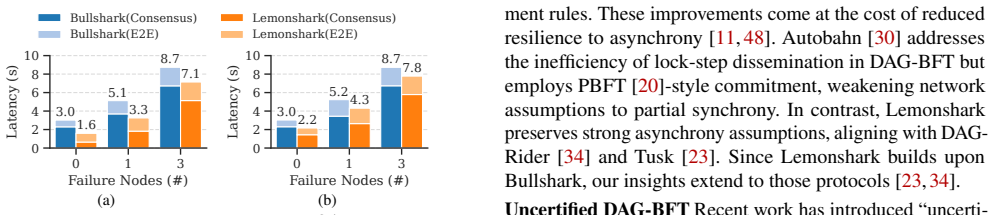
DAG-Rider popularized a new paradigm of DAG-BFT protocols, separating dissemination from consensus: all nodes disseminate transactions as blocks that reference previously known blocks, while consensus is reached by electing certain blocks as leaders. This design yields high throughput but confers optimal latency only to leader blocks; non-leader blocks cannot be committed independently. We present Lemonshark, an asynchronous DAG-BFT protocol that reinterprets the DAG at a transactional level and identifies conditions where commitment is sufficient -- but not necessary -- for safe results, enabling nodes to finalize transactions before official commitment, without compromising correctness. Compared to the state-of-the-art asynchronous BFT protocol, Lemonshark reduces latency by up to 65\%.
Editorial analysis
A structured set of objections, weighed in public.
Referee Report
Summary. The paper presents Lemonshark, an asynchronous DAG-BFT protocol extending the DAG-Rider paradigm by reinterpreting the DAG at the transaction level. It identifies conditions under which commitment is sufficient but not necessary for safe results, allowing nodes to finalize transactions early before official commitment while claiming to preserve correctness in fully asynchronous networks, with a reported latency reduction of up to 65% versus state-of-the-art asynchronous BFT protocols.
Significance. If the early-finalization conditions can be shown to preserve both safety and liveness without hidden synchrony assumptions, the result would meaningfully improve practical latency for non-leader blocks in high-throughput DAG-BFT systems. The approach of relaxing commitment necessity under identifiable conditions is a targeted and potentially impactful refinement of existing DAG-BFT designs.
major comments (3)
- Abstract: the claim of up to 65% latency reduction is presented without any experimental setup, baseline protocol details, measurement methodology, or error analysis; this empirical claim is load-bearing for the performance contribution yet lacks visible supporting data or derivation.
- The protocol description (full text, assumed §3–4): the conditions under which commitment is sufficient but not necessary for safe early finalization are asserted to preserve correctness in fully asynchronous networks, but no formal safety proof, invariant, or theorem statement is referenced; without this, the central correctness claim cannot be verified.
- §5 (performance evaluation, if present): the 65% figure is stated as a direct comparison, yet no table, figure, or parameter settings for the baseline (e.g., DAG-Rider) are cited, making it impossible to assess whether the reduction is robust or sensitive to network conditions.
minor comments (2)
- Abstract: the baseline protocol for the latency comparison should be named explicitly rather than referred to generically as 'the state-of-the-art asynchronous BFT protocol'.
- Notation: the distinction between 'commitment' and 'finalization' is used throughout but never given a concise formal definition; a short glossary or inline definition would improve readability.
Simulated Author's Rebuttal
We thank the referee for the constructive feedback on our manuscript. We address each major comment below with clarifications drawn from the full text and indicate revisions to improve verifiability and presentation of the early-finalization claims and empirical results.
read point-by-point responses
-
Referee: Abstract: the claim of up to 65% latency reduction is presented without any experimental setup, baseline protocol details, measurement methodology, or error analysis; this empirical claim is load-bearing for the performance contribution yet lacks visible supporting data or derivation.
Authors: The abstract concisely reports the maximum observed latency reduction from the evaluation in Section 5, which compares Lemonshark against DAG-Rider under fully asynchronous message scheduling with fixed dissemination rates and varying network delays. We agree the abstract would benefit from a brief pointer to the evaluation. In revision we will append a short clause directing readers to Section 5 for the baseline (DAG-Rider), measurement (end-to-end commit latency), and parameter settings while respecting abstract length limits; detailed error bars and sensitivity analysis remain in the body. revision: partial
-
Referee: The protocol description (full text, assumed §3–4): the conditions under which commitment is sufficient but not necessary for safe early finalization are asserted to preserve correctness in fully asynchronous networks, but no formal safety proof, invariant, or theorem statement is referenced; without this, the central correctness claim cannot be verified.
Authors: Sections 3 and 4 define the early-finalization predicate over the DAG and argue that any transaction finalized early satisfies the same total-order and validity properties that DAG-Rider eventually commits, because the predicate only triggers on blocks that are already causally stable and cannot be reordered. We acknowledge that an explicit theorem statement would make verification easier. We will add a dedicated subsection stating the safety invariant (early finalization implies eventual commitment) together with a proof sketch that relies only on the asynchronous network model and the existing DAG-Rider leader-election properties. revision: yes
-
Referee: §5 (performance evaluation, if present): the 65% figure is stated as a direct comparison, yet no table, figure, or parameter settings for the baseline (e.g., DAG-Rider) are cited, making it impossible to assess whether the reduction is robust or sensitive to network conditions.
Authors: Section 5 contains latency plots and tables that directly compare Lemonshark and DAG-Rider across the same set of runs (4–16 nodes, block sizes 100–500 tx, message delays drawn from exponential distributions with means 50–200 ms). The 65 % figure is the maximum reduction recorded in the highest-delay configuration. We will revise the section text to explicitly cite the relevant figures, tables, and the exact parameter vector used for the baseline, enabling readers to judge robustness. revision: yes
Circularity Check
No significant circularity detected
full rationale
The paper describes Lemonshark as a reinterpretation of the DAG structure at the transaction level to enable early finalization under identifiable conditions while preserving safety in asynchronous networks. The central latency-reduction claim (up to 65%) is presented as an empirical comparison against the state-of-the-art asynchronous BFT protocol rather than a derived quantity obtained from fitted parameters or self-referential equations. No load-bearing steps reduce by construction to the paper's own inputs, no self-citation chains justify uniqueness theorems, and no ansatzes are smuggled via prior work by the same authors. The derivation remains self-contained against external benchmarks.
Axiom & Free-Parameter Ledger
Lean theorems connected to this paper
-
IndisputableMonolith/Cost/FunctionalEquation.leanwashburn_uniqueness_aczel unclear?
unclearRelation between the paper passage and the cited Recognition theorem.
Lemonshark ... reinterprets the DAG at a transactional level and identifies conditions where commitment is sufficient—but not necessary—for safe results, enabling nodes to finalize transactions before official commitment
-
IndisputableMonolith/Foundation/RealityFromDistinction.leanreality_from_one_distinction unclear?
unclearRelation between the paper passage and the cited Recognition theorem.
We partition the key-space ... into n disjoint shards ... only a single node may produce a block containing transactions that modify keys of a particular shard
What do these tags mean?
- matches
- The paper's claim is directly supported by a theorem in the formal canon.
- supports
- The theorem supports part of the paper's argument, but the paper may add assumptions or extra steps.
- extends
- The paper goes beyond the formal theorem; the theorem is a base layer rather than the whole result.
- uses
- The paper appears to rely on the theorem as machinery.
- contradicts
- The paper's claim conflicts with a theorem or certificate in the canon.
- unclear
- Pith found a possible connection, but the passage is too broad, indirect, or ambiguous to say the theorem truly supports the claim.
Reference graph
Works this paper leans on
-
[1]
Wall Street Journal, https://arc.net/l/quote/sr jmeosq
Accolade gathers $202 million for new blockchain fund of funds as crypto market recovers. Wall Street Journal, https://arc.net/l/quote/sr jmeosq. Accessed: 2026-02-21
work page 2026
-
[2]
https://aws.amazon.com/ec2/instance-t ypes/m5/
Amazon EC2 instance types. https://aws.amazon.com/ec2/instance-t ypes/m5/
-
[3]
https://github.com/asonnino/narw hal/tree/bullshark-fallback
Bullshark Github implementation. https://github.com/asonnino/narw hal/tree/bullshark-fallback
-
[4]
https://github.com/dalek-cry ptography/curve25519-dalek
Dalek elliptic curve cryptography library. https://github.com/dalek-cry ptography/curve25519-dalek
-
[5]
https://www.ecb.europa.eu/ euro/digital_euro/html/index.en.html
European Central Bank: The digital euro. https://www.ecb.europa.eu/ euro/digital_euro/html/index.en.html
-
[6]
https://arc.net/l/quote/srjmeosq
Janus Henderson to follow BlackRock and Fidelity into tokenisation. https://arc.net/l/quote/srjmeosq
-
[7]
https://github.com/facebookresearch/ narwhal
Narwhal Github implementation. https://github.com/facebookresearch/ narwhal
- [8]
-
[9]
Tokio: An asynchronous runtime for the Rust programming language. https://tokio.rs/
-
[10]
ABRAHAM, I., MALKHI, D.,ANDSPIEGELMAN, A. Asymptotically optimal validated asynchronous Byzantine agreement.ACM Sympo- sium on Principles of Distributed Computing(2019)
work page 2019
-
[11]
Shoal++: High throughput DAG BFT can be fast!ArXiv abs/2405.20488(2024)
ARUN, B., LI, Z., SURI-PAYER, F., DAS, S.,ANDSPIEGELMAN, A. Shoal++: High throughput DAG BFT can be fast!ArXiv abs/2405.20488(2024)
-
[12]
BABEL, K., CHURSIN, A., DANEZIS, G., KICHIDIS, A., KOKORIS- KOGIAS, L., KOSHY, A., SONNINO, A.,ANDTIAN, M. Mysticeti: Reaching the latency limits with uncertified DAGs.Network and Distributed System Security Symposium(2023)
work page 2023
-
[13]
The Swirlds Hashgraph consensus algorithm: Fair, fast, Byzantine fault tolerance
BAIRD, L. The Swirlds Hashgraph consensus algorithm: Fair, fast, Byzantine fault tolerance
-
[14]
Another advantage of free choice (Extended Abstract): Completely asynchronous agreement protocols
BEN-OR, M. Another advantage of free choice (Extended Abstract): Completely asynchronous agreement protocols. InACM SIGACT- SIGOPS Symposium on Principles of Distributed Computing(1983)
work page 1983
-
[15]
Asynchronous secure computations with optimal resilience (extended abstract)
BEN-OR, M., KELMER, B.,ANDRABIN, T. Asynchronous secure computations with optimal resilience (extended abstract). InACM SIGACT-SIGOPS Symposium on Principles of Distributed Computing (1994)
work page 1994
-
[16]
Short signatures from the Weil pairing.Journal of Cryptology 17(2001), 297–319
BONEH, D., LYNN, B.,ANDSHACHAM, H. Short signatures from the Weil pairing.Journal of Cryptology 17(2001), 297–319
work page 2001
-
[17]
Asynchronous Byzantine agreement protocols.Inf
BRACHA, G. Asynchronous Byzantine agreement protocols.Inf. Comput. 75(1987), 130–143
work page 1987
-
[18]
Secure and efficient asynchronous broadcast protocols
CACHIN, C., KURSAWE, K., PETZOLD, F.,ANDSHOUP, V. Secure and efficient asynchronous broadcast protocols. InAnnual International Cryptology Conference(2001)
work page 2001
-
[19]
Studies in secure multiparty computation and applica- tions
CANETTI, R. Studies in secure multiparty computation and applica- tions
-
[20]
Practical Byzantine fault tolerance
CASTRO, M. Practical Byzantine fault tolerance. InUSENIX Sympo- sium on Operating Systems Design and Implementation(1999)
work page 1999
-
[21]
F., WICKERSON, J.,ANDRIGGER, M
CLARK, J., DONALDSON, A. F., WICKERSON, J.,ANDRIGGER, M. Validating database system isolation level implementations with version certificate recovery.Proceedings of the Nineteenth European Conference on Computer Systems(2024)
work page 2024
-
[22]
CORREIA, M. P., NEVES, N. F.,ANDVERÍSSIMO, P. From consensus to atomic broadcast: Time-Free Byzantine-Resistant protocols without signatures. 82–96
-
[23]
DANEZIS, G., KOKORIS-KOGIAS, E., SONNINO, A.,ANDSPIEGEL- MAN, A. Narwhal and Tusk: A DAG-based mempool and efficient BFT consensus.European Conference on Computer Systems(2021)
work page 2021
-
[24]
DOLEV, D., FISCHER, M. J., FOWLER, R. J., LYNCH, N. A.,AND STRONG, H. R. An efficient algorithm for Byzantine agreement with- out authentication.Information and Control 52(1982), 257–274
work page 1982
-
[25]
DOLEV, D.,ANDGAFNI, E. Some garbage in - some garbage out: Asynchronous t-Byzantine as Asynchronous benign t-resilient system with fixed t-trojan-horse inputs.ArXiv abs/1607.01210(2016)
-
[26]
DUAN, S., REITER, M. K.,ANDZHANG, H. BEAT: Asynchronous BFT made practical.ACM SIGSAC Conference on Computer and Communications Security(2018)
work page 2018
-
[27]
FISCHER, M. J., LYNCH, N. A.,ANDPATERSON, M. Impossibility of distributed consensus with one faulty process.J. ACM 32(1985), 374–382
work page 1985
-
[28]
GAGOL, A., LESNIAK, D., STRASZAK, D.,ANDSWIETEK, M. Aleph: Efficient atomic broadcast in asynchronous networks with Byzantine nodes.ACM Conference on Advances in Financial Technologies (2019)
work page 2019
-
[29]
Bullshark: DAG BFT protocols made practical
GIRIDHARAN, N., KOKORIS-KOGIAS, L., SONNINO, A.,AND SPIEGELMAN, A. Bullshark: DAG BFT protocols made practical. ACM SIGSAC Conference on Computer and Communications Security (2022)
work page 2022
-
[30]
Autobahn: Seamless high speed BFT.ACM SIGOPS Symposium on Operating Systems Principles(2024)
GIRIDHARAN, N., SURI-PAYER, F., ABRAHAM, I., ALVISI, L.,AND CROOKS, N. Autobahn: Seamless high speed BFT.ACM SIGOPS Symposium on Operating Systems Principles(2024)
work page 2024
-
[31]
HAN, R., YU, J.,ANDZHANG, R. Analysing and improving shard allocation protocols for sharded blockchains.ACM Conference on Advances in Financial Technologies(2022)
work page 2022
-
[32]
KAHN, A. B. Topological sorting of large networks.Communications of the ACM 5(1962), 558 – 562
work page 1962
-
[33]
H., GUPTA, S., MALKHI, D.,ANDSADOGHI, M
KANG, D. H., GUPTA, S., MALKHI, D.,ANDSADOGHI, M. Hotstuff- 1: Linear consensus with one-phase speculation.Proceedings of the ACM on Management of Data 3(2024), 1 – 29
work page 2024
-
[34]
All you need is DAG.ACM Symposium on Principles of Distributed Computing(2021)
KEIDAR, I., KOKORIS-KOGIAS, E., NAOR, O.,ANDSPIEGELMAN, A. All you need is DAG.ACM Symposium on Principles of Distributed Computing(2021)
work page 2021
-
[35]
KEIDAR, I., NAOR, O., POUPKO, O.,ANDSHAPIRO, E. Y. Cordial miners: Fast and efficient consensus for every eventuality. InInterna- tional Symposium on Distributed Computing(2022)
work page 2022
-
[36]
Elle: Inferring isolation anomalies from experimental observations.ArXiv abs/2003.10554(2020)
KINGSBURY, K.,ANDALVARO, P. Elle: Inferring isolation anomalies from experimental observations.ArXiv abs/2003.10554(2020)
-
[37]
LIBERT, B., JOYE, M.,ANDYUNG, M. Born and raised distributively: Fully distributed non-interactive adaptively-secure threshold signatures with short shares.ACM symposium on Principles of Distributed com- puting(2014)
work page 2014
-
[38]
LIU, C., DUAN, S.,ANDZHANG, H. EPIC: Efficient Asynchronous BFT with adaptive security.IEEE/IFIP International Conference on Dependable Systems and Networks (DSN)(2020), 437–451
work page 2020
-
[39]
J., KAMINSKY, M.,ANDANDERSEN, D
LLOYD, W., FREEDMAN, M. J., KAMINSKY, M.,ANDANDERSEN, D. G. Don’t settle for eventual: Scalable causal consistency for wide- area storage with COPS.ACM Symposium on Operating Systems Principles(2011)
work page 2011
-
[40]
Dumbo-MVBA: Optimal multi-valued validated asynchronous Byzantine agreement, revisited
LU, Y., LU, Z., TANG, Q.,ANDWANG, G. Dumbo-MVBA: Optimal multi-valued validated asynchronous Byzantine agreement, revisited. Symposium on Principles of Distributed Computing(2020)
work page 2020
-
[41]
BBCA-CHAIN: One-Message, low latency BFT consensus on a DAG.ArXiv abs/2310.06335(2023)
MALKHI, D., STATHAKOPOULOU, C.,ANDYIN, M. BBCA-CHAIN: One-Message, low latency BFT consensus on a DAG.ArXiv abs/2310.06335(2023)
-
[42]
K., XIA, Y., CROMAN, K., SHI, E.,ANDSONG, D
MILLER, A. K., XIA, Y., CROMAN, K., SHI, E.,ANDSONG, D. X. The Honey Badger of BFT protocols.Proceedings of the 2016 ACM SIGSAC Conference on Computer and Communications Security (2016)
work page 2016
-
[43]
Consolidating concur- rency control and consensus for commits under conflicts
MU, S., NELSON, L., LLOYD, W.,ANDLI, J. Consolidating concur- rency control and consensus for commits under conflicts. InUSENIX Symposium on Operating Systems Design and Implementation(2016)
work page 2016
-
[44]
Load balancing for sharded blockchains
OKANAMI, N., NAKAMURA, R.,ANDNISHIDE, T. Load balancing for sharded blockchains. InFinancial Cryptography Workshops(2020)
work page 2020
-
[45]
PETERSEN, K., SPREITZER, M., TERRY, D. B.,ANDTHEIMER, M. Bayou: Replicated database services for world-wide applications
-
[46]
Mako: Specu- lative distributed transactions with geo-replication
SHEN, W., CUI, Y., SEN, S., ANGEL, S.,ANDMU, S. Mako: Specu- lative distributed transactions with geo-replication. InUSENIX Sympo- sium on Operating Systems Design and Implementation(2025)
work page 2025
-
[47]
Practical threshold signatures
SHOUP, V. Practical threshold signatures. InInternational Conference on the Theory and Application of Cryptographic Techniques(2000)
work page 2000
-
[48]
Shoal: Improving DAG-BFT latency and robustness.ArXiv abs/2306.03058 (2023)
SPIEGELMAN, A., AURN, B., GELASHVILI, R.,ANDLI, Z. Shoal: Improving DAG-BFT latency and robustness.ArXiv abs/2306.03058 (2023)
-
[49]
Bullshark: The partially synchronous version.ArXiv abs/2209.05633(2022)
SPIEGELMAN, A., GIRIDHARAN, N., SONNINO, A.,ANDKOKORIS- KOGIAS, L. Bullshark: The partially synchronous version.ArXiv abs/2209.05633(2022)
-
[50]
TAN, C., ZHAO, C., MU, S.,ANDWALFISH, M. Cobra: Making trans- actional key-value stores verifiably serializable. InUSENIX Symposium on Operating Systems Design and Implementation(2020). A Definitions and Proofs A.1 Definitions for Bullshark This subsection describes the Bullshark consensus engine. We utilize definitions to illustrate better how Lemonshark...
work page 2020
-
[51]
In the raw causal history of the block produced by pi in the first round of the wave: if it shows neither the 2nd Stable leader in wave w−1 nor the Fallback leader is committed, paths by the block produced by pi in the last round of w to the Fallback leader are considered as a fallback vote. In Bullshark, a leader that has garnered sufficient votes is con...
-
[52]
In the next round, there exist no leaders (odd round)
-
[53]
if there exists a steady leader and there exists sufficient steady votes, if it is in-charge ofki, it must have a pointer to b
-
[54]
Or a leader in r+1 is already committed, while b is not
If there exists sufficient fallback votes,br+1 i must have a pointer to b. Or a leader in r+1 is already committed, while b is not. Otherwise, the block fails the leader check on shard ki. Note that b does not need to be in-charge of shard ki in this definition. We now prove using the following propositions that if the leader check is satisfied for a bloc...
-
[55]
t meets all of the conditions for STO for a Type α trans- action (see Lemma A.2)
-
[56]
b r i has a pointer to br−1 j and it has SBO, or br j is the oldest uncommitted block in-charge of kj
-
[57]
b r j does not have a transaction that modifies ka j, or br j is known to already be committed by some leader block
-
[58]
b r i passes the leader check for k j or the br+1 j does not have a transaction that modifies ka j. Proof. Let b′ be the leader block that eventually commits br i . As the transaction writes to ki, we require that t meets the conditions for STO as if it is a Type α transaction, including that it persists in roundr+1. Now, since t reads from k j, we now ad...
-
[59]
However, we achieved similar results when we utilized the parameters present in their repository 5
We were unable to get the claimed performance when utilizing parameters as described in their paper (utilizing their code). However, we achieved similar results when we utilized the parameters present in their repository 5. We believe this could either be a mistake on their part or one of the various bugs in their fallback version of the protocol
-
[60]
Each batch contains up to 500kB of transactions, but can be represented by a 32B hash
Similar to Narwhal-Tusk [23], nodes perform 1 round of one-to-all broadcast to create batches, and another one- to-all broadcast to form blocks including those batches. Each batch contains up to 500kB of transactions, but can be represented by a 32B hash. Therefore, a block size of 1000B should only contain approximately 32 batches. In their code, wheneve...
-
[61]
In Bullshark’s implementation, they ordered the nodes sequentially and selected the last f nodes to be faulty. We instead, chose to randomized the selection of faulty nodes. Furthermore, we also randomized the steady leader election as compared to a simple round-robin rotation (per Bullshark). However, we add a restriction that no two consecutive steady l...
-
[62]
of one-to-all broadcast. Suppose the process receiving the transaction provides the (unfinalized and potentially unsafe) speculative TO for t1 in b1 for round r1 during the first phase. In that case, the client may send a tentative transaction t′ 2 that executes conditionally on the speculated outcome of t1 being the one specified int ′ 2. Before the firs...
-
[63]
The finalized outcome matches the speculated out- come provided previously:In this case, the client sim- ply continues, knowing that t′ 2 has been submitted and will be executed in due time
-
[64]
The finalized outcome doesnotmatch the previously speculated outcome:In this case, t′ 2 will only execute if the speculative outcome of t1 aligns with the one in- cluded in t′
-
[65]
If not, t′ 2 is aborted, as are any subsequent transactions that depend on its speculated outcome. The client then immediately submits a new transaction, t′′ 2 , based on the finalized outcome of t1, thereby restarting the chain of transactions. Because cascading failure is intrinsic to the transaction chain itself, the above conclusions can be reached in...
discussion (0)
Sign in with ORCID, Apple, or X to comment. Anyone can read and Pith papers without signing in.