Recognition: no theorem link
Pinching Antenna Systems (PASS): Enabling Reconfigurable and Controllable Wireless Channels -- A Comprehensive Survey
Pith reviewed 2026-05-10 19:31 UTC · model grok-4.3
The pith
Pinching antenna systems link base stations to waveguides with pinch-point antennas to reconfigure wireless channels and bypass line-of-sight and path-loss limits.
A machine-rendered reading of the paper's core claim, the machinery that carries it, and where it could break.
Core claim
The paper establishes that PASS extend base-station reach by attaching radio-frequency chains to long waveguides on which radiating antennas are pinched at custom positions. This geometry gives designers direct control over antenna locations and thereby over the resulting propagation channel. The survey reviews how such control supports improved coverage and rates, stronger secrecy, joint sensing and communication, and lower energy use, while cataloging the different system architectures proposed to date.
What carries the argument
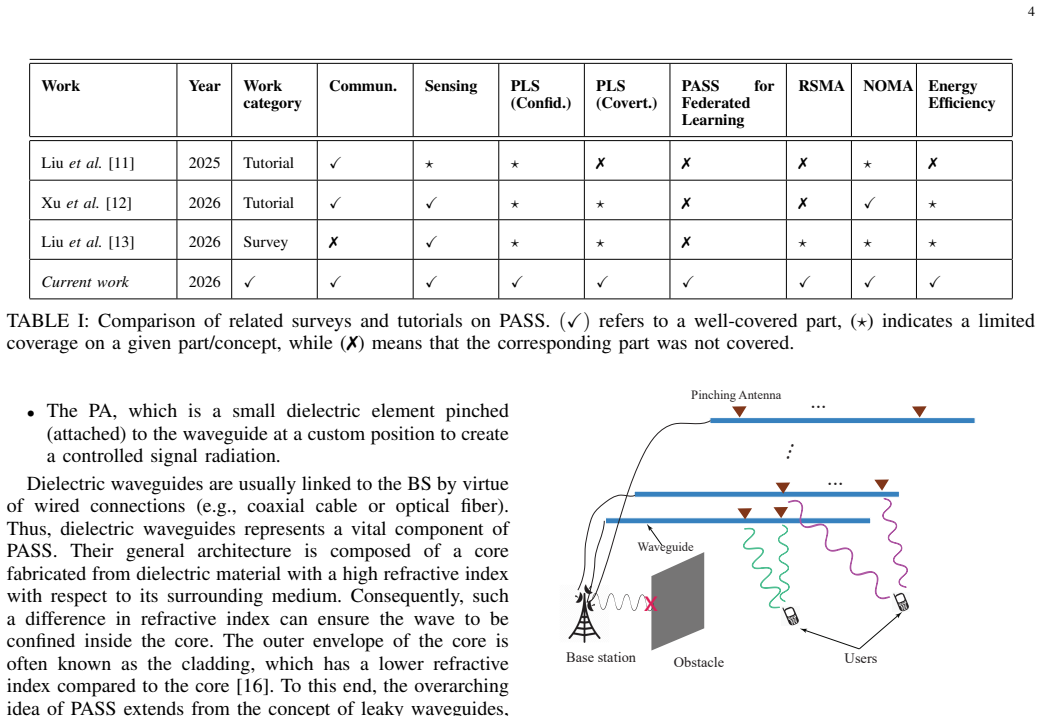
Pinching Antenna System (PASS), the arrangement of base-station RF chains connected to extended waveguides with radiating elements pinched at selectable points along the waveguide to tune the wireless channel.
If this is right
- Antenna placement along the waveguide can be chosen to reduce path loss by bringing radiating elements closer to intended receivers.
- Channel control through pinch locations can be used to steer energy away from eavesdroppers and raise secrecy rates.
- The same geometry supports simultaneous sensing and data transmission by shaping the radiated field for both functions.
- Dynamic repositioning of pinch points offers a route to adaptive coverage without moving the entire base station.
- Energy efficiency gains arise when shorter propagation distances lower the required transmit power for a target signal strength.
Where Pith is reading between the lines
- PASS could be combined with reconfigurable intelligent surfaces to create hybrid channel-control architectures that jointly adjust both transmit and reflect paths.
- Hardware prototypes would need to demonstrate low-loss waveguide feeds and fast, repeatable pinching mechanisms before large-scale trials become feasible.
- Standardization work might focus on waveguide length limits, pinch-point precision, and control interfaces that integrate with existing base-station software.
- Field trials in dense urban canyons or indoor factories would directly test whether the claimed coverage and sensing benefits survive real-world clutter and mobility.
Load-bearing premise
Traditional multi-antenna schemes are inherently unable to improve wireless channel quality without additional channel-altering hardware.
What would settle it
A side-by-side measurement campaign in a non-line-of-sight indoor or urban setting that shows no statistically significant improvement in received power, rate, or secrecy capacity when PASS configurations replace optimized fixed antenna arrays of comparable total aperture and power.
Figures



read the original abstract
The evolution of wireless networks is driving new paradigms for consideration in upcoming generations. To this end, the 6G anticipates the development of several data-rate-hungry applications, in addition to a forecast growth in sensing-centric applications. Such an evolution, however, is unbalanced on the other side by the accentuated scarcity of spectrum, which opens up urgent needs to develop spectrum-efficient communication and sensing techniques. Due to the inability of the traditional multi-antenna schemes to enhance a wireless channel quality, increasing interest has been paid to wireless channel-altering schemes, such as reconfigurable intelligent surfaces and movable antennas. Recently, a new technique in this category, called pinching antennas (PAs), was introduced and tested. PA systems (PASS) are based on extending the reach of a base station by connecting its radio-frequency chains to long waveguides, on which one or many radiating antennas are pinched at custom positions of interest. Thus, such a technique can provide a means of overcoming several unfavorable channel conditions, such as the absence of a line-of-sight and increased free-space path loss. Importantly, such a channel-tuning feature can provide notable enhancements in terms of sensing, network coverage, data rate, and resilience against eavesdropping. In this work, we provide a comprehensive review of research on PASS, designed to meet various system design objectives, such as network coverage and data rate, information-theoretically secure transmission, sensing, integrated sensing and communication, and energy efficiency. A categorization of the surveyed work is established by comparing the various PASS schemes presented. Several takeaways are illustrated on the proposed schemes' potential and limitations, along with several directions forward discussed, in terms of future deployment and implementation.
Editorial analysis
A structured set of objections, weighed in public.
Referee Report
Summary. This survey paper reviews Pinching Antenna Systems (PASS), a technique that extends base-station RF chains via long waveguides with one or more radiating antennas pinched at custom positions. It categorizes existing work on PASS for objectives including network coverage and data rate, information-theoretically secure transmission, sensing, integrated sensing and communication, and energy efficiency; the paper also provides comparative takeaways on the schemes' potential and limitations plus directions for future deployment.
Significance. If the literature coverage is complete and the analysis balanced, the survey would be a useful early reference for an emerging 6G channel-reconfiguration approach that offers positional flexibility beyond fixed arrays or RIS. The explicit categorization and listed takeaways could help organize subsequent research on coverage, secrecy, and ISAC use cases.
major comments (2)
- [Abstract] Abstract: The opening claim that interest in channel-altering schemes stems from 'the inability of the traditional multi-antenna schemes to enhance a wireless channel quality' is overstated. MIMO beamforming, massive MIMO, and adaptive arrays are established to deliver array gain, combat fading, and raise capacity under the same conditions (no LoS, path loss) that the survey attributes to PASS. Because this premise frames the entire motivation and categorization of PASS as addressing otherwise intractable gaps, the survey should qualify or correct the statement and explicitly delineate what PASS uniquely enables versus conventional MIMO.
- [Categorization and takeaways] Categorization and takeaways sections: The paper must supply a systematic comparison table or matrix that places each surveyed PASS scheme against both (i) conventional multi-antenna baselines and (ii) other channel-altering methods (RIS, movable antennas) on the same performance metrics (coverage probability, secrecy rate, sensing accuracy). Without such side-by-side quantification, the claim that PASS provides 'notable enhancements' remains qualitative and the proposed categorization loses discriminatory power.
minor comments (2)
- [Abstract / Introduction] The abstract and introduction should define 'pinching' and the waveguide architecture with a simple diagram or equation (e.g., position-dependent radiation pattern) on first use, rather than deferring the description.
- [References] Ensure the reference list is exhaustive for the 2023-2024 PASS literature; any omitted early works on waveguide-based pinching should be added with a brief justification.
Simulated Author's Rebuttal
We thank the referee for the constructive and detailed feedback on our survey paper. We agree that the abstract requires qualification and that a quantitative comparison table would strengthen the analysis. We address each major comment below and will incorporate the suggested revisions.
read point-by-point responses
-
Referee: [Abstract] Abstract: The opening claim that interest in channel-altering schemes stems from 'the inability of the traditional multi-antenna schemes to enhance a wireless channel quality' is overstated. MIMO beamforming, massive MIMO, and adaptive arrays are established to deliver array gain, combat fading, and raise capacity under the same conditions (no LoS, path loss) that the survey attributes to PASS. Because this premise frames the entire motivation and categorization of PASS as addressing otherwise intractable gaps, the survey should qualify or correct the statement and explicitly delineate what PASS uniquely enables versus conventional MIMO.
Authors: We acknowledge that the abstract phrasing is overstated and could imply that conventional MIMO provides no benefits, which is incorrect. MIMO and massive MIMO are established techniques for array gain and fading mitigation. PASS, however, provides a distinct form of channel reconfiguration through the flexible positioning of pinched antennas along waveguides, enabling dynamic optimization of antenna locations to address specific non-LoS or high path-loss scenarios without requiring physically large arrays. We will revise the abstract to qualify the original statement, acknowledge the strengths of traditional multi-antenna schemes, and explicitly delineate PASS's unique contributions, such as positional flexibility and reduced hardware overhead for certain deployments. revision: yes
-
Referee: [Categorization and takeaways] Categorization and takeaways sections: The paper must supply a systematic comparison table or matrix that places each surveyed PASS scheme against both (i) conventional multi-antenna baselines and (ii) other channel-altering methods (RIS, movable antennas) on the same performance metrics (coverage probability, secrecy rate, sensing accuracy). Without such side-by-side quantification, the claim that PASS provides 'notable enhancements' remains qualitative and the proposed categorization loses discriminatory power.
Authors: We agree that a side-by-side comparison table would make the analysis more rigorous and help readers assess the relative merits of PASS. Although the original works do not always report identical metrics, we will add a new table in the categorization section that aggregates the performance figures (e.g., coverage probability, secrecy rate, sensing accuracy) reported for each PASS scheme and contrasts them with representative values from conventional MIMO, RIS, and movable-antenna literature. This will render the 'notable enhancements' more quantitative while preserving the existing textual takeaways. revision: yes
Circularity Check
Survey paper contains no derivations or fitted predictions
full rationale
This is a literature review surveying existing PASS research with no original equations, models, or predictions. The abstract motivation statement regarding traditional multi-antenna schemes is a framing claim, not a derivation that reduces to its own inputs by construction. No self-citations, ansatzes, or fitted parameters are used in a load-bearing circular manner. The paper is self-contained as a summary of prior work.
Axiom & Free-Parameter Ledger
Reference graph
Works this paper leans on
-
[1]
On the road to 6g: Visions, requirements, key technologies, and testbeds,
C.-X. Wang, X. You, X. Gao, X. Zhu, Z. Li, C. Zhang, H. Wang, Y . Huang, Y . Chen, H. Haas, J. S. Thompson, E. G. Larsson, M. D. Renzo, W. Tong, P. Zhu, X. Shen, H. V . Poor, and L. Hanzo, “On the road to 6g: Visions, requirements, key technologies, and testbeds,” IEEE Communications Surveys & Tutorials, vol. 25, no. 2, pp. 905– 974, 2023
work page 2023
-
[2]
Twelve scientific challenges for 6g: Rethinking the foundations of communications theory,
M. Chafii, L. Bariah, S. Muhaidat, and M. Debbah, “Twelve scientific challenges for 6g: Rethinking the foundations of communications theory,”IEEE Communications Surveys & Tutorials, vol. 25, no. 2, pp. 868–904, 2023
work page 2023
-
[3]
Spectrum options and allocations for 6g: A regulatory and standardization review,
W. K. Alsaedi, H. Ahmadi, Z. Khan, and D. Grace, “Spectrum options and allocations for 6g: A regulatory and standardization review,”IEEE Open J. Commun. Soc., vol. 4, pp. 1787–1812, 2023
work page 2023
-
[4]
Massive MIMO: ten myths and one critical question,
E. Björnsonet al., “Massive MIMO: ten myths and one critical question,”IEEE Commun. Mag., vol. 54, no. 2, pp. 114–123, 2016
work page 2016
-
[5]
Movable antennas for wireless communication: Opportunities and challenges,
L. Zhu, W. Ma, and R. Zhang, “Movable antennas for wireless communication: Opportunities and challenges,”IEEE Commun. Mag., vol. 62, no. 6, pp. 114–120, 2024
work page 2024
-
[6]
Modeling and performance analysis for movable antenna enabled wireless communications,
——, “Modeling and performance analysis for movable antenna enabled wireless communications,”IEEE Trans. Wireless Commun., vol. 23, no. 6, pp. 6234–6250, 2024
work page 2024
-
[7]
Pinching antenna: Using a dielectric waveguide as an antenna,
A. Fukudaet al., “Pinching antenna: Using a dielectric waveguide as an antenna,”NTT DOCOMO Technical J., vol. 23, no. 3, p. 5–12, 2022
work page 2022
-
[8]
Pinching- antenna systems: Architecture designs, opportunities, and outlook,
Y . Liu, Z. Wang, X. Mu, C. Ouyang, X. Xu, and Z. Ding, “Pinching- antenna systems: Architecture designs, opportunities, and outlook,” IEEE Commun. Mag., vol. 64, no. 1, pp. 190–196, 2026
work page 2026
-
[9]
Pinching antennas: Principles, appli- cations and challenges,
Z. Yang, N. Wang, Y . Sun, Z. Ding, R. Schober, G. K. Karagiannidis, V . W. Wong, and O. A. Dobre, “Pinching antennas: Principles, appli- cations and challenges,”IEEE Wireless Commun., pp. 1–10, 2025
work page 2025
-
[10]
Flexible-antenna systems: A pinching-antenna perspective,
Z. Ding, R. Schober, and H. Vincent Poor, “Flexible-antenna systems: A pinching-antenna perspective,”IEEE Trans. Commun., vol. 73, no. 10, pp. 9236–9253, 2025
work page 2025
-
[11]
Pinching- antenna systems (PASS): A tutorial,
Y . Liu, H. Jiang, X. Xu, Z. Wang, J. Guo, C. Ouyang, X. Mu, Z. Ding, A. Nallanathan, G. K. Karagiannidis, and R. Schober, “Pinching- antenna systems (PASS): A tutorial,”IEEE Trans. Commun., pp. 1–1, 2026
work page 2026
-
[12]
Y . Xu, J. Cui, Y . Zhu, Z. Ding, T.-H. Chang, R. Schober, V . W. S. Wong, O. A. Dobre, G. K. Karagiannidis, H. V . Poor, and X. You, “Generalized pinching-antenna systems: A tutorial on principles, design strategies, and future directions,” 2025. [Online]. Available: https://arxiv.org/abs/2510.14166
-
[13]
A survey of pinching-antenna systems (PASS),
Y . Liu, H. Jiang, X. Gan, X. Xu, J. Guo, Z. Wang, C. Ouyang, X. Mu, Z. Ding, A. Nallanathan, O. A. Dobre, G. K. Karagiannidis, and R. Schober, “A survey of pinching-antenna systems (PASS),”
-
[14]
A survey of pinching-antenna systems (PASS),
[Online]. Available: https://arxiv.org/abs/2601.18927
-
[15]
Intelligent flexible position antenna systems for networking: A survey,
X. Yu, J. Wang, R. Q. Hu, D. I. Kim, N. Al-Dhahir, H. Wymeersch, and N. Zhao, “Intelligent flexible position antenna systems for networking: A survey,”IEEE Trans. Netw. Sci. Eng., vol. 13, pp. 3105–3126, 2026
work page 2026
-
[16]
A survey on reconfigurable and movable antennas for wireless communications and sensing,
W. Ma, L. Zhu, Y . Tan, B. Zheng, Y . Zhang, Y . Zhang, K. Ying, Z. Gao, H. Sun, X. Shao, Z. Xiao, D. Niyato, and R. Zhang, “A survey on reconfigurable and movable antennas for wireless communications and sensing,” Jan. 2026. [Online]. Available: http://dx.doi.org/10.36227/techrxiv.176857884.40392967/v1
-
[17]
S. O. Kasap,Optoelectronics & Photonics: Principles and Practices, 2nd ed. Boston: Pearson Education, 2013
work page 2013
-
[18]
Modeling and Beamforming Optimization for Pinching-Antenna Systems,
Z. Wanget al., “Modeling and beamforming optimization for pinching-antenna systems,” 2025. [Online]. Available: https://arxiv.org/abs/2502.05917
-
[19]
Theory and analysis of leaky coaxial cables with periodic slots,
J. H. Wang and K. Mei, “Theory and analysis of leaky coaxial cables with periodic slots,”IEEE Trans. Antennas Propag., vol. 49, no. 12, pp. 1723–1732, 2001
work page 2001
-
[20]
MMSE-optimal sequen- tial processing for cell-free massive MIMO with radio stripes,
Z. H. Shaik, E. Björnson, and E. G. Larsson, “MMSE-optimal sequen- tial processing for cell-free massive MIMO with radio stripes,”IEEE Trans. Commun., vol. 69, no. 11, pp. 7775–7789, 2021
work page 2021
-
[21]
C. Ouyang, H. Jiang, Z. Wang, Y . Liu, and Z. Ding, “Uplink and downlink communications in segmented waveguide-enabled pinching- antenna systems (SW ANs),”IEEE Trans. Commun., pp. 1–1, 2026
work page 2026
-
[22]
Center-fed pinching antenna system (C- PASS) aided wireless communications,
X. Gan and Y . Liu, “Center-fed pinching antenna system (C- PASS) aided wireless communications,” 2026. [Online]. Available: https://arxiv.org/abs/2601.07424
-
[23]
C-PASS: Center-fed pinching antenna system,
——, “C-PASS: Center-fed pinching antenna system,” 2025. [Online]. Available: https://arxiv.org/abs/2512.12619
-
[24]
Wireless-fed pinching-antenna systems (wi-pass) for NextG wireless networks,
K. R. Wijewardhana, A. Yadav, M. Zeng, M. Elsayed, O. A. Dobre, and Z. Ding, “Wireless-fed pinching-antenna systems (Wi- PASS) for nextg wireless networks,” 2025. [Online]. Available: https://arxiv.org/abs/2510.18743
-
[25]
Wireless-fed pinching-antenna systems with horn antennas,
H. Feng, M. Zeng, E. Bedeer, X. Li, O. A. Dobre, and Z. Ding, “Wireless-fed pinching-antenna systems with horn antennas,” 2026. [Online]. Available: https://arxiv.org/abs/2602.21167
-
[26]
Rate maximization for downlink pinching-antenna systems,
Y . Xu, Z. Ding, and G. K. Karagiannidis, “Rate maximization for downlink pinching-antenna systems,”IEEE Wireless Commun. Lett., vol. 14, no. 5, pp. 1431–1435, 2025
work page 2025
-
[27]
Downlink beamforming with pinching-antenna assisted MIMO systems,
A. Bereyhi, S. Asaad, C. Ouyang, Z. Ding, and H. V . Poor, “Downlink beamforming with pinching-antenna assisted MIMO systems,” in2025 IEEE International Conference on Communications Workshops (ICC Workshops), 2025, pp. 1–6
work page 2025
-
[28]
GPASS: Deep learning for beamforming in pinching-antenna systems (PASS),
J. Guo, Y . Liu, and A. Nallanathan, “GPASS: Deep learning for beamforming in pinching-antenna systems (PASS),” 2025. [Online]. Available: https://arxiv.org/abs/2502.01438
-
[29]
Minimum data rate maximization for uplink pinching- antenna systems,
S. Tegoset al., “Minimum data rate maximization for uplink pinching- antenna systems,”IEEE Wireless Commun. Lett., pp. 1–1, 2025
work page 2025
-
[30]
Uplink sum-rate maximization for pinching antenna-assisted multiuser MISO commu- nications,
J. Zhang, H. Xu, C. Ouyang, Q. Zou, and H. Yang, “Uplink sum-rate maximization for pinching antenna-assisted multiuser MISO commu- nications,”IEEE Commun. Lett., vol. 29, no. 12, pp. 2795–2799, 2025
work page 2025
-
[31]
Dynamic placement of pinching antennas for multicast MU-MISO downlinks,
J.-C. Chen, P.-C. Wu, and K.-K. Wong, “Dynamic placement of pinching antennas for multicast MU-MISO downlinks,”IEEE Open Journal of the Commun. Soc., vol. 6, pp. 5611–5625, 2025
work page 2025
-
[32]
Rate optimization for downlink URLLC via pinching antenna arrays,
T. Lin, J. Zhu, W. Huang, M. Hua, and Z. Zhang, “Rate optimization for downlink URLLC via pinching antenna arrays,” 2025. [Online]. Available: https://arxiv.org/abs/2509.01222
-
[33]
Deep learning optimization of two- state pinching antennas systems,
O. G. Karagiannidis, V . E. Galanopoulou, P. D. Diamantoulakis, Z. Ding, and O. A. Dobre, “Deep learning optimization of two- state pinching antennas systems,”IEEE Trans. Cogn. Commun. Netw., vol. 12, pp. 4942–4956, 2026
work page 2026
-
[34]
K. Zhou, W. Zhou, D. Cai, X. Lei, Y . Xu, Z. Ding, and P. Fan, “A gradient meta-learning joint optimization for beamforming and antenna position in pinching-antenna systems,”IEEE Trans. Commun., vol. 74, pp. 1099–1112, 2026
work page 2026
-
[35]
X. Xu, X. Mu, Y . Liu, and A. Nallanathan, “Joint transmit and pinching beamforming for pinching antenna system (PASS): Optimization-based or learning-based?”IEEE Transactions on Wireless Communications, vol. 25, pp. 11 449–11 464, 2026
work page 2026
-
[36]
Graph transformer for tri- beamforming in pinching antenna systems (pass),
J. Guo, Y . Liu, and A. Nallanathan, “Graph transformer for tri- beamforming in pinching antenna systems (pass),”IEEE Journal on Selected Areas in Communications, vol. 44, pp. 2872–2888, 2026
work page 2026
-
[37]
Directional pinching-antenna systems,
R. Zhang, Y . Shao, and Y . Liu, “Directional pinching-antenna systems,” 2025. [Online]. Available: https://arxiv.org/abs/2511.19133
-
[38]
LoS blockage in pinching-antenna systems: Curse or blessing?
Z. Ding and H. Vincent Poor, “LoS blockage in pinching-antenna systems: Curse or blessing?”IEEE Wireless Commun. Lett., vol. 14, no. 9, pp. 2798–2802, 2025
work page 2025
-
[39]
Pinching antennas in blockage-aware environments: Modeling, design, and optimization,
X. Xie, F. Fang, Z. Ding, and X. Wang, “Pinching antennas in blockage-aware environments: Modeling, design, and optimization,”
-
[40]
Pinching antennas in blockage-aware environments: Modeling, design, and optim ization,
[Online]. Available: https://arxiv.org/abs/2601.01277
-
[41]
Robust resource allocation for pinching-antenna systems under user location uncertainty,
M. Zeng, X. Wang, Y . Liu, Z. Ding, G. K. Karagiannidis, and H. V . Poor, “Robust resource allocation for pinching-antenna systems under user location uncertainty,”IEEE Trans. Veh. Technol., pp. 1–5, 2026
work page 2026
-
[42]
Total transmission power minimization for downlink pinching-antenna systems,
H. Li, Z. Yang, X. Lei, and Z. Ding, “Total transmission power minimization for downlink pinching-antenna systems,”IEEE Wireless Commun. Lett., vol. 15, pp. 645–649, 2026
work page 2026
-
[43]
Power Minimization in Pinching-Antenna Systems under Probabilistic LoS Blockage
L. Li, Y . Xu, T. Cai, and T.-H. Chang, “Power minimization in pinching-antenna systems under probabilistic LoS blockage,” 2025. [Online]. Available: https://arxiv.org/abs/2512.24573
work page internal anchor Pith review Pith/arXiv arXiv 2025
-
[44]
Y . Xu, D. Xu, X. Yu, S. Song, Z. Ding, and R. Schober, “Joint radiation power, antenna position, and beamforming optimization for pinching-antenna systems with motion power consumption,”IEEE Trans. Wireless Commun., vol. 25, pp. 7825–7841, 2026
work page 2026
-
[45]
Pinching-antenna systems (pass): Power radiation model and optimal beamforming 21 design,
X. Xu, X. Mu, Z. Wang, Y . Liu, and A. Nallanathan, “Pinching-antenna systems (pass): Power radiation model and optimal beamforming 21 design,”IEEE Transactions on Communications, vol. 74, pp. 2160– 2175, 2026
work page 2026
-
[46]
Energy-efficient uplink communication in UA V-enabled MEC networks with pinching antennas,
Y . Ai, C. Liu, and M. Li, “Energy-efficient uplink communication in UA V-enabled MEC networks with pinching antennas,”Drones, vol. 9, no. 11, 2025. [Online]. Available: https://www.mdpi.com/2504- 446X/9/11/796
work page 2025
-
[47]
Pinching-antenna- based communications: Spectral efficiency analysis and deployment strategies,
M. Qian, X. Mu, L. You, and M. Matthaiou, “Pinching-antenna- based communications: Spectral efficiency analysis and deployment strategies,”IEEE Trans. Commun., pp. 1–1, 2026
work page 2026
-
[48]
Spectral and Energy Efficiency Tradeoff for Pinching-Antenna Systems
Z. Zhou, Z. Wang, and Y . Liu, “Spectral and energy efficiency tradeoff for pinching-antenna systems,” 2025. [Online]. Available: https://arxiv.org/abs/2510.25192
work page internal anchor Pith review Pith/arXiv arXiv 2025
-
[49]
Dual-scale antenna deployment for pinching antenna systems,
X. Gan, Z. Wang, and Y . Liu, “Dual-scale antenna deployment for pinching antenna systems,” 2026. [Online]. Available: https://arxiv.org/abs/2510.27185
-
[50]
Energy-efficient design for downlink pinching-antenna systems with QoSt guarantee,
M. Zeng, J. Wang, G. Zhou, F. Fang, and X. Wang, “Energy-efficient design for downlink pinching-antenna systems with QoSt guarantee,” IEEE Trans. Veh. Technol., vol. 75, no. 2, pp. 3503–3507, 2026
work page 2026
-
[51]
Graph neural network enabled pinching antennas,
X. Xie, Y . Lu, and Z. Ding, “Graph neural network enabled pinching antennas,”IEEE Wireless Commun. Lett., vol. 14, no. 9, pp. 2982–2986, 2025
work page 2025
-
[52]
Pinching antenna systems versus reconfig- urable intelligent surfaces in mmWave,
M. Samy, H. Al-Hraishawi, M. Alsenwi, A. B. M. Adam, S. Chatzino- tas, and B. Ottersten, “Pinching antenna systems versus reconfig- urable intelligent surfaces in mmWave,”IEEE Wireless Commun. Lett., vol. 14, no. 12, pp. 4022–4026, 2025
work page 2025
-
[53]
Dynamic and static energy efficient design of pinching antenna systems,
S. Asaad, C. Ouyang, A. Bereyhi, and Z. Ding, “Dynamic and static energy efficient design of pinching antenna systems,” 2025. [Online]. Available: https://arxiv.org/abs/2511.08720
-
[54]
D. M. Pozar,Microwave Engineering.Hoboken, NJ, USA: Wiley, 2012
work page 2012
-
[55]
Physical-layer security of pinching-antenna systems,
O. S. Badarneh, H. S. Silva, and Y . H. A. Badarneh, “Physical-layer security of pinching-antenna systems,” 2025. [Online]. Available: https://arxiv.org/abs/2503.18322
-
[56]
Pinching-antenna systems for physical layer security,
K. Wang, Z. Ding, and N. Al-Dhahir, “Pinching-antenna systems for physical layer security,”IEEE Wireless Commun. Lett., pp. 1–1, 2025
work page 2025
-
[57]
Physical layer security for pinching-antenna systems via index and directional modulation,
Y . Zhong, J. Chen, Y . Xiao, S. Yang, X. Lei, Y . Gao, and M. Xiao, “Physical layer security for pinching-antenna systems via index and directional modulation,”IEEE Wireless Commun. Lett., pp. 1–1, 2025
work page 2025
-
[58]
Secure pinching antennas-aided wireless com- munication system,
E. Illi and M. Qaraqe, “Secure pinching antennas-aided wireless com- munication system,” in2025 International Symposium on Networks, Computers and Communications (ISNCC), 2025, pp. 1–6
work page 2025
-
[59]
Physical layer secu rity for pinching-antenna systems (PASS),
M. Sun, C. Ouyang, S. Wu, and Y . Liu, “Physical layer security for pinching-antenna systems (PASS),” 2025. [Online]. Available: https://arxiv.org/abs/2503.09075
-
[60]
Pinching- antenna systems (PASS)-enabled secure wireless communications,
G. Zhu, X. Mu, L. Guo, S. Xu, Y . Liu, and N. Al-Dhahir, “Pinching- antenna systems (PASS)-enabled secure wireless communications,” IEEE Trans. Commun., pp. 1–1, 2025
work page 2025
-
[61]
On the secrecy performance of pinching-antenna systems,
N. Li, W. Mei, L. Zhu, P. Wu, and B. Ning, “On the secrecy performance of pinching-antenna systems,” 2025. [Online]. Available: https://arxiv.org/abs/2509.16854
-
[62]
Security-driven power allocation in pinching- antenna systems enabling high-data-rate iot,
G. Wang and Q. Du, “Security-driven power allocation in pinching- antenna systems enabling high-data-rate iot,” in2025 IEEE 11th World Forum on Internet of Things (WF-IoT), 2025, pp. 1–6
work page 2025
-
[63]
K. T. Musri, A. Y . Sarhan, O. A. Abdullah, and H. Al-Hraishawi, “Adaptive pinching antenna optimization via meta-learning for physical-layer security in dynamic wireless networks,” 2025. [Online]. Available: https://arxiv.org/abs/2601.00115
-
[64]
Pinching antenna system (pass) enhanced covert communications: Against warden via sensing,
H. Jiang, Z. Wang, Y . Liu, A. Nallanathan, and Z. Ding, “Pinching antenna system (pass) enhanced covert communications: Against warden via sensing,” 2025. [Online]. Available: https://arxiv.org/abs/2509.06170
-
[65]
Pinching-antenna system (PASS) enhanced covert communications,
H. Jiang, Z. Wang, and Y . Liu, “Pinching-antenna system (PASS) enhanced covert communications,” 2025. [Online]. Available: https://arxiv.org/abs/2504.10442
-
[66]
Uplink rate maximization for pinching antenna- assisted covert backscatter communication,
Y . Wang, Y . Liu, Y . Fu, and Y . Liu, “Uplink rate maximization for pinching antenna- assisted covert backscatter communication,” 2025. [Online]. Available: https://arxiv.org/abs/2512.10970
-
[67]
Antenna activation for NOMA assisted pinching-antenna systems,
K. Wang, Z. Ding, and R. Schober, “Antenna activation for NOMA assisted pinching-antenna systems,”IEEE Wireless Commun. Lett., vol. 14, no. 5, pp. 1526–1530, 2025
work page 2025
-
[68]
Antenna activation and resource allocation in multi-waveguide pinching-antenna systems,
K. Wang, Z. Ding, and G. K. Karagiannidis, “Antenna activation and resource allocation in multi-waveguide pinching-antenna systems,” IEEE Trans. Wireless Commun., pp. 1–1, 2025
work page 2025
-
[69]
Sum rate maximization for NOMA-assisted uplink pinching-antenna systems,
M. Zeng, J. Wang, X. Li, D. G. Wang, O. A. Dobre, and Z. Ding, “Sum rate maximization for NOMA-assisted uplink pinching-antenna systems,”IEEE Wireless Commun. Lett., vol. 15, pp. 280–284, 2026
work page 2026
-
[70]
Sum-rate maximization for NOMA-assisted pinching-antenna systems,
Z. Zhou, Z. Yang, G. Chen, and Z. Ding, “Sum-rate maximization for NOMA-assisted pinching-antenna systems,”IEEE Wireless Commun. Lett., vol. 14, no. 9, pp. 2728–2732, 2025
work page 2025
-
[71]
S. Hu, R. Zhao, Y . Liao, D. W. K. Ng, and J. Yuan, “Sum- rate maximization for pinching antenna-assisted NOMA systems with multiple dielectric waveguides,” 2025. [Online]. Available: https://arxiv.org/abs/2503.10060
-
[72]
QoS-aware NOMA design for downlink pinching-antenna systems,
Y . Xu, Z. Ding, D. Cai, and V . W. Wong, “QoS-aware NOMA design for downlink pinching-antenna systems,”IEEE Trans. Commun., vol. 73, no. 12, pp. 13 611–13 625, 2025
work page 2025
-
[73]
S. Mohammadzadeh, K. Cumanan, and Z. Ding, “NOMA assisted downlink power allocation in pinching antenna systems using convolutional neural network,” 2025. [Online]. Available: https://arxiv.org/abs/2511.22328
-
[74]
Energy-efficient resource allocation for NOMA-assisted uplink pinching-antenna systems,
M. Zeng, X. Li, J. Wang, G. Huang, O. A. Dobre, and Z. Ding, “Energy-efficient resource allocation for NOMA-assisted uplink pinching-antenna systems,”IEEE Wireless Commun. Lett., vol. 14, no. 11, pp. 3695–3699, 2025
work page 2025
-
[75]
Power minimization for NOMA-assisted pinching antenna systems with multiple waveguides,
Y . Fu, F. He, Z. Shi, and H. Zhang, “Power minimization for NOMA-assisted pinching antenna systems with multiple waveguides,”
-
[76]
Power minimization for NOMA-assisted pinching antenna systems with multiple waveguides,
[Online]. Available: https://arxiv.org/abs/2503.20336
-
[77]
Efficient down- link power allocation for NOMA-based pinching-antenna systems,
S. Mohammadzadeh, K. Cumanan, C. Li, and Z. Ding, “Efficient down- link power allocation for NOMA-based pinching-antenna systems,” IEEE Wireless Commun. Lett., vol. 14, no. 12, pp. 4187–4191, 2025
work page 2025
-
[78]
Joint beamforming for NOMA assisted pinching antenna systems (pass),
D. Gan, X. Xu, J. Zuo, X. Ge, and Y . Liu, “Joint beamforming for NOMA assisted pinching antenna systems (pass),”IEEE Trans. Commun., pp. 1–1, 2025
work page 2025
-
[79]
P-NOMA for pinching-antenna systems (PASS),
B. Zhuo, J. Gu, W. Duan, M. Wen, L. Peng, and P.-H. Ho, “P-NOMA for pinching-antenna systems (PASS),”IEEE Wireless Commun. Lett., vol. 15, pp. 131–135, 2026
work page 2026
-
[80]
Joint power allocation and radiation optimization in NOMA-assisted pinching antenna systems,
N. Vashakidze, C. Assi, M. Elhattab, A. Ghrayeb, and M. J. Khabbaz, “Joint power allocation and radiation optimization in NOMA-assisted pinching antenna systems,” 2025. [Online]. Available: https://arxiv.org/abs/2511.04861
discussion (0)
Sign in with ORCID, Apple, or X to comment. Anyone can read and Pith papers without signing in.