Digital Privacy in IoT: Exploring Challenges, Approaches and Open Issues
Pith reviewed 2026-05-10 20:06 UTC · model grok-4.3
The pith
A multi-layered framework called AURA-IoT can mitigate AI-driven privacy risks in IoT systems by combining adversarial robustness, explainability, dynamic consent, and policy enforcement.
A machine-rendered reading of the paper's core claim, the machinery that carries it, and where it could break.
Core claim
The paper claims that AURA-IoT, a futuristic framework, tackles AI-driven privacy risks through a multi-layered structure integrating adversarial robustness, explainability, transparency, fairness, compliance, dynamic consent, and policy enforcement mechanisms to ensure digital privacy, security, and accountable IoT operations.
What carries the argument
AURA-IoT, the proposed multi-layered framework that stacks adversarial robustness, explainability, transparency, fairness, compliance, dynamic consent, and policy enforcement to manage privacy risks.
Load-bearing premise
That integrating the listed mechanisms into a multi-layered structure will ensure digital privacy and security in real IoT deployments.
What would settle it
A controlled testbed deployment of AURA-IoT that measures actual reduction in privacy breaches or inference attacks compared with standard IoT systems without the framework.
Figures


read the original abstract
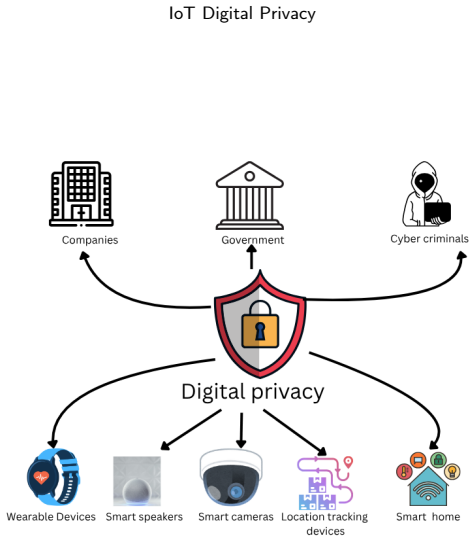
Privacy has always been a critical issue in the digital era, particularly with the increasing use of Internet of Things (IoT) devices. As the IoT continues to transform industries such as healthcare, smart cities, and home automation, it has also introduced serious challenges regarding the security of sensitive and private data. This paper examines the complex landscape of digital privacy in IoT ecosystems, highlighting the need to protect personally identifiable information (PII) of individuals and uphold their rights to digital independence. Global events, such as the COVID-19 pandemic, have accelerated the adoption of IoT, raising concerns about privacy and data protection. This paper provides an in-depth examination of digital privacy risks in the IoT domain and introduces a clear taxonomy for evaluating them using the IEEE Digital Privacy Model. The proposed framework categorizes privacy risks into five types: identity-oriented, behavioral, inference, data manipulation, and regulatory risks. We review existing digital privacy solutions, including encryption technologies, blockchain, federated learning, differential privacy, reinforcement learning, AI, and dynamic consent mechanisms, to mitigate these risks. We also highlight how these privacy-enhancing technologies (PETs) help with data confidentiality, access control, and trust management. Additionally, this study presents AURA-IoT, a futuristic framework that tackles AI-driven privacy risks through a multi-layered structure. AURA-IoT integrates adversarial robustness, explainability, transparency, fairness, compliance, dynamic consent, and policy enforcement mechanisms to ensure digital privacy, security, and accountable IoT operations. Finally, we discuss ongoing challenges and potential research directions for integrating AI and encryption-based privacy solutions to achieve comprehensive digital privacy in future IoT systems.
Editorial analysis
A structured set of objections, weighed in public.
Referee Report
Summary. The paper surveys digital privacy challenges in IoT, categorizes risks into five types (identity-oriented, behavioral, inference, data manipulation, and regulatory) using the IEEE Digital Privacy Model, reviews privacy-enhancing technologies such as encryption, blockchain, federated learning, differential privacy, reinforcement learning, AI, and dynamic consent, and proposes AURA-IoT as a multi-layered futuristic framework that integrates adversarial robustness, explainability, transparency, fairness, compliance, dynamic consent, and policy enforcement to address AI-driven privacy risks and ensure digital privacy, security, and accountable IoT operations.
Significance. The taxonomy and review of existing PETs provide a useful organization of the literature on IoT privacy risks and mitigation approaches. If the AURA-IoT framework were developed with concrete architecture, component interaction rules, and supporting analysis or evaluation, it could serve as a high-level blueprint for integrating AI safety mechanisms with privacy controls in IoT systems, advancing research on accountable and secure deployments.
major comments (1)
- [Abstract and AURA-IoT description] Abstract and section describing AURA-IoT: the central claim that the framework 'tackles AI-driven privacy risks through a multi-layered structure integrating adversarial robustness, explainability, transparency, fairness, compliance, dynamic consent, and policy enforcement mechanisms to ensure digital privacy, security, and accountable IoT operations' is unsupported. The manuscript supplies only a high-level list of components and a risk taxonomy, with no layer definitions, data-flow specifications, composition rules, threat-model mappings, pseudocode, or metrics demonstrating how the mechanisms interact to close the identified risk categories (e.g., inference attacks).
minor comments (1)
- The review would be strengthened by adding explicit citations for the IEEE Digital Privacy Model and for each reviewed technology (encryption, blockchain, federated learning, etc.) to allow readers to trace the sources.
Simulated Author's Rebuttal
We thank the referee for the constructive feedback on our survey paper. We address the major comment below and will revise the manuscript to better reflect the conceptual scope of the AURA-IoT framework.
read point-by-point responses
-
Referee: [Abstract and AURA-IoT description] Abstract and section describing AURA-IoT: the central claim that the framework 'tackles AI-driven privacy risks through a multi-layered structure integrating adversarial robustness, explainability, transparency, fairness, compliance, dynamic consent, and policy enforcement mechanisms to ensure digital privacy, security, and accountable IoT operations' is unsupported. The manuscript supplies only a high-level list of components and a risk taxonomy, with no layer definitions, data-flow specifications, composition rules, threat-model mappings, pseudocode, or metrics demonstrating how the mechanisms interact to close the identified risk categories (e.g., inference attacks).
Authors: We appreciate the referee's observation that the AURA-IoT description is high-level. The paper is a survey that reviews IoT privacy risks via the IEEE model, categorizes them into five types, and surveys PETs including encryption, blockchain, federated learning, differential privacy, reinforcement learning, AI, and dynamic consent. AURA-IoT is introduced as a futuristic conceptual framework to highlight integration opportunities for addressing AI-driven risks, not as a fully specified system. We agree that the abstract and section overstate the framework's readiness by implying concrete interactions and closure of risks without providing layer definitions, data flows, composition rules, or evaluations. We will revise the abstract to describe AURA-IoT explicitly as a high-level blueprint for future research and expand the section with a conceptual mapping of components to risk categories (e.g., adversarial robustness for inference attacks, dynamic consent for regulatory risks). We will also add a limitations paragraph noting the absence of implementation details or metrics, which would require a follow-on engineering paper. These changes will align the claims with the survey's scope while preserving the framework's value as an organizing vision. revision: yes
Circularity Check
No circularity: AURA-IoT is a high-level conceptual proposal without derivations or reductions
full rationale
The paper is a survey-style review that taxonomizes IoT privacy risks using the IEEE Digital Privacy Model and lists existing PETs (encryption, blockchain, federated learning, etc.) before outlining AURA-IoT as a multi-layered integration of adversarial robustness, explainability, dynamic consent, and similar mechanisms. No equations, parameter fittings, formal derivations, or self-referential definitions appear in the provided text. The central claim that the listed components 'ensure' privacy is an assertion rather than a derived result that reduces to its own inputs by construction. No self-citation chains, ansatzes smuggled via prior work, or uniqueness theorems are invoked in a load-bearing way. The absence of any mathematical or algorithmic derivation chain means none of the enumerated circularity patterns can be exhibited with a specific quote and reduction.
Axiom & Free-Parameter Ledger
axioms (1)
- domain assumption IoT ecosystems collect and process personally identifiable information that requires protection to uphold individual rights.
invented entities (1)
-
AURA-IoT
no independent evidence
Reference graph
Works this paper leans on
-
[1]
JacksonAdamsandHalaAlmahmoud. Themeaningofprivacyinthedigitalera.InternationalJournalofSecurityandPrivacyinPervasive Computing (IJSPPC), 15(1):1–15, March 2023
work page 2023
-
[2]
Abdul Majeed and Seong Oun Hwang. A comprehensive analysis of privacy protection techniques developed for covid-19 pandemic.IEEE Access, 9:164159–164187, November 2021
work page 2021
-
[3]
Santhosh Srinivas and Huigang Liang. Being digital to being vulnerable: does digital transformation allure a data breach?Journal of Electronic Business & Digital Economics, 1(1/2):111–137, November 2022
work page 2022
-
[4]
Statista. Impact of consumer data privacy laws.https://www.statista.com/statistics/1403400/ us-uk-firms-transfer-data-internationally-impact-law/, 2023. Accessed: March 23, 2025
-
[5]
Digital privacy.Management Science, 69(6):3157–3173, August 2023
Itay P Fainmesser, Andrea Galeotti, and Ruslan Momot. Digital privacy.Management Science, 69(6):3157–3173, August 2023
work page 2023
-
[6]
AbdulSalam.Internetofthingsforsustainability:perspectivesinprivacy,cybersecurity,andfuturetrends.InInternetofthingsforsustainable community development: wireless communications, sensing, and systems, pages 299–326. Springer, May 2024
work page 2024
-
[7]
PhD thesis, Robert Morris University, 2020
Trisha Bartlett.Privacy and Security Management Practices of Emerging Technologies: Internet of Things. PhD thesis, Robert Morris University, 2020
work page 2020
-
[8]
Yan Huang, Yi Joy Li, and Zhipeng Cai. Security and privacy in metaverse: A comprehensive survey.Big Data Mining and Analytics, 6(2):234–247, 2023
work page 2023
-
[9]
RichaSinghaiandRamaSushil. Aninvestigationofvarioussecurityandprivacyissuesininternetofthings.MaterialsToday:Proceedings, 80:3393–3397, 2023
work page 2023
-
[10]
Kholoud Y Najmi, Mohammed A AlZain, Mehedi Masud, NZ Jhanjhi, Jehad Al-Amri, and Mohammed Baz. A survey on security threats and countermeasures in iot to achieve users confidentiality and reliability.Materials Today: Proceedings, 81:377–382, 2023
work page 2023
-
[11]
Francesca Meneghello, Matteo Calore, Daniel Zucchetto, Michele Polese, and Andrea Zanella. Iot: Internet of threats? a survey of practical security vulnerabilities in real iot devices.IEEE Internet of Things Journal, 6(5):8182–8201, 2019
work page 2019
-
[12]
Facebook and cambridge analytica: An unholy alliance
Mitchell Matara, Guillermo D Rose, and Peter Conklin. Facebook and cambridge analytica: An unholy alliance. 2024
work page 2024
- [13]
-
[14]
Saci Medileh, Abdelkader Laouid, Reinhardt Euler, Ahcène Bounceur, Mohammad Hammoudeh, Muath AlShaikh, Amna Eleyan, Osama Ahmed Khashan, et al. A flexible encryption technique for the internet of things environment.Ad Hoc Networks, 106:102240, 2020
work page 2020
-
[15]
An efficient lightweight cryptographic algorithm for iot security
Muyideen Abdulraheem, Joseph Bamidele Awotunde, Rasheed Gbenga Jimoh, and Idowu Dauda Oladipo. An efficient lightweight cryptographic algorithm for iot security. InInternational Conference on Information and Communication Technology and Applications, pages 444–456. Springer, 2020
work page 2020
-
[16]
Dinh C Nguyen, Ming Ding, Pubudu N Pathirana, Aruna Seneviratne, Jun Li, and H Vincent Poor. Federated learning for internet of things: A comprehensive survey.IEEE Communications Surveys & Tutorials, 23(3):1622–1658, 2021
work page 2021
-
[17]
Qinbin Li, Zeyi Wen, Zhaomin Wu, Sixu Hu, Naibo Wang, Yuan Li, Xu Liu, and Bingsheng He. A survey on federated learning systems: Vision, hype and reality for data privacy and protection.IEEE Transactions on Knowledge and Data Engineering, 35(4):3347–3366, 2021. Shini Girija et al.:Preprint submitted to ElsevierPage 22 of 27 IoT Digital Privacy
work page 2021
-
[18]
Zhaoming Qin, Di Liu, Haochen Hua, and Junwei Cao. Privacy preserving load control of residential microgrid via deep reinforcement learning.IEEE Transactions on Smart Grid, 12(5):4079–4089, 2021
work page 2021
-
[19]
Privacy-cost management in smart meters using deep reinforcement learning
Mohammadhadi Shateri, Francisco Messina, Pablo Piantanida, and Fabrice Labeau. Privacy-cost management in smart meters using deep reinforcement learning. In2020 IEEE PES Innovative Smart Grid Technologies Europe (ISGT-Europe), pages 929–933. IEEE, 2020
work page 2020
-
[20]
Giammaria Giordano, Fabio Palomba, and Filomena Ferrucci. On the use of artificial intelligence to deal with privacy in iot systems: A systematic literature review.Journal of Systems and Software, 193:111475, 2022
work page 2022
-
[21]
Saurabh Suman Choudhuri and Jayesh Jhurani. Privacy-preserving techniques in artificial intelligence applications for industrial iot driven digital transformation.International Journal on Recent and Innovation Trends in Computing and Communication, 11(11):624–632, 2023
work page 2023
-
[22]
Siva Karthik Devineni. Ai in data privacy and security.International Journal of Artificial Intelligence & Machine Learning (IJAIML), 3(01):35–49, 2024
work page 2024
-
[23]
IGI Global Scientific Publishing, 2025
PSelvakumar,PSudheer,andNandiniKannan.Balancinginnovationandprivacy:Understandingaiinthedigitalworld.InDigitalCitizenship and the Future of AI Engagement, Ethics, and Privacy, pages 279–304. IGI Global Scientific Publishing, 2025
work page 2025
-
[24]
Recentadvancesofdifferentialprivacyincentralizeddeeplearning:Asystematicsurvey
LeaDemelius,RomanKern,andAndreasTrügler. Recentadvancesofdifferentialprivacyincentralizeddeeplearning:Asystematicsurvey. ACM Computing Surveys, 57(6):1–28, 2025
work page 2025
-
[25]
Quantum differential privacy in the local model.IEEE Transactions on Information Theory, 2025
Armando Angrisani and Elham Kashefi. Quantum differential privacy in the local model.IEEE Transactions on Information Theory, 2025
work page 2025
-
[26]
MuhammadAkbarHusnoo,AdnanAnwar,RiponKChakrabortty,RobinDoss,andMikeJRyan. Differentialprivacyforiot-enabledcritical infrastructure: A comprehensive survey.IEEE Access, 9:153276–153304, 2021
work page 2021
-
[27]
Yang Zhao, Jun Zhao, Mengmeng Yang, Teng Wang, Ning Wang, Lingjuan Lyu, Dusit Niyato, and Kwok-Yan Lam. Local differential privacy-based federated learning for internet of things.IEEE Internet of Things Journal, 8(11):8836–8853, 2020
work page 2020
-
[28]
Chehara Pathmabandu, John Grundy, Mohan Baruwal Chhetri, and Zubair Baig. Privacy for iot: informed consent management in smart buildings.Future Generation Computer Systems, 145:367–383, 2023
work page 2023
-
[29]
Mechanismsformeaningfulconsentininternet of things
SusanYLWakenshaw,CarstenMaple,MCSchraefel,RichardGomer,andKevinGhirardello. Mechanismsformeaningfulconsentininternet of things. InLiving in the Internet of Things: Cybersecurity of the IoT-2018, pages 1–10. IET, 2018
work page 2018
-
[30]
Dillip Kumar Rath and Ajit Kumar. Information privacy concern at individual, group, organization and societal level-a literature review. Vilakshan-XIMB Journal of Management, 18(2):171–186, 2021
work page 2021
-
[31]
JoseRamonSaura,DomingoRibeiro-Soriano,andDanielPalacios-Marqués. Evaluatingsecurityandprivacyissuesofsocialnetworksbased information systems in industry 4.0.Enterprise Information Systems, 16(10-11):1694–1710, 2022
work page 2022
-
[32]
Acomprehensiveexaminationofdigitalprivacyincrowdsourcingapplications
SantoshKumarandMohannadFaisal. Acomprehensiveexaminationofdigitalprivacyincrowdsourcingapplications. In2024International Conference on Automation and Computation (AUTOCOM), pages 352–357. IEEE, 2024
work page 2024
-
[33]
The privacy and security challenges of crowdsourcing activities a systematic literature review
Muhammad Faisal Shahzad. The privacy and security challenges of crowdsourcing activities a systematic literature review. 2024
work page 2024
-
[34]
A taxonomy and gap-analysis in digital privacy education
Sumit Kumar Paul and DA Knox. A taxonomy and gap-analysis in digital privacy education. InInternational Symposium on Foundations and Practice of Security, pages 221–235. Springer, 2022
work page 2022
-
[35]
Anton Kamenskih. The analysis of security and privacy risks in smart education environments.Journal of Smart Cities and Society, 1(1):17–29, 2022
work page 2022
-
[36]
Right to digital privacy: a technological intervention of blockchain and big data analytics
Shruti Kasera, Anita Gehlot, Vaibhav Uniyal, Shweta Pandey, Gunjan Chhabra, and Kapil Joshi. Right to digital privacy: a technological intervention of blockchain and big data analytics. In2023 International Conference on Innovative Data Communication Technologies and Application (ICIDCA), pages 1122–1127. IEEE, 2023
work page 2023
-
[37]
Post-quantum era privacy protection for intelligent infrastructures.IEEE Access, 9:36038–36077, 2021
LukasMalina,PetrDzurenda,SaraRicci,JanHajny,GautamSrivastava,RaimundasMatulevičius,Abasi-AmefonOAffia,MarylineLaurent, Nazatul Haque Sultan, and Qiang Tang. Post-quantum era privacy protection for intelligent infrastructures.IEEE Access, 9:36038–36077, 2021
work page 2021
-
[38]
Digital privacy in healthcare: State-of-the-art and future vision.IEEE Access, 2024
Shalaka S Mahadik, Pranav M Pawar, Raja Muthalagu, Neeli Rashmi Prasad, Sin-Kuen Hawkins, Dimitris Stripelis, Sreedhar Rao, Peter Ejim, and Bruce Hecht. Digital privacy in healthcare: State-of-the-art and future vision.IEEE Access, 2024
work page 2024
-
[39]
Survey on security and privacy issues in iot healthcare
Basavaraj Madhu. Survey on security and privacy issues in iot healthcare. InMining Biomedical Text, Images and Visual Features for Information Retrieval, pages 45–66. Elsevier, 2025
work page 2025
-
[40]
MuhammadAqeel,FahadAli,MuhammadWaseemIqbal,ToqirARana,MuhammadArif,andMdRabiulAuwul. Areviewofsecurityand privacy concerns in the internet of things (iot).Journal of Sensors, 2022(1):5724168, 2022
work page 2022
-
[41]
Ieeedigitalprivacy&securitycommittee.https://digitalprivacy.ieee.org/about/digital-privacy-model-give. Accessed: [Date of access]
-
[42]
Bridging the technologist-policymaker divide in digital privacy, 2024
IEEE. Bridging the technologist-policymaker divide in digital privacy, 2024
work page 2024
-
[43]
Alexandra Giannopoulou. Digital identity infrastructures: a critical approach of self-sovereign identity.Digital Society, 2(2):18, 2023
work page 2023
-
[44]
Linking sensitive data.Methods and techniques for practical privacy-preserving information sharing
Peter Christen, Thilina Ranbaduge, and Rainer Schnell. Linking sensitive data.Methods and techniques for practical privacy-preserving information sharing. Cham: Springer, 2020
work page 2020
-
[45]
Milad Taleby Ahvanooey, Mark Xuefang Zhu, Qianmu Li, Wojciech Mazurczyk, Kim-Kwang Raymond Choo, Birij B Gupta, and Mauro Conti. Modern authentication schemes in smartphones and iot devices: An empirical survey.IEEE Internet of Things Journal, 9(10):7639– 7663, 2021
work page 2021
-
[46]
Muhammad Shafiq, Zhaoquan Gu, Omar Cheikhrouhou, Wajdi Alhakami, and Habib Hamam. The rise of “internet of things”: Review and open research issues related to detection and prevention of iot-based security attacks.Wireless Communications and Mobile Computing, 2022(1):8669348, 2022
work page 2022
-
[47]
Mahdi Akil, Lejla Islami, Simone Fischer-Hübner, Leonardo A Martucci, and Albin Zuccato. Privacy-preserving identifiers for iot: a systematic literature review.IEEE Access, 8:168470–168485, 2020
work page 2020
-
[48]
Tianli Yang, Li Shan Cang, Muddesar Iqbal, and Dhafer Almakhles. Attack risk analysis in data anonymization in internet of things.IEEE transactions on computational social systems, 2023. Shini Girija et al.:Preprint submitted to ElsevierPage 23 of 27 IoT Digital Privacy
work page 2023
-
[49]
A survey on privacy and security of internet of things.Computer Science Review, 38:100312, 2020
Mark Mbock Ogonji, George Okeyo, and Joseph Muliaro Wafula. A survey on privacy and security of internet of things.Computer Science Review, 38:100312, 2020
work page 2020
-
[50]
Mohammad Hosein PanahiRizi and Seyed AminHosseini Seno. Asystematic review of technologies andsolutions to improve security and privacy protection of citizens in the smart city.Internet of Things, 20:100584, 2022
work page 2022
-
[51]
Jide S Edu, Jose M Such, and Guillermo Suarez-Tangil. Smart home personal assistants: a security and privacy review.ACM Computing Surveys (CSUR), 53(6):1–36, 2020
work page 2020
-
[52]
Ashwin Karale. The challenges of iot addressing security, ethics, privacy, and laws.Internet of Things, 15:100420, 2021
work page 2021
-
[53]
Ayshika Kapoor and Dheeraj Kumar. Computation and communication efficient approach for federated learning based urban sensing applications against inference attacks.Pervasive and Mobile Computing, 98:101875, 2024
work page 2024
-
[54]
Whenfederatedlearningmeetsprivacy-preservingcomputation
JingxueChen,HangYan,ZhiyuanLiu,MinZhang,HuXiong,andShuiYu. Whenfederatedlearningmeetsprivacy-preservingcomputation. ACM Computing Surveys, 56(12):1–36, 2024
work page 2024
-
[55]
ParveenSingla,HitendraGarg,AdityaPathak,SimarPreetSingh,etal.Privacyenhancementininternetofthings(iot)viamrmrforprevention and avoidance of data leakage.Computers and Electrical Engineering, 116:109151, 2024
work page 2024
-
[56]
CalvinLeeandGouherAhmed.Improvingiotprivacy,dataprotectionandsecurityconcerns.InternationalJournalofTechnology,Innovation and Management (IJTIM), 1(1):18–33, 2021
work page 2021
-
[57]
SaurabhSingh,ShailendraRathore,OsamaAlfarraj,AmrTolba,andByungunYoon. Aframeworkforprivacy-preservationofiothealthcare data using federated learning and blockchain technology.Future Generation Computer Systems, 129:380–388, 2022
work page 2022
-
[58]
Defendingdatapoisoningattackviatrustedplatformmoduleand blockchain oracle
MingyuanHuang,ShengCao,XiongLi,KeHuang,andXiaosongZhang. Defendingdatapoisoningattackviatrustedplatformmoduleand blockchain oracle. InICC 2022-IEEE International Conference on Communications, pages 1245–1250. IEEE, 2022
work page 2022
-
[59]
JonathanCook,SabihUrRehman,andMArifKhan. Securityandprivacyforlowpoweriotdeviceson5gandbeyondnetworks:Challenges and future directions.IEEE Access, 11:39295–39317, 2023
work page 2023
-
[60]
Tine Munk. The internet-of-things: A surveillance wonderland.Rethinking Cybercrime: Critical Debates, pages 191–211, 2021
work page 2021
-
[61]
Atheer Aljeraisy, Masoud Barati, Omer Rana, and Charith Perera. Privacy laws and privacy by design schemes for the internet of things: A developer’s perspective.ACM Computing Surveys (Csur), 54(5):1–38, 2021
work page 2021
-
[62]
Fadhilah Abdul Ghani, Syahirah Mohd Shabri, Maizatul Akmar Mohd Rasli, Nurulhuda Ahmad Razali, and Emir Hambali Ahmad Shuffri. An overview of the personal data protection act 2010 (pdpa): Problems and solutions.Global Business and Management Research: An International Journal, 12(4):559–566, 2020
work page 2010
-
[63]
Xuanxia Yao, Fadi Farha, Rongyang Li, Ismini Psychoula, Liming Chen, and Huansheng Ning. Security and privacy issues of physical objects in the iot: Challenges and opportunities.Digital Communications and Networks, 7(3):373–384, 2021
work page 2021
-
[64]
MustafaAMustafa,AlexandrosKonios,andMatiasGarcia-Constantino. Iot-basedactivitiesofdailylivingforabnormalbehaviordetection: privacy issues and potential countermeasures.IEEE Internet of Things Magazine, 4(3):90–95, 2021
work page 2021
-
[65]
Sijing Duan, Dan Wang, Ju Ren, Feng Lyu, Ye Zhang, Huaqing Wu, and Xuemin Shen. Distributed artificial intelligence empowered by end-edge-cloud computing: A survey.IEEE Communications Surveys & Tutorials, 25(1):591–624, 2022
work page 2022
-
[66]
Secure healthcare data aggregation and transmission in iot—a survey.IEEE Access, 9:16849–16865, 2021
Ata Ullah, Muhammad Azeem, Humaira Ashraf, Abdulellah A Alaboudi, Mamoona Humayun, and Nadeem Z Jhanjhi. Secure healthcare data aggregation and transmission in iot—a survey.IEEE Access, 9:16849–16865, 2021
work page 2021
-
[67]
Ashima Shahi, Shaloo Bansal, Sunil Kumar Chawla, and Ahmed A Elngar. Navigating compliance for the industrial iot landscape: Frameworks, security, standards, and key ethical considerations. InIndustrial Internet of Things Security, pages 81–99. CRC Press, 2024
work page 2024
-
[68]
Towards data privacy in a fog of things.Internet Technology Letters, page e512, 2024
George Pacheco Pinto and Cassio Prazeres. Towards data privacy in a fog of things.Internet Technology Letters, page e512, 2024
work page 2024
-
[69]
MpyanaMwambaMerlec,YounKyuLee,Seng-PhilHong,andHohPeterIn. Asmartcontract-baseddynamicconsentmanagementsystem for personal data usage under gdpr.Sensors, 21(23):7994, 2021
work page 2021
-
[70]
Shuai Li, Miao Li, Haitao Xu, and Xianwei Zhou. Searchable encryption scheme for personalized privacy in iot-based big data.Sensors, 19(5):1059, 2019
work page 2019
-
[71]
AhmedAAbdEL-Latif,BassemAbd-El-Atty,EmanMAbou-Nassar,andSalvadorEVenegas-Andraca. Controlledalternatequantumwalks based privacy preserving healthcare images in internet of things.Optics & Laser Technology, 124:105942, 2020
work page 2020
-
[72]
Keping Yu, Liang Tan, Caixia Yang, Kim-Kwang Raymond Choo, Ali Kashif Bashir, Joel JPC Rodrigues, and Takuro Sato. A blockchain- based shamir’s threshold cryptography scheme for data protection in industrial internet of things settings.IEEE Internet of Things Journal, 9(11):8154–8167, 2021
work page 2021
-
[73]
Parminder Singh, Mehedi Masud, M Shamim Hossain, and Avinash Kaur. Blockchain and homomorphic encryption-based privacy- preserving data aggregation model in smart grid.Computers & Electrical Engineering, 93:107209, 2021
work page 2021
-
[74]
End-to-end encryption in resource-constrained iot device.IEEE Access, 11:70040–70051, 2023
Ala Saleh D Alluhaidan and P Prabu. End-to-end encryption in resource-constrained iot device.IEEE Access, 11:70040–70051, 2023
work page 2023
-
[75]
LongChen,Ya-NanLi,QiangTang,andMotiYung. End-to-same-endencryption:Modularlyaugmentinganappwithanefficient,portable, and blind cloud storage.ACM Transactions on Privacy and Security, 28(2):1–35, 2025
work page 2025
-
[76]
Blockchain in healthcare and iot: A systematic literature review.Array, 14:100139, 2022
Endale Mitiku Adere. Blockchain in healthcare and iot: A systematic literature review.Array, 14:100139, 2022
work page 2022
-
[77]
Abderrazak Abdaoui, Aiman Erbad, Abdulla Khalid Al-Ali, Amr Mohamed, and Mohsen Guizani. Fuzzy elliptic curve cryptography for authentication in internet of things.IEEE Internet of Things Journal, 9(12):9987–9998, 2021
work page 2021
-
[78]
Yingnan Sun, Frank P-W Lo, and Benny Lo. Lightweight internet of things device authentication, encryption, and key distribution using end-to-end neural cryptosystems.IEEE Internet of Things Journal, 9(16):14978–14987, 2021
work page 2021
-
[79]
Wanli Xue, Yiran Shen, Chengwen Luo, Weitao Xu, Wen Hu, and Aruna Seneviratne. A differential privacy-based classification system for edge computing in iot.Computer Communications, 182:117–128, 2022
work page 2022
-
[80]
Wen Huang, Shijie Zhou, Tianqing Zhu, and Yongjian Liao. Privately publishing internet of things data: Bring personalized sampling into differentially private mechanisms.IEEE Internet of Things Journal, 9(1):80–91, 2021
work page 2021
discussion (0)
Sign in with ORCID, Apple, or X to comment. Anyone can read and Pith papers without signing in.