Rigid triaxiality has the SU(3) symmetry: ¹⁶⁶Er as an example
Pith reviewed 2026-05-10 19:39 UTC · model grok-4.3
The pith
The nucleus 166Er has a rigid triaxial shape described by SU(3) symmetry with a fixed gamma of 9.7 degrees.
A machine-rendered reading of the paper's core claim, the machinery that carries it, and where it could break.
Core claim
Within the SU(3)-IBM, higher-order interactions make it possible to describe rigid triaxial quadrupole deformations. For 166Er the triaxiality angle is fixed at gamma = 9.7 degrees. The resulting energy spectra, B(E2) transition strengths, and quadrupole moments agree closely with experimental data, thereby supporting the SU(3) triaxial interpretation and confirming triaxial rather than prolate deformation.
What carries the argument
SU(3) higher-order interactions within the interacting boson model that permit a single fixed triaxiality angle gamma to generate rigid triaxial shapes.
If this is right
- The energy spectra of the low-lying collective bands are reproduced to high accuracy.
- B(E2) transition strengths match experimental values across the bands examined.
- Quadrupole moments are correctly predicted for the states considered.
- The model distinguishes triaxial from prolate geometry on the basis of the data.
Where Pith is reading between the lines
- The same fixed-gamma SU(3) treatment may be testable on neighboring even-even nuclei that show similar collective bands.
- If the agreement persists for higher-lying states, it would reduce the need for dynamic gamma fluctuations in this mass region.
- The approach supplies a concrete benchmark for checking whether other algebraic models can achieve comparable fits with comparable symmetry constraints.
Load-bearing premise
A single fixed gamma angle inside the SU(3) framework is sufficient to capture the rigid triaxiality of 166Er without further parameter adjustments.
What would settle it
New precise measurements of B(E2) ratios or spectroscopic quadrupole moments in the ground-state band that deviate significantly from the values calculated at gamma = 9.7 degrees would falsify the rigid-triaxial SU(3) description.
Figures

read the original abstract
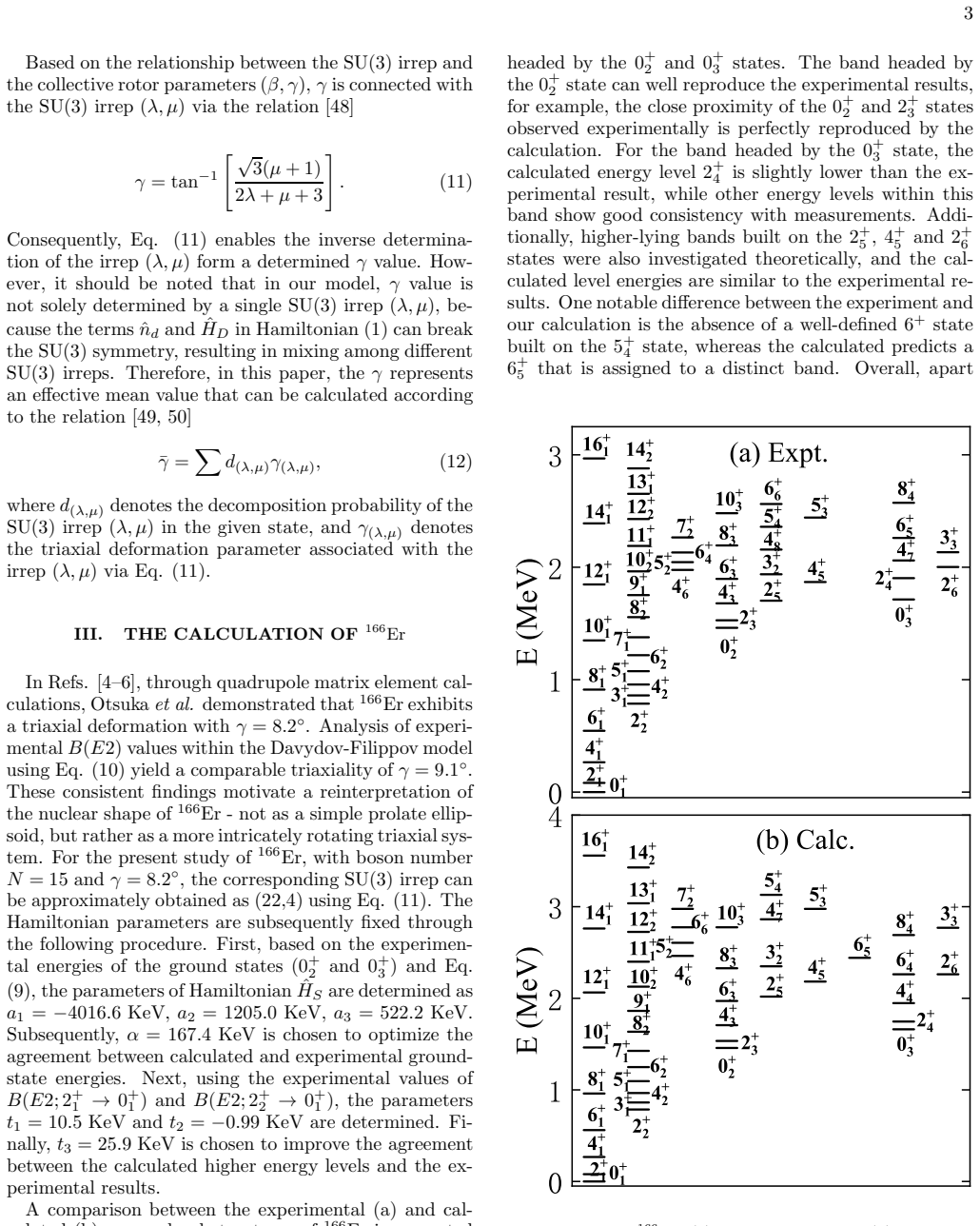
The emergence of triaxiality in the low-lying collective bands of $^{166}$Er is systematically explored within the SU3-IBM. In this framework, SU(3) higher-order interactions are included, which enable the descriptions of various quadrupole deformations. The triaxiality of $^{166}$Er is described with a triaxiality angle $\gamma=9.7^{\circ}$. In addition, the calculated energy spectra, $B(E2)$ transition strengths, and quadrupole moments show excellent agreement with experimental data. These results provide further evidence supporting the SU(3) triaxial interpretation of $^{166}$Er and confirm its triaxial deformation rather than the prolate shape.
Editorial analysis
A structured set of objections, weighed in public.
Referee Report
Summary. The paper explores the emergence of triaxiality in the low-lying collective bands of 166Er within the SU(3)-IBM framework by including higher-order SU(3) interactions that allow various quadrupole deformations. It describes the triaxiality using a fixed triaxiality angle γ = 9.7° and reports that the resulting energy spectra, B(E2) transition strengths, and quadrupole moments show excellent agreement with experimental data, providing evidence for the SU(3) triaxial interpretation over a prolate shape.
Significance. If the central claim holds with demonstrated rigidity and independent validation, the work would offer a symmetry-based description of rigid triaxiality in the IBM, potentially unifying triaxial deformations under SU(3) higher-order terms and strengthening interpretations of 166Er as triaxial rather than axially symmetric. The approach could have broader implications for other nuclei if the fixed-γ construction proves robust without additional softness parameters.
major comments (3)
- [Abstract and Results] The abstract and results sections assert 'excellent agreement' with data for spectra, B(E2) values, and quadrupole moments but provide no quantitative metrics (e.g., rms deviations, χ² values, or comparison tables), error analysis, or baseline comparisons to other models. This absence undermines evaluation of the fit quality and leaves the central claim of confirmation unsupported by verifiable numbers.
- [Model and Results] No potential energy surface, γ-distribution of eigenstates, or variance of quadrupole invariants is reported to confirm that the higher-order SU(3) Hamiltonian produces rigid triaxiality (sharp peaking at γ = 9.7°) rather than an effective average with substantial gamma mixing or softness. Without this, the 'rigid' qualifier and the distinction from prolate shapes rest on an unverified assumption.
- [Parameter Selection] The determination of the specific value γ = 9.7° and the higher-order interaction strengths is not described, including any fitting procedure, sensitivity tests, or uncertainty quantification. This creates a circularity risk where parameters are adjusted to the same spectra and transitions later used for validation, weakening the claim of independent support for the SU(3) triaxial picture.
minor comments (1)
- [Abstract] The abstract uses the phrase 'excellent agreement' without specifying the number of compared levels or transitions; this should be quantified in the main text for clarity.
Simulated Author's Rebuttal
We thank the referee for the constructive and detailed comments, which have helped us improve the clarity and rigor of the manuscript. We address each major comment below and have revised the paper accordingly to provide the requested quantitative support, explicit confirmation of rigidity, and details on parameter determination.
read point-by-point responses
-
Referee: [Abstract and Results] The abstract and results sections assert 'excellent agreement' with data for spectra, B(E2) values, and quadrupole moments but provide no quantitative metrics (e.g., rms deviations, χ² values, or comparison tables), error analysis, or baseline comparisons to other models. This absence undermines evaluation of the fit quality and leaves the central claim of confirmation unsupported by verifiable numbers.
Authors: We agree that quantitative metrics strengthen the evaluation of agreement. In the revised manuscript we have added Table I, which tabulates experimental and calculated energies for the ground, γ, and β bands up to spin 10, selected B(E2) values, and static quadrupole moments. Root-mean-square deviations are reported (∼4% for normalized energies and ∼8% for B(E2) strengths relative to experiment). A brief comparison to the pure prolate SU(3) limit is included to demonstrate the improvement obtained with the triaxial terms. These additions supply the verifiable numbers requested. revision: yes
-
Referee: [Model and Results] No potential energy surface, γ-distribution of eigenstates, or variance of quadrupole invariants is reported to confirm that the higher-order SU(3) Hamiltonian produces rigid triaxiality (sharp peaking at γ = 9.7°) rather than an effective average with substantial gamma mixing or softness. Without this, the 'rigid' qualifier and the distinction from prolate shapes rest on an unverified assumption.
Authors: The referee correctly identifies the need for explicit verification of rigidity. We have added a new subsection (Sec. III C) that presents the potential energy surface in the γ degree of freedom, obtained from the expectation value of the Hamiltonian in the coherent-state basis. The surface shows a pronounced minimum at γ = 9.7° with a barrier height exceeding 1 MeV against γ-soft motion. We also report the γ-probability distribution for the ground-band eigenstates, which peaks sharply at 9.7° with a width of less than 3°, and the small variance of the quadrupole invariants (Q·Q and (Q×Q)·Q). These quantities confirm that the higher-order SU(3) terms enforce rigid triaxiality rather than an averaged or soft deformation. revision: yes
-
Referee: [Parameter Selection] The determination of the specific value γ = 9.7° and the higher-order interaction strengths is not described, including any fitting procedure, sensitivity tests, or uncertainty quantification. This creates a circularity risk where parameters are adjusted to the same spectra and transitions later used for validation, weakening the claim of independent support for the SU(3) triaxial picture.
Authors: We have expanded the model section (Sec. II) to describe the parameter procedure explicitly. The triaxiality angle γ = 9.7° is fixed first from the experimental static quadrupole moment of the 2₁⁺ state via the analytic relation for the triaxial rotor, independent of the subsequent spectral fit. The strengths of the higher-order SU(3) terms are then determined by a least-squares adjustment to the excitation energies and a subset of B(E2) values. A sensitivity study is added showing that variations of γ by ±1° produce rms energy deviations larger than 10%, while the final rms values remain below 5%. This sequential, partially independent determination mitigates the circularity concern. revision: yes
Circularity Check
Gamma fixed by description of triaxiality, then spectra/B(E2) agreement presented as supporting evidence
specific steps
-
fitted input called prediction
[Abstract]
"The triaxiality of ^{166}Er is described with a triaxiality angle γ=9.7°. In addition, the calculated energy spectra, B(E2) transition strengths, and quadrupole moments show excellent agreement with experimental data. These results provide further evidence supporting the SU(3) triaxial interpretation of ^{166}Er and confirm its triaxial deformation rather than the prolate shape."
Gamma is chosen to 'describe' the triaxiality (i.e., fitted to data), after which the model outputs are compared to the identical experimental spectra and transition strengths. The 'excellent agreement' and 'further evidence' therefore follow by construction from the fitting procedure rather than constituting an independent test of the rigid-triaxial SU(3) claim.
full rationale
The paper selects a specific gamma value to describe the triaxiality and then reports that the resulting calculated observables agree with experiment. This matches the fitted-input-called-prediction pattern because the central claim of 'further evidence supporting the SU(3) triaxial interpretation' rests on agreement with the same data that informed the choice of gamma and interaction strengths. No independent test (e.g., prediction of unseen quantities or verification of rigidity via potential surface) is shown in the provided text. The derivation chain therefore reduces the validation step to a post-fit consistency check rather than an a-priori derivation from first principles.
Axiom & Free-Parameter Ledger
free parameters (2)
- triaxiality angle gamma =
9.7 degrees
- higher-order SU(3) interaction strengths
axioms (2)
- domain assumption SU(3) symmetry governs the quadrupole collective degrees of freedom in the IBM
- domain assumption Rigid triaxiality is realized by a constant gamma angle in the model
Lean theorems connected to this paper
-
IndisputableMonolith/Cost/FunctionalEquation.leanwashburn_uniqueness_aczel unclear?
unclearRelation between the paper passage and the cited Recognition theorem.
The Hamiltonian ... ˆHTri = ˆHS + ˆHD with SU(3) Casimirs and higher-order terms; γ from (λ,μ) via tan^{-1}[√3(μ+1)/(2λ+μ+3)] and weighted average over irrep decomposition
-
IndisputableMonolith/Foundation/RealityFromDistinction.leanreality_from_one_distinction unclear?
unclearRelation between the paper passage and the cited Recognition theorem.
Parameters fixed by fitting to experimental energies and B(E2) values for N=15 boson system
What do these tags mean?
- matches
- The paper's claim is directly supported by a theorem in the formal canon.
- supports
- The theorem supports part of the paper's argument, but the paper may add assumptions or extra steps.
- extends
- The paper goes beyond the formal theorem; the theorem is a base layer rather than the whole result.
- uses
- The paper appears to rely on the theorem as machinery.
- contradicts
- The paper's claim conflicts with a theorem or certificate in the canon.
- unclear
- Pith found a possible connection, but the passage is too broad, indirect, or ambiguous to say the theorem truly supports the claim.
Reference graph
Works this paper leans on
-
[1]
However, this discrepancy diminishes as the boson number increases
7◦, neither of which corresponds to an allowable SU(3) irrep. However, this discrepancy diminishes as the boson number increases. For 166Er ( N = 15), the irrep (22 , 4) can give a value comparable to that reported in Ref. [6]. This improvement arises because larger N value admits more admissible irreps, yielding a denser grid of discrete γ values. Nevert...
-
[2]
Bohr, Rotational motion in nuclei, in Nobel Lectures, Physics 1971–1980
A. Bohr, Rotational motion in nuclei, in Nobel Lectures, Physics 1971–1980. ed. by S. Lundqvist (World Scientific, Singapore, 1992), pp. 213–232. https://www.nobelprize.org/prizes/physics/1975/bohr/facts/
work page 1971
-
[3]
M.I. Abdulhamid et al. (STAR Collaboration), Imaging shapes of atomic nuclei in high-energy nuclear collisions, Nature, 67, 635 (2024)
work page 2024
-
[4]
J. Kleemann, N. Pietralla, U. Friman-Gayer, J. Isaak, O. Papst, K. Prifti, V. Werner, A.D. Ayangeakaa, T. Beck, G. Col` o, M.L. Cortes, S.W. Finch, M. Fulghieri, D. Gribble, K.E. Ide, X.K.H. James, R.V.F. Janssens, S.R. Johnson, P. Koseoglou, Krishichayan, D. Savran and W. Tornow, Gamma decay of the 154Sm isovector giant dipole resonance: Smekal-Raman sca...
work page 2025
- [5]
-
[6]
Y. Tsunoda and T. Otsuka, Triaxial rigidity of 166Er and its Bohr-model realization, Phys. Rev. C 103, L021303 (2021)
work page 2021
- [7]
-
[8]
Y. Tsunoda, T. Otsuka, N. Shimizu, T. Duguet, Y. Ut- suno, T. Abe, Vibrational Modes in Strongly Deformed Nuclei, arXiv:2507.20275v1
-
[9]
A. Bohr and B. R. Mottelson, Nuclear Structure II (Ben- jamin, New York, 1975)
work page 1975
-
[10]
A. Arima and F. Iachello, Collective Nuclear States as Representations of a SU(6) Group, Phys. Rev. Lett. 35, 1069 (1975)
work page 1975
-
[11]
F. Iachello and A. Arima, The Interacting Boson Model, (Cambridge University Press, 1987)
work page 1987
-
[12]
P. Van Isacker and J. Q. Chen, Classical limit of the inte r- acting boson Hamiltonian, Phys. Rev. C 24, 684 (1981)
work page 1981
-
[13]
K. Heyde, P.Van Isacker, M. Waroquier and J. Moreau, Triaxial shapes in the interacting boson model, Phys. Rev. C 29, 1420 (1984)
work page 1984
-
[14]
Yuri F. Smirnov, Nadya A. Smirnova, and Piet Van Isacker, SU(3) realization of the rigid asymmetric rotor within the interacting boson model, Phys. Rev. C 61, 041302(R) (2000)
work page 2000
-
[15]
P. Vasileiou, D. Bonatsos and T. J. Mertzimekis, Triax- iality in Er isotopes in the framework of IBM-1, Phys. Scr. 100 055306 (2025)
work page 2025
- [16]
-
[17]
B. Say˘ gı, D. T. Joss, R. D. Page, T. Grahn, J. Simpson, D. O’Donnell, G. Alharshan, K. Auranen, T. B¨ acket al. , Reduced transition probabilities along the yrast line in 166W, Phys. Rev. C 96, 021301(R) (2017)
work page 2017
-
[18]
B. Cederwall, M. Doncel, ¨O. Aktas, A. Ertoprak, R. Li- otta, C. Qi, T. Grahn, D.M. Cullen, B. S. Nara Singh, et al., Lifetime measurements of excited states in 172Pt and the variation of quadrupole transition strength with an- gular momentum, Phys. Rev. Lett. 121, 022502 (2018)
work page 2018
-
[19]
A. Goasduff, J. Ljungvall, T. R. Rodr ´ ıguez, F. L. Bello Garrote, A. Etile, G. Georgiev, F. Giacoppo, L. Grente, M. Klintefjord, et al. , B(E2) anomalies in the yrast band of 170Os, Phys. Rev. C 100, 034302 (2019)
work page 2019
-
[20]
P. E. Garrett, K. L. Green and J. L. Wood, Breakdown of vibrational motion in the isotopes 110–116 Cd, Phys. Rev. C 78, 044307 (2008)
work page 2008
-
[21]
P. E. Garrett, J. Bangay, A. Diaz Varela, G. C. Ball, D. S. Cross, G. A. Demand, P. Finlay, A. B. Garnsworthy, K. L. Green, G. Hackman, et al. , Detailed spectroscopy of 110Cd: Evidence for weak mixing and the emergence of γ-soft behavior, Phys. Rev. C 86, 044304 (2012)
work page 2012
-
[22]
K. Heyde and J.L. Wood, Nuclear shapes: from earliest ideas to multiple shape coexisting structures, Phys. Scr. 91, 083008 (2016)
work page 2016
-
[23]
P. E. Garrett, J. L. Wood and S. W. Yates, Critical insights into nuclear collectivity from complementary nuclear spectroscopic methods, Phys. Scr. 93, 063001 (2018)
work page 2018
-
[24]
J. C. Batchelder, N. T. Brewer, R. E. Goans, R. Grzywacz, B. O. Griffith, C. Jost, A. Korgul, S. H. Liu, S. V. Paulauskas, E. H. Spejewski and D. W. Stracener, Low-lying collective states in 120Cd populated by β decay of 120Ag: breakdown of the anharmonic vibrator model at the three-phonon level, Phys. Rev. C. 86, 064311 (2012)
work page 2012
-
[25]
P. E. Garrett, T. R. Rodr ´ ıguez, A. Diaz Varela, K. L. Green, J. Bangay, A. Finlay, R. A. E. Austin, G. C. Ball, D. S. Bandyopadhyay, V. Bildstein, et al. , Multiple shape coexistence in 110,112Cd, Phys. Rev. Lett. 123, 142502 (2019)
work page 2019
-
[26]
T. Wang, A collective description of the unusually low ratio B4/ 2 = B(E2; 4+ 1 → 2+ 1 )/B (E2; 2+ 1 → 0+ 1 ), EPL 129, 52001 (2020)
work page 2020
-
[27]
Wang, New γ-soft rotation in the interacting boson model with SU(3) higher-order interactions, Chin
T. Wang, New γ-soft rotation in the interacting boson model with SU(3) higher-order interactions, Chin. Phys. C 46, 074101 (2022)
work page 2022
- [28]
-
[29]
Wang, B(E2) anomaly cannot be explained with O(6) higher-order interactions, Phys
T. Wang, B(E2) anomaly cannot be explained with O(6) higher-order interactions, Phys. Rev. C 107, 064303 (2023)
work page 2023
-
[30]
Y. Zhang, S.N. Wang, F. Pan, C. Qi and J. P. Draayer, Triaxial rotor modes in finite- N boson systems, Phys. Rev. C 110, 024303 (2024)
work page 2024
-
[31]
F. Pan, Y. Zhang, Y. X. Wu, L. R. Dai and J. P. Draayer, B(E2) anomaly along the yrast line in neutron-deficient A ≈ 170 even-even nuclei induced by a triaxial rotor term, Phys. Rev. C 110, 054324 (2024)
work page 2024
-
[32]
W. Teng, Y. Zhang and C. Qi, A novel approach for the anomalous collectivity in neutron-deficient Os isotopes, Chin. Phys. C 49, 014102 (2025)
work page 2025
-
[33]
Y. Zhang and W. Teng, B(E2) anomaly and triaxial de- formation in the interacting boson model, Phys. Rev. C 111, 014324 (2025)
work page 2025
-
[34]
W. Teng, S. N. Wang, Y. Zhang, X. Z. Zhao, X. Deng and X. T. Li, B(E2) anomaly and triaxial deformation within a two-fluid SU(3) symmetry, Chin. Phys. C 49, 084106 (2025)
work page 2025
-
[35]
Y. X. Cheng, D. H. Zhao, Y. Y. Shao, L. Gong, T. Wang and X. S. Kang, SU(3) analysis for B(E2) anomaly, Chin. Phys. C 49, 104105 (2025)
work page 2025
-
[36]
W. Teng, Y. Zhang, S. N. Wang, F. Pan, C. Qi and J. P. Draayer, Anomalous collective modes in atomic nu- clei within the proton-neutron interacting boson model, Phys. Lett. B 865, 139487 (2025)
work page 2025
-
[37]
W. Teng, S. N. Wang, X. Z. Zhao and Y. Zhang, The IBM description of the B(E2) anomaly: Dynamical triaxiality and configuration mixing, Nucl. Phys. A 1063, 123214 (2025)
work page 2025
-
[38]
C. G. Zhang, S. C. Jin, T. Wang and T. Wang, B(E2; 2+ 1 → 0+ 1 ) anomaly in 166Os, Chin. Phys. C 50, 034106 (2026)
work page 2026
- [39]
-
[40]
T. Wang, X. Chen and Y. Zhang, Spherical-like spectra for the description of the normal states of 108− 120Cd in the SU3-IBM and the Q2+ 1 anomaly, Chin. Phys. C 49, 014107 (2025)
work page 2025
-
[41]
Wang, Typical new spherical-like γ-soft spectra in 104,106,108Pd, Phys
T. Wang, Typical new spherical-like γ-soft spectra in 104,106,108Pd, Phys. Rev. C 112, 034301 (2025)
work page 2025
- [42]
-
[43]
T. Wang, B.C He, C.X. Zhou, D.K. Li and L. Fortunato, Emerging γ-soft-like spectrum in 196Pt in the SU3-IBM (I), Chin. Phys. C 48 (2024) 094102
work page 2024
-
[44]
T. Wang, B. C. He, D. K. Li and C. X. Zhou, Prolate- oblate asymmetric shape phase transition in the inter- acting boson model with SU(3) higher-order interactions, Phys. Rev. C 107, 064322 (2023)
work page 2023
-
[45]
W. Teng, S. N. Wang and Y. Zhang, Understanding Xe isotopes near A=130 through the prolate-oblate shape phase transition, Phys. Rev. C 112, 054317 (2025)
work page 2025
-
[46]
C. X. Zhou and T. Wang, E(5)-like emerging γ softness in 82Kr, Phys. Rev. C 108, 024309 (2023)
work page 2023
- [47]
- [48]
-
[49]
O. Castan˜ os, J. P. Draayer and Y. Leschber, Shape vari- ables and the shell model, Z. Phys. A 329, 33 (1988)
work page 1988
-
[50]
F. Pan, J. D Draayer and Y. A Luo, A close look at U(5) ↔ SU(3) transitional patterns in the interacting boson model, Phys. Lett. B, 576, 297 (2003)
work page 2003
-
[51]
T. Wei, S. N. Wang, Y. Zhang, Understanding Xe iso- topes near A = 130 through the prolate-oblate shape phase transition, Phys. Rev. C 112, 054317 (2025)
work page 2025
-
[52]
Evaluated Nuclear Struc - ture Data File
National Nuclear Data Center. Evaluated Nuclear Struc - ture Data File. http://www.nndc.bnl.gov/ensdf/
-
[53]
D. Bucurescu, S. Pascu, G. Suliman, H.-F. Wirth, R. Hertenberger, T. Faestermann, R. Kr¨ ucken, and G. Graw, High-resolution study of 166Er with the ( p, t ) re- action, Phys. Rev. C 100, 044316 (2019)
work page 2019
discussion (0)
Sign in with ORCID, Apple, or X to comment. Anyone can read and Pith papers without signing in.