Recognition: no theorem link
Subtleties in non-equilibrium horizon thermodynamics of modified gravity theories
Pith reviewed 2026-05-10 19:32 UTC · model grok-4.3
The pith
In modified gravity the extra entropy term arises from the Bianchi identity for Rindler horizons but must be inserted by hand for apparent horizons to recover the Friedmann equations.
A machine-rendered reading of the paper's core claim, the machinery that carries it, and where it could break.
Core claim
Even though both the Eling-Guedens-Jacobson Rindler-horizon framework and the apparent-horizon formulation in FLRW spacetimes employ identical entropy balance relations that resemble non-equilibrium thermodynamics, the entropy-production term originates from consistency requirements tied to the Bianchi identity in the first case and is introduced solely to recover the Friedmann equations in the second. As a result the non-equilibrium contribution affects the dynamical equations of gravity directly only in the apparent-horizon treatment. Thermodynamic descriptions of horizons in modified gravity are therefore not unique; equilibrium and non-equilibrium pictures arise from different choices of
What carries the argument
The entropy-production term that augments the Clausius relation on horizons, whose origin is traced to the Bianchi identity in one framework and to the requirement of matching the Friedmann equations in the other.
If this is right
- Only the apparent-horizon version places the extra entropy term inside the dynamical equations of gravity.
- The Rindler version keeps the extra term outside the field equations because it follows from an identity rather than from a matching condition.
- Changing the thermodynamic variables can convert a non-equilibrium description into an equilibrium one in either framework.
- Any consistent thermodynamic foundation for gravity beyond general relativity must distinguish the two origins of the extra term.
Where Pith is reading between the lines
- The distinction suggests that horizon thermodynamics in modified gravity may require an additional selection rule to decide which framework applies to a given spacetime.
- Cosmological models built on the apparent-horizon approach could acquire extra effective stress-energy contributions that the Rindler approach does not produce.
- Tests that compare predicted horizon temperatures or entropy flows in modified-gravity cosmologies against observations could discriminate between the two constructions.
Load-bearing premise
That the entropy balance relations are identical in both approaches and that a direct comparison between local Rindler horizons and cosmological apparent horizons remains valid despite their different physical settings.
What would settle it
An explicit calculation that inserts the Bianchi-derived entropy term into the apparent-horizon first law and checks whether the resulting equations still reproduce the correct modified Friedmann equations without further adjustment.
Figures
read the original abstract
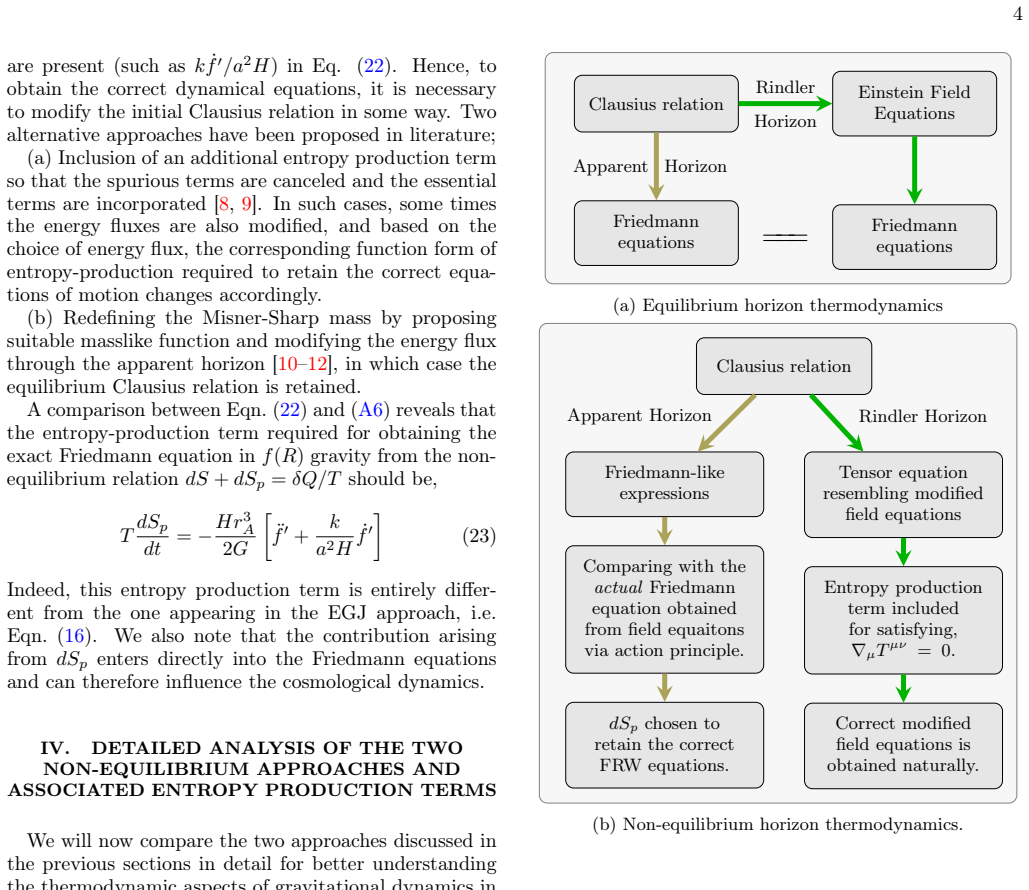
Thermodynamic interpretations of gravity often arise from applying the Clausius relation to spacetime horizons. In modified gravity theories with higher-order equations of motion, such as f(R) and scalar-tensor gravity, this relation generally acquires additional entropy-production term. In this context, two distinct formulations have been proposed in literature: the non-equilibrium approach of Eling, Guedens, and Jacobson based on local Rindler horizons, and the thermodynamic formulation of cosmological apparent horizons in FLRW spacetimes. In this article, we present a detailed analysis of these approaches, and show that, even though both employ identical entropy balance relations that resemble non-equilibrium thermodynamics, the exact origin and role of each entropy-production term is fundamentally different. In the Rindler-horizon framework the extra term follows directly from consistency requirements related to the Bianchi identity, whereas in the apparent-horizon approach it is introduced solely to recover the Friedmann equations. Furthermore, we will see that the latter non-equilibrium contribution enters directly into dynamical equations of gravity, while the former does not. Finally, we also highlight the fact that thermodynamic descriptions of horizons in such modified gravity are not unique, and that equilibrium, and non-equilibrium descriptions can arise from different choices of thermodynamic variables. A clear understanding of these distinctions is therefore crucial for establishing a consistent and physically meaningful thermodynamic foundation for gravity beyond general relativity.
Editorial analysis
A structured set of objections, weighed in public.
Referee Report
Summary. The paper analyzes two non-equilibrium thermodynamic approaches to horizons in modified gravity (f(R) and scalar-tensor theories): the Eling-Guedens-Jacobson construction based on local Rindler horizons and the apparent-horizon formulation in FLRW spacetimes. It claims that both employ identical entropy balance relations (Clausius-type with an extra entropy-production term), but the term's origin differs—arising from Bianchi-identity consistency requirements in the Rindler case versus being inserted ad hoc to recover the Friedmann equations in the apparent-horizon case—with the latter entering the gravitational dynamical equations while the former does not. The paper further notes that horizon thermodynamic descriptions in modified gravity are non-unique, as equilibrium or non-equilibrium forms can result from different choices of thermodynamic variables.
Significance. If the distinctions are rigorously established, the work clarifies important subtleties in applying thermodynamic interpretations to gravity beyond general relativity, helping to prevent conflation of frameworks that appear similar but differ in foundational origins and dynamical implications. Credit is due for explicitly addressing the non-uniqueness of thermodynamic descriptions arising from variable choices, which provides a useful cautionary perspective.
major comments (1)
- [Abstract and comparison of the two frameworks] The central claim requires that the entropy balance relations (including the specific entropy, horizon area element, and heat-flux projection) take exactly the same functional form in both frameworks so that the only difference is the provenance of the extra term. The abstract asserts this identity, but the manuscript must exhibit the two relations side-by-side (with explicit equations) without context-dependent redefinitions; absent such a direct comparison, the subsequent statements about differing origins, roles, and dynamical entry lose force.
Simulated Author's Rebuttal
We thank the referee for the careful reading and for identifying the need for a more explicit side-by-side comparison of the entropy balance relations. We have revised the manuscript to incorporate this direct presentation, which we believe strengthens the clarity of our analysis regarding the differing origins and roles of the entropy-production terms.
read point-by-point responses
-
Referee: The central claim requires that the entropy balance relations (including the specific entropy, horizon area element, and heat-flux projection) take exactly the same functional form in both frameworks so that the only difference is the provenance of the extra term. The abstract asserts this identity, but the manuscript must exhibit the two relations side-by-side (with explicit equations) without context-dependent redefinitions; absent such a direct comparison, the subsequent statements about differing origins, roles, and dynamical entry lose force.
Authors: We agree that an explicit side-by-side exhibition of the relations is necessary to make the central claim fully rigorous. In the revised manuscript we have added a new table (Table 1) and accompanying paragraph in Section 3 that places the two entropy balance equations directly adjacent, using identical notation throughout: both frameworks are written as δQ = T dS + T δS_prod, where S is the horizon entropy (proportional to area in each case), dA is the area element, and the heat flux is the same projected component q^a k_a. No variables are redefined between the two presentations. The text then reiterates that the functional forms are therefore identical and that the sole distinction lies in the provenance of δS_prod (Bianchi-identity consistency for the Rindler construction versus ad-hoc insertion to recover the Friedmann equations for the apparent-horizon case). We have also clarified the distinct dynamical roles of the production term in each framework. These additions directly address the comment. revision: yes
Circularity Check
No circularity: comparison rests on independent mathematical identities
full rationale
The paper's central distinction—that the two frameworks employ identical entropy-balance forms but differ in the provenance of the extra term (Bianchi consistency vs. ad-hoc insertion)—is advanced by direct comparison of the relevant equations rather than by any self-definitional loop, fitted-parameter renaming, or load-bearing self-citation. The abstract and analysis invoke standard horizon thermodynamics (Clausius relation, Wald entropy, etc.) and previously published derivations; no step reduces the claimed identity or the differing roles to an input that is itself defined by the output. Self-citations, if used for background, are not required to establish the uniqueness or the Bianchi-identity origin. The derivation chain therefore remains self-contained against external benchmarks.
Axiom & Free-Parameter Ledger
axioms (2)
- standard math The Bianchi identity holds in modified gravity and imposes consistency requirements on the entropy balance for local Rindler horizons.
- domain assumption The Friedmann equations must be recovered from the thermodynamic relations in the apparent-horizon approach.
Reference graph
Works this paper leans on
- [1]
- [2]
-
[3]
G. Chirco and S. Liberati, Phys. Rev. D81, 024016 (2010), 0909.4194
- [4]
- [5]
-
[6]
M. Akbar and R.-G. Cai, Phys. Rev. D75, 084003 (2007), hep-th/0609128
- [7]
-
[8]
R.-G. Cai and L.-M. Cao, Phys. Rev. D75, 064008 (2007), gr-qc/0611071
-
[9]
D. W. Tian and I. Booth, Phys. Rev. D90, 104042 (2014), URLhttps://link.aps.org/doi/10. 1103/PhysRevD.90.104042
2014
- [10]
-
[11]
org/10.1209/0295-5075/89/50003
K.Bamba, C.-Q.Geng, S.Nojiri, andS.D.Odintsov, Eu- rophysics Letters89, 50003 (2010), URLhttps://doi. org/10.1209/0295-5075/89/50003
-
[12]
Bamba, C.-Q
K. Bamba, C.-Q. Geng, and S. Tsujikawa, Physics Letters B688, 101 (2010), ISSN 0370-2693, URL https://www.sciencedirect.com/science/article/ pii/S0370269310004041
2010
-
[13]
Ge, Physics Letters B651, 49 (2007), ISSN 0370- 2693, URLhttps://www.sciencedirect.com/science/ article/pii/S0370269307006508
X.-H. Ge, Physics Letters B651, 49 (2007), ISSN 0370- 2693, URLhttps://www.sciencedirect.com/science/ article/pii/S0370269307006508
2007
-
[14]
Akbar and R.-G
M. Akbar and R.-G. Cai, Phys. Rev. D75, 084003 (2007), URLhttps://link.aps.org/doi/10. 1103/PhysRevD.75.084003
2007
- [15]
-
[16]
S. W. Hawking, Phys. Rev. D13, 191 (1976)
1976
- [17]
discussion (0)
Sign in with ORCID, Apple, or X to comment. Anyone can read and Pith papers without signing in.