Coexistence of CHSH Nonlocality and KCBS Contextuality in a Single Quantum State
Pith reviewed 2026-05-10 19:13 UTC · model grok-4.3
The pith
A qubit-qutrit entangled state can exhibit both CHSH nonlocality and KCBS contextuality, but only inside a narrow intermediate parameter regime.
A machine-rendered reading of the paper's core claim, the machinery that carries it, and where it could break.
Core claim
In the hybrid CHSH-KCBS scenario with a qubit-qutrit entangled state, contextuality governed by the KCBS inequality depends solely on the population parameter p2 of the qutrit in the |2> level, whereas nonlocality via the CHSH inequality depends irreducibly on the coherence parameters Xi and Yi that encode amplitudes and phases. The optimal parameter regions for the two violations do not overlap, confining their coexistence to a narrow intermediate regime.
What carries the argument
The qubit-qutrit entangled state in which the population parameter p2 for the qutrit |2> level controls KCBS contextuality independently of the coherence parameters Xi and Yi that control CHSH nonlocality.
If this is right
- KCBS violation strength is set exclusively by the value of p2.
- CHSH violation requires simultaneous control of amplitudes and phases inside the coherence terms.
- The two strongest violation regions lie apart, so simultaneous violation occurs only inside an intermediate band of parameter values.
- Closed-form expressions give the exact boundaries of the coexistence window.
Where Pith is reading between the lines
- Contextuality and nonlocality may draw from physically distinct resources inside the same composite state.
- The same separation could be tested by pairing other contextuality inequalities with other Bell inequalities.
- Experiments could deliberately maximize one correlation while keeping the other near its classical bound.
Load-bearing premise
The population p2 and the coherence parameters Xi and Yi can be varied independently when the qubit-qutrit state is prepared.
What would settle it
Preparation of the qubit-qutrit state at a point outside the predicted narrow regime that produces simultaneous strong violation of both the CHSH and KCBS inequalities.
Figures


read the original abstract
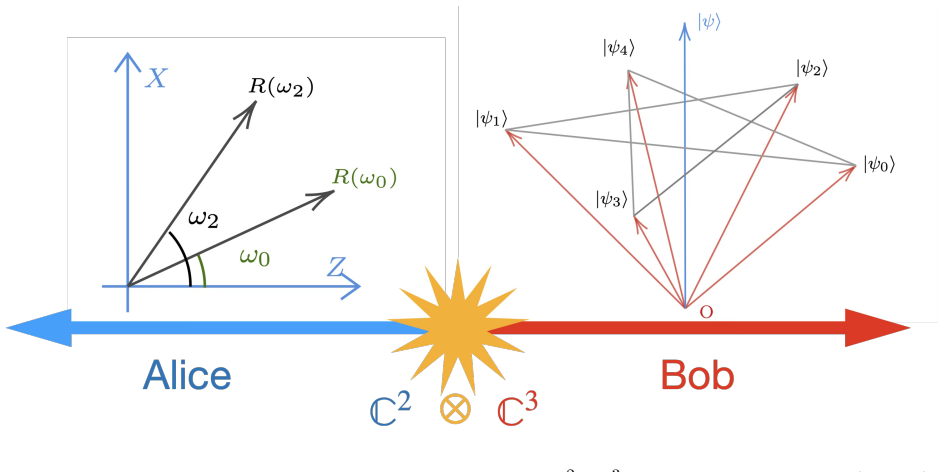
Contextuality and nonlocality are distinct manifestations at the foundation of quantum mechanics, yet their coexistence within a single quantum state remains subtle. In a hybrid CHSH--KCBS scenario involving the entanglment of a qubit and a qutrit, the qutrit supports the KCBS contextuality test, and the CHSH nonlocality arises from correlations between the qubit and qutrit. Here, we derive the analytical closed-form expressions for both inequalities and also simulate this physics on a quantum circuit. We show that contextuality is governed solely by a population parameter $p_2$, associated with the occupation of the qutrit subsystem in the $|2\rangle$ level, which plays a distinguished role in the KCBS structure. In contrast, nonlocality depends irreducibly on coherence, involving both amplitudes and phases encoded in parameters $(X_i, Y_i)$. This separation of physical resources reveals parameter regimes that optimize KCBS violation while suppress CHSH violation, and vice versa. As a result, the optimal regions do not overlap, and coexistence is restricted to a narrow intermediate regime in parameter space.
Editorial analysis
A structured set of objections, weighed in public.
Referee Report
Summary. The paper examines coexistence of CHSH nonlocality and KCBS contextuality in a single qubit-qutrit entangled state. It derives closed-form analytical expressions for the CHSH and KCBS violations, performs quantum circuit simulations, and shows that KCBS violation depends only on the qutrit population parameter p2 while CHSH violation depends irreducibly on the coherence parameters (Xi, Yi). This leads to non-overlapping optimal regions with coexistence possible only in a narrow intermediate parameter regime.
Significance. If the derivations hold, the work provides a clear separation of physical resources governing contextuality versus nonlocality within one state, supported by explicit analytical expressions and circuit simulations. This strengthens understanding of how distinct quantum features can be independently tuned and offers a concrete example of their limited overlap, which may inform foundational studies and hybrid quantum information protocols.
minor comments (2)
- The abstract contains a typographical error ('entanglment' instead of 'entanglement').
- Notation for the coherence parameters (Xi, Yi) and their explicit definitions in terms of state amplitudes/phases should be cross-referenced to the state parameterization section for immediate clarity.
Simulated Author's Rebuttal
We thank the referee for their positive evaluation of our work and for recommending acceptance. The report accurately captures the key contributions regarding the separation of resources for CHSH nonlocality and KCBS contextuality in the qubit-qutrit state.
Circularity Check
No significant circularity in the derivation chain
full rationale
The paper derives closed-form expressions for the CHSH and KCBS violations directly from the standard parameterization of the qubit-qutrit entangled state, where p2 controls the qutrit population for the KCBS test and the coherence terms (Xi, Yi) control the correlations for CHSH. This separation follows from the definitions of the two inequalities applied to the given state ansatz and independent choice of measurement settings; it does not reduce to a fitted parameter renamed as a prediction, nor does it rely on self-citation chains, uniqueness theorems imported from prior work, or smuggling of ansatzes. The circuit simulation serves only as numerical confirmation of the analytics. The derivation remains self-contained against external benchmarks with no load-bearing step that collapses to its own inputs by construction.
Axiom & Free-Parameter Ledger
free parameters (2)
- p2
- (Xi, Yi)
axioms (2)
- domain assumption The prepared state is an entangled qubit-qutrit state whose density matrix can be parameterized by independent population and coherence terms.
- domain assumption The CHSH and KCBS inequalities are tested with the standard two-setting and five-setting measurement choices appropriate to the hybrid system.
Lean theorems connected to this paper
-
IndisputableMonolith/Cost/FunctionalEquation.leanwashburn_uniqueness_aczel unclear?
unclearRelation between the paper passage and the cited Recognition theorem.
contextuality is governed solely by a population parameter p2... nonlocality depends irreducibly on coherence, involving both amplitudes and phases encoded in parameters (Xi, Yi)
-
IndisputableMonolith/Foundation/AbsoluteFloorClosure.leanabsolute_floor_iff_bare_distinguishability unclear?
unclearRelation between the paper passage and the cited Recognition theorem.
SKCBS = n(4c-2)/(1+c) * p2 + n(1-c)/(1+c) > n-2
What do these tags mean?
- matches
- The paper's claim is directly supported by a theorem in the formal canon.
- supports
- The theorem supports part of the paper's argument, but the paper may add assumptions or extra steps.
- extends
- The paper goes beyond the formal theorem; the theorem is a base layer rather than the whole result.
- uses
- The paper appears to rely on the theorem as machinery.
- contradicts
- The paper's claim conflicts with a theorem or certificate in the canon.
- unclear
- Pith found a possible connection, but the passage is too broad, indirect, or ambiguous to say the theorem truly supports the claim.
Reference graph
Works this paper leans on
-
[1]
Bell nonlocality.Reviews of modern physics, 86(2):419–478, 2014
Nicolas Brunner, Daniel Cavalcanti, Stefano Pironio, Valerio Scarani, and Stephanie Wehner. Bell nonlocality.Reviews of modern physics, 86(2):419–478, 2014
work page 2014
-
[2]
Kochen-specker contextuality.Reviews of Modern Physics, 94(4):045007, 2022
Costantino Budroni, Ad´ an Cabello, Otfried G¨ uhne, Matthias Kleinmann, and Jan-˚Ake Lars- son. Kochen-specker contextuality.Reviews of Modern Physics, 94(4):045007, 2022
work page 2022
-
[3]
Pawe l Kurzy´ nski, Ad´ an Cabello, and Dagomir Kaszlikowski. Fundamental monogamy relation between contextuality and nonlocality.Physical Review Letters, 112(10):100401, 2014
work page 2014
-
[4]
Lucas EA Porto, Gabriel Ruffolo, Rafael Rabelo, Marcelo Terra Cunha, and Pawe l Kurzy´ nski. Trade-off relations between bell nonlocality and local kochen–specker contextuality in gener- alized bell scenarios.New Journal of Physics, 26(8):083028, 2024
work page 2024
-
[5]
Albert Einstein, Boris Podolsky, and Nathan Rosen. Can quantum-mechanical description of physical reality be considered complete?Physical review, 47(10):777, 1935
work page 1935
-
[6]
On the einstein podolsky rosen paradox.Physics Physique Fizika, 1(3):195, 1964
John S Bell. On the einstein podolsky rosen paradox.Physics Physique Fizika, 1(3):195, 1964
work page 1964
-
[7]
Proposed experiment to test local hidden-variable theories.Physical review letters, 23(15):880, 1969
John F Clauser, Michael A Horne, Abner Shimony, and Richard A Holt. Proposed experiment to test local hidden-variable theories.Physical review letters, 23(15):880, 1969
work page 1969
-
[8]
Quantum generalizations of bell’s inequality.Letters in Mathematical Physics, 4(2):93–100, 1980
Boris S Cirel’son. Quantum generalizations of bell’s inequality.Letters in Mathematical Physics, 4(2):93–100, 1980
work page 1980
-
[9]
Alain Aspect, Jean Dalibard, and G´ erard Roger. Experimental test of bell’s inequalities using time-varying analyzers.Physical review letters, 49(25):1804, 1982
work page 1982
-
[10]
Bas Hensen, Hannes Bernien, Ana¨ ıs E Dr´ eau, Andreas Reiserer, Norbert Kalb, Machiel S Blok, Just Ruitenberg, Raymond FL Vermeulen, Raymond N Schouten, Carlos Abell´ an, et al. Loophole-free bell inequality violation using electron spins separated by 1.3 kilometres.Nature, 526(7575):682–686, 2015
work page 2015
-
[11]
Strong loophole-free test of local realism.Physical review letters, 115(25):250402, 2015
Lynden K Shalm, Evan Meyer-Scott, Bradley G Christensen, Peter Bierhorst, Michael A Wayne, Martin J Stevens, Thomas Gerrits, Scott Glancy, Deny R Hamel, Michael S Allman, et al. Strong loophole-free test of local realism.Physical review letters, 115(25):250402, 2015. 17
work page 2015
-
[12]
Johannes Handsteiner, Andrew S Friedman, Dominik Rauch, Jason Gallicchio, Bo Liu, Hannes Hosp, Johannes Kofler, David Bricher, Matthias Fink, Calvin Leung, et al. Cosmic bell test: measurement settings from milky way stars.Physical review letters, 118(6):060401, 2017
work page 2017
-
[13]
The problem of hidden variables in quantum mechanics
Simon Kochen and Ernst P Specker. The problem of hidden variables in quantum mechanics. InErnst Specker Selecta, pages 235–263. Springer, 2011
work page 2011
-
[14]
N David Mermin. Simple unified form for the major no-hidden-variables theorems.Physical review letters, 65(27):3373, 1990
work page 1990
-
[15]
State-independent proof of kochen-specker theorem with 13 rays
Sixia Yu and Choo Hiap Oh. State-independent proof of kochen-specker theorem with 13 rays. Physical review letters, 108(3):030402, 2012
work page 2012
-
[16]
Ad´ an Cabello, Matthias Kleinmann, and Costantino Budroni. Necessary and sufficient con- dition for quantum state-independent contextuality.Physical Review Letters, 114(25):250402, 2015
work page 2015
-
[17]
State-independent contextuality sets for a qutrit.Physics Letters A, 379(34-35):1868–1870, 2015
Zhen-Peng Xu, Jing-Ling Chen, and Hong-Yi Su. State-independent contextuality sets for a qutrit.Physics Letters A, 379(34-35):1868–1870, 2015
work page 2015
-
[18]
Mateus Ara´ ujo, Marco T´ ulio Quintino, Costantino Budroni, Marcelo Terra Cunha, and Ad´ an Cabello. All noncontextuality inequalities for the n-cycle scenario.Physical Review A—Atomic, Molecular, and Optical Physics, 88(2):022118, 2013
work page 2013
-
[19]
Yeong-Cherng Liang, Robert W Spekkens, and Howard M Wiseman. Specker’s parable of the overprotective seer: A road to contextuality, nonlocality and complementarity.Physics Reports, 506(1-2):1–39, 2011
work page 2011
-
[20]
Simple test for hidden variables in spin-1 systems.Physical review letters, 101(2):020403, 2008
Alexander A Klyachko, M Ali Can, Sinem Binicio˘ glu, and Alexander S Shumovsky. Simple test for hidden variables in spin-1 systems.Physical review letters, 101(2):020403, 2008
work page 2008
-
[21]
Graph-theoretic approach to quantum correlations.Physical review letters, 112(4):040401, 2014
Ad´ an Cabello, Simone Severini, and Andreas Winter. Graph-theoretic approach to quantum correlations.Physical review letters, 112(4):040401, 2014
work page 2014
-
[22]
Proposal for revealing quantum nonlocality via local contextuality.Phys
XH Wu and RH Xie. Proposal for revealing quantum nonlocality via local contextuality.Phys. Lett. A, 211:129, 1996
work page 1996
-
[23]
Nonlocality from local contextuality.Physical Review Letters, 117(22):220402, 2016
Bi-Heng Liu, Xiao-Min Hu, Jiang-Shan Chen, Yun-Feng Huang, Yong-Jian Han, Chuan-Feng Li, Guang-Can Guo, and Ad´ an Cabello. Nonlocality from local contextuality.Physical Review Letters, 117(22):220402, 2016
work page 2016
-
[24]
Peng Xue, Lei Xiao, G Ruffolo, A Mazzari, T Temistocles, M Terra Cunha, and R Rabelo. Synchronous observation of bell nonlocality and state-dependent contextuality.Physical Re- 18 view Letters, 130(4):040201, 2023
work page 2023
-
[25]
Yuichiro Kitajima. States violating both locality and noncontextuality inequalities in quantum theory.Journal of Physics A: Mathematical and Theoretical, 58(11):115301, 2025
work page 2025
-
[26]
Michael A. Nielsen and Isaac L. Chuang.Quantum Computation and Quantum Information. Cambridge University Press, Cambridge, 10th anniversary edition edition, 2010
work page 2010
-
[27]
Complete unitary qutrit control in ultracold atoms.Physical Review Applied, 19(3):034089, 2023
Joseph Lindon, Arina Tashchilina, Logan W Cooke, and Lindsay J LeBlanc. Complete unitary qutrit control in ultracold atoms.Physical Review Applied, 19(3):034089, 2023
work page 2023
- [28]
-
[29]
1X e=0 2X f=0 c∗ ef ⟨f|⟨e| # A⊗B
General state for both Locality and Non-Contextuality inequality The general state inC 2 ⊗C 3 is: |ϕ⟩= 1X j=0 2X k=0 cjk|j⟩|k⟩, 1X j=0 2X k=0 c∗ jkcjk = 1. And their dual state: ⟨ϕ|= 1X j=0 2X k=0 c∗ jk⟨k|⟨j| LetA∈ H 2 andB∈ H 3 be Hermitian operators, where Hn :={X∈M n(C)|X † =X}. The expectation value ofA⊗Bon this state is: S=⟨A⊗B⟩= " 1X e=0 2X f=0 c∗ e...
-
[30]
B.1, we now compute explicitly the outcome of this circuit
Quantum Fourier Test As introduced in Eq. B.1, we now compute explicitly the outcome of this circuit. 24 We aim to evaluate a Hermitan and Unitary operatorU: ⟨U⟩=⟨ψ|U|ψ⟩, The qutrit Fourier transform is defined as F3|k⟩= 1√ 3 2X j=0 ωjk|j⟩, ω=e 2πi/3. Starting from the initial state |0⟩|ψ⟩ F3 − → 1√ 3 2X a=0 |a⟩|ψ⟩, we apply the controlled operation |a⟩|ψ...
-
[31]
Hence, Alice’s system is restricted to the subspace{|0⟩,|1⟩}
Explicit State Preparation Circuit for the Minimal Nonlocal–Contextual State We consider a hybrid Hilbert space where Alice’s subsystem is effectively two-dimensional (dA = 2), embedded in a qutrit space, while Bob’s subsystem is fully three-dimensional (dB = 3). Hence, Alice’s system is restricted to the subspace{|0⟩,|1⟩}. The target state is: |ψ⟩= sin θ...
-
[32]
q 4c2 +csin 2 θcos 2 ϕ(4(−1) ms2 −2) 2 + q (2−4c) 2 +csin 2 θcos 2 ϕ(4(−1) ms2 + 2)2 # −2 → 1 2
Explicit forms for Eq(16) For the state |ψn⟩= r 2 n+ 4 |00⟩+ r n+ 2 n+ 4 eikπ|12⟩, k∈Z,(D.4) which gives sin θ 2 = q 2 n+4 and cos θ 2 = q n+2 n+4, yielding sinθ= 2 q 2(n+2) (n+4)2 . In the asymptotic limitn→ ∞, we assumec= 1. The KCBS term becomes: SKCBS −(n−2) = n 1 +c (4c−2) cos 2 θ 2 −2c + 2 n→∞ − − − →n 2 2 n+ 2 n+ 4 −2 + 2 = 8 n+ 4 . (D.5) Similarly...
discussion (0)
Sign in with ORCID, Apple, or X to comment. Anyone can read and Pith papers without signing in.