Black Hole Entropy in f(Q) Gravity from the RVB Residue Method
Pith reviewed 2026-05-10 18:42 UTC · model grok-4.3
The pith
Black hole entropy in f(Q) gravity follows a universal integral relation incorporating residue-induced temperature shifts.
A machine-rendered reading of the paper's core claim, the machinery that carries it, and where it could break.
Core claim
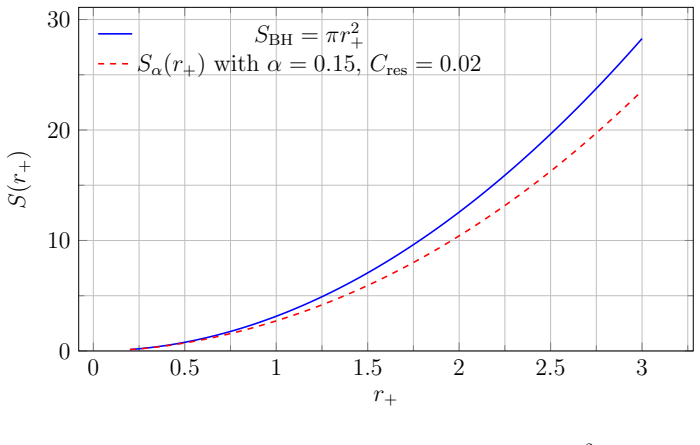
We extend the residue-based Robson-Villari-Biancalana (RVB) method from the calculation of Hawking temperature to the determination of black hole entropy within f(Q) gravity. Starting from the residue-corrected temperature prescription, we combine this with the first law to derive a general expression for the entropy of static, spherically symmetric configurations. The entropy satisfies a universal integral relation whose integrand depends on horizon data and a residue-induced temperature shift parameter. For the quadratic model we obtain an explicit closed-form expression at first order in the residue parameter, recovering the standard area law when the residue vanishes.
What carries the argument
Residue-corrected temperature prescription inserted into the first law of black hole thermodynamics to produce an entropy integral.
If this is right
- The entropy satisfies a universal integral relation depending explicitly on horizon data and the residue-induced temperature shift parameter.
- For the specific quadratic model, an explicit closed-form expression for the entropy is obtained at first order in the residue parameter.
- In the limit where the residue contribution vanishes, the standard Bekenstein-Hawking area law is recovered.
- Once the complex contour contribution is retained, a correction beyond the area law naturally emerges.
Where Pith is reading between the lines
- This method may not provide a universal formula for all f(Q) black hole solutions, requiring case-specific verification as noted.
- The integral relation offers a concrete way to quantify how contour integration effects modify classical black hole thermodynamics.
Load-bearing premise
The residue-corrected temperature from earlier RVB work on f(Q) black holes can be inserted directly into the first law without additional consistency checks.
What would settle it
An independent calculation of the entropy for the quadratic f(Q) black hole using the Noether charge method or Wald formula should reproduce or contradict the closed-form expression derived here.
Figures
read the original abstract
We extend the residue-based Robson-Villari-Biancalana (RVB) method from the calculation of Hawking temperature to the determination of black hole entropy within f(Q) gravity. Starting from the residue-corrected temperature prescription developed in recent RVB analyses of f(Q) black holes, we combine this approach with the first law of black hole thermodynamics to derive a general expression for the entropy of static, spherically symmetric configurations. By expressing the metric in a standard Schwarzschild-like decomposition with an additional correction term, we show that the entropy satisfies a universal integral relation. The integrand depends explicitly on horizon data as well as on a residue-induced temperature shift parameter. For the specific quadratic model, we obtain an explicit closed-form expression for the entropy at first order in the residue parameter. In the limit where the residue contribution vanishes, the standard Bekenstein-Hawking area law is recovered. However, once the complex contour contribution is retained, a correction beyond the area law naturally emerges. This framework should be interpreted as a residue-induced thermodynamic extension of the temperature-based method, rather than as a universal Noether charge formulation applicable to all f(Q) black hole solutions.
Editorial analysis
A structured set of objections, weighed in public.
Referee Report
Summary. The manuscript extends the residue-based Robson-Villari-Biancalana (RVB) method from Hawking temperature calculations to black hole entropy in f(Q) gravity. Starting from the residue-corrected temperature, the authors combine it with the first law of thermodynamics applied to a Schwarzschild-like metric ansatz with a correction term, deriving a universal integral relation for the entropy that depends on horizon data and the residue-induced temperature shift parameter. For the quadratic f(Q) model they obtain an explicit closed-form expression at first order in the residue parameter, recovering the Bekenstein-Hawking area law when the residue vanishes.
Significance. If the assumptions are validated, the work supplies a concrete computational route to entropy corrections in f(Q) theories that incorporates contour-integration effects from the RVB prescription. The explicit first-order result for the quadratic model and the recovery of the area law in the appropriate limit constitute useful consistency checks and could serve as a template for thermodynamic analyses in other non-metricity-based modified gravities.
major comments (2)
- [Section deriving the universal integral relation (combination of RVB temperature with first law)] The central derivation obtains the entropy by integrating dS = dM/T after inserting the RVB residue-shifted temperature into the first law. In f(Q) gravity the variation of the action generally produces additional surface terms and modified Noether charges arising from the non-metricity scalar Q; the manuscript does not verify that these contributions vanish identically at the horizon for the chosen ansatz. This assumption is load-bearing for both the universal integral relation and the closed-form quadratic-model expression.
- [Metric ansatz and horizon-data section] The metric is written in a standard Schwarzschild-like decomposition supplemented by a single correction term. It is not demonstrated that this ansatz exhausts the static spherically symmetric solutions of general f(Q) or that f(Q)-dependent contributions to the thermodynamic quantities are absent. Without such a demonstration the claimed universality of the integral relation rests on an unverified restriction of the solution space.
minor comments (2)
- The abstract correctly cautions that the framework is a 'residue-induced thermodynamic extension' rather than a universal Noether-charge formulation; this important qualification should be repeated explicitly in the introduction and conclusion to prevent over-interpretation.
- The residue-induced temperature shift parameter is introduced via prior RVB references; a self-contained definition or brief recap of its explicit form upon first appearance in the entropy integral would improve readability.
Simulated Author's Rebuttal
We thank the referee for the careful reading and constructive comments on our manuscript. We respond point by point to the major comments below.
read point-by-point responses
-
Referee: [Section deriving the universal integral relation (combination of RVB temperature with first law)] The central derivation obtains the entropy by integrating dS = dM/T after inserting the RVB residue-shifted temperature into the first law. In f(Q) gravity the variation of the action generally produces additional surface terms and modified Noether charges arising from the non-metricity scalar Q; the manuscript does not verify that these contributions vanish identically at the horizon for the chosen ansatz. This assumption is load-bearing for both the universal integral relation and the closed-form quadratic-model expression.
Authors: Our derivation extends the RVB residue prescription for temperature directly to entropy via the standard first law dM = T dS applied to the chosen metric ansatz. As stated in the manuscript, the framework is presented as a residue-induced thermodynamic extension of the temperature-based method rather than a complete Noether-charge derivation from the f(Q) action. We agree that potential additional surface terms and modified charges from the non-metricity scalar are not explicitly verified to vanish. We will add a clarifying remark in the derivation section acknowledging this assumption and the limited scope of the approach. revision: partial
-
Referee: [Metric ansatz and horizon-data section] The metric is written in a standard Schwarzschild-like decomposition supplemented by a single correction term. It is not demonstrated that this ansatz exhausts the static spherically symmetric solutions of general f(Q) or that f(Q)-dependent contributions to the thermodynamic quantities are absent. Without such a demonstration the claimed universality of the integral relation rests on an unverified restriction of the solution space.
Authors: The Schwarzschild-like ansatz with a correction term is adopted specifically to describe the class of static spherically symmetric configurations to which the RVB method is applied in this work. We do not claim or demonstrate that the ansatz encompasses all possible static spherically symmetric solutions of arbitrary f(Q) theories, which may admit more general forms. The integral relation is derived and described as universal within this ansatz class, consistent with the manuscript's explicit statement that the framework is a residue-induced extension rather than a universal formulation for all f(Q) black hole solutions. We will revise the text to state this restriction more clearly. revision: yes
Circularity Check
No significant circularity; derivation extends prior temperature result via standard first law without reducing to input by construction.
full rationale
The paper takes the residue-corrected temperature from prior RVB work as an input and inserts it into the first law dM = T dS to obtain an integral expression for S that depends on horizon data and the shift parameter. This is a direct but non-circular extension: the resulting universal integral relation and the first-order quadratic-model expression are not equivalent to the temperature prescription by definition or algebraic reduction. When the residue parameter vanishes the standard area law is recovered, confirming the derivation adds content rather than renaming or tautologically reproducing the input. No self-definitional loop, fitted prediction masquerading as result, or load-bearing self-citation chain that collapses the central claim is present in the abstract or described derivation chain. The assumption that the first law retains its form is a modeling choice whose validity is external to the circularity question.
Axiom & Free-Parameter Ledger
free parameters (1)
- residue-induced temperature shift parameter
axioms (2)
- domain assumption The first law of black hole thermodynamics holds for static spherically symmetric solutions in f(Q) gravity
- domain assumption The metric admits a standard Schwarzschild-like decomposition with an additional correction term suitable for f(Q) black holes
Lean theorems connected to this paper
-
IndisputableMonolith/Cost/FunctionalEquation.leanwashburn_uniqueness_aczel unclear?
unclearRelation between the paper passage and the cited Recognition theorem.
We combine this approach with the first law of black hole thermodynamics to derive a general expression for the entropy... S(r+) = ∫ 2πu Ξ(u) / (Ξ(u) + 4π C_res u) du + S_0
-
IndisputableMonolith/Foundation/RealityFromDistinction.leanreality_from_one_distinction unclear?
unclearRelation between the paper passage and the cited Recognition theorem.
For the quadratic model f(Q)=Q+αQ² we obtain an explicit closed-form expression for the entropy at first order in the residue parameter
-
IndisputableMonolith/Foundation/AlexanderDuality.leanalexander_duality_circle_linking unclear?
unclearRelation between the paper passage and the cited Recognition theorem.
the entropy satisfies a universal integral relation. The integrand depends explicitly on horizon data as well as on a residue-induced temperature shift parameter
What do these tags mean?
- matches
- The paper's claim is directly supported by a theorem in the formal canon.
- supports
- The theorem supports part of the paper's argument, but the paper may add assumptions or extra steps.
- extends
- The paper goes beyond the formal theorem; the theorem is a base layer rather than the whole result.
- uses
- The paper appears to rely on the theorem as machinery.
- contradicts
- The paper's claim conflicts with a theorem or certificate in the canon.
- unclear
- Pith found a possible connection, but the passage is too broad, indirect, or ambiguous to say the theorem truly supports the claim.
Reference graph
Works this paper leans on
-
[1]
Jacob D. Bekenstein. Black holes and entropy.Physical Review D, 7(8):2333–2346, 1973
work page 1973
-
[2]
S. W. Hawking. Particle creation by black holes.Communications in Mathematical Physics, 43(3):199–220, 1975
work page 1975
-
[3]
Robert M. Wald. Black hole entropy is the noether charge.Physical Review D, 48(8):R3427–R3431, 1993
work page 1993
-
[4]
Review onf(q) gravity.Physics Reports, 1066:1–78, 2024
Lavinia Heisenberg. Review onf(q) gravity.Physics Reports, 1066:1–78, 2024
work page 2024
-
[5]
Sanjay Mandal, Deng Wang, and P. K. Sahoo. Cosmography inf(q) gravity.Physical Review D, 102(12):124029, 2020
work page 2020
-
[6]
Robson, Leone Di Mauro Villari, and Fabio Biancalana
Charles W. Robson, Leone Di Mauro Villari, and Fabio Biancalana. Topological nature of the hawking temperature of black holes.Physical Review D, 99(4):044042, 2019. 8
work page 2019
-
[7]
Wen-Xiang Chen. Calculating the hawking temperature of black holes inf(q) gravity using the rvb method: A residue-based approach.Canadian Journal of Physics, 103:531–542, 2025
work page 2025
-
[8]
Wald’s entropy in coin- cident general relativity.Classical and Quantum Gravity, 39(23):235002, 2022
Lavinia Heisenberg, Simon Kuhn, and Laurens Walleghem. Wald’s entropy in coin- cident general relativity.Classical and Quantum Gravity, 39(23):235002, 2022
work page 2022
- [9]
- [10]
discussion (0)
Sign in with ORCID, Apple, or X to comment. Anyone can read and Pith papers without signing in.