Strategic Delay and Coordination Efficiency in Global Games
Pith reviewed 2026-05-10 19:27 UTC · model grok-4.3
The pith
Strategic delay in global games lets agents observe early participants to achieve higher coordination efficiency despite discounted payoffs.
A machine-rendered reading of the paper's core claim, the machinery that carries it, and where it could break.
Core claim
In this two-stage global game, agents who delay rationally update their beliefs about the fundamental by observing first-stage participation; the resulting increase in coordination probability more than compensates for the payoff discount incurred by delayers, raising total welfare compared with the no-delay case.
What carries the argument
The intertemporal information-payoff trade-off, in which agents weigh the value of observing first-stage actions against the known discount applied to later success.
If this is right
- Coordination success rates rise because second-stage agents make better-informed choices after seeing who acted early.
- Overall welfare increases even though delayers receive lower payoffs when coordination occurs.
- The option to delay expands the set of equilibria in which agents can coordinate on the efficient action.
- The model preserves the global-games uniqueness property while adding dynamic information revelation.
Where Pith is reading between the lines
- The same logic may apply to real-world settings such as technology adoption or protest turnout where early movers reveal information to later ones.
- Relaxing the assumption of a fixed, commonly known discount factor could reveal whether efficiency gains survive when agents disagree about the cost of waiting.
- Extending the framework to more than two stages or to networks with partial observability would test how far the coordination benefit generalizes.
Load-bearing premise
Agents are rational Bayesian updaters who correctly treat observed first-stage participation as a signal about the fundamental and know the exact payoff discount for delay in advance.
What would settle it
A controlled experiment or numerical simulation in which agents who observe first-stage participation fail to update their beliefs correctly and show no net gain in coordination probability would falsify the efficiency improvement.
Figures
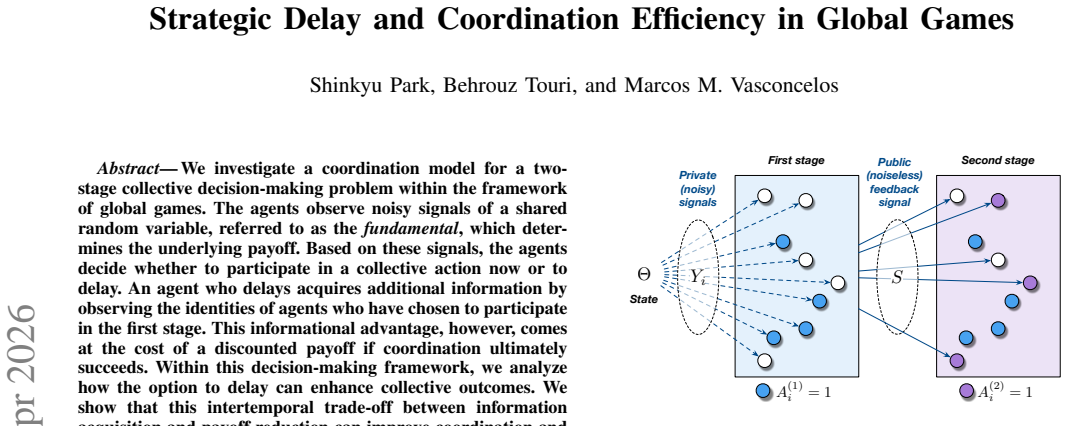

read the original abstract
We investigate a coordination model for a two-stage collective decision-making problem within the framework of global games. The agents observe noisy signals of a shared random variable, referred to as the fundamental, which determines the underlying payoff. Based on these signals, the agents decide whether to participate in a collective action now or to delay. An agent who delays acquires additional information by observing the identities of agents who have chosen to participate in the first stage. This informational advantage, however, comes at the cost of a discounted payoff if coordination ultimately succeeds. Within this decision-making framework, we analyze how the option to delay can enhance collective outcomes. We show that this intertemporal trade-off between information acquisition and payoff reduction can improve coordination and increase the efficiency of collective decision-making.
Editorial analysis
A structured set of objections, weighed in public.
Referee Report
Summary. The paper analyzes a two-stage global game coordination problem in which a continuum of agents receive noisy private signals about a common fundamental and choose whether to act in stage 1 or delay to stage 2. Delaying agents observe the measure of stage-1 participants as an endogenous public signal and then decide whether to participate, but receive a discounted payoff (by a fixed known factor) if coordination succeeds. The authors derive the unique equilibrium thresholds under Bayesian updating, compare them to the one-stage benchmark, and show that the information-payoff trade-off raises ex-ante welfare and coordination probability for an open set of parameters.
Significance. If the equilibrium construction and welfare comparison hold, the result demonstrates that endogenous public information generated by strategic delay can improve efficiency in global games, extending the classic literature on coordination under incomplete information. The explicit derivation of thresholds and the parameter-dependent welfare gain constitute a clear, falsifiable contribution.
minor comments (2)
- §3.2: the statement that the second-stage threshold is 'strictly lower' than the first-stage threshold should be accompanied by the explicit inequality relating the two cutoffs (currently only described verbally).
- The welfare integral in §4.1 is written with respect to the prior on the fundamental; it would be helpful to add a short remark confirming that the expectation is taken before private signals are drawn.
Simulated Author's Rebuttal
We thank the referee for the positive summary, significance assessment, and recommendation of minor revision. We appreciate the recognition that the equilibrium construction and welfare results extend the global games literature. As no specific major comments were raised in the report, we have no point-by-point rebuttals to provide and will incorporate any minor editorial suggestions in the revised manuscript.
Circularity Check
No significant circularity in derivation chain
full rationale
The paper constructs an explicit two-stage global game with continuum agents, private signals about a common fundamental, and a fixed discount factor for delay. Equilibrium thresholds are derived by solving the Bayesian updating and best-response conditions in each stage, with the second-stage action conditioned on the observed first-stage participation set. The welfare comparison to the no-delay benchmark follows directly from integrating over the resulting equilibrium strategies and the distribution of the fundamental; this is a standard comparative-statics exercise on the solved model rather than a redefinition, a fitted parameter renamed as a prediction, or a load-bearing self-citation. No ansatz is smuggled via prior work, and the claimed efficiency gain is shown to hold only for some parameter values, preserving falsifiability outside the model primitives.
Axiom & Free-Parameter Ledger
axioms (2)
- domain assumption Agents are rational Bayesian updaters who use observed participation to refine beliefs about the fundamental
- domain assumption The payoff discount for delaying is a fixed, commonly known parameter
Reference graph
Works this paper leans on
-
[1]
V . Krishnamurthy, “Decentralized spectrum access amongst cognitive radios—an interacting multivariate global game-theoretic approach,” IEEE Transactions on Signal Processing, vol. 57, no. 10, pp. 3999– 4013, 2009
work page 2009
-
[2]
Modeling multi-robot task allo- cation with limited information as global game,
A. Kanakia, B. Touri, and N. Correll, “Modeling multi-robot task allo- cation with limited information as global game,”Swarm Intelligence, vol. 10, no. 2, pp. 147–160, 2016
work page 2016
-
[3]
L. E. Beaver, “Multi-robot task allocation using global games with negative feedback: the colony maintenance problem,” inProceedings of the AAAI Conference on Artificial Intelligence, vol. 39, pp. 13597– 13604, 2025
work page 2025
-
[4]
Y . Wei and M. M. Vasconcelos, “Strategic multi-task coordination over regular networks of robots with limited computation and communica- tion capabilities,” in57th Annual Conference on Information Sciences and Systems (CISS), pp. 1–6, 2023
work page 2023
-
[5]
Coordination via delay: Theory and experiment,
Y . Jin, Z. Zhou, and A. Brandenburger, “Coordination via delay: Theory and experiment,”Games and Economic Behavior, vol. 137, pp. 23–49, 2023
work page 2023
-
[6]
Multi-agent coordination under poisson observations: A global game approach,
M. M. Vasconcelos and B. Touri, “Multi-agent coordination under poisson observations: A global game approach,”(submitted to) IEEE Transactions on Automatic Control - arXiv:2507.00424, 2025
-
[7]
Dynamic global games of regime change: Learning, multiplicity, and the timing of attacks,
G.-M. Angeletos, C. Hellwig, and A. Pavan, “Dynamic global games of regime change: Learning, multiplicity, and the timing of attacks,” Econometrica, vol. 75, pp. 711–756, May 2007
work page 2007
-
[8]
Global games with noisy information sharing,
H. Mahdavifar, A. Beirami, B. Touri, and J. S. Shamma, “Global games with noisy information sharing,”IEEE Transactions on Signal and Information Processing over Networks, vol. 4, no. 3, pp. 497–509, 2017
work page 2017
-
[9]
Coordination with local information,
M. A. Dahleh, A. Tahbaz-Salehi, J. N. Tsitsiklis, and S. I. Zoumpoulis, “Coordination with local information,”Operations Research, vol. 64, no. 3, pp. 622–637, 2016
work page 2016
-
[10]
On the coordination efficiency of strategic multi-agent robotic teams,
M. M. Vasconcelos and B. Touri, “On the coordination efficiency of strategic multi-agent robotic teams,” in2023 62nd IEEE Conference on Decision and Control (CDC), pp. 8130–8137, 2023
work page 2023
-
[11]
Global games and equilibrium se- lection,
H. Carlsson and E. Van Damme, “Global games and equilibrium se- lection,”Econometrica: Journal of the Econometric Society, pp. 989– 1018, 1993
work page 1993
-
[12]
S. Morris and H. S. Shin,Global Games: Theory and Applications, vol. 1 ofEconometric Society Monographs, pp. 56–114. Cambridge University Press, 2003
work page 2003
-
[13]
Coordination and delay in global games,
A. Dasgupta, “Coordination and delay in global games,”Journal of Economic Theory, vol. 134, no. 1, pp. 195–225, 2007
work page 2007
-
[14]
Y . S. Chow and H. Teicher,Probability theory: independence, inter- changeability, martingales. Springer Science & Business Media, 2003
work page 2003
-
[15]
T. M. Cover and J. A. Thomas,Elements of Information Theory. Wiley-Interscience, 2nd ed., 2006
work page 2006
-
[16]
C. P. Chamley,Rational Herds: Economic Models of Social Learning. Cambridge University Press, 2004
work page 2004
-
[17]
Bayesian learning in social networks,
D. Acemoglu, M. A. Dahleh, I. Lobel, and A. Ozdaglar, “Bayesian learning in social networks,”Review of Economic Studies, vol. 78, no. 4, pp. 1201–1236, 2011. APPENDIX A. Proof of Theorem 1 Let(τ ⋆, λ⋆)denote the BNE threshold policy for the two- stage global game, and letτ ⋆ single denote the BNE threshold in the corresponding single-stage global game. Si...
work page 2011
discussion (0)
Sign in with ORCID, Apple, or X to comment. Anyone can read and Pith papers without signing in.