textit{Ab initio} textit{GW}-BSE theory of optical activity in α-quartz
Pith reviewed 2026-05-10 20:11 UTC · model grok-4.3
The pith
A GW-BSE theory formulates dielectric spatial dispersion via exciton envelope modulation and sum-over-exciton-states to compute optical activity in solids.
A machine-rendered reading of the paper's core claim, the machinery that carries it, and where it could break.
Core claim
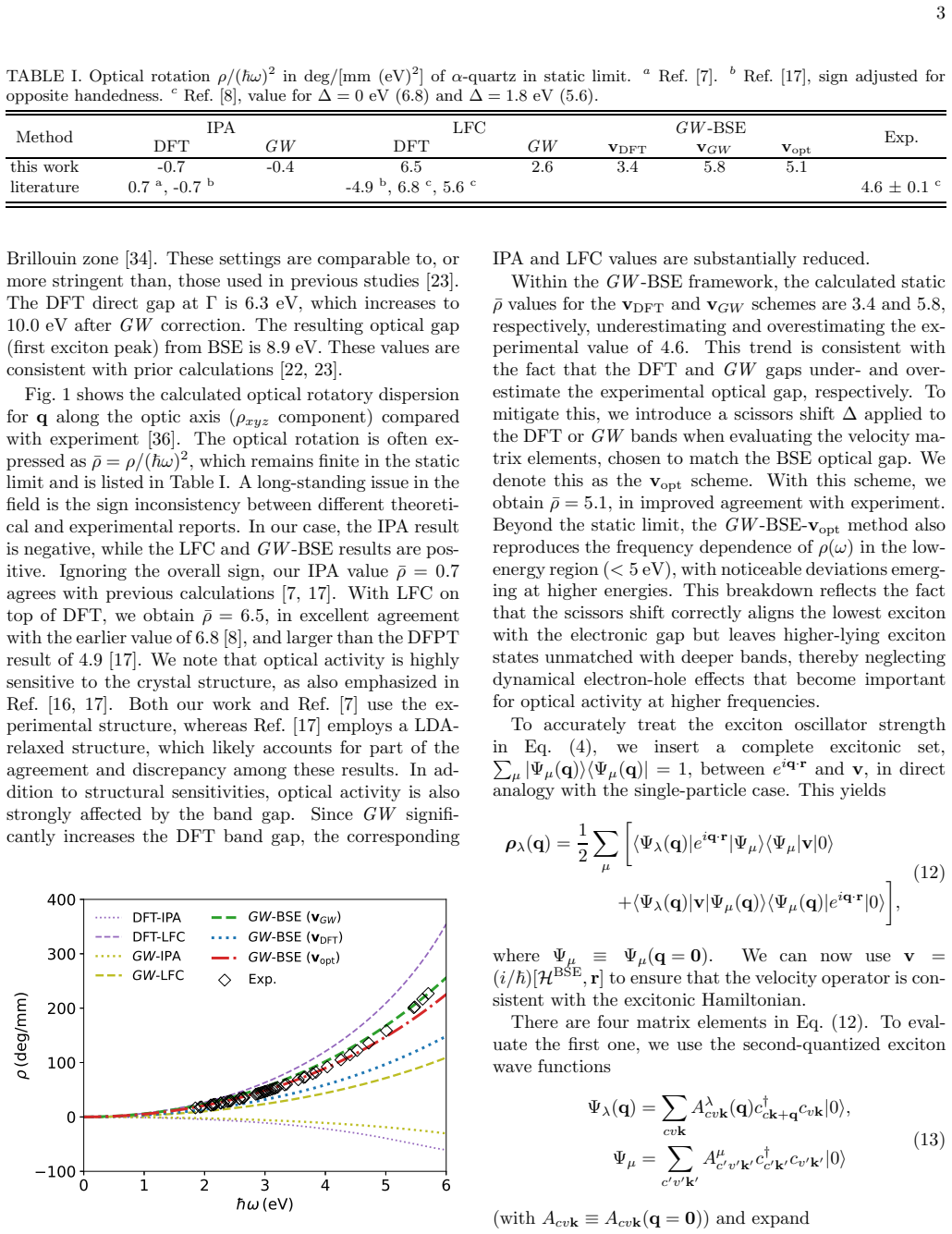
We present an ab initio many-body theory of optical activity in solids within the GW-BSE framework. Dielectric spatial dispersion is formulated in two complementary forms: exciton envelope modulation and sum-over-exciton-states expansion. Our application to α-quartz reveals that the envelope-modulated formulation captures the low-frequency region, whereas the sum-over-exciton-states formulation is essential to reproduce the correct full frequency dependence. Comparisons with the independent-particle approximation and simple local-field corrections further highlight the decisive role of excitonic many-body effects in shaping the spectral dispersion of optical activity in solids.
What carries the argument
GW-BSE treatment of dielectric spatial dispersion expressed through exciton envelope modulation and sum-over-exciton-states expansion.
If this is right
- The envelope-modulated formulation suffices for the low-frequency optical activity of α-quartz.
- The sum-over-exciton-states formulation is required to obtain the correct frequency dependence over the entire spectrum.
- Excitonic many-body effects dominate the dispersion of optical activity beyond what independent-particle or local-field approximations can provide.
- The method supplies a parameter-free route to predict optical activity spectra in other crystalline solids.
Where Pith is reading between the lines
- The same two-formulation structure could be applied to other chiral crystals to map how exciton binding energies influence their rotatory dispersion.
- Broadband optical activity measurements on α-quartz would provide a direct test separating the low-frequency envelope regime from the full exciton-sum regime.
- Material design efforts could target exciton energies to engineer specific frequency windows of strong optical rotation.
Load-bearing premise
The GW-BSE framework and its two new formulations for dielectric spatial dispersion accurately capture the many-body physics of optical activity without uncontrolled approximations or missing higher-order effects.
What would settle it
Quantitative experimental spectra of optical rotatory power versus frequency in α-quartz that deviate from the sum-over-exciton-states prediction while agreeing with the envelope form only at low frequency would falsify the necessity of the full exciton expansion.
Figures


read the original abstract
We present an ab initio many-body theory of optical activity in solids within the GW-BSE framework. Dielectric spatial dispersion is formulated in two complementary forms: exciton envelope modulation and sum-over-exciton-states expansion. Our application to $\alpha$-quartz reveals that the envelope-modulated formulation captures the low-frequency region, whereas the sum-over-exciton-states formulation is essential to reproduce the correct full frequency dependence. Comparisons with the independent-particle approximation and simple local-field corrections further highlight the decisive role of excitonic many-body effects in shaping the spectral dispersion of optical activity in solids.
Editorial analysis
A structured set of objections, weighed in public.
Referee Report
Summary. The manuscript develops an ab initio GW-BSE framework for optical activity in solids, formulating the dielectric spatial dispersion in two complementary ways: an exciton-envelope-modulation approach that captures the low-frequency regime and a sum-over-exciton-states expansion required for the full frequency dependence. Application to α-quartz demonstrates that excitonic many-body effects dominate the spectral dispersion, in contrast to the independent-particle approximation and simple local-field corrections.
Significance. If the derivations and numerical results hold, the work constitutes a notable advance by providing the first parameter-free, many-body treatment of optical rotatory power and circular dichroism in solids. The dual-formulation strategy resolves a practical limitation in frequency coverage while isolating the role of excitons, offering a template for future studies of chiral optics in complex materials.
minor comments (3)
- [§2.3] §2.3: the transition from the envelope-modulated to the sum-over-states expression for the spatial-dispersion tensor is presented without an explicit intermediate step showing how the exciton wave-function expansion is substituted; adding one line of algebra would improve traceability.
- [Fig. 4] Fig. 4: the comparison of rotatory power spectra lacks a statement of the k-point mesh and number of bands used for the final curves; a brief convergence note would strengthen the claim that the full frequency dependence is reproduced.
- [Abstract and §4] The abstract states that the envelope formulation 'captures the low-frequency region,' yet no quantitative criterion (e.g., deviation threshold below 1 eV) is given in the text; defining this threshold would make the regime distinction unambiguous.
Simulated Author's Rebuttal
We thank the referee for the positive and accurate summary of our work, as well as for recommending minor revision. The referee's assessment correctly identifies the two complementary formulations of dielectric spatial dispersion within the GW-BSE framework and the central role of excitonic effects in α-quartz. Since no specific major comments were raised, we have no points to address point-by-point at this stage.
Circularity Check
No significant circularity detected in derivation chain
full rationale
The manuscript formulates dielectric spatial dispersion via two complementary expressions (exciton envelope modulation and sum-over-exciton-states) inside the established GW-BSE framework, then applies the resulting expressions to α-quartz spectra and compares against IPA and local-field approximations. No equation reduces to a fitted parameter renamed as a prediction, no self-definitional loop appears in the spatial-dispersion definitions, and no load-bearing uniqueness theorem or ansatz is imported solely via self-citation. The central claims rest on explicit numerical comparisons that remain falsifiable against external benchmarks and are independent of the input data used to construct the formulations. This is the expected outcome for a standard ab initio many-body derivation.
Axiom & Free-Parameter Ledger
axioms (1)
- domain assumption The GW approximation combined with the Bethe-Salpeter equation provides an accurate description of quasiparticle energies and excitonic effects in solids.
Lean theorems connected to this paper
-
IndisputableMonolith/Foundation/AbsoluteFloorClosure.leanreality_from_one_distinction unclear?
unclearRelation between the paper passage and the cited Recognition theorem.
Comparisons with the independent-particle approximation and simple local-field corrections further highlight the decisive role of excitonic many-body effects
What do these tags mean?
- matches
- The paper's claim is directly supported by a theorem in the formal canon.
- supports
- The theorem supports part of the paper's argument, but the paper may add assumptions or extra steps.
- extends
- The paper goes beyond the formal theorem; the theorem is a base layer rather than the whole result.
- uses
- The paper appears to rely on the theorem as machinery.
- contradicts
- The paper's claim conflicts with a theorem or certificate in the canon.
- unclear
- Pith found a possible connection, but the passage is too broad, indirect, or ambiguous to say the theorem truly supports the claim.
Reference graph
Works this paper leans on
-
[1]
914 ˚ A and c = 5 . 406 ˚ A. DFT, GW, and BSE calcu- lations are performed using vasp [30, 31]. We employ the PBE functional [32] for DFT. For GW, we use the GW0 scheme [33], include 1024 bands [34], and perform basis-size extrapolation [35]. The BSE Hamiltonian is constructed using 18 valence and 24 conduction bands. A 10 × 10 × 10 Γ-centered k-mesh is u...
-
[2]
D. F. J. Arago, Mem. Cl. Sci. Math. Inst. Natl. France 12, 93 (1811)
-
[3]
T. M. Lowry and P. C. Austin, Nature 109, 447 (1922)
work page 1922
-
[4]
Flack, Foundations of Crystallography 65, 371 (2009)
H. Flack, Foundations of Crystallography 65, 371 (2009)
work page 2009
-
[5]
L. D. Barron, Molecular Light Scattering and Optical Ac- tivity (Cambridge University Press, 2004)
work page 2004
-
[6]
L. D. Landau and E. M. Lifshitz, Electrodynamics of Con- tinuous Media (Pergamon, 1984)
work page 1984
- [7]
- [8]
-
[9]
L. J¨ onsson, Z. H. Levine, and J. W. Wilkins, Physical Review Letters 76, 1372 (1996)
work page 1996
- [10]
-
[11]
S. S. Tsirkin, P. A. Puente, and I. Souza, Physical Revie w B 97, 035158 (2018)
work page 2018
-
[12]
M. R´ erat and B. Kirtman, Journal of Chemical Theory and Computation 17, 4063 (2021)
work page 2021
-
[13]
T. Balduf and M. Caricato, The Journal of Chemical Physics 157, 214105 (2022)
work page 2022
-
[14]
C. Multunas, A. Grieder, J. Xu, Y. Ping, and R. Sun- dararaman, Phys. Rev. Mater. 7, 123801 (2023)
work page 2023
- [15]
- [16]
-
[17]
J. K. Desmarais, B. Kirtman, and M. R´ erat, Phys. Rev. B 107, 224430 (2023)
work page 2023
- [18]
- [19]
- [20]
- [21]
-
[22]
M. S. Hybertsen and S. G. Louie, Phys. Rev. B 34, 5390 (1986)
work page 1986
-
[23]
E. K. Chang, M. Rohlfing, and S. G. Louie, Phys. Rev. Lett. 85, 2613 (2000)
work page 2000
- [24]
-
[25]
S. Li, X. Xu, C. A. Kocoj, C. Zhou, Y. Li, D. Chen, J. A. Bennett, S. Liu, L. Quan, S. Sarker, et al. , Nature Communications 15, 2573 (2024)
work page 2024
- [26]
-
[27]
V. M. Agranovich and V. Ginzburg, Crystal optics with spatial dispersion, and excitons (Springer Berlin, Heidel- berg, 1984)
work page 1984
-
[28]
D. Y. Qiu, G. Cohen, D. Novichkova, and S. Refaely- Abramson, Nano letters 21, 7644 (2021)
work page 2021
-
[29]
D. Sangalli, J. Berger, C. Attaccalite, M. Gr¨ uning, an d P. Romaniello, Physical Review B 95, 155203 (2017)
work page 2017
-
[30]
G. A. Lager, J. Jorgensen, and F. Rotella, Journal of Applied Physics 53, 6751 (1982)
work page 1982
-
[31]
G. Kresse and J. Furthm¨ uller, Computational Material s Science 6, 15 (1996)
work page 1996
- [32]
-
[33]
J. P. Perdew, K. Burke, and M. Ernzerhof, Physical Re- view Letters 77, 3865 (1996)
work page 1996
- [34]
-
[35]
(15) and the inter- exciton transition dipole moment
See supplemental material at [url], for additional det ails on convergence and derivations of Eq. (15) and the inter- exciton transition dipole moment
-
[36]
J. Klimeˇ s, M. Kaltak, and G. Kresse, Physical Review B 90, 075125 (2014)
work page 2014
-
[37]
T. M. Lowry, Optical rotatory power (Dover New York, 1964)
work page 1964
-
[38]
T. G. Pedersen, Physical Review B 92, 235432 (2015)
work page 2015
-
[39]
A. Taghizadeh, F. Hipolito, and T. G. Pedersen, Physica l Review B 96, 195413 (2017)
work page 2017
-
[40]
A. Taghizadeh and T. G. Pedersen, Physical Review B 97, 205432 (2018)
work page 2018
-
[41]
Ab initio GW -BSE theory of optical activity in α -quartz
J. Ruan, Y.-H. Chan, and S. G. Louie, Nano letters 24, 15533 (2024). Supplementary Material for “ Ab initio GW -BSE theory of optical activity in α -quartz” Xiaoming Wang ∗ and Yanfa Yan † Department of Physics and Astronomy, Wright Center for Phot ovoltaics Innovation and Commercialization, The University of Toledo, Toledo, Ohio 43606, USA I. DERIV ATION...
work page 2024
discussion (0)
Sign in with ORCID, Apple, or X to comment. Anyone can read and Pith papers without signing in.